Generation
Porsche Boxster 986
The 986 was built from 1996 to 2004 but spans Porsche model years 1997-2004. This reference separates the 2.5, 2.7 and Boxster S engine and gearbox phases, explains the 986 II update and sets out evidence-led buying checks.
Variant directory
986 variants
Choose an exact 986 derivative for engine, gearbox, performance, dimensions, equipment and buying-context detail.
TMJC Catalog guide
Porsche Boxster 986: model years, engine codes, 986 I vs 986 II and buying guide
The 986 was built from 1996 to 2004 but spans Porsche model years 1997-2004. This reference separates the 2.5, 2.7 and Boxster S engine and gearbox phases, explains the 986 II update and sets out evidence-led buying checks.
- Page
- Generation overview
- Reviewed
- 13 Sept 2026
- Specifications
- 0 verified
The Porsche Boxster 986 was built from 1996 to 2004, but Porsche's own original parts catalogue describes the cars as model years 1997 through 2004. That difference matters. A late-1996 production car can be a 1997 model-year car, and a UK registration date does not by itself identify the engine, gearbox or update phase.
Across the generation Porsche used three broad base-car stages — the original 2.5, the 2.7 and the later 2.7 — alongside the 3.2-litre Boxster S. Porsche Classic records 164,874 examples of the 986 worldwide.
If you are comparing adverts, start with the model year and derivative, not a single generic Boxster 986 specification.
When was the Boxster 986 made?
Porsche launched Boxster series production in August 1996. The 986 remained the production Boxster generation until the 987 arrived in 2004.
Porsche's original 986 parts catalogue starts at model year 1997 and runs through model year 2004. That gives two useful but different date ranges:
- production-generation chronology: 1996-2004;
- Porsche model years covered by the 986 catalogue: 1997-2004.
This is why a classified advert headed 1996 Boxster, 1999 2.7 or 2003 facelift needs more checking before you borrow a specification table. Production date, market launch, model year and first registration can sit on different sides of a calendar-year boundary.
Porsche's parts catalogue also explains that the VIN carries a model-year identifier. For an exact car, that build information is stronger evidence than the date on the number plate.
986 engine codes and power by model year
Porsche's original parts catalogue gives a much cleaner map than a single generation-wide power figure:
| Porsche model year | Derivative | Engine | Capacity | Factory output |
|---|---|---|---|---|
| 1997-1999 | Boxster | M96.20 | 2.5 litres | 150 kW |
| 2000 | Boxster | M96.22 | 2.7 litres | 160 kW |
| 2001-2002 | Boxster | M96.22 | 2.7 litres | 162 kW |
| 2000-2002 | Boxster S | M96.21 | 3.2 litres | 185 kW |
| 2003-2004 | Boxster | M96.23 | 2.7 litres | 168 kW |
| 2003-2004 | Boxster S | M96.24 | 3.2 litres | 191 kW |
Porsche Classic describes the launch 2.5 as 204 PS and the later 2.7 broadly as 220 PS before the final 228 PS version. Those headline numbers are useful orientation. The parts catalogue is more useful when you are trying to establish exactly which engine family belongs to which model year.
There is also an apparent date mismatch that is easy to explain. Porsche's historical account says the 2.7 arrived in 1999, while its parts catalogue maps the M96.22 2.7 from model year 2000. A calendar launch and a model-year designation are not the same thing; they should not be forced into one date label.
Manual and Tiptronic gearbox codes
The transmission changed with the engine phases too. Porsche's catalogue lists:
| Model years | Derivative | Manual | Automatic |
|---|---|---|---|
| 1997-1999 | Boxster | G86.00, 5-speed | A86.00, 5-speed Tiptronic |
| 2000-2004 | Boxster | G86.01, 5-speed | A86.05, 5-speed Tiptronic |
| 2000-2004 | Boxster S | G86.20, 6-speed | A86.20, 5-speed Tiptronic |
That is why manual 986 is not a complete specification. A five-speed base car and a six-speed Boxster S belong to different derivative and gearbox families, while the Tiptronic also changed across the production run.
For the late base-car branch, see the Boxster 986 2.7 Manual (986 II) reference.
What is a 986 I and a 986 II?
986 I and 986 II are useful shorthand for the earlier and later phases, but the safest way to identify a car is still by its model/build data.
One clear factory-documented late-car change is the hood rear window. Porsche Classic says that from model year 2003 the Boxster received a heated glass rear window, replacing the earlier plastic screen. Porsche's parts catalogue gives another hard boundary: model-year 2003 base cars move to M96.23 / 168 kW, while the S moves to M96.24 / 191 kW.
Specialist guides also point to the visible 2002-era exterior update — revised lamps, bumpers and clear indicator treatment — but visual cues should be corroboration, not the final word. Twenty-year-old roadsters can have replacement roofs, lamps and body parts.
If an advert simply says facelift, establish:
- the VIN/model year;
- base Boxster or Boxster S;
- engine number/code where available;
- gearbox type and code where relevant;
- whether visible late-car parts are original to the car or later replacements.
Why the 986 mattered beyond being a cheaper 911
The 986 was not an open 911 with a different badge. It used a mid-engine layout and revived the proportions of earlier Porsche sports-racing roadsters such as the 550 Spyder and 718 RS 60.
The 1993 Boxster concept had already made that intent clear. Porsche says the name combines boxer and roadster, and the favourable response to the Detroit concept helped drive the production programme.
At the same time, the 986 was deliberately engineered alongside the 996-generation 911. Porsche's own retrospective says the two programmes shared the front section, doors and numerous components. That common-parts strategy was a business and manufacturing decision as much as a styling one: it reduced complexity and cost while allowing the two cars to retain different engine layouts and characters.
The broader Porsche Boxster model history covers how that strategy evolved through the 987, 981 and 718 generations. On a 986 page, the important point is simpler: shared 996 development explains some familiar parts, but it does not make the 986 a rear-engined 911 derivative.
What should you inspect before buying a 986?
A 986 inspection should be wider than the question has the IMS bearing been done?.
Service and invoice history
Porsche Classic's own used-986 article places real weight on service history and detailed invoices. That is sensible because phrases such as engine rebuilt, IMS done, new suspension or cooling system sorted can describe very different amounts of work.
For each major claim, ask for the invoice and look for date, mileage, workshop and parts/work actually recorded. A thick file is useful when it lets you reconstruct what happened rather than merely adding paper.
Oil leaks and engine evidence
Porsche Classic specifically calls out leakage around the transmission-side crankshaft seal area as something to inspect. Hagerty also treats IMS history as a documentary question rather than a reason to reduce every 986 to one component.
If an engine has had substantial work, establish why it was opened, what was measured or replaced, what machining was done, and how many miles the car has covered since. A rebuild can be excellent provenance, but the word alone is not a specification.
Cooling system and front radiators
Hagerty recommends looking closely at the radiators behind the front bumper grilles because leaves and debris can collect around them and encourage corrosion. Also check coolant level and condition, the expansion-tank area and invoices for pumps, tanks, radiators or hoses.
A stable temperature gauge on a short test drive is not a complete cooling-system history.
Roof, drains and water ingress
Earlier cars' plastic rear screens deserve inspection for clouding, cracking and folding damage. Model-year-2003-on cars should have the later heated glass-window arrangement unless the hood has been replaced or altered.
Check the hood through a complete operating cycle. Specialist guidance also highlights the roof drains: blocked drains can allow water into the cabin, including the area beneath the passenger seat where electronics can be damaged. Look and feel for damp rather than accepting a dry surface at face value.
Suspension, steering, brakes and tyres
Porsche Classic itself mentions age-related work around wishbones, stabiliser bushes, dampers and tension struts. Hagerty likewise expects suspension arms and bushes to appear in the history of a properly maintained car.
Listen for knocks, check the car tracks and brakes cleanly, inspect tyre age and matching specification, and judge the car on how the chassis feels as a whole. A 986 can still feel competent when worn, which is why comparison with a properly sorted example or a specialist pre-purchase inspection is useful.
Gearbox and clutch
Check manual shift quality from cold and when fully warm, clutch bite and any driveline noise. On Tiptronic cars, check engagement and operation in both automatic and manual-selection modes. Hagerty also recommends looking for gearbox-fluid service evidence.
The factory gearbox-code table above is useful when a seller's description does not quite match the car in front of you.
IMS: what a useful advert should actually tell you
The IMS bearing has become shorthand for 986 engine risk, but IMS done is not enough information to value a car or judge the work.
Ask:
- when the work was carried out;
- at what mileage;
- which workshop performed it;
- which parts or bearing solution were used;
- whether the clutch, rear main seal or other engine work was carried out at the same time;
- how many miles the car has covered since.
The generation spans multiple engine revisions, so an internet rule derived from one engine year should not be applied blindly to every 986. Where the history is unclear, a Porsche specialist inspection is a better next step than trying to infer condition from a badge or registration year.
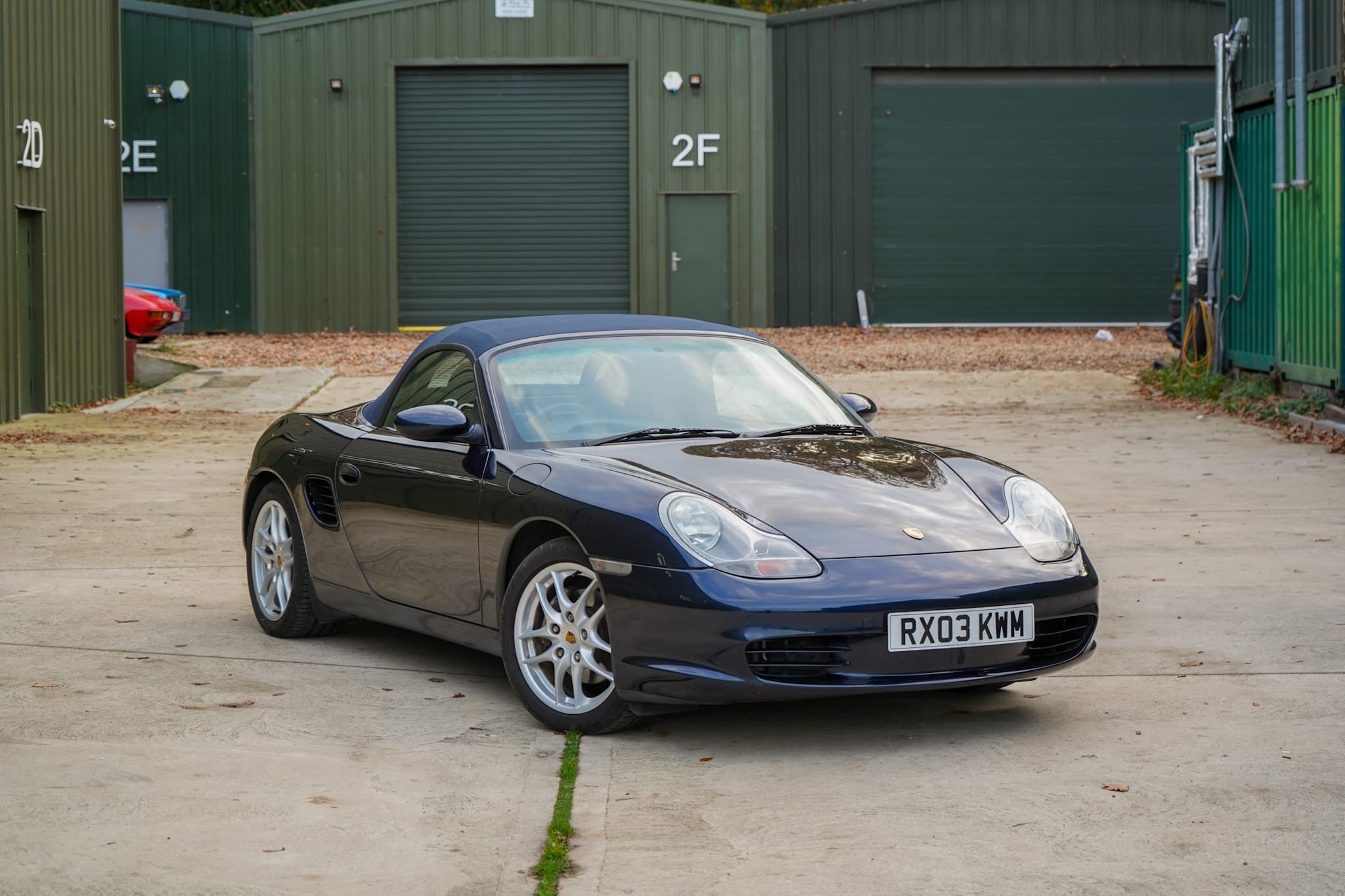
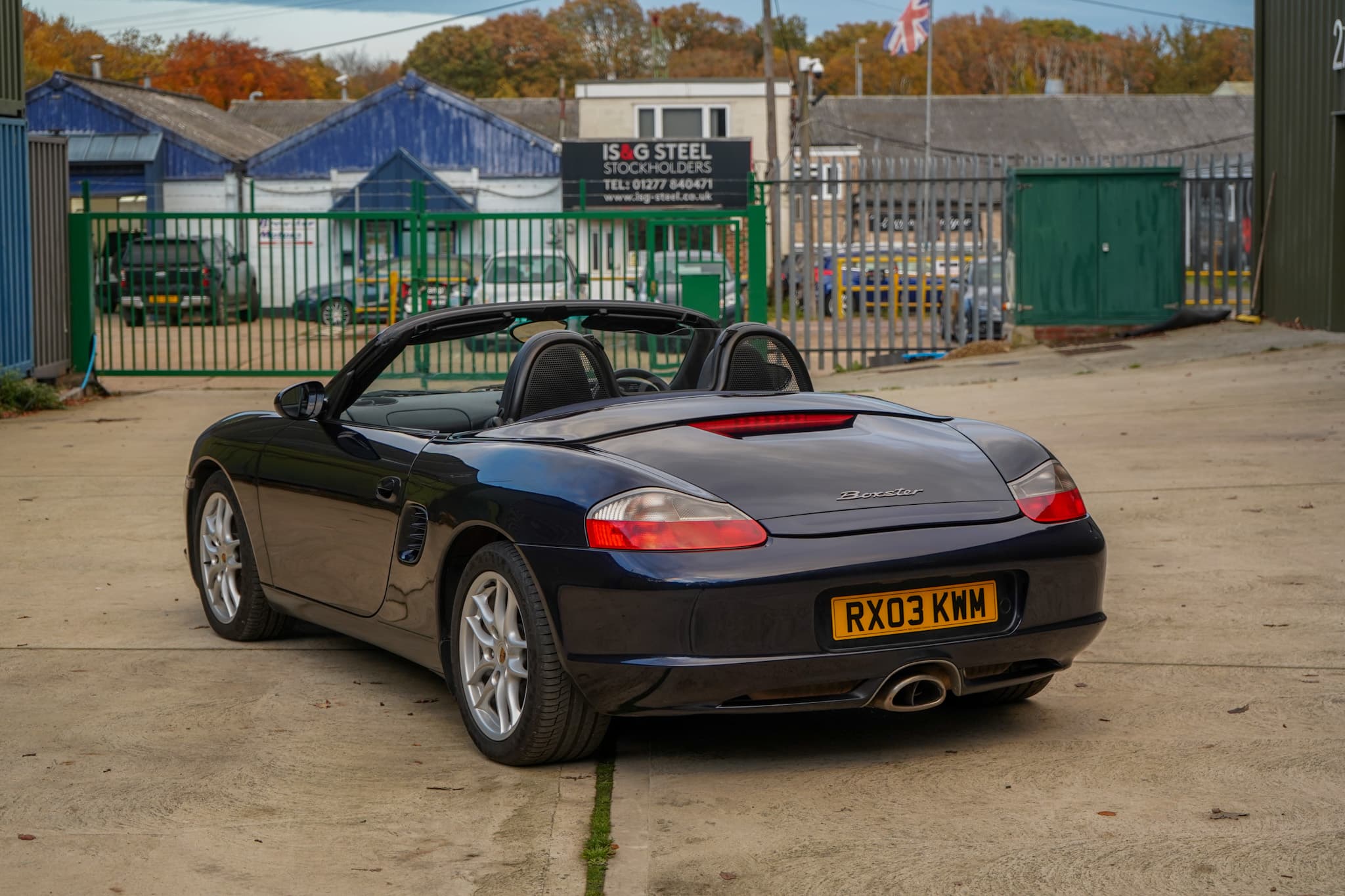
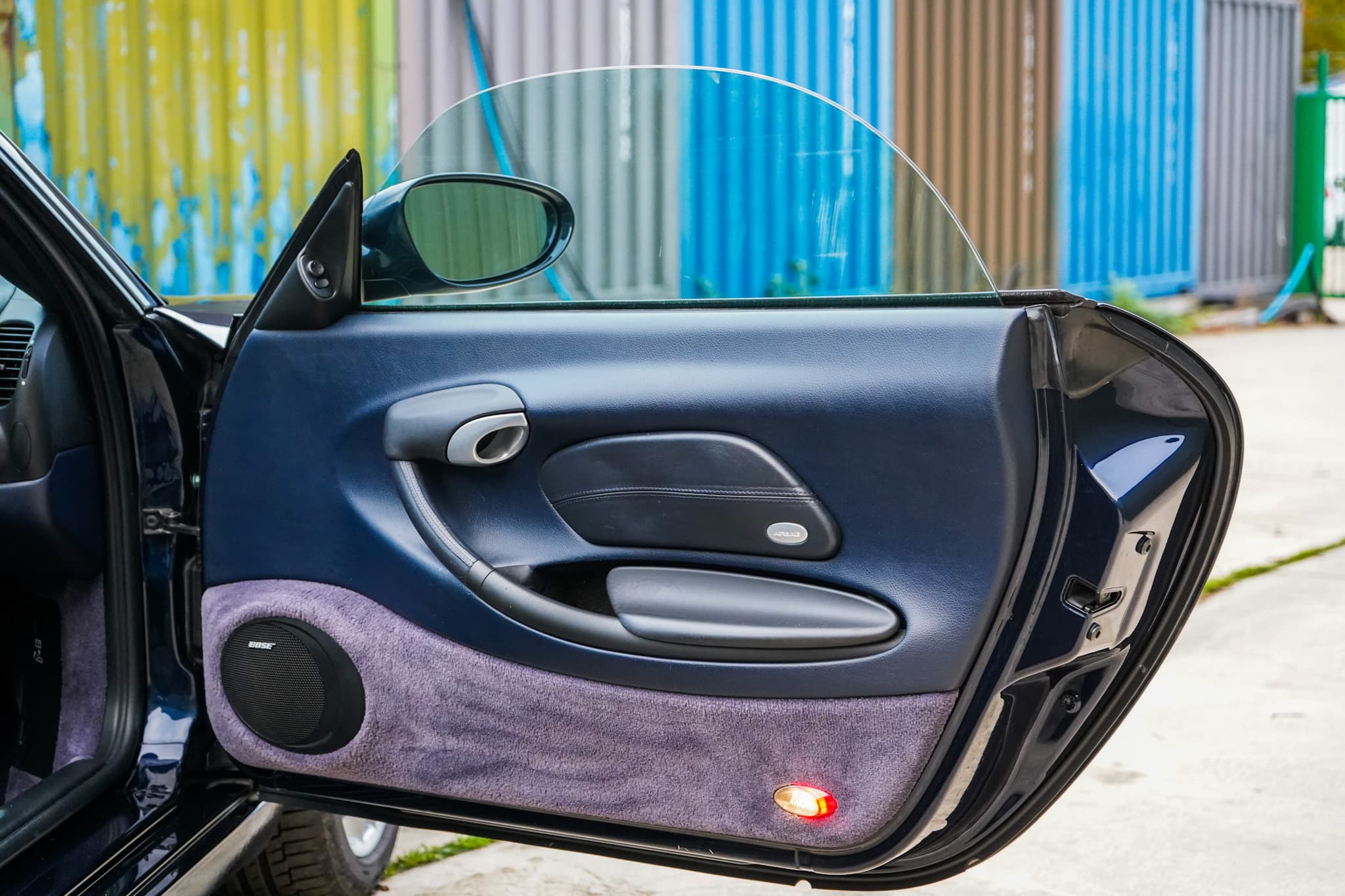
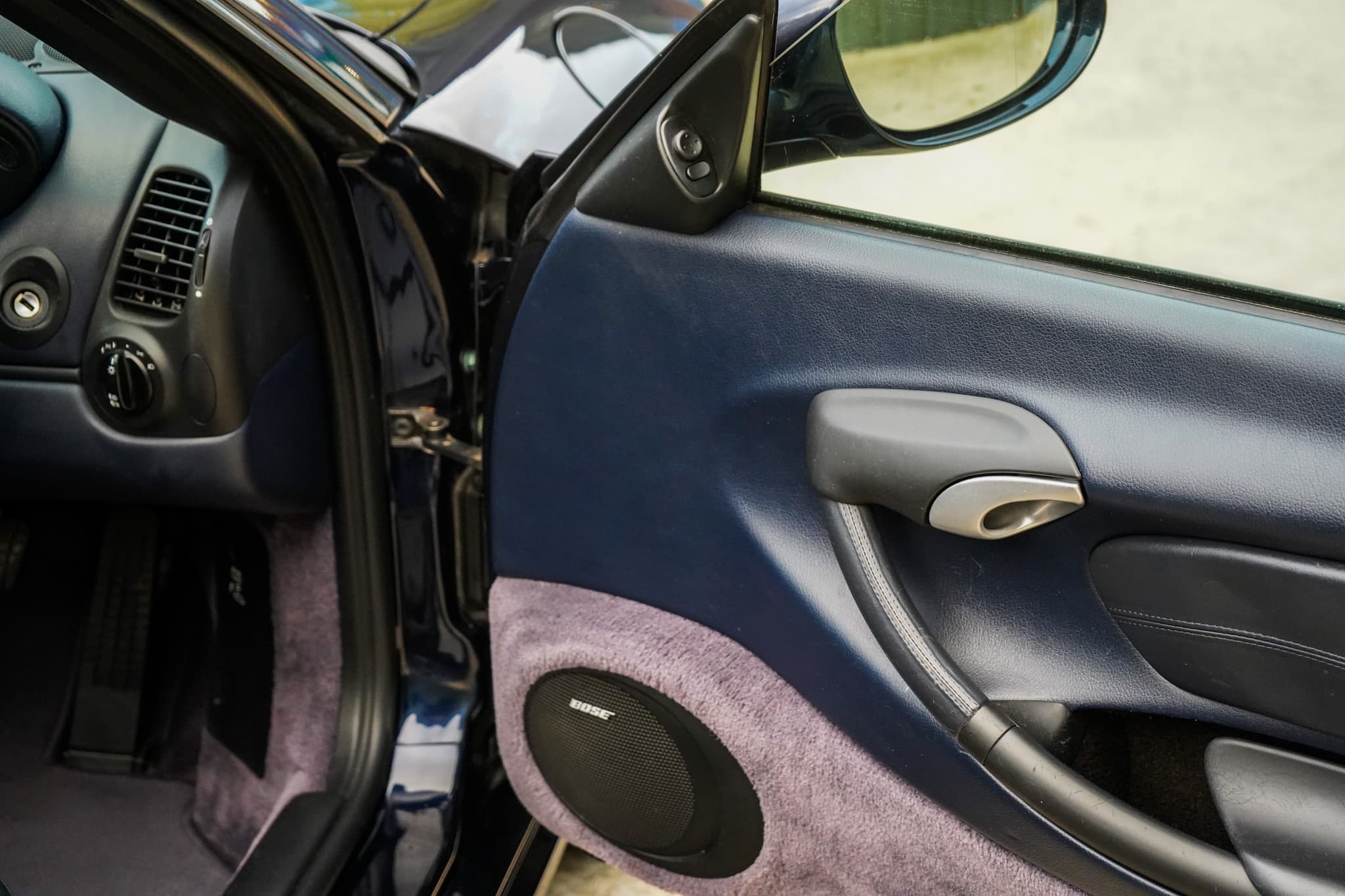
A TMJC-handled 2003 2.7 manual
A surviving Car & Classic advert attributed to The Matt Johnston Collection records RX03KWM as a 2003 right-hand-drive 2.7 Boxster with a five-speed manual gearbox, showing 59,167 miles at the time of the advert and first registered by AFN Porsche Guildford in April 2003.
Its value as an example is the level of mechanical documentation. The advert records a specialist engine rebuild in 2020 at 32,553 miles including bearings, chains, gaskets, an IMS bearing, clutch and an exhaust valve. It then records further top-end work in 2025 including hydraulic tappets, a camshaft, water pump, drive belt and seals.
That does not mean every 2003 Boxster requires the same work. It shows why rebuilt engine becomes much more useful when it is tied to named work, a mileage and subsequent history.
Nor does April 2003 registration by itself prove that RX03KWM carries every canonical model-year-2003 detail in the table above. The model/build data is the right evidence for that individual-car question.
986 buying checklist
Before agreeing a deal, establish:
- VIN/model year and whether it matches the advertised derivative;
- base Boxster or Boxster S;
- engine capacity and, where important, engine code;
- five-speed or six-speed manual, or the correct Tiptronic phase;
- cold-start behaviour, oil/coolant condition and any visible leakage;
- invoices supporting engine, IMS, clutch, RMS or cooling-system claims;
- front-radiator condition and evidence of cooling-system maintenance;
- roof operation, rear-window condition, drains and signs of cabin water ingress;
- suspension-arm/bush/damper history, steering feel and brake condition;
- tyre age and matching quality, not only tread depth;
- service history that reconciles dates, mileage and major work.
The best 986 is not automatically the lowest-mileage example or the one with the longest list of advert buzzwords. The stronger car is the one whose identity, condition and maintenance history agree with each other.
Sources and further reading
- Porsche — Original Parts Catalogue: Boxster (986), model years 1997-2004
- Porsche Classic — One step ahead
- Porsche Newsroom — Boxster 25 Years
- Porsche Newsroom — The Boxster sports car concept
- Porsche Newsroom — The people and ideas behind the Boxster
- Hagerty UK — Buying Guide: Porsche Boxster 986
- The Matt Johnston Collection via Car & Classic — 2003 Porsche Boxster 986 2.7
Editorial information
The Matt Johnston Collection
Research and editorial from TMJC Garage.
Research and editorialTMJC Garage
Published byThe Matt Johnston Collection
Model lineage
Where this car sits
TMJC media
Explore the car in detail


Sell, consign or editorial
Thinking of selling or consigning a special car?
Continue with TMJC for a discreet conversation, professional presentation and collector-focused support.
Enquire now