Published guide
Porsche Boxster 986 IMS bearing: years, types and checks
Porsche Boxster 986 IMS bearing guide covering 1997–2004 types, the mixed 2000–01 transition, replacement engines and what an “IMS done” claim proves.
Overview
Porsche Boxster 986 IMS bearing guide covering 1997–2004 types, the mixed 2000–01 transition, replacement engines and what an “IMS done” claim proves.
The IMS bearing is the Porsche Boxster 986 issue most likely to be reduced to a three-word advert claim: “IMS already done.” That is useful information, but it is not a complete answer.
For a buyer, there are really four questions:
- Which intermediate-shaft bearing did this engine originally use?
- Is the engine still the one the car was built with?
- If the bearing has been changed, what exactly was fitted, when and at what mileage?
- Does that replacement product itself have a future service interval?
Those questions matter because the 986 did not use one IMS-bearing design throughout production, and the transition is less tidy than many year-by-year internet tables suggest.
Which IMS bearing does a Porsche Boxster 986 have?
For an original-engine 986, current specialist guidance from LN Engineering gives this practical framework:
| Porsche model year | Original IMS arrangement | What a buyer should assume |
|---|---|---|
| 1997-1999 | Dual-row bearing | Early factory arrangement, but still verify any claimed later work |
| 2000-2001 | Dual-row or single-row | Model year alone is not enough to identify the bearing |
| 2002-2004 | Smaller serviceable single-row bearing | Relevant to the later 986, provided the original engine is still fitted |
The middle row is the important one. A 2000 or 2001 Boxster cannot safely be classified as single-row or dual-row just from the year in the advert. LN’s dedicated guidance for these model years says both designs were fitted during the transition.
That is also where current search results become confusing. Some buyer guides put 2000 straight into the single-row era. Others describe both 2000 and 2001 as dual-row. A neat table is attractive, but it can create confidence the production evidence does not support.
If the distinction matters on a 2000-2001 car, the sensible endpoint is physical identification by a Porsche specialist rather than another round of guessing from a registration date.
For the broader model-year chronology, engine codes and gearbox changes, see the Porsche Boxster 986 reference.
Why the registration year is not enough
A UK V5C first-registration date is not the same thing as Porsche model year, and neither necessarily tells you what is now inside a 20-plus-year-old engine.
The first step is to establish the car’s model year from its build/VIN evidence. Our model year vs registration year guide explains why those dates can differ.
Then ask a second question that is often missed: has the engine ever been replaced?
LN Engineering notes that Porsche replacement or remanufactured engines can contain the IMS design current when the replacement engine itself was manufactured. In other words, an early chassis can end up with later internal hardware. Once an engine replacement enters the history, a rule based only on the car’s original year becomes much weaker evidence.
That is why an engine number, rebuild/replacement invoice and the physical hardware matter more than a generic “2001 cars have X” statement.
Can the VIN or engine number tell you single-row versus dual-row?
They can narrow the investigation, but they should not be treated as an infallible shortcut through the mixed 2000-2001 period.
LN’s current installation guidance specifically cautions against relying solely on VIN or engine-number assumptions to distinguish the two original serviceable bearing types. When an exact answer is required before ordering parts or valuing prior work, visual confirmation at the IMS flange is the reliable check.
That distinction is useful for a buyer even if you never intend to fit a bearing yourself. It tells you what sort of evidence deserves confidence:
- an advert year is weak evidence;
- a chassis VIN establishes model-year identity but not necessarily current engine internals;
- an engine number and replacement history are stronger context;
- a workshop invoice naming the part is stronger again;
- physical identification closes the question where the transition remains ambiguous.
What does “IMS done” actually prove?
At minimum, it should lead you to an invoice.
A useful invoice lets you establish:
- the date and mileage of the work;
- the workshop that carried it out;
- whether the engine was original, rebuilt or replaced;
- the bearing or conversion product fitted;
- whether the clutch, flywheel or rear main seal was inspected or replaced at the same time;
- whether the work was preventative or part of a wider engine repair.
Without those details, “IMS done” proves much less than it appears to.
The wording can describe anything from an original factory bearing changed during a clutch job to a specific aftermarket retrofit fitted during a complete engine rebuild. Those are not equivalent histories.
A replacement bearing may not mean “done forever”
This is one of the most useful details to retain with the paperwork.
Different aftermarket solutions have different maintenance requirements. LN Engineering’s current guidance, for example, gives a six-year / 75,000-mile interval for its current Single Row Pro and Classic Dual Row IMS Retrofit products, while older Classic Single Row products had a shorter stated interval. Its pressure-fed IMS Solution is treated differently and is described as not requiring periodic bearing replacement.
Those are product-manufacturer requirements, not a universal Porsche schedule. Another bearing or conversion may have different instructions.
So a 2026 advert saying only IMS replaced in 2018 is incomplete. The buyer still needs to know which product was installed before deciding whether its maker considers any further work due.
That is why the best provenance entry is not IMS done; it is something closer to:
IMS product / installer / date / mileage / invoice / related work.
Did Porsche specify an IMS-bearing replacement interval?
Not in the Porsche maintenance schedule reviewed for this research.
Porsche Cars North America’s Edition 2-06 maintenance schedule for the 996 and 986 lists scheduled work including engine oil and filters, spark plugs, the polyrib belt, transmission oil, differential oil, brake fluid and inspections of the cooling, suspension, clutch and other systems. IMS-bearing replacement does not appear as a scheduled maintenance item.
There are two important boundaries to that statement.
First, the document is explicitly a USA/Canada maintenance schedule, so it should not be presented as a UK-market service booklet.
Second, absence from the factory schedule does not mean the component cannot fail. It means only that Porsche did not list periodic IMS-bearing replacement among the scheduled items in that document.
That is different from an aftermarket retrofit manufacturer specifying a renewal interval for its own product.
What about the famous IMS failure percentages?
You will repeatedly see figures around the internet comparing early dual-row and later single-row bearings.
LN Engineering and a Porsche Club of America regional technical article both repeat approximately 1% for the original dual-row bearing and 8% for the smaller single-row bearing, attributing those figures to material made public around the Eisen class-action litigation.
They help explain why the smaller single-row design gained its reputation. They are not a personalised probability that a Boxster in front of you has an 8% chance of failing now.
For that sort of conclusion you would need the exact population, observation period, warranty exposure, engine history and present condition. Current web articles often repeat the percentage without those qualifiers, and some inflate it further.
For a buyer, documentary and mechanical evidence is more actionable than converting an old population figure into a prediction for one car.
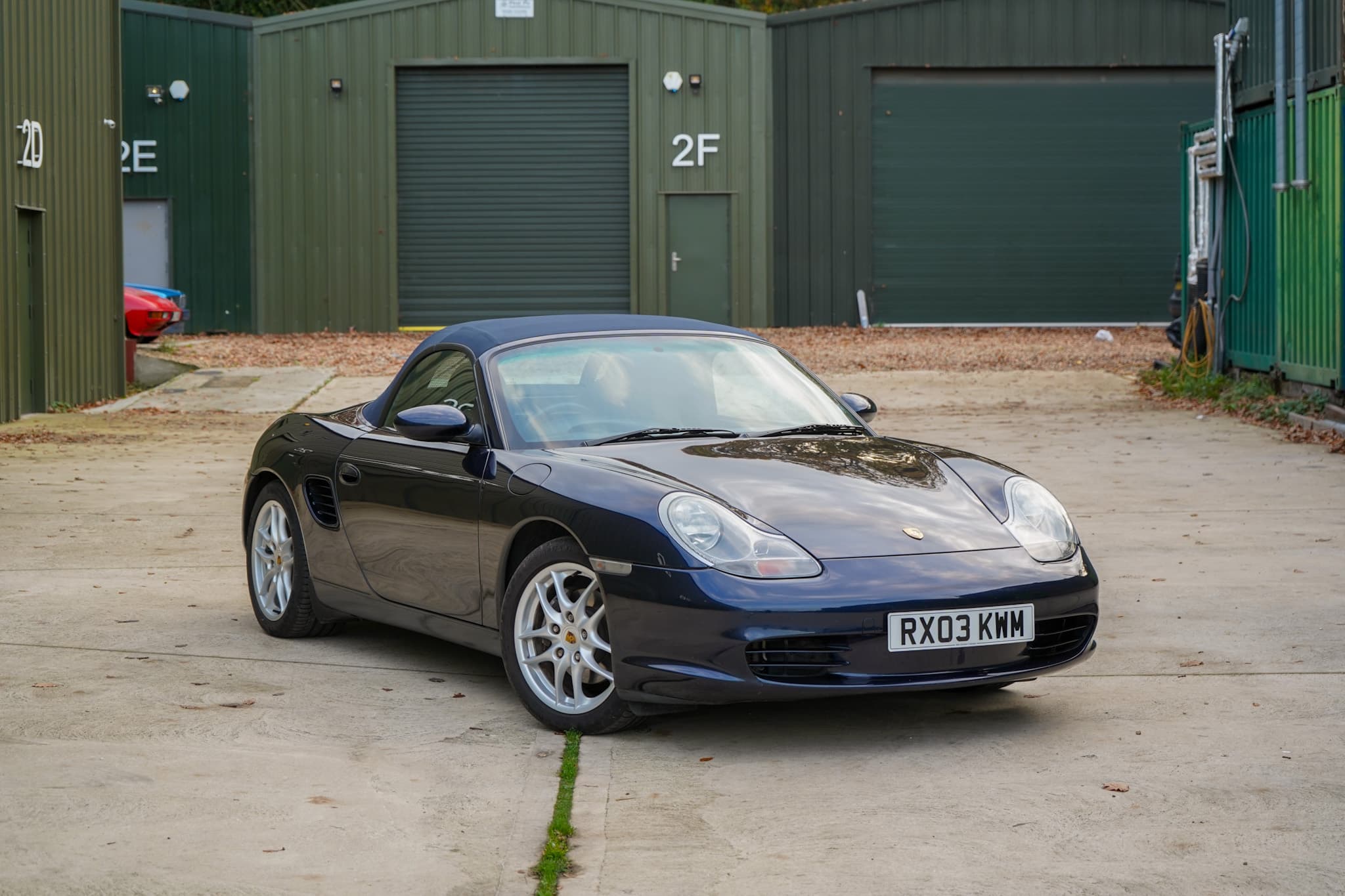
A TMJC example: RX03KWM
A surviving Car & Classic advert from The Matt Johnston Collection records RX03KWM, a 2003 2.7-litre five-speed-manual Boxster, with a particularly detailed engine history.
The listing says Ramus Porsche Specialists rebuilt the engine in 2020 at 32,553 miles, including bearings, chains, gaskets, an IMS bearing, clutch kit and an exhaust valve. At the advert’s stated 59,167 miles, the rebuilt engine had subsequently covered about 26,600 miles. The listing also records substantial top-end work in 2025.
That is strong provenance compared with a vague IMS sorted description. It gives a workshop, mileage and wider repair context.
But it also demonstrates the limit of an advert. The listing does not name the IMS bearing product fitted in 2020. From the public description alone, it would be wrong to say whether that part is a particular LN retrofit, another aftermarket bearing or a conversion with a specific future service interval.
The next piece of evidence is therefore the underlying Ramus invoice.
For the exact late-car specification around this example, see the Boxster 986 II 2.7 Manual reference.
Does an IMS upgrade make the whole M96 engine “sorted”?
No single component can carry that conclusion.
UK engine specialist Hartech continues to list IMS failure alongside other M96/M97 engine problems including cracked or scored cylinders, crank-bearing damage and timing-chain failures. That does not mean every 986 will develop those faults. It means an IMS invoice should not replace a normal engine assessment.
A buyer should still look at cold-start behaviour, oil and coolant history, leaks, filter contents where a specialist recommends inspection, cooling-system condition and the quality of any previous rebuild.
The same principle works in the other direction: a car that has not had an aftermarket IMS retrofit is not automatically condemned by one line on a checklist. Establish the exact engine and bearing arrangement, then make the decision with a specialist who can inspect the car.
Why this does not apply to every water-cooled Porsche
“Porsche IMS” is often discussed as though every late-1990s and 2000s Porsche shared one engine architecture.
They did not. The Turbo, GT2 and GT3 versions of the 996/997 use the Mezger-derived engine family with a different intermediate-shaft bearing arrangement and are not the same proposition as the M96/M97 road-car ball-bearing design discussed here.
That matters on TMJC’s own 996 Turbo X50 reference: applying a base-Carrera or Boxster IMS checklist to that Turbo would be the wrong technical starting point.
Boxster 986 IMS verification checklist
If you are inspecting a 986 and the seller mentions the IMS bearing, work through the evidence in this order:
- Establish Porsche model year, not just first-registration year.
- Confirm the engine identity and whether it is original, rebuilt or replaced.
- For MY2000-2001, do not assume single-row or dual-row from the year alone.
- Ask for the IMS invoice, not just a verbal statement or advert line.
- Record the bearing/conversion product, installer, date and mileage.
- Check whether that exact aftermarket product has a manufacturer-defined renewal interval.
- Reconcile the IMS work with the wider engine history: clutch, RMS, chains, bearings, cooling-system or rebuild work.
- If the bearing type remains material and uncertain, have a Porsche specialist identify the fitted hardware physically.
- Treat the IMS as one part of a complete pre-purchase inspection rather than a substitute for it.
The useful question is not simply “Has the IMS been done?” It is: “What is fitted to this engine now, and what evidence tells me that?”
Sources and further reading
- Porsche — Original Parts Catalogue, Boxster (986), model years 1997-2004
- Porsche Cars North America — 996/986 Maintenance Schedule, Edition 2-06
- LN Engineering — Which IMS Bearing Does My Porsche Engine Have?
- LN Engineering — MY2000-2001 Boxster and 911 IMS bearing
- LN Engineering — identifying previous IMS work and replacement intervals
- Hartech — common Porsche engine faults
- The Matt Johnston Collection via Car & Classic — RX03KWM
Related car
Cars covered in this guide
Explore the cars this guide covers, with model information, history and related TMJC guidance.
 2.7 Manual (986 II)
Buying guide
2.7 Manual (986 II)
PurchaseExplore model details, specifications, history and related guidance for Porsche Boxster 986 2.7 Manual (986 II).
986Maintenance
986
OwnershipExplore model details, specifications, history and related guidance for Porsche Boxster 986.
Editorial information
The Matt Johnston Collection
Research and editorial from TMJC Garage.
Research and editorialTMJC Garage
Reviewed byMatt Johnston
Last reviewed14 September 2026
Published byThe Matt Johnston Collection