Generation
Porsche 911 997
Porsche 911 Type 997 explained: year-range and production-number conflicts, the 997.1-to-997.2 update, Carrera/Targa/Turbo/GT distinctions and evidence-led buying checks.
Variant directory
997 variants
Choose an exact 997 derivative for engine, gearbox, performance, dimensions, equipment and buying-context detail.
TMJC Catalog guide
Porsche 911 997: 997.1 vs 997.2, models and buying guide
Porsche 911 Type 997 explained: year-range and production-number conflicts, the 997.1-to-997.2 update, Carrera/Targa/Turbo/GT distinctions and evidence-led buying checks.
- Page
- Generation overview
- Reviewed
- 13 Sept 2026
- Specifications
- 0 verified
The Porsche 911 Type 997 is the sixth generation of the 911. Porsche presented the Carrera and Carrera S in July 2004, and most historical Porsche material treats the generation as running to 2012. But even Porsche's own archives use more than one date range: Porsche Classic labels the Type 997 2005-2013. The difference is a useful warning for buyers and researchers: presentation date, production period, model year and later Classic-parts coverage are not always the same thing.
The same care is needed with the familiar labels 997.1 and 997.2. They are useful enthusiast shorthand for the early and updated phases of the Type 997, not separate Porsche generation codes. The important boundary is mechanical as well as visual: the 2008 update brought direct fuel injection to the Carrera engines and introduced PDK in place of Tiptronic S for the normal Carrera range.
Porsche 997 years: why Porsche gives different ranges
Porsche Newsroom's historical material calls the 997 the 2004-2012 generation and dates the first Carrera/Carrera S presentation to July 2004. Porsche Classic's current model overview, intended around classic-model support and vehicle information, labels Type 997 2005-2013.
Those ranges should not be forced into one supposedly definitive answer. For a specific car, the useful evidence is its VIN-linked build data, model year, first-registration date and exact derivative. A car registered in a calendar year close to a model update should not be identified from the registration year alone.
There is an even more interesting factory-source discrepancy in the production total.
| Porsche source | Type 997 total |
|---|---|
| Porsche Newsroom, 2017 911 generation history | 215,092 |
| Porsche Newsroom, 2018 dedicated Type 997 history | 213,004 |
| Porsche 60 Years press kit | 213,004 |
The later press kit says 213,004 examples were built from 2004 through the 2012 financial years. Porsche's 2017 retrospective instead gives 215,092. That is a difference of 2,088 cars, and the Porsche material reviewed here does not explain it. Rather than average the numbers or quietly choose whichever one is repeated most often elsewhere, it is better to keep the source and scope attached to the figure.
997.1 vs 997.2: what actually changed?
The early cars commonly called 997.1 use the first Type 997 Carrera engine family and the original transmission choices. Porsche gives the early rear-drive Carrera a 3.6-litre naturally aspirated flat-six with 325 PS, while the Carrera S uses a 3.8-litre engine with 355 PS.
For the model update in 2008, Porsche did considerably more than change lamps and bumpers. The revised Carrera engines adopted direct fuel injection. Output rose to 345 PS for the 3.6-litre Carrera and 385 PS for the 3.8-litre Carrera S. Porsche also introduced its dual-clutch PDK transmission; Porsche Classic specifically records PDK replacing Tiptronic S in the updated Carrera range.
Visual clues help, but they should confirm rather than define the mechanical identity. Porsche's 2018 history dates the facelift to July 2008 and notes bi-xenon headlights with LED daytime running lights. All-wheel-drive Carrera 4 cars also gained the continuous rear reflector strip around the update. A badge, lamp or bumper can be replaced; build data is harder to misunderstand.
| Area | Early phase, commonly 997.1 | Updated phase, commonly 997.2 |
|---|---|---|
| Base Carrera | 3.6-litre, 325 PS | 3.6-litre DFI, 345 PS |
| Carrera S | 3.8-litre, 355 PS | 3.8-litre DFI, 385 PS |
| Automatic option | Tiptronic S in relevant Carrera derivatives | PDK replaces Tiptronic S |
| Lighting | Original 997 treatment | Updated lights; LED daytime running lights noted by Porsche |
| Identification | Phase plus derivative still required | Phase plus derivative still required |
This table deliberately describes the ordinary Carrera family. It is not a specification table for every Turbo, GT or special-edition 997.
One generation, a much wider range than 'Carrera'
Porsche says the 997 ultimately spanned 24 model variants including special editions. There were Coupés, Cabriolets, Targas and a Speedster; rear- and all-wheel-drive cars; narrow and wide bodies; naturally aspirated and turbocharged engines; plus GTS, GT2, GT2 RS, GT3 and GT3 RS derivatives.
That breadth is why a generic advert saying only Porsche 997 tells you surprisingly little. Establish at least the body, rear- or all-wheel drive, Carrera/S/Turbo/GT derivative, phase and gearbox before comparing specifications or known issues.
Carrera, Carrera S and Carrera 4 are different cars mechanically
The early base Carrera and Carrera S do not merely differ by trim. Porsche's own figures separate the 3.6-litre 325 PS Carrera from the 3.8-litre 355 PS Carrera S, with PASM standard on the S in the period material.
The Carrera 4 and 4S add all-wheel drive and have their own body and chassis details. They should not be treated as cosmetic option packs for the rear-drive cars. Porsche Classic also records six-speed manual and optional Tiptronic S configurations for early Carrera 4 derivatives, with the updated all-wheel-drive range moving to the new direct-injection engine generation and PDK-era specification.
For a buyer, this distinction matters twice: it changes what the car is, and it changes which maintenance history and inspection questions are relevant.
Why the 997 Targa is easy to misdescribe
The Type 997 made a notable change to the Targa. Porsche says the 997 Targa was offered exclusively with permanent all-wheel drive as the Targa 4 and Targa 4S. Porsche's heritage material also describes its rear bodywork as 44 mm wider and records a viscous multiple-disc clutch distributing part of the drive to the front axle.
So a 997 Targa is not simply a rear-drive Carrera with a glass roof. Roof mechanism, body, drivetrain and derivative all belong in the identity.
Turbo and GT cars sit outside the normal Carrera engine story
The 997 Turbo arrived in 2006 with a major Porsche milestone: Porsche describes it as the first series-production petrol car to use turbochargers with Variable Turbine Geometry (VTG). The first 997 Turbo used a 3.6-litre engine at 480 PS; the later 3.8-litre direct-injection Turbo rose to 500 PS, with the Turbo S at 530 PS.
The GT branch is different again. Porsche Classic records the 997 GT3 at 415 PS in its first form and 435 PS after the update, with GT3 RS derivatives becoming progressively more specialised and the final GT3 RS 4.0 limited to 600 cars at 500 PS. These cars use a different technical and ownership context from an ordinary Carrera.
That distinction is important when reading buying advice. An article about intermediate-shaft bearings on early naturally aspirated Carrera engines should not be pasted across a 997 Turbo or GT3 simply because the cars share a generation code.
Chassis and technology: more than a styling reset of the 996
Porsche's 60 Years material says the 997 received a redesigned chassis, increased flexural and torsional stiffness and a more extensively clad underbody. Porsche Active Suspension Management (PASM) was standard on the Carrera S, while Sport Chrono Plus could alter accelerator response, engine behaviour and the intervention or response of several chassis/transmission systems where fitted.
The design also moved deliberately away from the 996's integrated headlamp treatment. Porsche described the 997's oval clear-glass headlights and separate auxiliary lights as a return to a more traditional 911 visual cue. That makes the 997 easy to recognise at a glance, but it is the engineering spread underneath the body that makes exact derivative identification necessary.
The Type 996 generation guide explains the water-cooled predecessor, while the Type 991 generation guide covers the substantially newer generation that followed. The broader Porsche 911 model guide places all three in the complete 911 lineage.
How to identify a 997 properly
Start with the factory identity, not the advert headline.
- Confirm that the VIN/build data identifies a Type 997 and establish the model year.
- Identify the exact derivative: Carrera, Carrera S, Carrera 4/4S, Targa, Turbo, GTS, GT2 or GT3 family.
- Confirm body style and driven wheels.
- Match engine capacity and gearbox to the phase and derivative.
- Check factory option/build information before treating fitted wheels, seats, brakes, aero parts or badges as original.
This matters particularly around 2008-09. A later registration date does not by itself prove an updated direct-injection car, and cosmetic parts can make an early car look later or vice versa.
What should you inspect before buying a Porsche 997?
Begin by checking that the car's paperwork, mechanical specification and physical identity agree. Only then apply the known-issue list for that exact derivative.
For first-phase naturally aspirated Carrera engines, current specialist buying guidance consistently treats cylinder-bore condition and the intermediate-shaft bearing as important due-diligence topics. Evo notes that bore scoring is more associated with the 3.8-litre engine than the 3.6, but that is not evidence that every 3.8 will suffer or that a 3.6 is immune.
Useful evidence can include:
- a coherent service and MOT history;
- invoices showing what work was actually done rather than shorthand such as
IMS done; - cold- and hot-running behaviour, oil consumption history and exhaust condition;
- diagnostic/over-rev data where appropriate;
- a specialist borescope when justified by the car, engine and inspection findings;
- cooling-system, radiator and condenser condition;
- suspension, brakes, tyres, alignment and age-related rubber components;
- accident repair and underbody condition.
A rebuilt engine is not automatically a reason to reject a car, just as the word rebuilt is not automatically reassuring. The useful questions are who did the work, why, which components were replaced, what evidence survives and how many miles the car has covered since.
For Cabriolets, operate the roof through a complete cycle and check seals, drainage and the cabin for water entry. For Targas, the glass-roof mechanism and its history deserve the same evidence-led attention.
A TMJC-handled 2006 Carrera Cabriolet
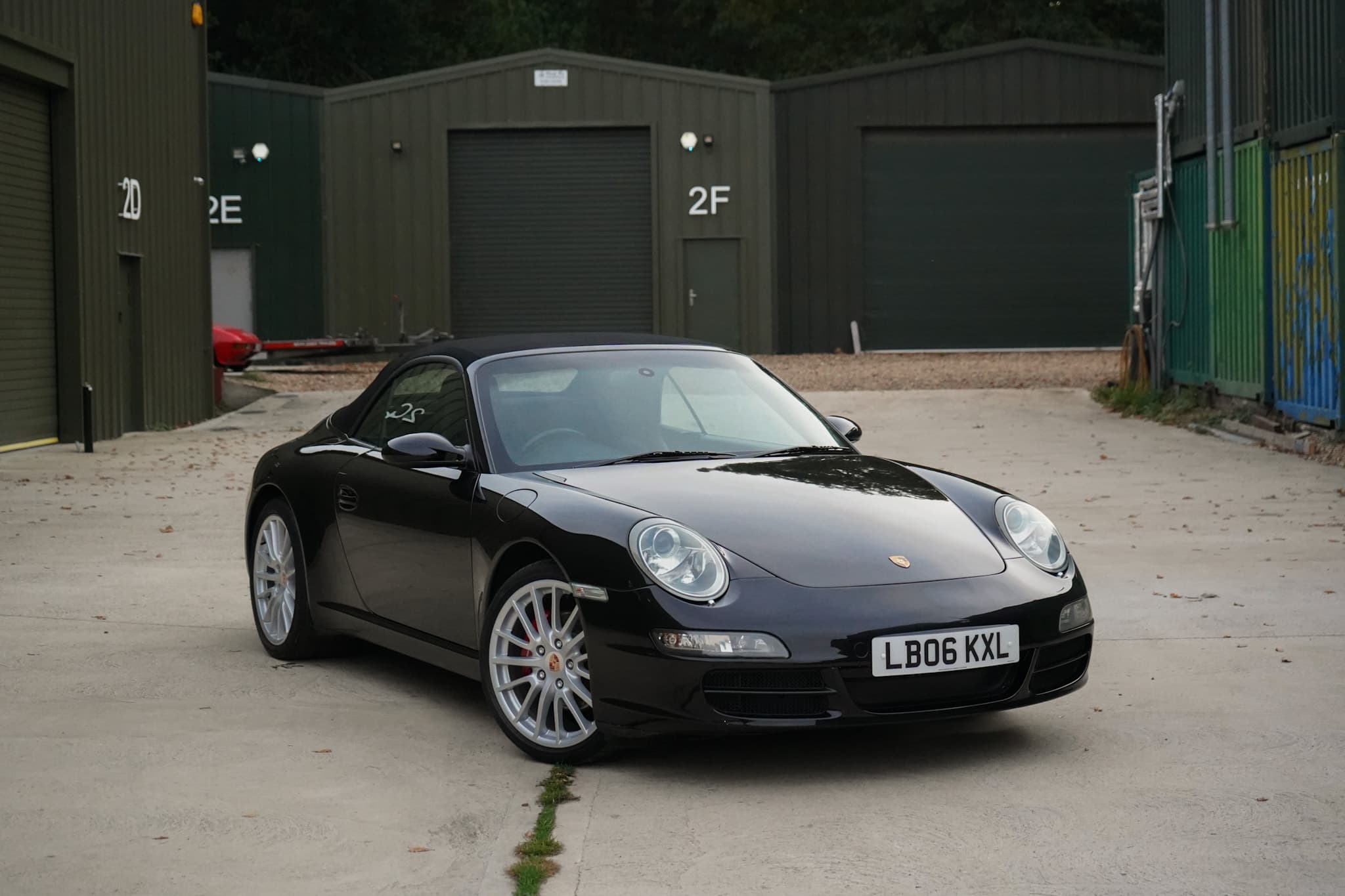
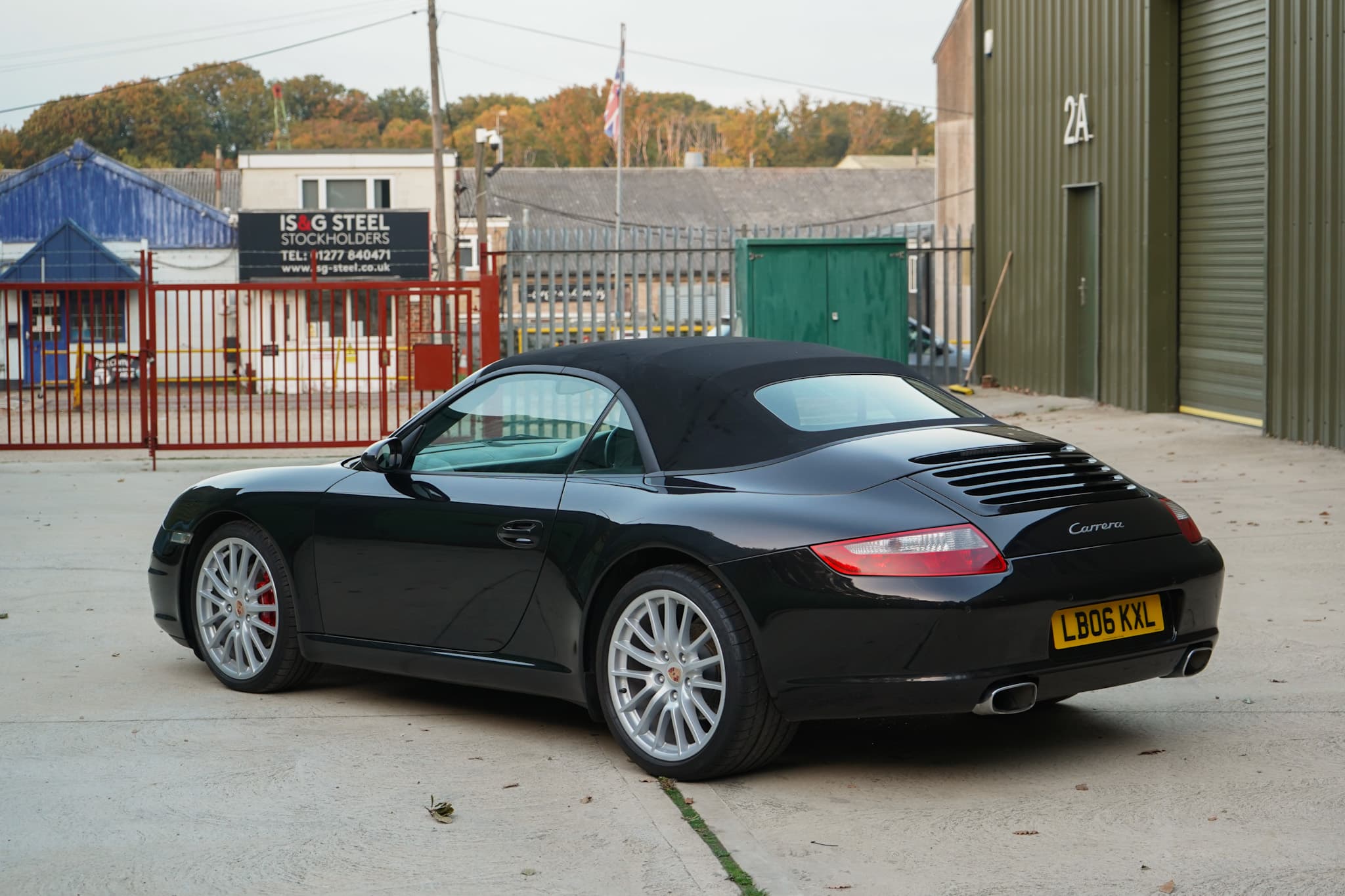
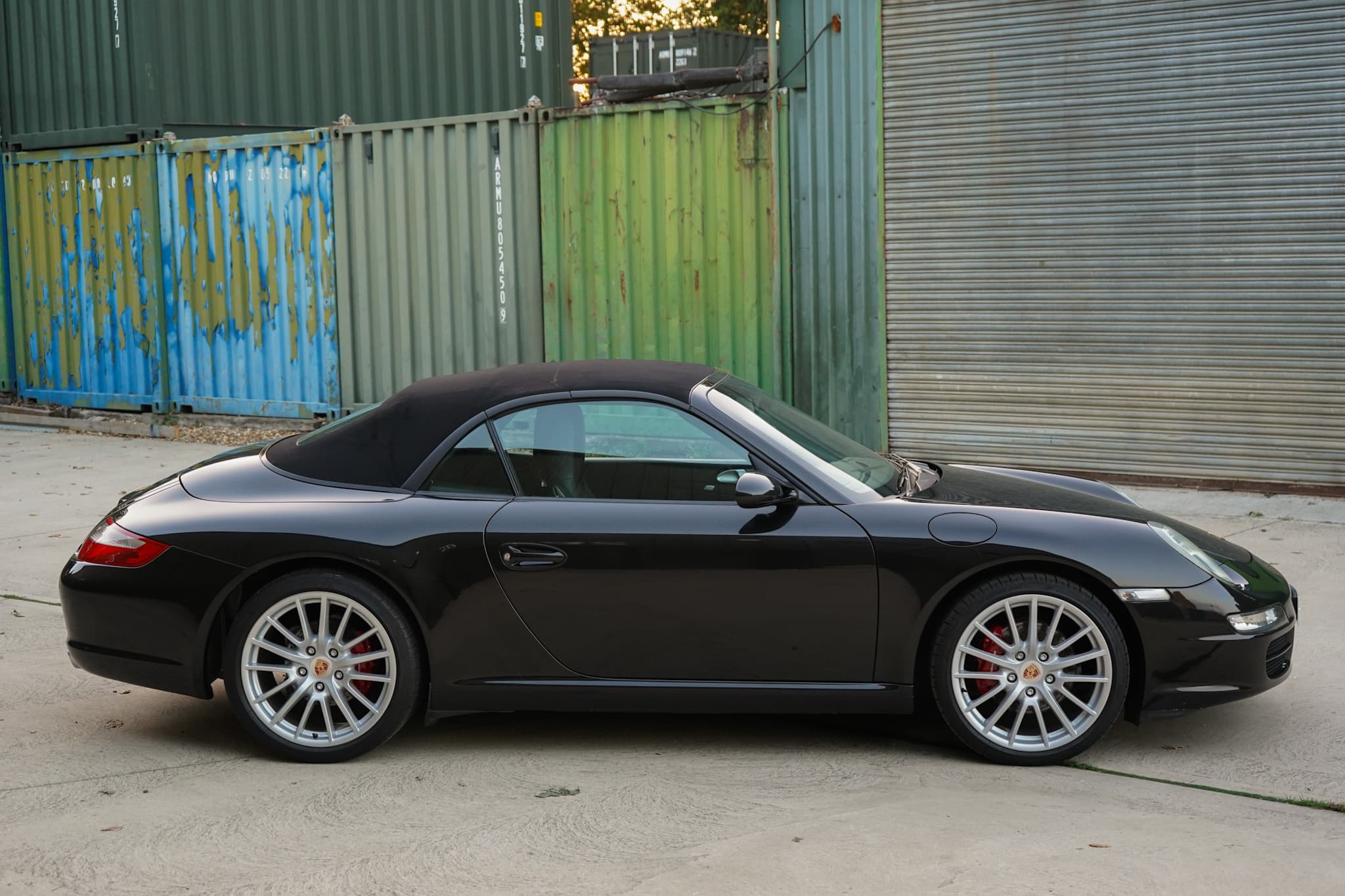
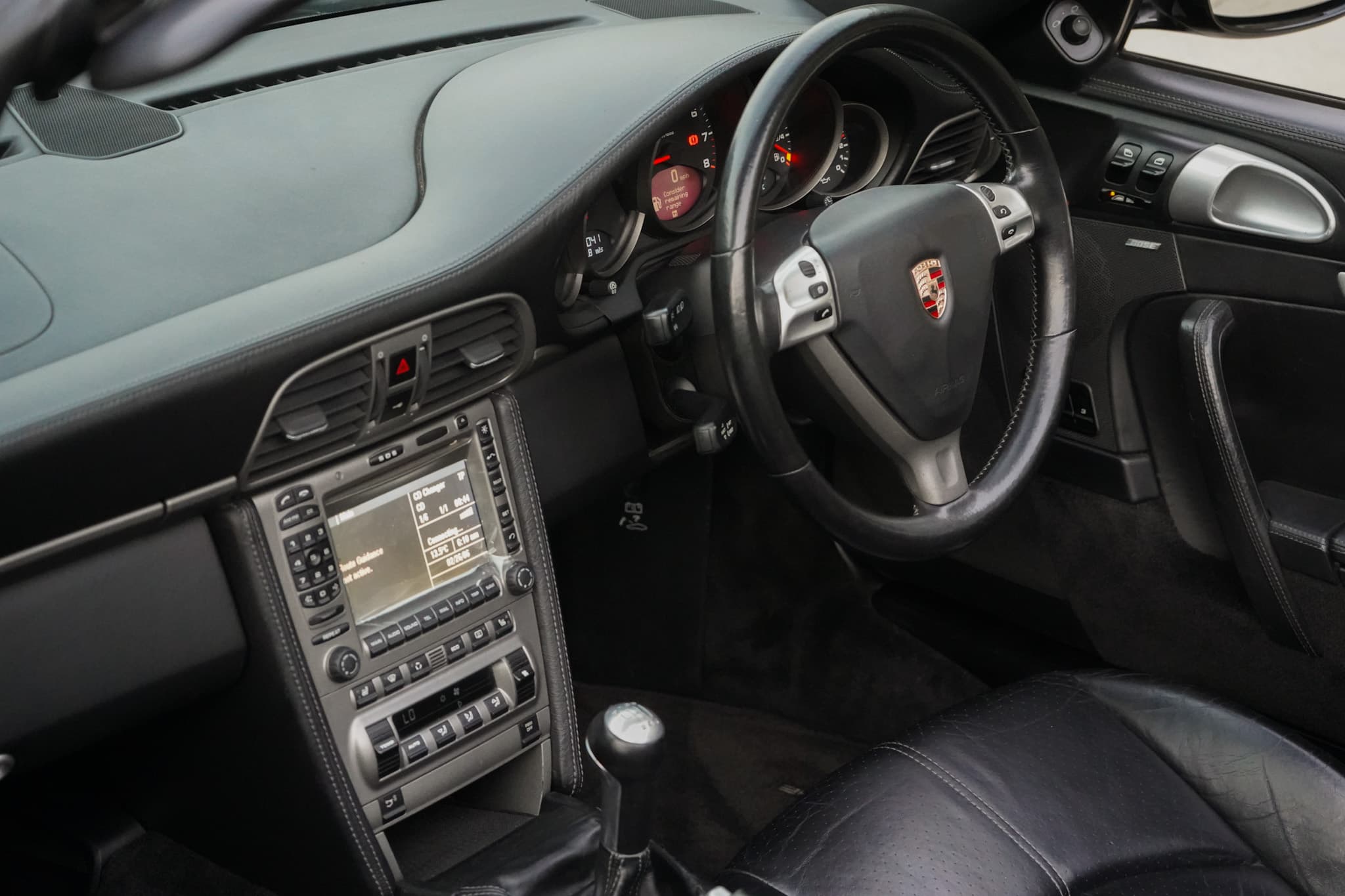
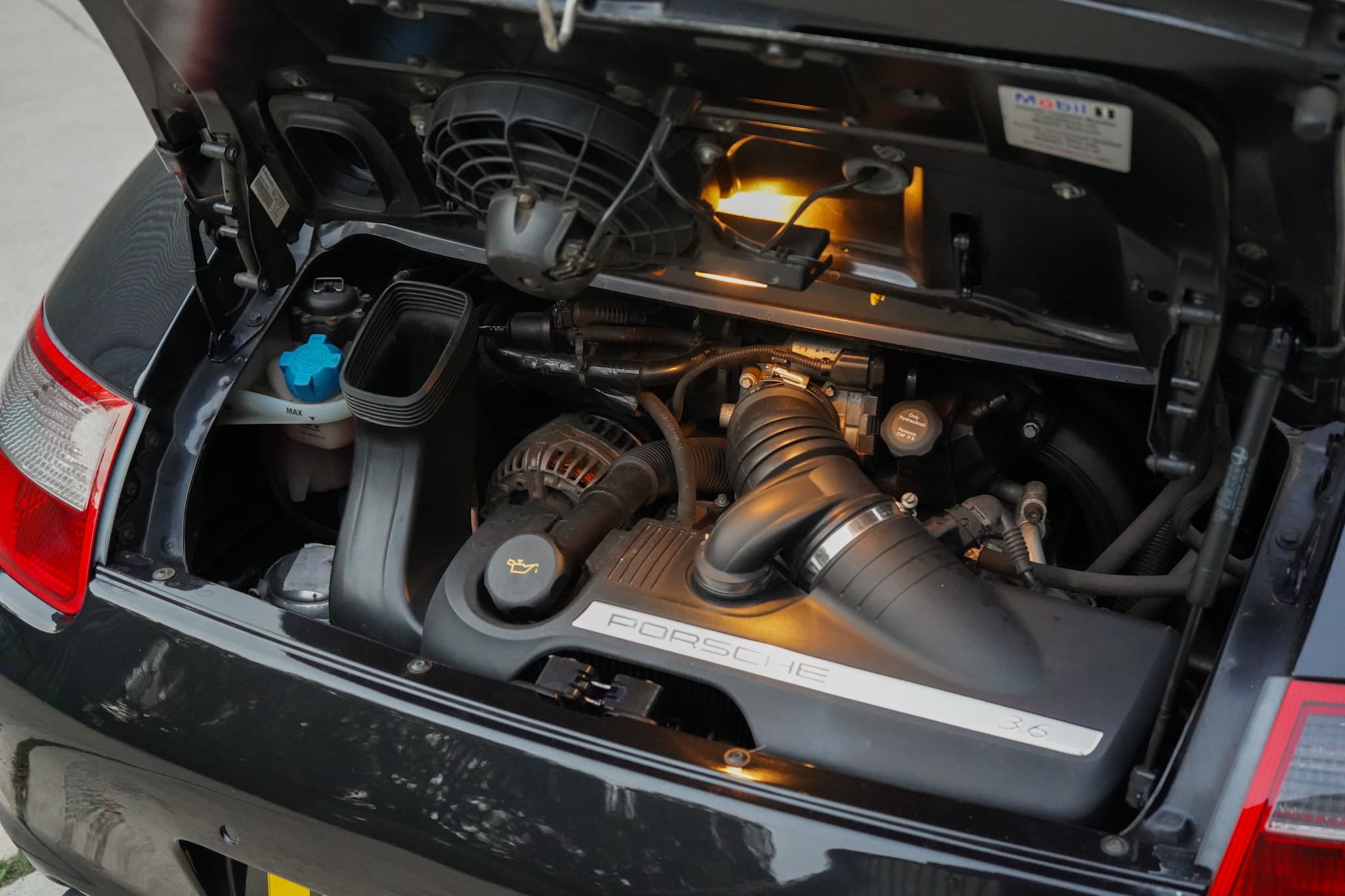
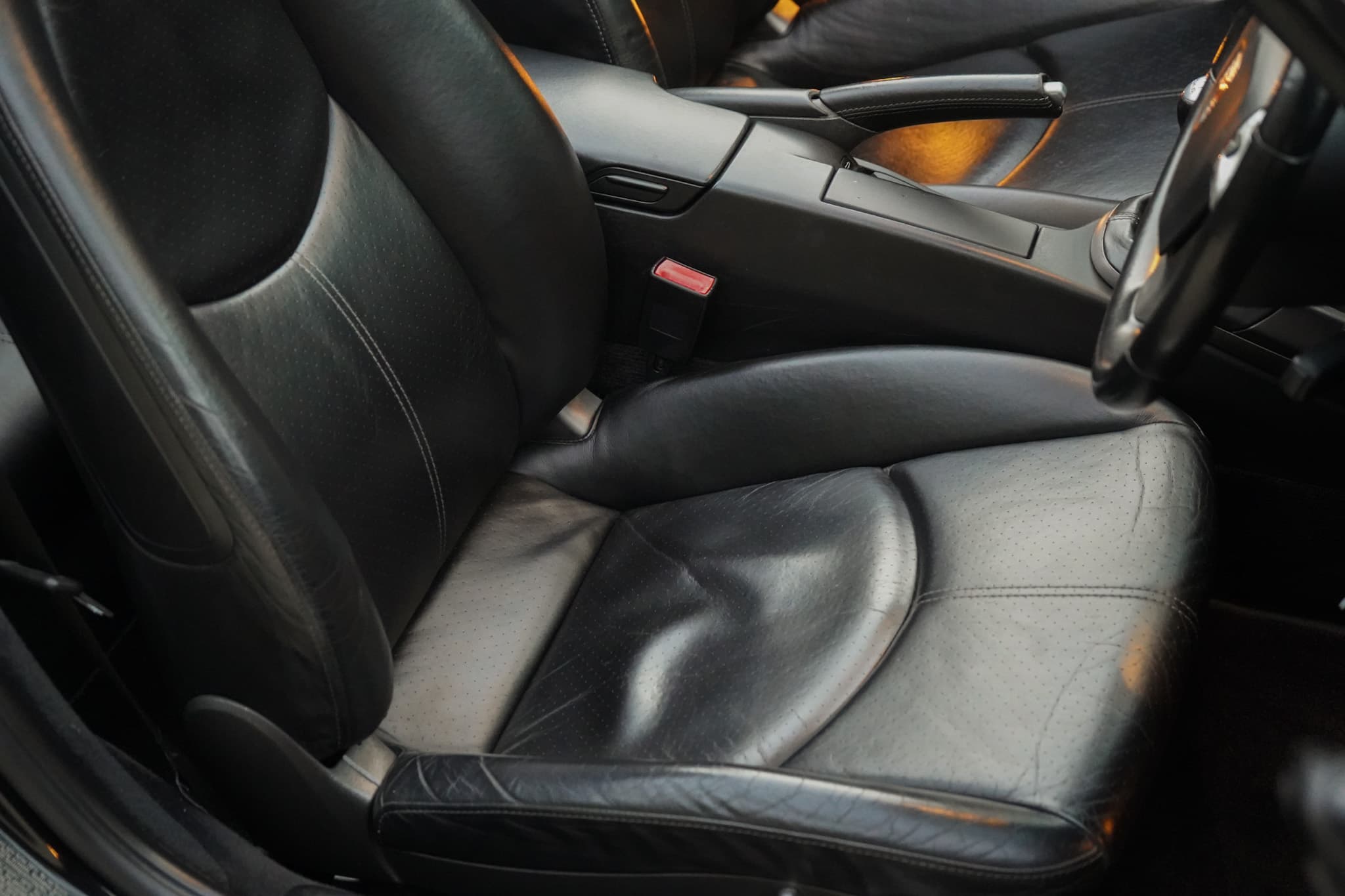
A surviving historical advert associated with The Matt Johnston Collection records LB06KXL as a 2006 right-hand-drive Carrera Cabriolet, with a 3,596 cc petrol engine, six-speed manual gearbox and 52,041 miles at the time of the advert. It records Porsche Centre Chiswick supply in June 2006 and substantial maintenance in June 2025 including the clutch and dual-mass flywheel.
More usefully for this subject, the advert says the car received a documented borescope inspection and that all six cylinders were reported clear of scoring at that point. That does not prove anything about every 3.6-litre 997. It is simply a good example of the type of car-specific evidence that is more useful than trying to diagnose an individual 911 from the reputation of its engine family.
The exact early 3.6-litre Carrera Cabriolet already has its own researched draft within TMJC Garage. It remains unpublished pending editorial review, so this generation page keeps the public internal links to already available 911, 996 and 991 references.
So which production number is correct: 213,004 or 215,092?
At present, both numbers are traceable to Porsche itself. The later dedicated 997 history and the 60 Years press kit say 213,004; the 2017 millionth-911 retrospective says 215,092. None of the reviewed Porsche pages explains the 2,088-car difference.
That makes the disagreement more useful than a falsely precise answer. If Porsche later publishes an archival clarification defining the counting scope, the structured record can be resolved. Until then, the source should travel with the number.
Sources and further reading
- Porsche Newsroom — Sixth generation Porsche 911 (997), 2004-2012: https://newsroom.porsche.com/en/press-kits/60-Years-Porsche-911/6.-Generation-Porsche-911,-(997),-2004-012.html
- Porsche Newsroom — The 997: Technology offensive, new design and great variety for the 911: https://newsroom.porsche.com/en/history/porsche-911-seven-generations-part-6-type-997-16489.html
- Porsche Newsroom — Sixth generation - Engines: https://newsroom.porsche.com/en/press-kits/60-Years-Porsche-911/6.-Generation---Motoren.html
- Porsche Newsroom — Porsche 911 (Type 997) Targa 4S: https://newsroom.porsche.com/en/press-kits/Porsche-Heritage-Experience/Porsche-911-(Typ-997)-Targa-4S.html
- Porsche Classic — Model Overview 997: https://www.porsche.com/usa/accessoriesandservice/classic/models/997/
- Porsche Classic — Porsche 911 Carrera (type 997): https://www.porsche.com/australia/accessoriesandservice/classic/models/997/997/
- Porsche Newsroom — From zero to 1,000,000: Seven generations of the Porsche 911: https://newsroom.porsche.com/de/produkte/porsche-einmillionste-911-produktionsjubilaeum-sieben-generationen-13732.html
- evo — Used Porsche 911 (997, 2004-2012) buying guide: https://www.evo.co.uk/porsche/911/6578/used-porsche-911-997-2004-2012-the-ultimate-sweet-spot-911
- Historical TMJC-linked Car & Classic advert for LB06KXL: https://www.carandclassic.com/car/C1957328
Editorial information
The Matt Johnston Collection
Research and editorial from TMJC Garage.
Research and editorialTMJC Garage
Published byThe Matt Johnston Collection
Model lineage
Where this car sits
TMJC media
Explore the car in detail
Sell, consign or editorial
Thinking of selling or consigning a special car?
Continue with TMJC for a discreet conversation, professional presentation and collector-focused support.
Enquire now