TMJC assistance
Want TMJC to help with this vehicle?
Sourcing, consignment and valuationContinue to the main TMJC website and speak directly with the collection team.
Variant
Factory-backed early 997 Carrera Cabriolet specs, 997.1 vs 997.2 identification, IMS and bore-scope evidence, plus checks for a 3.6-litre manual car.
TMJC Catalog guide
Factory-backed early 997 Carrera Cabriolet specs, 997.1 vs 997.2 identification, IMS and bore-scope evidence, plus checks for a 3.6-litre manual car.
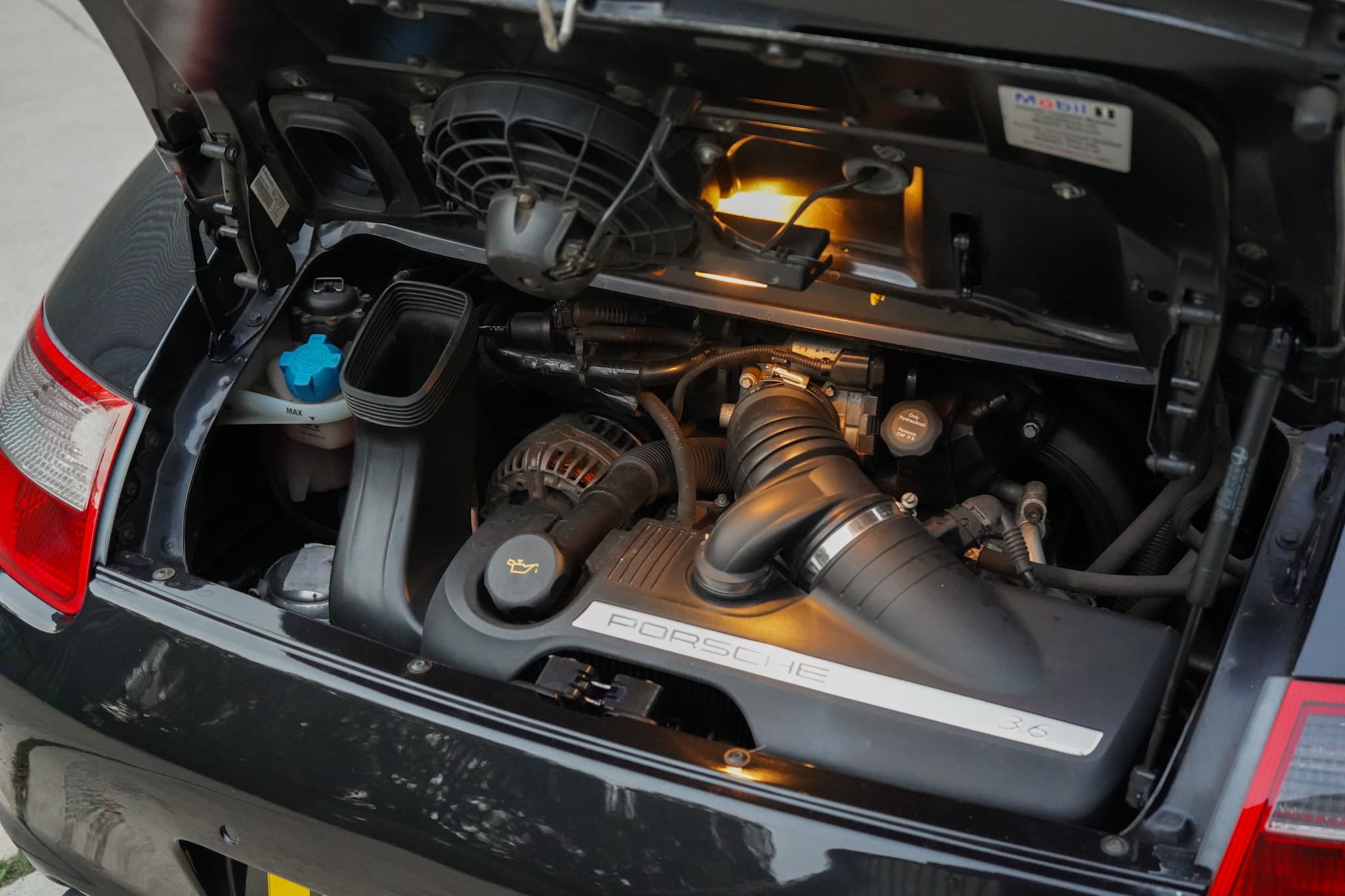
The Porsche 911 Carrera Cabriolet (Type 997, early phase) is the rear-wheel-drive open version of the base Carrera: 3,596 cc, naturally aspirated flat-six, 239 kW / 325 PS and 370 Nm in the factory specification covered here. Porsche Classic groups the early Carrera Coupé and Carrera Cabriolet as 2005-08 cars. The later direct-injection Carrera belongs to the updated Type 997 phase commonly called 997.2.
That distinction matters. A seller describing a car simply as a “997 Cabriolet” has not told you whether it is a Carrera, Carrera S, Carrera 4 or Carrera 4S, nor whether it is an early or updated car. Those differences change the engine, driven wheels, suspension specification, gearbox choices and the ownership questions worth asking.
Porsche's own historical material supplies a useful core specification, while a current Porsche-network legacy listing exposes additional factory data for the manual rear-drive derivative.
| Item | Early Carrera Cabriolet |
|---|---|
| Porsche type | 997 |
| Common phase name | 997.1 / early Type 997 |
| Porsche Classic grouping | 2005-08 |
| Body | Cabriolet |
| Driven wheels | Rear-wheel drive |
| Engine | Naturally aspirated flat-six |
| Displacement | 3,596 cc / 3.6 litres |
| Fuel system | Sequential multipoint injection |
| Power | 239 kW / 325 PS at 6,800 rpm |
| Torque | 370 Nm at 4,250 rpm |
| Manual gearbox | Six-speed, dual-mass flywheel |
| Manual 0-100 km/h | 5.2 seconds |
| Manual top speed | 285 km/h |
| Wheelbase | 2,350 mm |
| Manual DIN unladen weight | 1,480 kg |
The performance and weight rows are deliberately labelled manual. Porsche also offered Tiptronic S in this period, so it would be misleading to flatten one set of manual-car figures into a gearbox-neutral specification.
Porsche Classic lists Porsche Active Suspension Management (PASM) as an extra-cost option on the base Carrera, along with the extendable aerodynamic rear spoiler and the period PCM system. That is useful when comparing cars because PASM being present on one Carrera Cabriolet does not make it standard equipment across every base car.
997 is Porsche's Type designation. 997.1 and 997.2 are useful enthusiast and trade shorthand for the early and updated phases, not two separate Porsche Type numbers.
Porsche's history gives the meaningful mechanical boundary. The early Carrera used the 3.6-litre engine at 325 PS; the early Carrera S used a 3.8 at 355 PS. The model update introduced in 2008 brought direct fuel injection and the option of Porsche Doppelkupplung (PDK). The updated 3.6 Carrera rose to 345 PS and the 3.8 Carrera S to 385 PS. Porsche Classic groups those updated Carrera Coupé/Cabriolet cars as 2009-12.
For a car close to the changeover, the first-registration year is therefore a clue rather than the final answer. Build data, VIN-linked specification, the actual engine and the gearbox fitted are better evidence.
The simplest distinction is also one of the most frequently blurred in adverts:
Porsche also lists PASM as optional on the base Carrera but part of the S model's standard chassis specification. The S received its own brake and wheel specification as well. An S therefore should not be described as a base Carrera with a little more power, and an ordinary Carrera should not inherit the S model's equipment by assumption.
The same applies to the number 4 in Carrera 4 and 4S. Those are all-wheel-drive derivatives. The base Carrera Cabriolet on this page is rear-wheel drive.
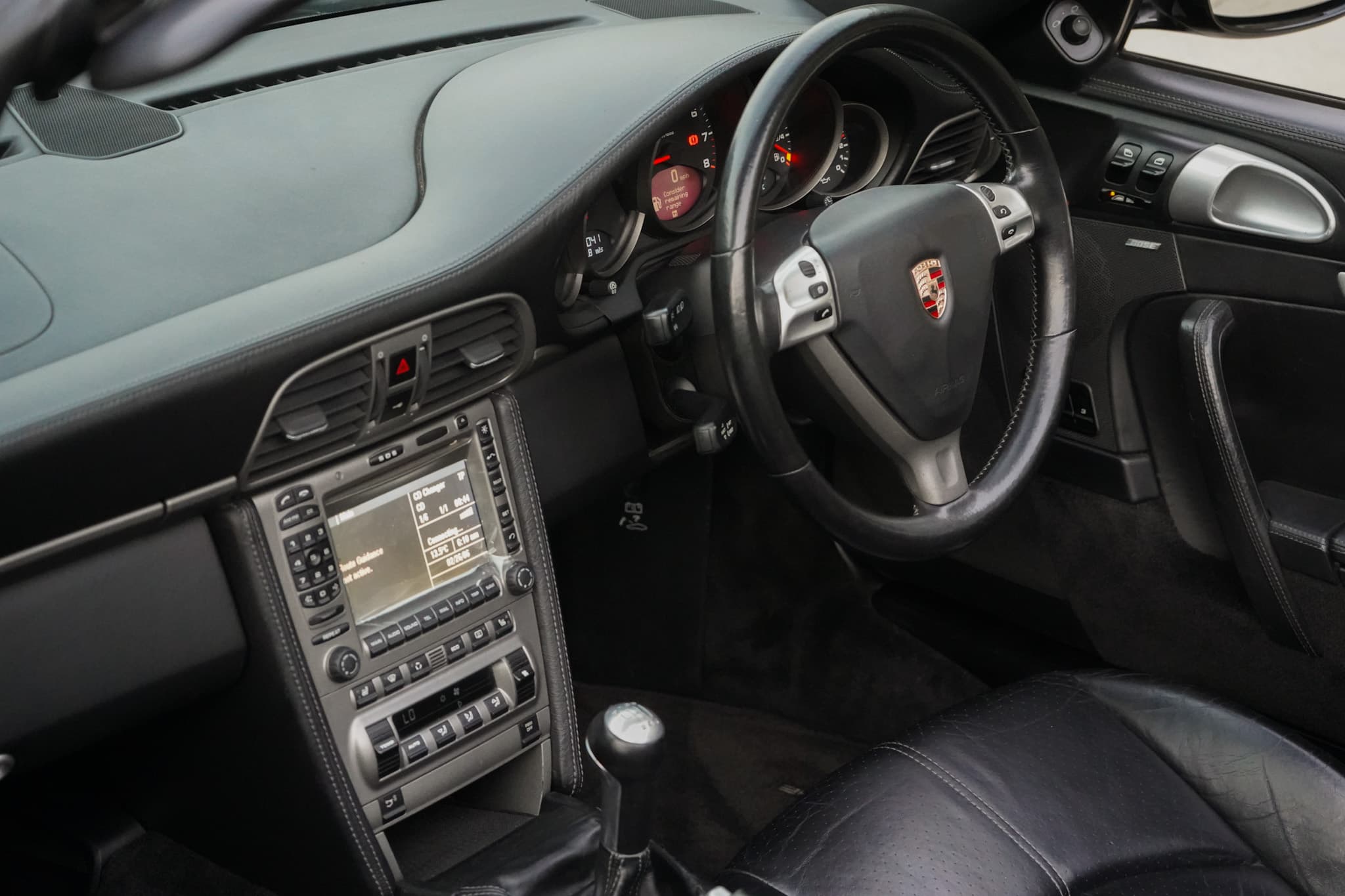
TMJC's 2006 example is a six-speed manual, and Porsche's legacy specification for a manual early Carrera Cabriolet gives the 5.2-second 0-100 km/h time and 285 km/h top speed shown above. Porsche's own legacy performance data also distinguishes manual and Tiptronic values, confirming that an early Carrera Cabriolet should not be reduced to “997.1 equals manual”.
On a manual car, clutch and dual-mass-flywheel history can be useful evidence of how the car has been maintained. On an automatic, the questions change. Either way, the gearbox should agree with the build information and invoices rather than with a generic online specification copied from another car.
The intermediate-shaft bearing is one of the most repeated subjects around early water-cooled 911s, but the phrase “IMS done” can hide more than it explains.
LN Engineering's specialist technical guide says model-year 2006-on 997/987 engines used a larger, non-serviceable IMS bearing that cannot simply be replaced through the familiar retrofit procedure without engine disassembly. It also notes that a Porsche replacement engine may contain the bearing design current when that replacement engine was built.
RPM Specialist Cars goes further for the base 3.6, publishing an M96/05 engine-number breakpoint between the earlier smaller bearing and the revised larger design. That is useful specialist identification guidance, but it is not being treated here as a Porsche factory specification.
The practical conclusion is straightforward: ask for the engine number and the invoice. If a seller says a 2006-08 car had its “IMS changed with the clutch”, the paperwork should explain precisely what work was performed. Do not assume the phrase means the same procedure on every 997.
This is also why registration date should not be used as a substitute for engine identity. A late-registered earlier-build car, an engine replaced under warranty or a later replacement unit can break a simple calendar-year rule.
Cylinder-bore scoring is a separate question from the IMS bearing. The two should not be bundled into one vague “engine issues” label.
Specialist sources including Hartech treat scored cylinders as a real repair category on the M96/M97-era water-cooled engines, while contemporary used-car guidance commonly associates the problem more strongly with the 3.8-litre Carrera S. That does not justify describing every 3.6 as immune or assigning a failure probability to an individual car from its badge.
A useful pre-purchase investigation starts with the actual engine. Service history, oil-use evidence, cold and hot running, exhaust behaviour and diagnostic information can all form part of a specialist inspection. If a borescope is appropriate, ask what was inspected and whether the report covers all six cylinders, ideally with dated images or a written finding.
The distinction between “a borescope was mentioned in the advert” and “there is a specialist report showing the condition at a known date” is important. Neither is a lifetime guarantee, but the latter is real evidence.
The internet discussion around 997.1 Carreras can become so engine-focused that the rest of a roughly 20-year-old sports car receives too little attention.
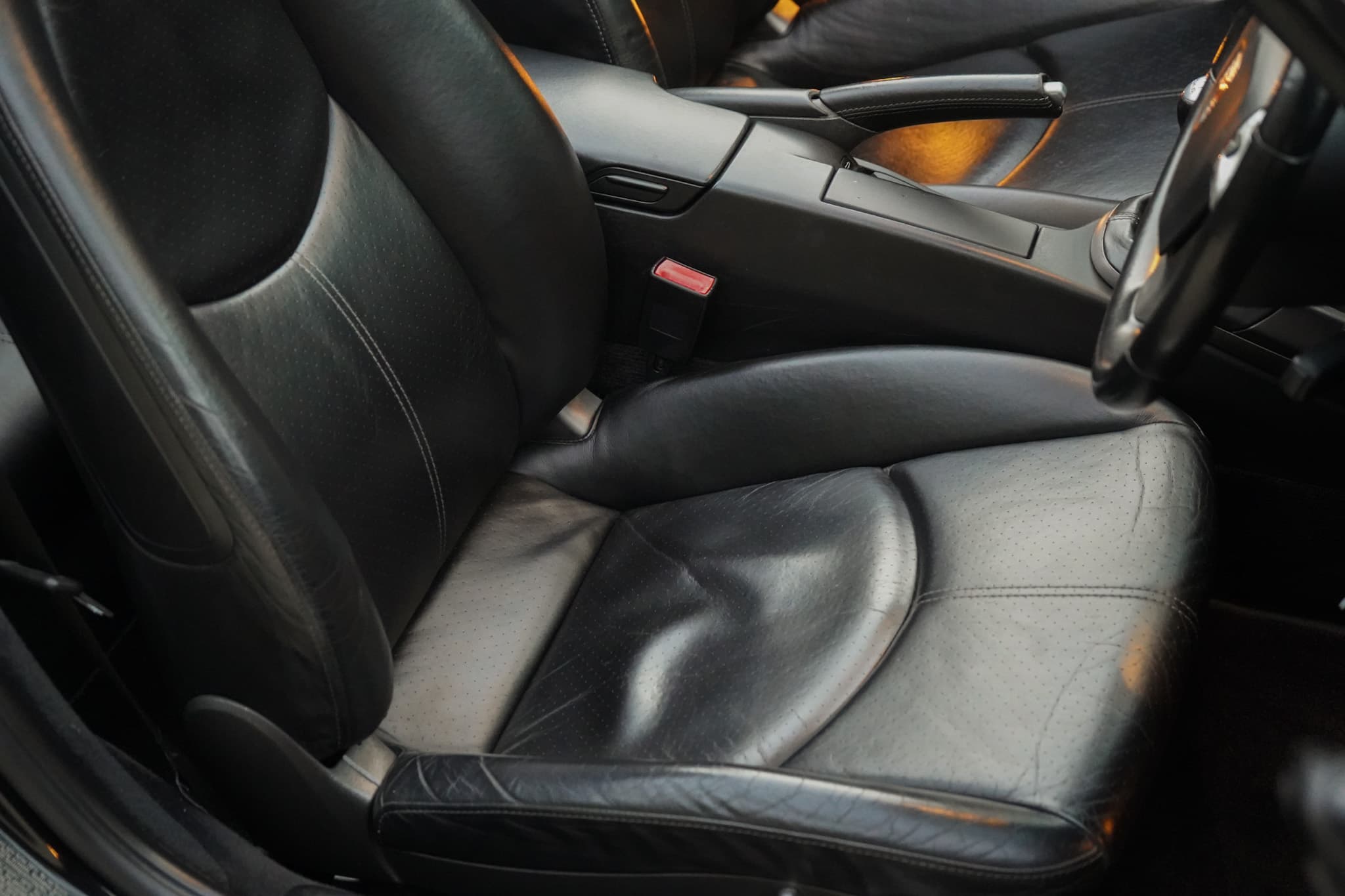
A specialist pre-purchase inspection should reconcile the car with its paperwork, then assess the whole vehicle. On a Carrera Cabriolet that includes:
PASM deserves particular care in adverts. Porsche Classic lists it as an option on the base Carrera. If fitted, it is part of that particular car's specification; if absent, that is not evidence that the car is incomplete.
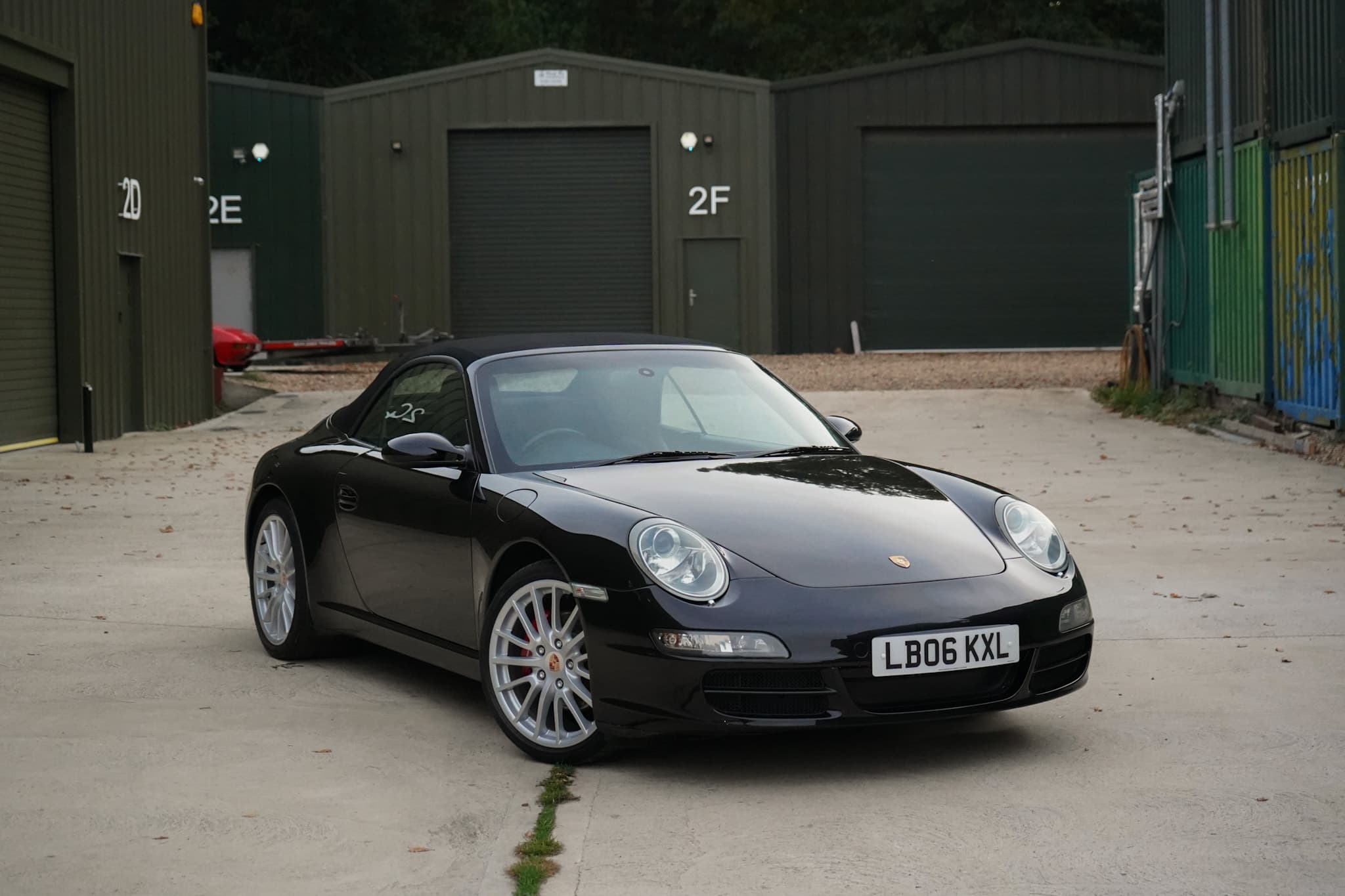
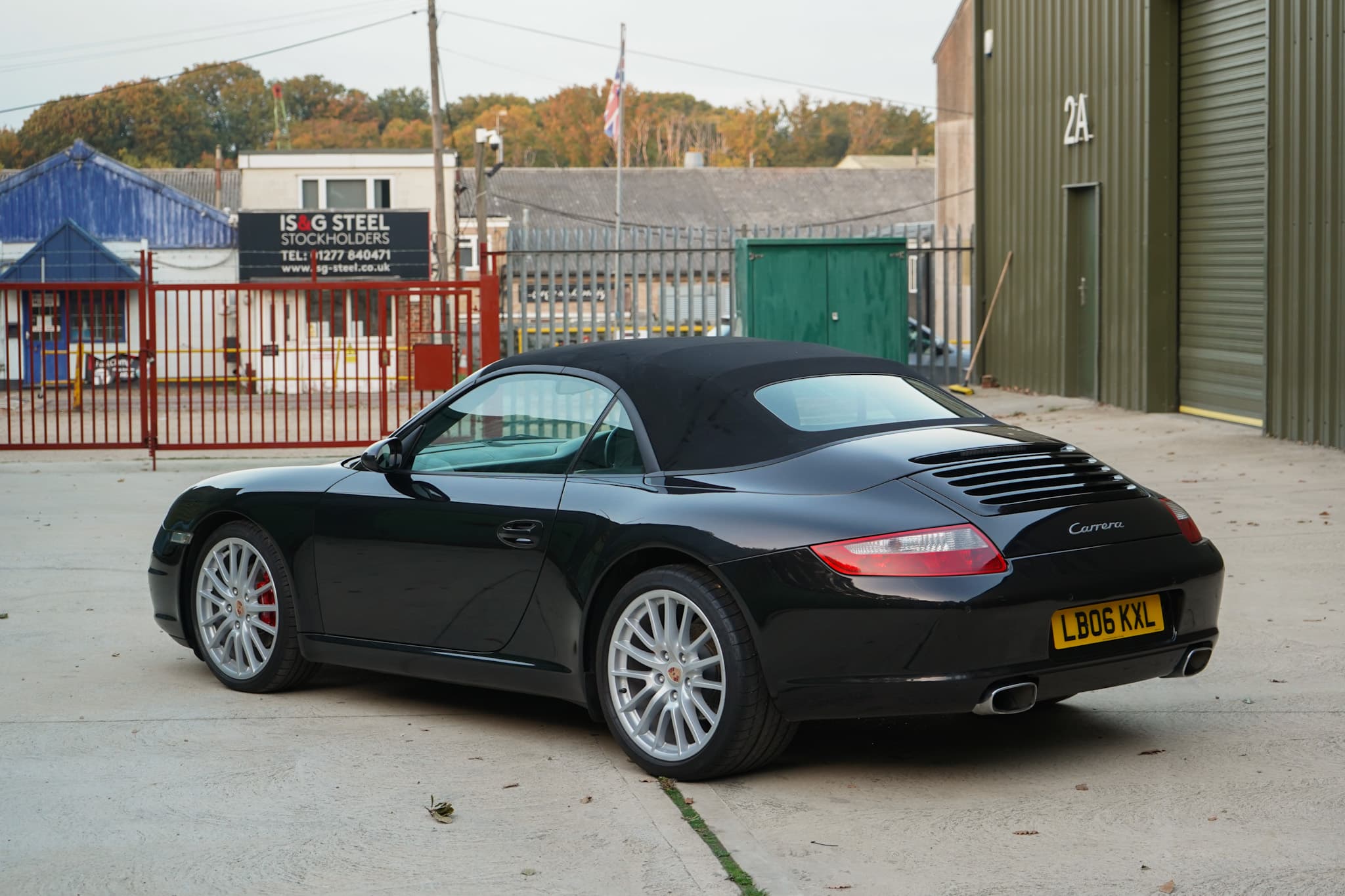
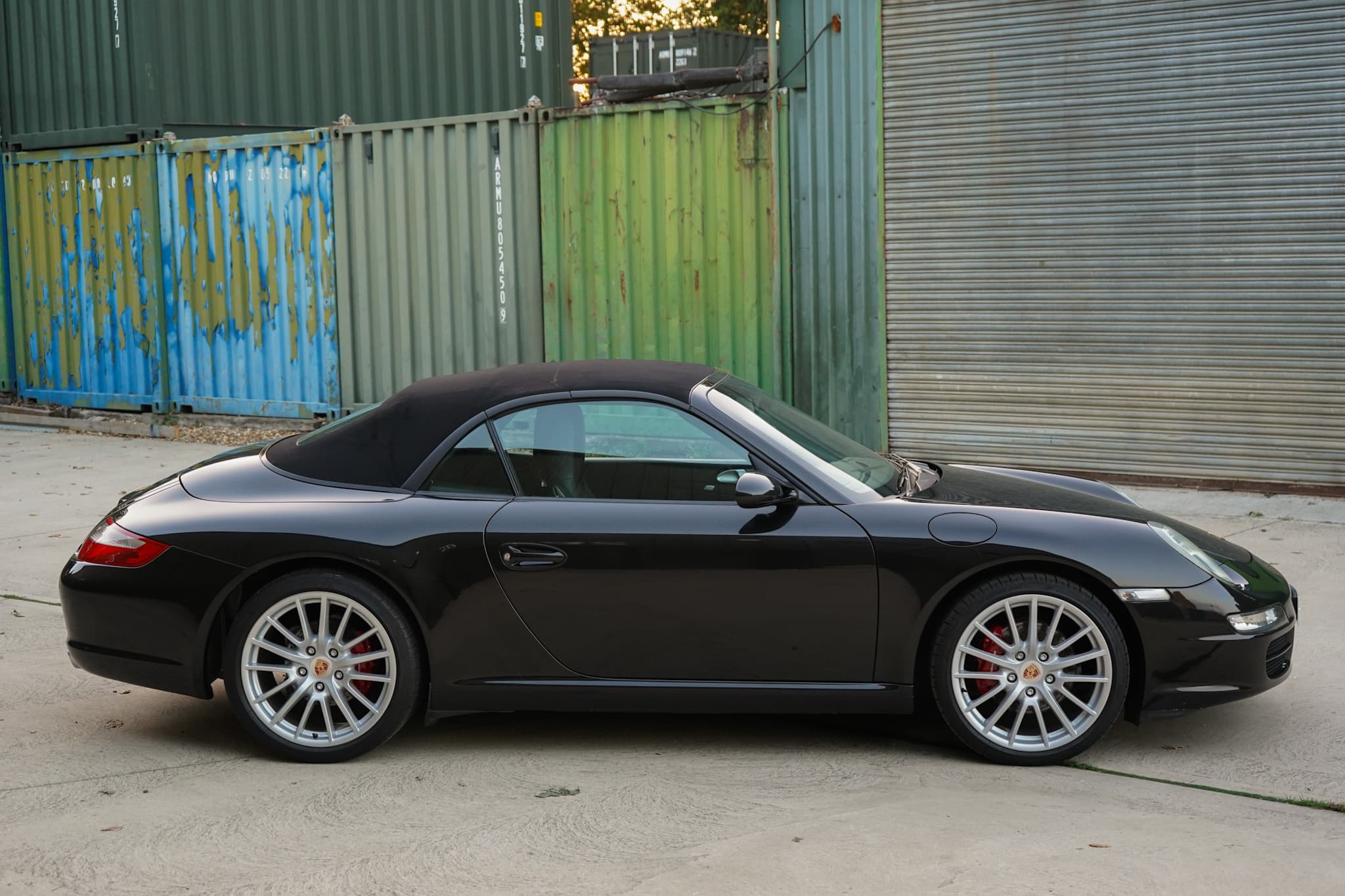
A surviving historical advert connected to The Matt Johnston Collection records LB06KXL as a 2006 right-hand-drive Carrera Convertible with 3,596 cc, six-speed manual transmission and 52,041 miles at the time of sale. The seller record says Porsche Centre Chiswick supplied the car in June 2006.
Its most useful detail is not the option list. The advert says a specialist carried out a full borescope inspection of all six cylinders, finding no scoring and visible cross-hatch at that point. It also records June 2025 work including the clutch and dual-mass flywheel, clutch release/slave components, water pump, drive belt, plugs, filters, fluids and routine service items.
That makes LB06KXL a good illustration of how to read a used 997 advert. A buyer can ask to see the borescope paper trail and the invoices behind the maintenance claims. Those documents say much more about the individual car than a sentence claiming that the 3.6 is inherently safe.
The same restraint works the other way: a clear borescope at one date does not prove that a cylinder can never develop wear later. It records condition at the time of inspection.
| Question | Why it matters |
|---|---|
| Is it Carrera, Carrera S, Carrera 4 or Carrera 4S? | Engine, driven wheels and equipment differ. |
| Is it early 997 or the direct-injection update? | Engine and gearbox technology changed materially. |
| What is the engine number, and is the engine original? | More useful than registration year for IMS applicability and replacement-engine history. |
| What does any “IMS done” invoice actually describe? | Later bearings are not the same service proposition as earlier retrofit-type bearings. |
| Is there a dated borescope report and what cylinders were inspected? | Turns a marketing phrase into inspectable evidence. |
| What are the oil-use and service records? | Helps a specialist assess engine condition in context. |
| Has the clutch/DMF or Tiptronic received documented work? | Transmission history is car-specific and can be costly. |
| Does the hood complete a full cycle without fault or water ingress? | Cabriolet condition is more than engine condition. |
| Is PASM actually fitted? | It was optional on the base early Carrera, not something to infer from another derivative. |
The Porsche 911 Type 997 guide covers the full generation, including the 997.1/997.2 transition, Carrera S, Targa, Turbo and GT derivatives. The Porsche 911 model guide places the 997 in the wider 911 lineage.
For the exact early base Cabriolet, the useful summary is simpler: 3.6-litre naturally aspirated flat-six, 325 PS, rear-wheel drive, Cabriolet body, with the individual gearbox, options, engine identity and condition verified from the car's own documentation.
Editorial information
Research and editorial from TMJC Garage.
Research and editorialTMJC Garage
Reviewed byMatt Johnston
Last reviewed13 September 2026
Published byThe Matt Johnston Collection
Model lineage
TMJC media
TMJC assistance
Continue to the main TMJC website and speak directly with the collection team.
Sell, consign or editorial
Continue with TMJC for a discreet conversation, professional presentation and collector-focused support.
Enquire now