TMJC assistance
Want TMJC to help with this vehicle?
Sourcing, consignment and valuationContinue to the main TMJC website and speak directly with the collection team.
Variant
The first 992-generation GT3 arrived in 2021 with a 4.0-litre naturally aspirated flat-six, manual or PDK, double-wishbone front suspension and 510 PS.
TMJC guide
The first 992-generation GT3 arrived in 2021 with a 4.0-litre naturally aspirated flat-six, manual or PDK, double-wishbone front suspension and 510 PS.
The first GT3 of the 992-generation Porsche 911 arrived in 2021. Porsche gave it a naturally aspirated 4.0-litre flat-six, 510 PS, a 9,000 rpm rev limit and a choice of six-speed GT manual or seven-speed PDK. It also marked a substantial chassis change: the road-going GT3 adopted a double-wishbone front axle derived from Porsche's competition work rather than the MacPherson-strut layout used by the regular 992 range.
The 992.1 GT3 shorthand refers here to that first 992 GT3 phase. Porsche itself launched the car simply as the new 911 GT3. Porsche presented a materially updated GT3 in October 2024 with revised aerodynamics, shorter gearing, new equipment choices and different torque output, so mixing those later figures into a 2021-2024-era car produces a specification that never existed.
| Specification | First 992 GT3 |
|---|---|
| Engine | 3,996 cc naturally aspirated flat-six boxer |
| Maximum power | 375 kW / 510 PS at 8,400 rpm |
| Maximum torque | 470 Nm at 6,100 rpm (Porsche AG engineering and EU technical data) |
| Rev limit | 9,000 rpm |
| Drive | Rear-wheel drive |
| Gearboxes | 6-speed GT manual or 7-speed PDK |
| Launch weight | 1,418 kg manual / 1,435 kg PDK |
| 0–100 km/h | 3.4 seconds (PDK launch figure) |
| Top speed | 320 km/h manual / 318 km/h PDK |
| Front suspension | Double wishbone |
| Rear suspension | Five-link |
| Standard brakes | 408 mm front / 380 mm rear iron-composite discs |
| Optional PCCB | 410 mm front / 390 mm rear ceramic-composite discs |
| Wheels | 20-inch front / 21-inch rear |
| Launch tyre sizes | 255/35 ZR20 front / 315/30 ZR21 rear |
The weight figures are transmission-specific. They are shown separately because averaging them would erase one of the real differences between the manual and PDK cars.
Porsche's launch material describes a four-litre six-cylinder boxer closely related to the engine used in the 911 GT3 R race car. In the road GT3 it produces 375 kW (510 PS) at 8,400 rpm and can run to 9,000 rpm.
The engineering detail is as important as the headline output. Porsche documents rigid rocker-arm valve actuation, VarioCam, plasma-coated cylinder liners and individual throttle valves, with dry-sump lubrication using a separate oil tank and seven suction stages. During development Porsche says the engine accumulated more than 22,000 hours on the test rig. The car also completed more than 5,000 km at a constant 300 km/h at Nardo, stopping only for fuel. Those are development-validation figures, not a promise about the service life of an individual used engine.
Porsche's own sources disagree on the peak-torque figure. Porsche Cars Australia's October 2021 product material lists 460 Nm at 6,100 rpm. Porsche AG's February 2021 technical-data sheet for the EU-model PDK GT3 gives 346 lb-ft at 6,100 rpm, while Porsche AG's dedicated April engine-development article says maximum torque was increased from 460 to 470 Nm. The two Porsche AG documents therefore support 6,100 rpm as the peak-torque speed and the 470 Nm headline, while the Australian page retains a 460 Nm regional/source inconsistency. That is why the specification table uses 470 Nm at 6,100 rpm but the disagreement is preserved here rather than erased.
Porsche offered the first 992 GT3 with a six-speed GT manual or a seven-speed PDK. The difference is not only the presence of a clutch pedal.
At launch Porsche quoted 1,418 kg for the manual and 1,435 kg for PDK, a 17 kg difference. Porsche's technical material also distinguishes the rear differential systems: the PDK car uses an electronically controlled rear differential lock, while the manual uses a mechanical limited-slip system.
For a buyer, that makes transmission choice a genuine part of the car's mechanical specification rather than a cosmetic preference.
The 992 GT3's double-wishbone front axle was a significant break from the regular 911's architecture. Porsche described the system as derived from the 911 RSR and the contemporary 911 GT3 Cup, with the rear remaining a five-link arrangement.
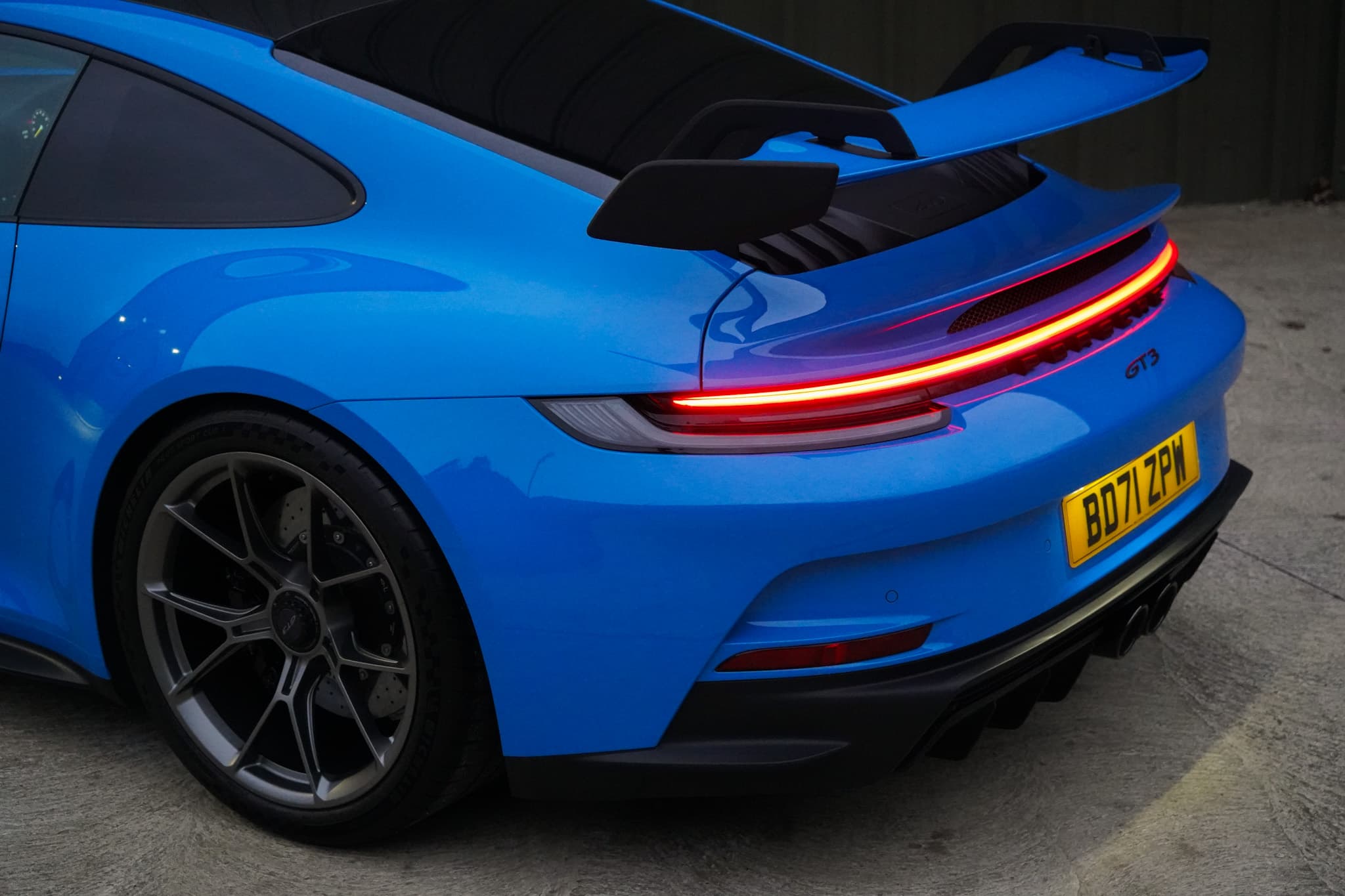
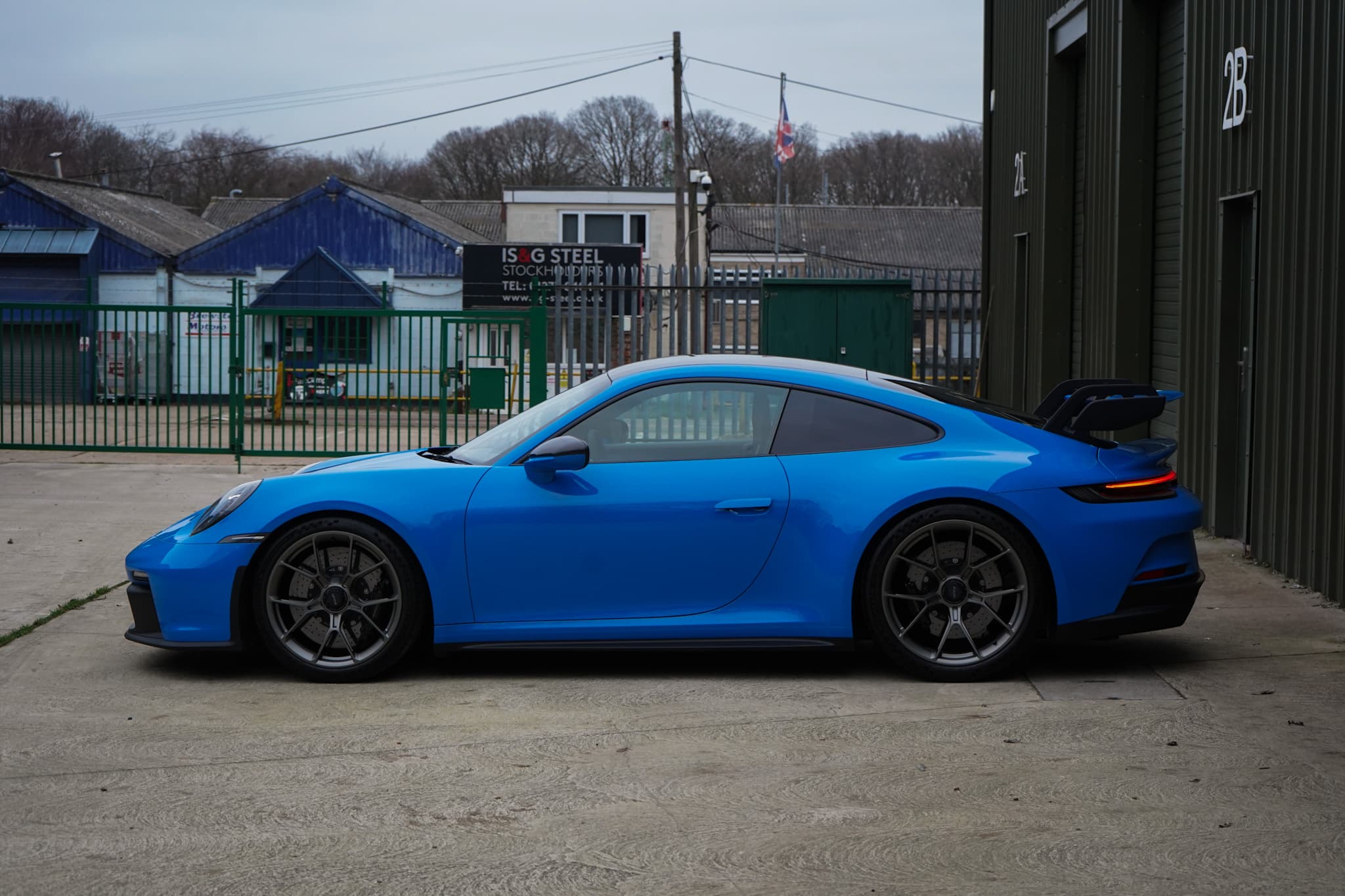
On the winged GT3, the rear wing uses the distinctive swan-neck mounting, keeping the aerodynamically sensitive underside of the wing clear of conventional supports. Porsche says the aero package went through roughly 700 simulations and more than 160 hours of wind-tunnel work.
The rear wing angle and front diffuser can each be manually set to four positions. Porsche quotes 50 per cent more downforce than the previous GT3 at 200 km/h in the factory setting and more than 150 per cent more in the maximum-downforce track setting. Those percentages are relative to the predecessor rather than a universal kilogram figure, and the maximum setting is specifically circuit-oriented.
The launch car's Nürburgring benchmark also needs its test context attached. Porsche recorded 6:59.927 around the full 20.8 km Nordschleife and 6:55.2 on the shorter 20.6 km configuration, using the optionally available Michelin Pilot Sport Cup 2 R tyres. The lap is therefore an engineering benchmark for that tyre and test context, not a claim that every road-tyred GT3 will reproduce it.
The first 992-generation GT3 was available in two visually distinct forms. Porsche opened ordering for the Touring package in June 2021, after the winged GT3 had been unveiled that February. Porsche described Touring as a no-cost equipment package for the GT3, not as a different engine or drivetrain derivative.
The obvious difference is at the rear. Touring deletes the fixed swan-neck wing and uses an automatically extending rear spoiler instead. Porsche also gave it a GT3 touring rear-grille treatment, different exterior trim and a more classically trimmed interior.
Mechanically, Porsche Cars North America states that the Touring package carries over the regular GT3's engine, transmission, suspension, wheels and tyres. Porsche's global release gives the six-speed GT manual as standard and says PDK could be chosen at no extra cost; the US release reverses that ordering, with PDK standard and the manual a no-cost alternative where permitted. Transmission and equipment status therefore need to stay attached to market, even when the underlying hardware choices are the same.
Porsche also says almost all of the regular GT3's optional equipment could be combined with Touring, including PCCB, front-axle lift, the GT3 seat choices and Chrono. For a used-car comparison, Touring is therefore not shorthand for a softer or lower-output 992.1 GT3. Confirm which configuration the car is, then verify its individual build specification rather than inferring the mechanical specification from the presence or absence of the fixed wing.
The standard GT3 braking system is already substantial: 408 mm front and 380 mm rear iron-composite discs with six-piston front and four-piston rear fixed calipers.
Porsche Ceramic Composite Brake, or PCCB, was a separate factory choice in the cited launch material. It increased disc diameter to 410 mm front and 390 mm rear and reduced rotating/unsprung mass. That does not make the standard brakes inadequate; it changes the hardware, inspection points and replacement economics.
The GT3 also moved to a staggered wheel diameter, with 20-inch front and 21-inch rear wheels. Porsche's launch technical data specifies 255/35 ZR20 front and 315/30 ZR21 rear tyres.
For a detailed explanation of PCCB, seats, front lift, carbon roof, Chrono and Clubsport, see the dedicated 992.1 GT3 options guide.
A recurring problem with 992 GT3 specification lists is that equipment treatment changed by market. The front-axle lift system shows why: Porsche Cars Australia listed it among Australian standard specifications, while other markets treated equipment differently.
The safe rule for a used UK car is therefore to verify the original build/order record rather than import a US, Australian or European option table wholesale.
Porsche presented an updated 911 GT3 and GT3 with Touring package in October 2024. It retained 375 kW / 510 PS, but Porsche documented changed aerodynamics, shorter final-drive gearing, new option/equipment choices including Weissach-package availability and 450 Nm of torque.
That later car is why the early and updated 992 GT3 specifications should be kept separate. If a used car is being described as a 992.1, its engine, gearing, seats, aero and options should be checked against the pre-update documentation rather than the later specification.
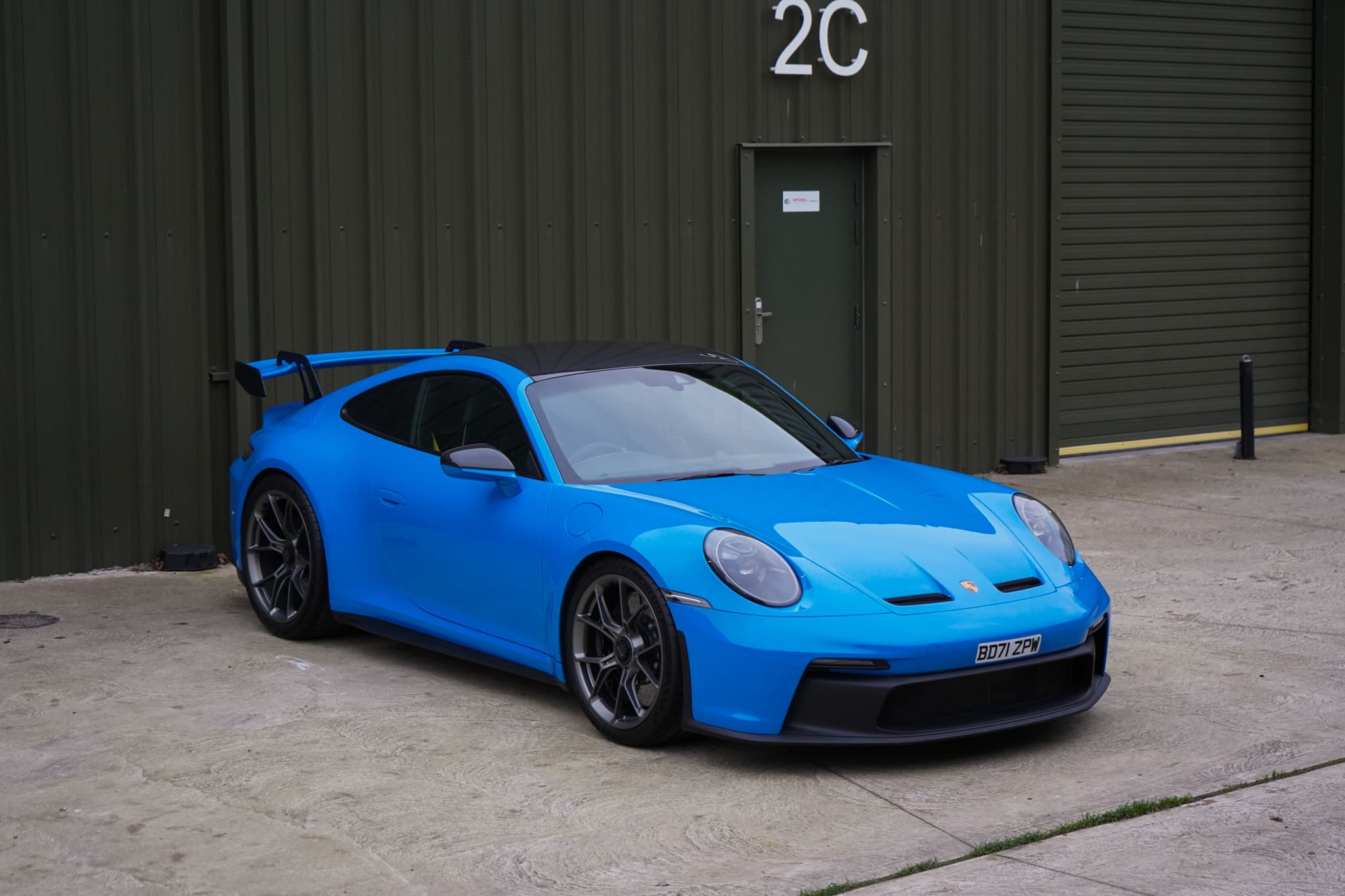
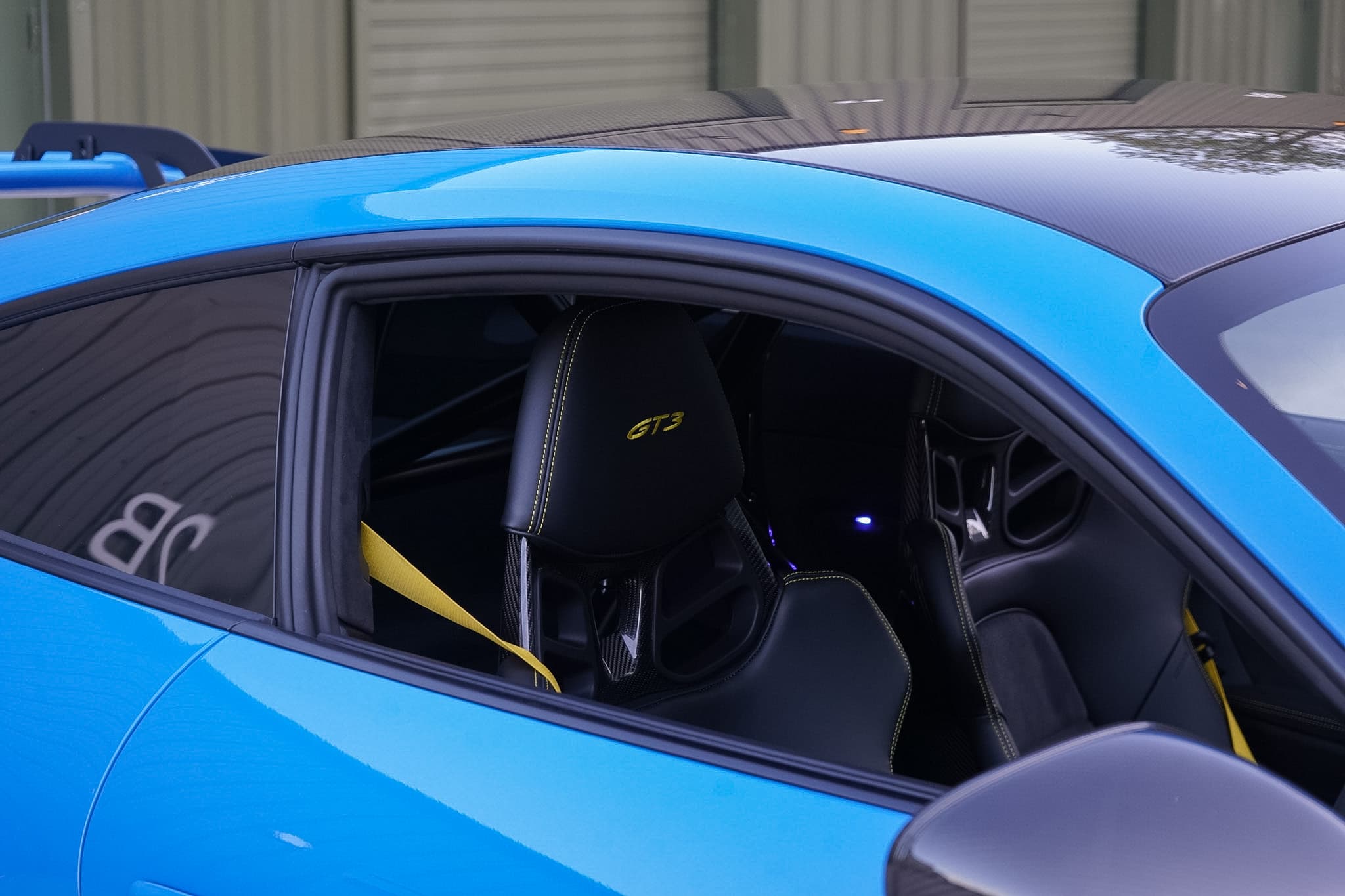
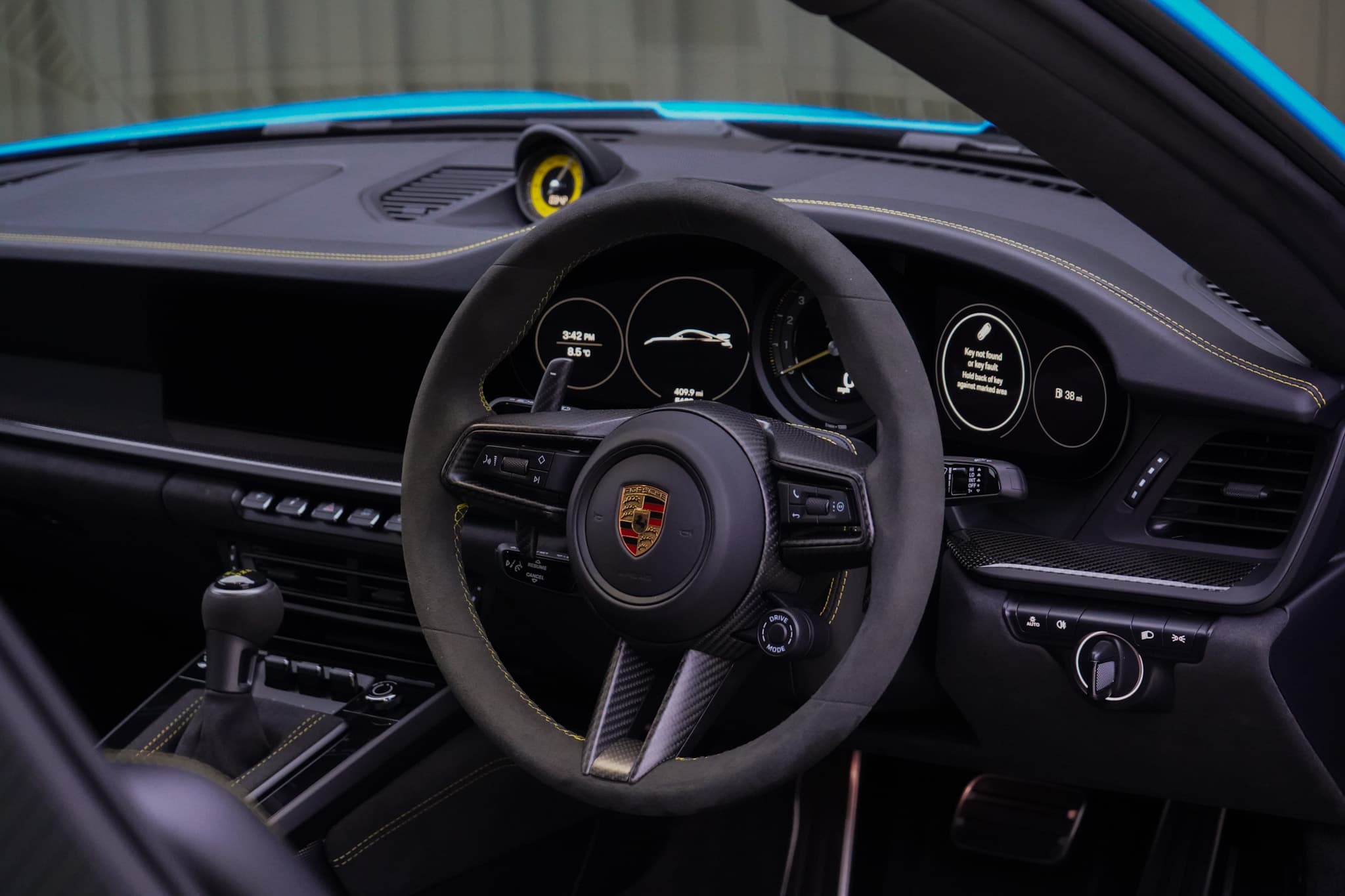
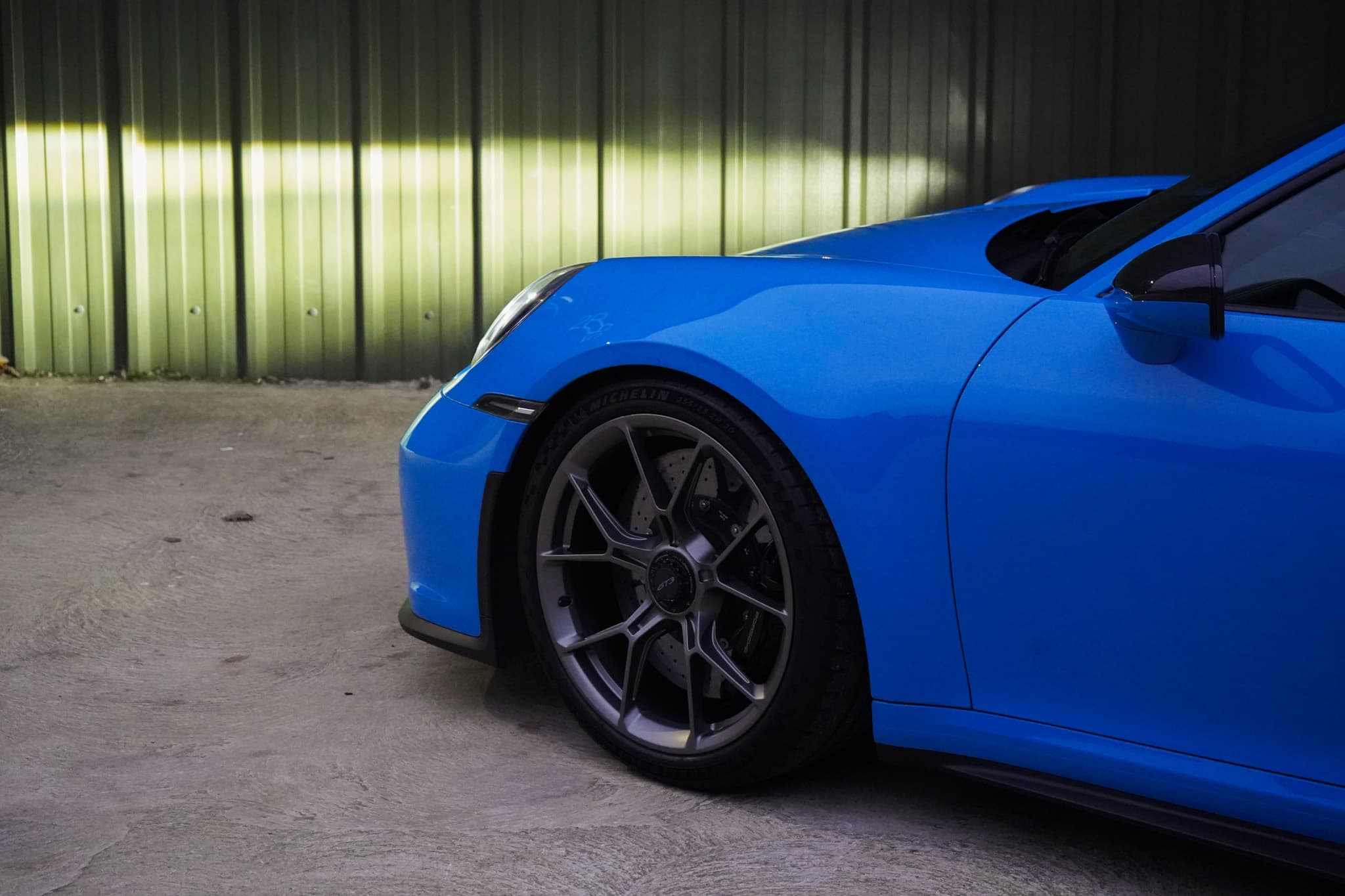
The Matt Johnston Collection has handled a 2022 Porsche 911 992 GT3 in Shark Blue. It is a right-hand-drive PDK car and TMJC records Full Bucket Seats, PCCB, Clubsport, front-axle lift, Chrono and a carbon roof among its individual specification.
It is a real-world example of a heavily optioned first-phase 992 GT3. It does not mean every correct GT3 should carry the same equipment. The car's colour, mileage, service history, warranty, PPF and individual option mix belong to that specific example.
For the wider model lineage, see the Porsche 911 reference.
The same documentary logic applies more broadly to collector cars; TMJC's classic-car provenance checklist explains how to weigh original records against later descriptions.
Editorial information
Research and editorial from TMJC Garage.
Research and editorialTMJC Garage
Reviewed byMatt Johnston
Last reviewed20 September 2026
Published byThe Matt Johnston Collection
Model lineage
TMJC photography
TMJC Guides
TMJC assistance
Continue to the main TMJC website and speak directly with the collection team.
Sell, consign or source
Continue with TMJC for a discreet conversation, professional presentation and collector-focused support.
Enquire now