Published guide
Porsche 992.1 GT3 options: buckets, PCCB and lift
Which 992.1 GT3 choices actually change the car: manual vs PDK, buckets, PCCB, lift, carbon roof, Chrono and Clubsport.
Overview
Which 992.1 GT3 choices actually change the car: manual vs PDK, buckets, PCCB, lift, carbon roof, Chrono and Clubsport.
This guide covers GT3 (992.1) and links directly to the relevant car record for further detail.
A used Porsche 992.1 GT3 is often reduced to a row of shorthand: buckets, PCCB, lift, carbon roof, Clubsport. Those options matter, but not for the same reasons — and their absence does not turn a GT3 into a lesser version of the car.
Porsche already gave the first 992 GT3 four-way Sports Seats Plus, substantial iron brakes, rear-axle steering, its GT-specific chassis and the naturally aspirated 4.0-litre flat-six as part of the basic car. The option list then let the first owner change weight, seating, clearance, track equipment, timing hardware, comfort and appearance.
The useful question when comparing used cars is therefore not simply "how many options does it have?" It is what does each option actually change, and does that change matter to the way you will use the car?
This guide covers the first-generation 992 GT3 — commonly called the 992.1 GT3 — rather than the later updated 992.2.
What was standard and what was optional?
The table below is deliberately limited to the items most often pulled into used-car adverts.
| Item | 992.1 GT3 status | What it changes |
|---|---|---|
| 7-speed PDK / 6-speed GT manual | Factory transmission choice | PDK prioritises rapid shifts; the manual is about 17 kg lighter and uses a different rear differential system |
| Four-way Sports Seats Plus | Standard | Supportive road/track seat with electric height/backrest adjustment |
| Full Bucket Seats | Optional | Fixed-shell-style seating, lower weight and stronger lateral support |
| 18-way Adaptive Sports Seats Plus | Optional | Much greater electric adjustment and comfort flexibility |
| 408/380 mm iron-composite brakes | Standard | The normal GT3 braking system; already six-piston front/four-piston rear |
| PCCB | Optional | 410/390 mm ceramic-composite discs; lower rotating/unsprung mass and different ownership economics |
| Front-axle lift / Smart Lift | Market-dependent | Raises the nose for ramps, speed humps and awkward entrances; standard-vs-option treatment varied by market |
| Lightweight exposed-carbon roof | Optional | Replaces the conventional roof with a factory lightweight carbon component |
| Chrono package | Optional | Adds timing/stopwatch functionality; not the source of the GT3's basic track display capability |
| Clubsport package | Factory option | Rear roll bar, driver's six-point harness, battery-disconnect preparation and fire extinguisher |
That distinction is worth making because a dealer headline can make a car without PCCB or buckets sound "missing" something fundamental. It is missing an option. It is not missing the GT3 chassis, engine or standard braking system.
PDK or manual: a bigger choice than many visual options
The transmission deserves a place in any used-spec comparison because it changes more than the way the driver shifts gears. Porsche offered the 992.1 GT3 with a seven-speed PDK or a six-speed GT manual.
Porsche's 2021 launch material gives the manual car at 1,418 kg and the PDK car at 1,435 kg — a 17 kg difference. The factory press kit also separates the differential hardware: the PDK version uses an electronically controlled rear differential lock, while the manual uses a mechanical limited-slip system.
That means a manual GT3 is not simply a PDK car with a clutch pedal, and a PDK car is not simply the manual with faster shifting. PDK prioritises rapid, uninterrupted gear changes and acceleration; the manual prioritises direct driver control and carries less transmission mass. Which is preferable is a use-case decision, not a quality ranking.
For UK used-car research, avoid assuming the original price treatment from another market. Factory material and order structures varied by market and between the winged GT3 and Touring package. The defensible check is the car's original build/order documentation and the transmission physically fitted.
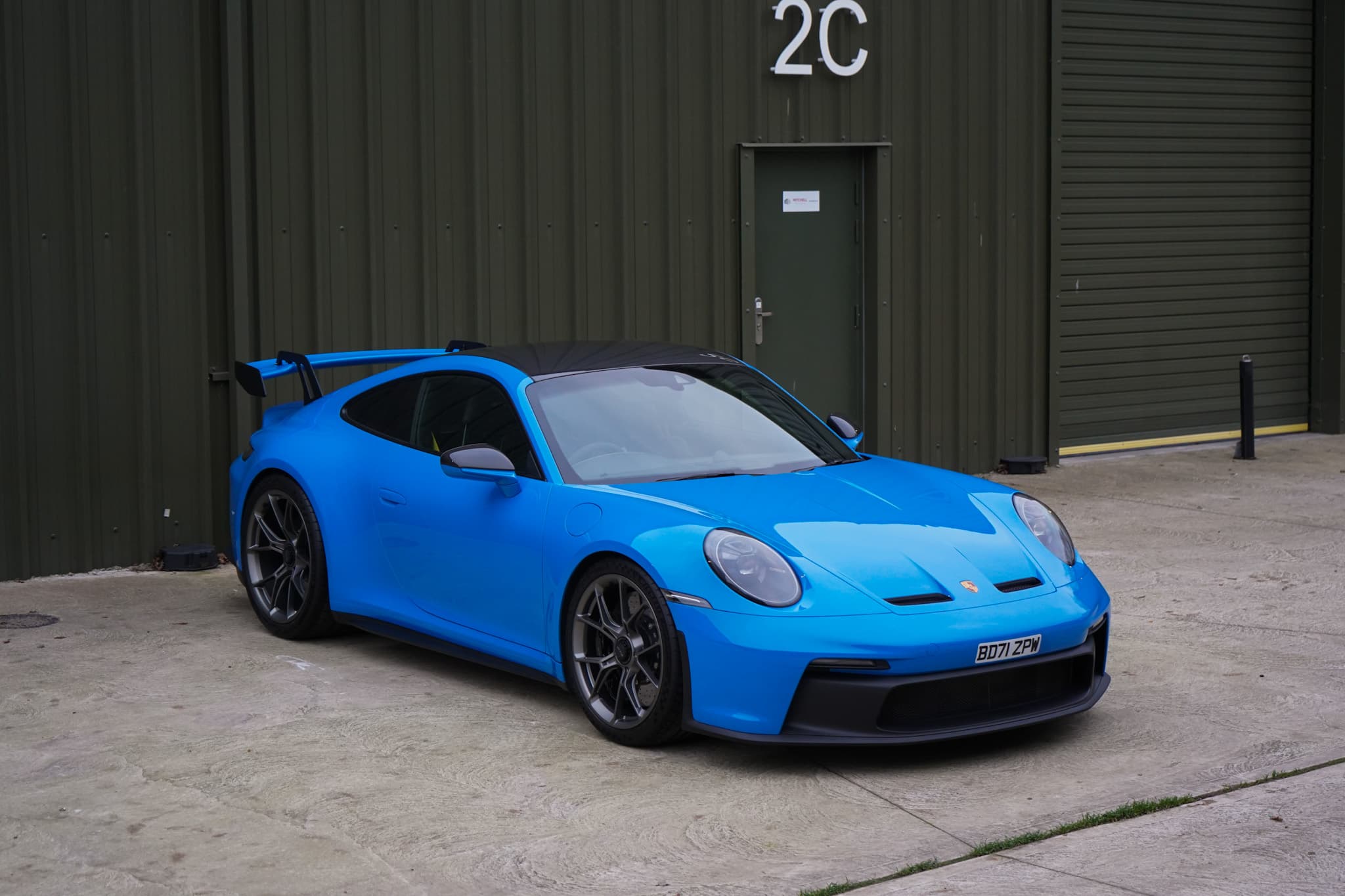
TMJC's 2022 Shark Blue example is a seven-speed PDK car. That is an individual configuration choice on this car, not evidence that PDK was the universally preferable 992.1 GT3 specification.
Full Bucket Seats: more than the seats everyone photographs
The Full Bucket Seats are probably the most visually obvious 992 GT3 option, but the useful difference is functional.
Porsche supplied four-way Sports Seats Plus as standard and also offered 18-way Adaptive Sports Seats Plus. The full buckets reduce weight and hold the occupant more rigidly during high lateral loads, but they also make entry, exit and seating position less adaptable. A driver who uses the car mainly on road may reasonably prefer the 18-way seat; a track-focused buyer may put much more value on the buckets.
Buckets and Clubsport often appear together in used-car specifications, but they are not synonyms. Porsche describes Clubsport as its own optional package, adding the rear roll bar, driver's six-point harness, battery-disconnect preparation and handheld fire extinguisher. Buckets alone therefore do not prove the car left the factory with the full Clubsport equipment. If that package matters, verify the build documentation and the actual roll-bar, harness and extinguisher installation.
PCCB versus the standard GT3 brakes
A standard 992.1 GT3 did not leave the factory with ordinary Carrera-sized brakes. Porsche specified 408 mm front and 380 mm rear iron-composite discs, clamped by six-piston front and four-piston rear fixed calipers.
PCCB — Porsche Ceramic Composite Brake — was optional. On the GT3 it increased disc diameter to 410 mm at the front and 390 mm at the rear and replaced the iron friction material with ceramic composite. Porsche's 2021 product material describes a weight-saving advantage of around 50 per cent for the ceramic discs, reducing rotating and unsprung mass.
That is a real engineering difference. It is not the same as saying PCCB is automatically the correct choice for every owner.
For a used buyer, PCCB also changes what should be inspected. Condition, damage and remaining service life matter because replacement economics are very different from conventional iron discs. Conversely, choosing the standard brakes does not mean choosing inadequate stopping hardware: the standard GT3 system was designed for this car and is substantial in its own right.
So the useful used-car question is not "does it have yellow calipers?" It is which brake system is fitted, what condition is it in, and does that system suit how you intend to use the car?
Front-axle lift: the least glamorous option may be the easiest to use
The GT3's nose is low enough that steep ramps, garage entrances and some speed humps can become part of route planning. The front-axle lift system exists for exactly that problem. Its original equipment status was market-dependent: Porsche Cars Australia listed it among Australian standard specifications, so a used UK car should be checked against its own build/order record rather than a generic international option list.
Porsche's contemporary material describes approximately 40 mm of extra front clearance and a GPS-based Smart Lift memory. Once a location is stored, the car can recognise it on a later journey and raise the nose again.
That makes lift different from most other headline options: it does not make the GT3 faster or more track-focused. It makes certain roads and entrances less awkward.
Its value is use-case dependent rather than universal. A buyer whose routes are flat may care less. A buyer with a steep home ramp may care more about lift than carbon trim, PCCB or stereo specification combined.
Carbon roof: genuine factory lightweight equipment, not proof of a "better" GT3
Porsche offered the 992.1 GT3 with a lightweight exposed-carbon-fibre roof through its GT3-specific personalisation programme. It is therefore a genuine factory weight-saving component, not merely a visual carbon option.
What the available primary material does not justify is inventing a precise roof-only kilogram saving from unrelated package figures. The sensible conclusion is narrower: the roof replaces a conventional component with a lighter carbon-fibre one and also gives the car a visibly different specification.
For a used buyer, originality matters more than internet folklore about the exact number of kilograms. If a car is advertised with a factory carbon roof, verify it through the original build specification or equivalent documentary evidence rather than assuming that any carbon-looking roof panel proves factory fitment.
Chrono package: useful, but do not confuse it with the GT3's basic track hardware
Chrono was optional on the 992.1 GT3. It added the familiar dashboard stopwatch and timing functions.
The important distinction is that the GT3 already had track-oriented instrumentation and Porsche Track Precision capability. A non-Chrono GT3 is therefore not a car stripped of its core track display environment.
This is another example of why an option decoder is more useful than a checkbox count. Chrono is desirable to some buyers and visually recognisable, but it does not create the GT3's chassis, engine, brakes or basic track focus.
Clubsport: optional did not mean standard
Clubsport is one of the easiest option descriptions to misunderstand because it is a factory package, not a separate GT3 model. Porsche's 2021 material describes it as optional. The package brought a bolted rear roll bar, driver's six-point harness, preparation for a battery disconnect switch and a handheld fire extinguisher.
That makes Clubsport a useful provenance check on a used car. If a seller describes a GT3 as Clubsport, the safest route is to verify the original specification rather than relying on the presence of one component. An aftermarket cage or roll bar can be fitted later; buckets can exist without Clubsport; the factory combination is a documented specification, not a nickname.
A real example: TMJC's 2022 Shark Blue GT3
The broader Porsche 911 guide covers the model family. TMJC's own 2022 992 GT3 is useful here for a different reason: it combines most of the options that buyers repeatedly debate.
The individual car is finished in Shark Blue and has a seven-speed PDK. TMJC lists Full Bucket Seats, PCCB, Clubsport, front-axle lift, Chrono and a carbon roof, alongside Matrix lighting, BOSE, carbon interior trim and other individual equipment.
That makes it a strong worked example of how a heavily optioned GT3 fits together. The buckets and Clubsport equipment are both present; PCCB changes the brake hardware; lift solves the clearance problem; the carbon roof reduces mass and changes appearance; Chrono adds its timing equipment.
It should not be read backwards into a rule that every good GT3 needs the same list. Porsche's standard car was already mechanically serious. The value of this example is that each option has a clear job.
How to verify a used 992.1 GT3 specification
Start with documentary evidence rather than the advert headline. The same logic used in our classic-car provenance guide applies to a modern GT car: separate what the seller says from what the factory record and physical car can prove.
For a 992.1 GT3, check:
- Original build specification or order documentation. This is the cleanest way to separate factory option from later modification.
- Physical equipment. Buckets, roll bar, PCCB discs/calipers, lift controls and carbon roof should agree with the documents.
- Package completeness. A claimed Clubsport car should make sense as a complete package, not merely have one later-added component.
- Condition before prestige. A desirable option in poor condition can be a bigger ownership issue than a simpler specification in excellent condition.
- Intended use. Lift may matter enormously to a road car. Buckets and Clubsport may matter more to someone who attends track days. Eighteen-way seats may make the car better for long trips.
Which options matter most?
There is no defensible universal ranking, because the options solve different problems.
| If your priority is... | Options worth examining closely |
|---|---|
| Road clearance and regular use | Front-axle lift, seat choice |
| Track-day preparation | Full buckets, Clubsport, brake condition/system |
| Lower mass / specification focus | Carbon roof, buckets, PCCB |
| Long-distance comfort | 18-way seats, audio/comfort specification |
| Factory originality | Build-sheet verification for all major options |
| Resale-minded shopping | Understand current buyer preference, but do not substitute forum consensus for condition and provenance |
The strongest used 992.1 GT3 is therefore not automatically the car with the longest advert headline. It is the car whose specification suits the buyer, whose options are correctly represented, and whose condition and documentary history support what is being sold.
Sources and further reading
Related car