Published guide
Porsche 992 GT3 four-year service: what is actually due?
What a 992.1 GT3 four-year service really proves, why low mileage still matters, and how to verify plugs, fluids, filters and service history.
Overview
What a 992.1 GT3 four-year service really proves, why low mileage still matters, and how to verify plugs, fluids, filters and service history.
This guide covers GT3 (992.1) and links directly to the relevant car record for further detail.
“Major four-year service completed” sounds like a simple line in a Porsche 992 GT3 advert. It is not a complete maintenance record.
For a used 992.1 GT3, the useful question is not whether the seller can say “four-year service”. It is what work was actually done, when it was done, at what mileage, and against which market-specific service schedule.
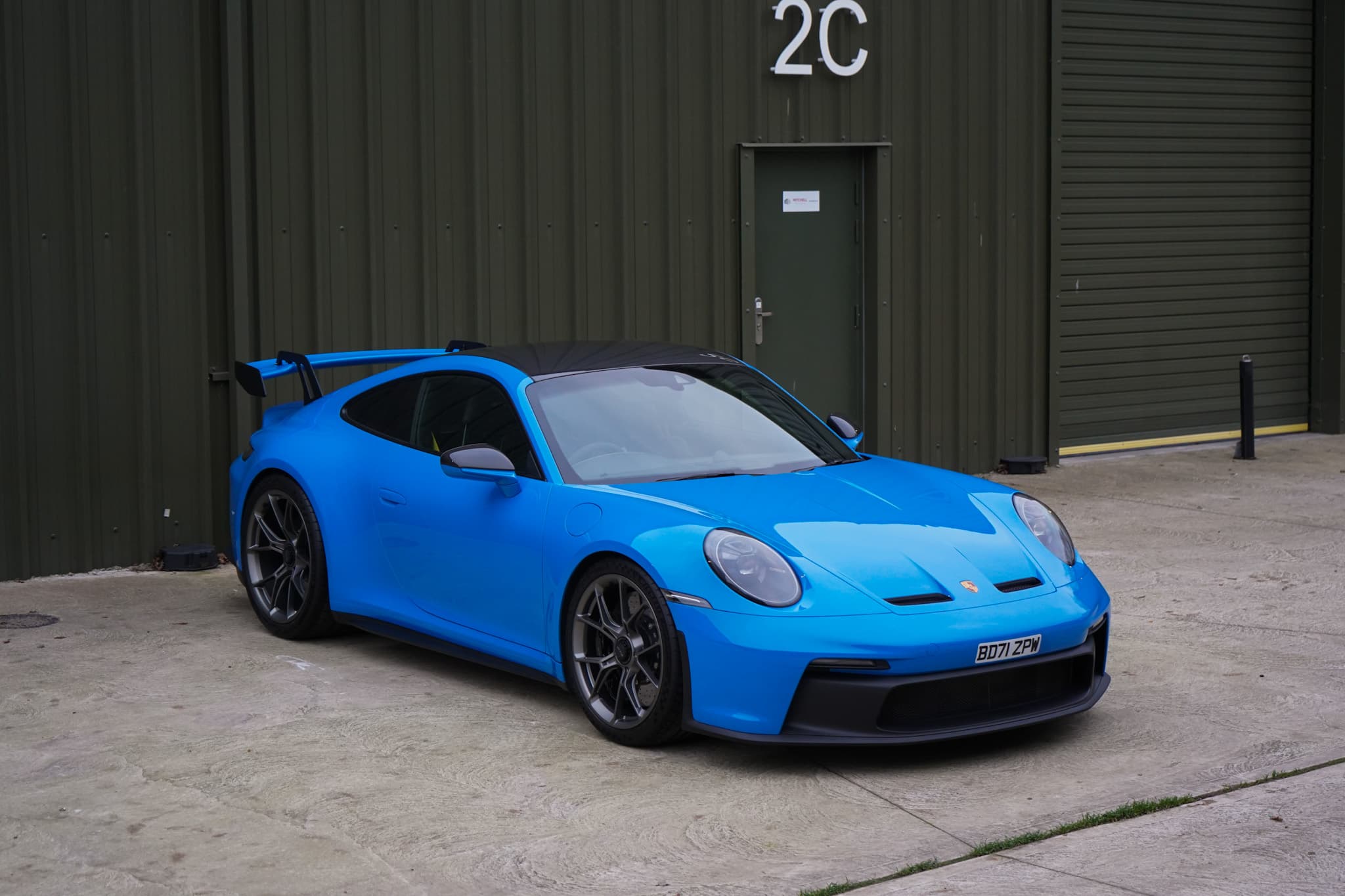
That distinction matters because these cars are now reaching exactly the age where time-based maintenance starts to separate otherwise similar low-mileage examples. TMJC's own 2022 Shark Blue GT3 has covered only 5,642 miles, yet its listing specifically highlights that the major four-year service has already been completed. Low mileage does not stop the calendar.
What does “four-year service” mean on a 992 GT3?
In UK Porsche-specialist servicing, the first-phase 992 GT3 is commonly described as alternating between a two-year minor service and a four-year major service. Precision Porsche, for example, currently lists 20,000 miles/two years for its minor and 40,000 miles/four years for its major 992 GT3/GT3 RS service, with brake fluid every two years and spark plugs at 40,000 miles/four years.
RPM Technik uses the same broad minor/major language and says the major service includes spark plugs.
That is a useful UK ownership framework. It is not a licence to turn “four-year service” into one global Porsche parts list. Porsche Centre schedules published for the same Type 992 GT3 in Australia use different intervals for several GT3-specific items.
The correct conclusion is therefore:
four years is a service milestone, but the exact work due belongs to the individual car's market, model year, transmission and maintenance history.
Why 5,000 miles does not make a four-year service irrelevant
Many GT3s cover little annual mileage. Service schedules still contain age limits because not every maintenance item is governed only by distance.
Across the material checked for this guide, brake fluid is time-based, and plugs, filters, belts and transmission fluids are described using time-or-distance intervals. That means a garage-kept car can reach a service requirement long before it reaches the mileage figure printed beside it.
This is why two 2022 GT3s showing similar mileage can present different ownership positions. One may have documentary evidence for the relevant age-based work; another may simply be approaching it.
Mileage still matters. Age still matters. The service record needs both.
The UK four-year picture
Two current UK specialist schedules give a useful picture of the language a British buyer is likely to encounter:
| Item | UK specialist treatment found in this research |
|---|---|
| Minor service | 20,000 miles / 2 years in the Precision Porsche schedule |
| Major service | 40,000 miles / 4 years in the Precision Porsche schedule |
| Brake fluid | Every 2 years |
| Spark plugs | 40,000 miles / 4 years |
| Engine air filter | 60,000 miles / 6 years in the Precision schedule |
| Auxiliary belt | 60,000 miles / 6 years in the Precision schedule |
| PDK oil / transmission work | Later interval; verify the exact applicable schedule |
| Manual gearbox oil | Later interval; verify the exact applicable schedule |
RPM Technik separately describes the 992 GT3 as needing service at least every two years or 12,000 miles in its programme and says the major service includes spark plugs.
These are UK specialist schedules, not a substitute for Porsche Cars Great Britain's vehicle-specific maintenance information. Their value here is that they explain why a British advert may legitimately emphasise the car's four-year major service.
Why you should not copy a foreign 992 GT3 interval table
Porsche's own dealer network demonstrates the market-scope problem.
Current Porsche Centre Sydney South and Porsche Centre Willoughby Type 992 schedules list the GT3/GT3 RS with:
- brake fluid every two years;
- spark plugs every 20,000 km or two years;
- engine air filter every 40,000 km or four years;
- drive belt every 40,000 km or four years;
- PDK clutch fluid every 80,000 km or six years;
- GT3 PDK transmission oil at 160,000 km or 12 years;
- GT3 manual transmission oil at 160,000 km or 12 years.
Those Porsche Centre pages are stronger evidence for an Australian car than a UK independent workshop table. They are also the reason not to paste the numbers straight onto a UK GT3: they materially disagree with the UK specialist schedules on plugs, air filters and belt timing.
The disagreement is useful. It shows that “Porsche 992 GT3 service interval” needs a market attached to it.
For a UK car, use the VIN/model year and the car's own Porsche service information. Do not assume that a US forum screenshot, Australian Porsche Centre table or generic 992 Carrera schedule settles what is due.
What should a four-year-service invoice actually prove?
If a seller says the major service has been done, ask to see the invoice or Porsche Centre work record. The useful evidence is the line-by-line work, not the adjective “major”.
Check for:
- Date and mileage. Does the service sit where the car's chronology says it should?
- Engine oil and filter. Was the normal service work completed at the same visit or separately?
- Inspection. Is there evidence of the scheduled inspection rather than only a quick oil change?
- Spark plugs. Were they actually replaced, and was that required at this visit for this market/car?
- Brake fluid. When was the last change? A prior two-year visit may already account for it.
- Filters and belt. Do not assume they are four-year items everywhere; check the applicable schedule.
- Transmission-specific work. PDK and manual cars have different later maintenance operations. Do not copy one onto the other.
- Additional work. Tyres, alignment, brakes, warranty repairs or other condition-based jobs can materially change the invoice total without being part of the core scheduled service.
That final point is important when comparing costs. Two invoices both called “four-year service” can cover very different amounts of work.
Is the four-year service the first service?
No.
The UK specialist schedules reviewed here put a two-year service before the four-year major event. Brake fluid is also listed on a two-year interval. In other markets, Porsche Centre schedules can place other GT3-specific operations earlier too.
A four-year-old car with no evidence before its four-year invoice therefore does not become a complete-history car simply because a large service has just been done. Read the whole chronology.
PDK versus manual: why the gearbox still matters to the maintenance record
The 992.1 GT3 was available with six-speed manual or seven-speed PDK, and the service record should match the transmission fitted.
Current Porsche Centre regional schedules separate PDK clutch fluid / transmission oil from manual transmission oil and put them on later time/distance intervals than the early service milestones. The exact UK requirement should be confirmed for the individual car rather than lifted from those foreign figures.
For a buyer, the point is simple: when somebody presents a stack of service invoices, check that the maintenance story makes mechanical sense for that actual GT3. A PDK service line belongs to a PDK car; a manual gearbox service line belongs to a manual car.
For the broader mechanical differences between the two transmissions, see the 992.1 GT3 options guide.
TMJC's 2022 GT3: a useful low-mileage example
The Matt Johnston Collection's 2022 Shark Blue GT3 is a useful example because it makes the age-versus-mileage issue obvious. TMJC records the car at 5,642 miles and says its major four-year service has been completed.
The listing also quotes £4.6k when discussing the four-year service looming on comparable cars. Treat that figure as context for this individual sales proposition, not as a fixed Porsche tariff.
Why? Because “service cost” can include different scheduled items, centre labour rates, condition-based work and work already completed at an earlier visit. Current UK independent specialist prices for a basic major service are not the same as that figure, while Porsche Centre prices vary by location and scope.
The better buying question is not “is £4.6k the correct number?” It is:
what did this particular car have done, by whom, and what work will the next owner actually face?
Can My Porsche prove the full service history?
Not necessarily on an early 992 GT3.
Porsche Cars Great Britain says its digital maintenance history in the My Porsche app applies to 911s from model year 2022, but the current history only includes qualifying work performed at authorised Porsche service centres from April 2025 onward. Earlier services are not retrospectively added to that digital history.
That creates an important provenance point for a 2022 car. A sparse digital history may simply reflect the system's start date rather than missing maintenance. Porsche says older records can be requested through a Porsche Centre, and paper/PDF invoices remain valuable evidence.
Porsche UK's Smart Service also applies to the 911 from model year 2022 and can show upcoming maintenance needs in PCM and My Porsche. It is useful vehicle-specific information, but it should sit alongside the car's documentary history rather than replacing it.
For a broader method of checking records, invoices and claims against the physical car, see TMJC's collector-car provenance checklist.
Track use changes the questions, not the factory history
A GT3 may have spent its life on road, on occasional track days or in regular circuit use. UK specialists often recommend more frequent oil changes and inspections for cars used hard on track.
That is sensible ownership context, but it should be described correctly: a specialist recommendation for hard use is not the same thing as the universal scheduled interval.
Ask how the car was used, then look for evidence that the maintenance frequency made sense for that use. A car with track history is not automatically badly maintained; equally, a low odometer reading does not prove easy mechanical life.
Used 992.1 GT3 service-history checklist
Before treating “major service done” as a value point, verify:
- the car's exact model year, market and transmission;
- the date and mileage of each service, not only the latest one;
- invoices for the two-year and four-year milestones;
- whether brake fluid and spark plugs were completed when applicable;
- whether filters/belt are due now or later under the car's actual schedule;
- PDK or manual transmission maintenance appropriate to the fitted gearbox;
- Porsche Centre campaign/warranty work separately from scheduled maintenance;
- any additional maintenance linked to track use;
- older invoices that pre-date My Porsche's April 2025 digital-history window.
A four-year service can remove a meaningful near-term ownership job. Its value is strongest when the paperwork makes clear exactly what was done.
For the wider 911 lineage, see the Porsche 911 reference.
Sources and further reading
- The Matt Johnston Collection — 2022 Porsche 911 '992' GT3
- Porsche Cars Great Britain — Smart Service
- Porsche Cars Great Britain — digital maintenance history
- Porsche Centre Sydney South — 911 Type 992 service
- Porsche Centre Willoughby — 911 Type 992 service
- Precision Porsche — Type 992 service schedule
- RPM Technik — Porsche 992 GT3 servicing
- Porsche Newsroom — 2021 Porsche 911 GT3 product highlights
Related car