TMJC assistance
Want TMJC to help with this vehicle?
Sourcing, consignment and valuationContinue to the main TMJC website and speak directly with the collection team.
Variant
Mazda’s R-Limited paired 130 PS with shorter 4.300 gearing, a light flywheel, torque-sensing LSD, Bilstein-developed damping and BBS wheels.
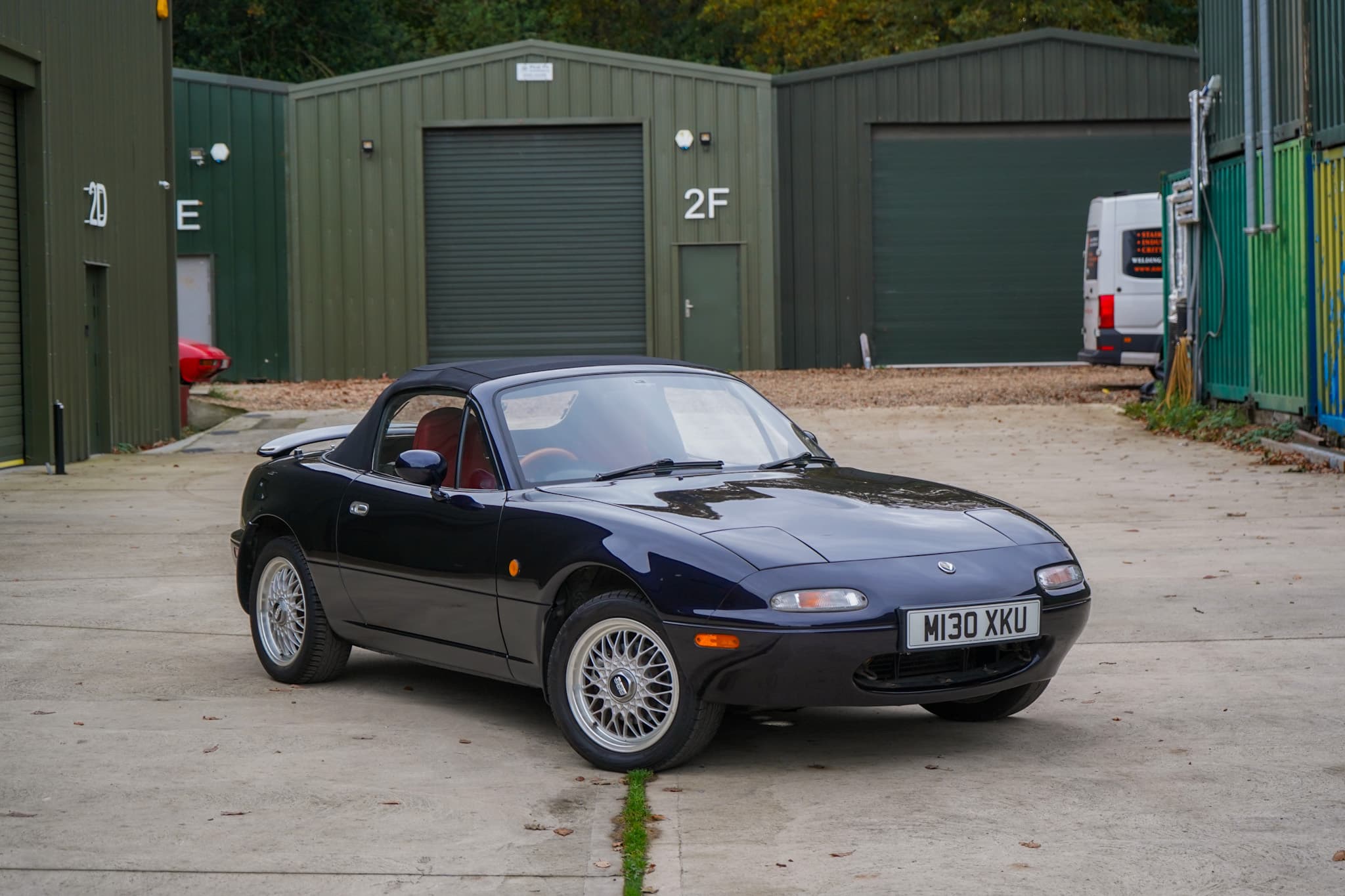
TMJC guide
Mazda’s R-Limited paired 130 PS with shorter 4.300 gearing, a light flywheel, torque-sensing LSD, Bilstein-developed damping and BBS wheels.
The 1995 Eunos Roadster R-Limited was a Japanese-market factory special built around response, gearing and chassis tuning rather than a higher peak-power engine.
Mazda advertised a 1,000-car limited run. Its period brochure gives a 1,839 cc DOHC 16-valve engine producing 130 PS at 6,500 rpm, but the parts that make the R-Limited distinctive sit around that engine: a 4.300 final drive, lightweight flywheel, torque-sensing limited-slip differential, hard-tuned double-wishbone suspension with Bilstein-developed dampers, 15-inch BBS wheels and Bridgestone Potenza RE010 tyres.
That distinction is worth making because Eunos Roadster, R-Limited and MX-5 are often collapsed into one idea in British adverts. Mazda's own history says the first-generation MX-5 was known in Japan as the Eunos Roadster. R-Limited identifies one specific 1995 grade within that Japanese range.
The factory brochure is unusually detailed for a 1990s special edition.
| Item | Factory R-Limited specification |
|---|---|
| Japanese type designation | E-NA8C |
| Body | 2-door open, 2 seats |
| Engine | 1,839 cc DOHC 16-valve |
| Compression ratio | 9.0:1 |
| Maximum power | 130 PS at 6,500 rpm |
| Maximum torque | 16.0 kg-m at 4,500 rpm |
| Transmission | 5-speed manual only |
| Final drive | 4.300 |
| Differential | Torque-sensing limited-slip differential |
| Suspension | Four-wheel double wishbone, hard tune, performance rods |
| Dampers | Developed with Bilstein |
| Steering | Rack and pinion |
| Front brakes | Ventilated discs |
| Rear brakes | Solid discs |
| Wheels | BBS 15 x 6-JJ aluminium |
| Tyres | Bridgestone Potenza RE010, 195/50R15 82V |
| Kerb weight | 990 kg |
| Length | 3,955 mm |
| Width | 1,675 mm |
| Height | 1,235 mm |
| Wheelbase | 2,265 mm |
| Front / rear track | 1,405 / 1,420 mm |
The brochure also specifies a dry single-plate diaphragm clutch, power steering and power windows. Its featured exterior combination is Satellite Blue Mica with a dark-blue hood, contrasted by a red cabin.
A specification table can make the R-Limited look less different than it really is. The engine still carries the familiar 130 PS headline, so the meaningful factory changes are easy to miss if the comparison stops at horsepower.
Mazda's own brochure makes the intention much clearer. The R-Limited uses a 4.300 final-drive ratio specifically to make the car respond more quickly to the driver's right foot. Mazda claimed the shorter gearing improved 40–60 km/h and 60–80 km/h third-gear overtaking performance by roughly 4–5 per cent against its comparison baseline.
That is a period manufacturer claim rather than an independent road test, but it explains the engineering logic. A shorter final drive multiplies torque more strongly at the wheels in a given gear. It does not create extra peak engine power; it changes how the available power is delivered to the road.
The lightweight flywheel attacks response from another direction. Reducing rotational inertia lets engine speed change more readily when the throttle is opened or closed. Mazda explicitly linked the lighter flywheel to sharper accelerator response.
Put together, those two changes explain why 130 PS is an incomplete description of the R-Limited.
The same period material gives a useful comparison with the contemporary G-Limited. Both are shown with the same 1,839 cc displacement, 9.0 compression ratio, 130 PS at 6,500 rpm and 16.0 kg-m at 4,500 rpm.
The R-Limited summary then calls out the light flywheel and 4.300 final drive and is five-speed manual only. The G-Limited summary lists manual and automatic transmissions without those R-Limited powertrain call-outs.
That is a much better way to understand the edition than saying it was a more powerful Eunos. The factory was changing immediacy and response around the engine, not advertising a higher peak-output number.
There is also an important timeline point. The R-Limited did not introduce the 4.300 final-drive and lightweight-flywheel combination. Mazda's July 1994 RS Limited brochure already lists both as limited-edition items. The R-Limited carried that response-focused formula into its February 1995 package, and Japanese catalogue data records the wider domestic manual range adopting lighter-flywheel and 4.300-final-drive changes in the August 1995 update. The sequence therefore runs from the RS Limited, through the R-Limited, into the broader domestic manual update rather than beginning with the R-Limited.
The names are easy to confuse, but R-Limited is not a shortened way of writing RS Limited.
Mazda's July 1994 RS Limited brochure describes a 500-car handling-focused edition and specifically lists co-developed Recaro full-bucket seats, 195/50R15 Potenza RE010 tyres, 15-inch BBS wheels, a 4.300 final drive, lightweight flywheel and Montego Blue Mica.
The February 1995 R-Limited keeps much of that response-led mechanical recipe — the 4.300 final drive, lightweight flywheel, 15-inch BBS/RE010 package and a hard-tuned, Bilstein-developed chassis — but gives it a different identity. Its own brochure specifies red leather, Nardi wood controls and the Satellite Blue Mica/dark-blue hood presentation. The later evidence for genuine Chaste White cars is a separate wrinkle covered below.
That makes the two editions related, not interchangeable. The RS Limited leans harder on its Recaro-seat/Montego Blue handling identity; the R-Limited combines similar response-focused mechanical thinking with the red-leather-and-wood presentation that makes it immediately recognisable today.
For a buyer, this is more than trivia. An R-Limited fitted with desirable RS-style Recaros has not become a more correct R-Limited, and an RS Limited wearing red leather and wood trim would need an explanation. Seats, wheels, steering wheels, dampers, differentials and flywheels can all move between cars, so establish the Japanese grade/build evidence first and use surviving hardware to corroborate it.
The driveline changes were matched by a chassis package rather than left to work alone.
Mazda specifies a torque-sensing limited-slip differential. That wording matters. It is stronger evidence than simply copying the word Torsen from a modern advert, and it also prevents the R-Limited's differential from being generalised to every Japanese Eunos Roadster.
The four-wheel double-wishbone suspension is described as a hard-tuned setup. The brochure specifically discusses dampers developed with Bilstein, along with performance rods. The tyre and wheel package moves to 195/50R15 Potenza RE010s on 15 x 6-JJ BBS wheels.
None of those parts should be read in isolation. Shorter gearing can make the car feel more eager; a lighter flywheel changes engine response; the LSD manages torque across the rear axle; the damper/suspension tune changes body control; the wheel and tyre package changes the contact patch and transient response. The R-Limited is interesting because Mazda assembled those changes into one coherent factory grade.
The visual specification is much easier to imitate today than the original paperwork, but it is still distinctive.
Mazda's brochure lists:
That combination gives the R-Limited much of its identity, but it should be treated as corroborating evidence rather than a VIN plate. BBS wheels, Nardi controls and red trim have been desirable parts for three decades and can be transferred to another Roadster.
Start with evidence that is difficult to recreate accidentally, then work towards the visible trim.
The deeper Eunos Roadster R-Limited vs UK MX-5 guide covers the import-specific paperwork, odometer and market-identification questions in more detail.
Yes — but a white car needs more evidence, not less.
There is an important wrinkle in the R-Limited story. Mazda's period brochure presents Satellite Blue Mica with the dark-blue hood, and the February 1995 Japanese catalogue record describes the same blue/red combination. Roadster BROS. also treats Satellite Blue Mica as the advertised R-Limited colour. If those were the only records available, a white car would look suspicious.
Japanese specialist evidence shows why that conclusion is too simple. Best Car documents Chaste White R-Limiteds that were not listed in the catalogue and reports 106 as the commonly accepted size of that white batch. Other enthusiast production research also arrives at 106 white cars, although it disagrees on the number of blue cars and the final total.
That leaves two different levels of evidence. The blue specification is documented by the period Mazda sales material. The existence of genuine Chaste White cars is well supported by later Japanese specialist research, but the exact 106 figure and the claim that they were the final cars have not been tied here to a Mazda factory build ledger.
For a buyer, the useful lesson is not to use paint colour as a shortcut. A Chaste White car should be checked against its Japanese identity/build paperwork where available, chassis/type details, original colour-code evidence and the R-Limited mechanical and cabin package. Equally, a Satellite Blue repaint with red trim and BBS wheels is not authenticated merely by looking right.
The careful answer is: Mazda advertised the R-Limited as a 1,000-car limited run.
That is not quite the same claim as proving that exactly 1,000 finished cars left the factory.
Later enthusiast production research has published a figure of 997 actual cars, including 891 Satellite Blue and 106 Chaste White examples. Other enthusiast and market sources instead repeat 894 blue plus 106 white, which neatly totals the advertised 1,000. Those two accounts cannot both describe the same final-build ledger.
Mazda's brochure supports the 1,000-car announced limit, but later sources disagree on the final-build and colour breakdown. The exact actual-build and colour split therefore remain unresolved.
That distinction matters because precise rarity figures are often repeated in classifieds without identifying their source.
The Matt Johnston Collection has handled a 1995 Japanese-market R-Limited imported into the UK in 2010. The car is presented in Satellite Blue Mica with a red leather interior and retains the key R-Limited-style mechanical and trim package alongside Japanese history and import/export paperwork.
Its provenance is particularly useful for this model. An imported special edition has two separate questions to answer: what did Mazda build? and what happened to this particular car afterwards? The factory brochure answers the first. Japanese/import records, later UK history and physical inspection answer the second.
TMJC's listing records same-family ownership after UK import and a substantial surviving history. Those details belong to that individual car; they are not turned into R-Limited-wide claims here.
For a collector or enthusiast, the expensive mistakes tend to come from assuming attractive parts prove the identity.
The result should be a coherent story across paperwork, mechanical specification and physical details. One badge or one desirable component is not enough.
Editorial information
Research and editorial from TMJC Garage.
Research and editorialTMJC Garage
Reviewed byMatt Johnston
Last reviewed12 September 2026
Published byThe Matt Johnston Collection
Model lineage
TMJC Guides
TMJC assistance
Continue to the main TMJC website and speak directly with the collection team.
Sell, consign or source
Continue with TMJC for a discreet conversation, professional presentation and collector-focused support.
Enquire now