Model
MX-5
From NA to ND, the Mazda MX-5 has kept the same lightweight rear-drive idea while engines, roofs, structure and technology evolved across four generations.
Generation directory
MX-5 generations
Choose a MX-5 generation to see its production years, body styles, engines, chassis changes and variants.
TMJC Catalog guide
Mazda MX-5: generations, history and what changed
From NA to ND, the Mazda MX-5 has kept the same lightweight rear-drive idea while engines, roofs, structure and technology evolved across four generations.
- Page
- Model overview
- Reviewed
- 9 Sept 2026
- Specifications
- 0 verified
The Mazda MX-5 has been in production since 1989 and, despite four generations of development, its basic idea has changed remarkably little: a compact two-seat sports car, engine in the front, drive to the rear wheels and enough restraint in weight and complexity to make ordinary speeds enjoyable.
That continuity is the reason an early pop-up-headlamp Mk1 and a current RF still feel related. It is also why the name can be misleading in classifieds: an MX-5, a North American Miata and a Japanese Roadster or Eunos Roadster may belong to the same broad family, while their exact engines, trim and factory equipment can differ substantially by market and generation.
Mazda MX-5 generations at a glance
| Generation | Approximate era | What changed most |
|---|---|---|
| NA / Mk1 | 1989–1997/98 | Original lightweight roadster; pop-up headlamps; 1.6 then 1.8-litre development; soft top |
| NB / Mk2 | 1998–2005 | Full redesign; fixed headlamps; developed chassis and equipment while retaining the compact roadster layout |
| NC / Mk3 | 2005–2015 | Larger third-generation platform; later offered a power-retractable hardtop as well as the fabric roof |
| ND / Mk4 | 2015–present | Major weight reduction, SKYACTIV engineering and KODO styling; soft-top Roadster plus RF retractable-fastback body |
The dates above describe the broad generation changes, not every market's registration cut-off. Cars can be built in one calendar year and registered in another, and special editions often overlap a changeover.
Why Mazda created the MX-5
Mazda's own history starts the project with a problem rather than a specification sheet. By the early 1980s, the small, affordable open sports cars that had been popular in the 1960s had largely disappeared as safety, emissions and weight increased.
Mazda considered front-wheel drive, rear-wheel drive and a mid-engined layout. It chose front engine and rear-wheel drive because the engineering team believed that layout was necessary for the linear, communicative handling it wanted. It also resisted a 2+2 seating proposal and committed to two seats and a manually operated soft top to keep mass down.
The development idea became Jinba Ittai — usually translated as rider and horse as one. It can sound like marketing shorthand today, but the original engineering decisions were tangible: restrained weight, naturally aspirated four-cylinder power, double-wishbone suspension and a powerplant frame linking transmission and differential on the first generation.
The finished roadster reached production at Mazda's Ujina plant in Hiroshima in April 1989. Sales started in the United States that spring and in Japan in September.
NA / Mk1: the original formula
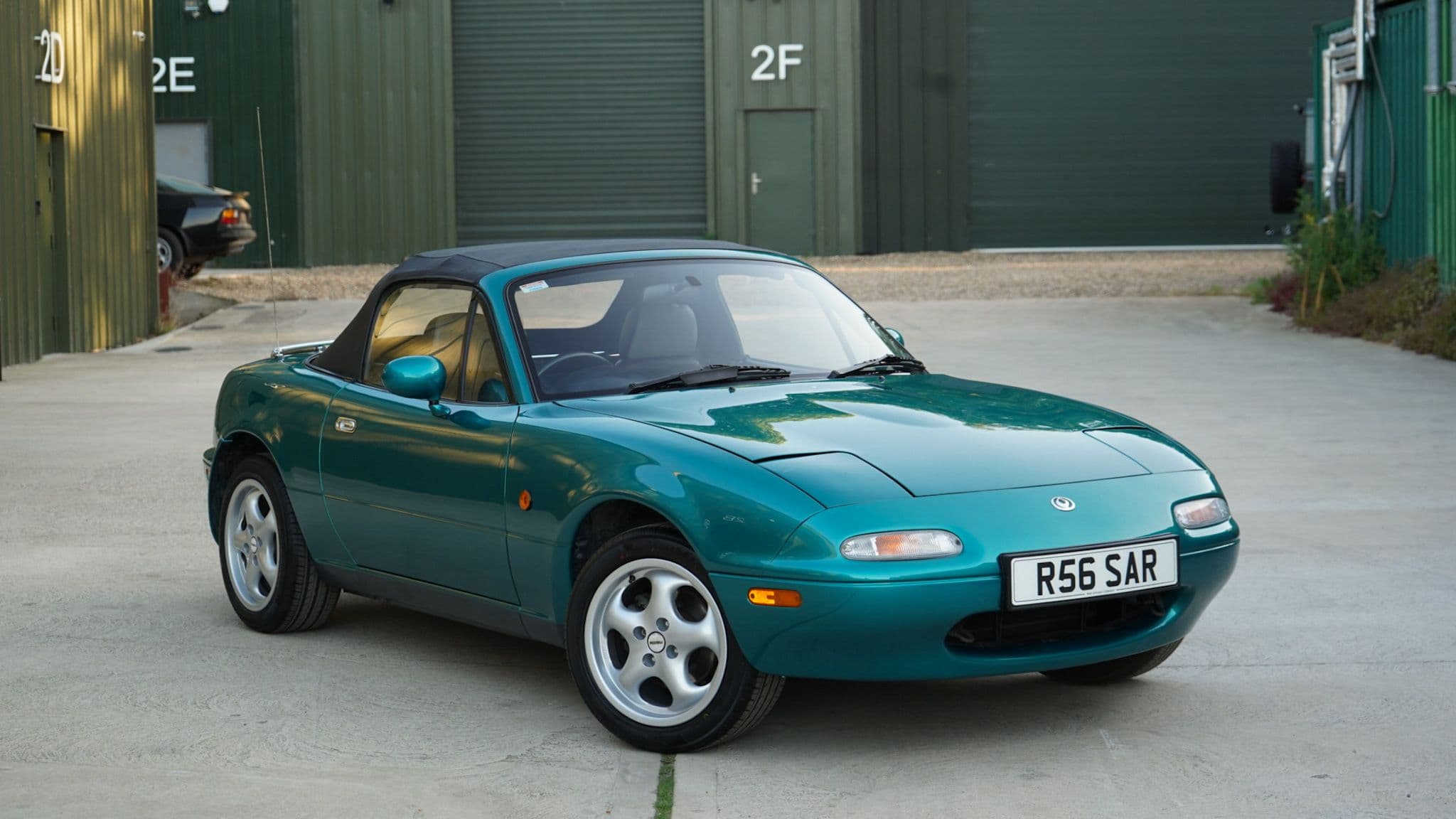
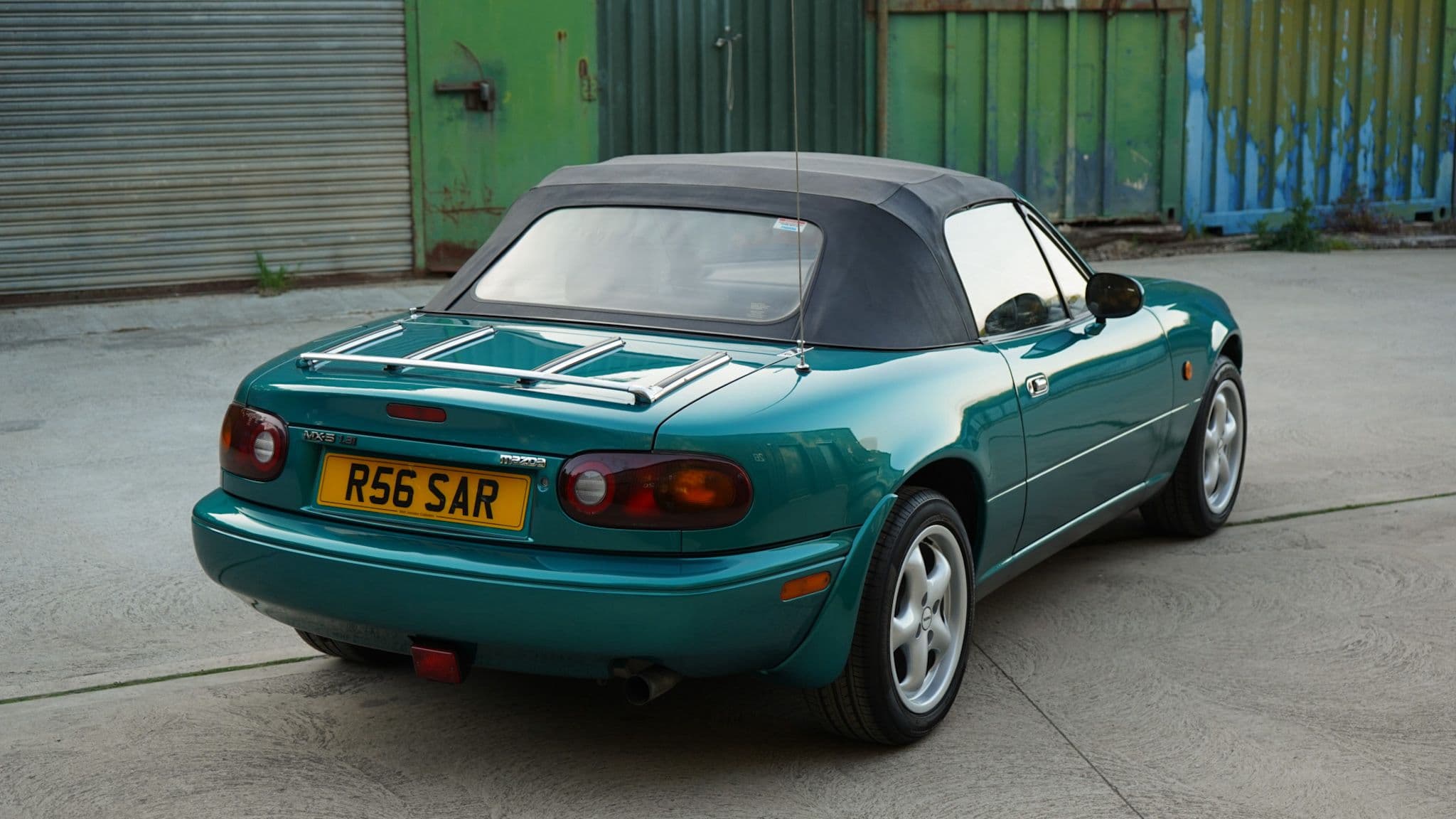
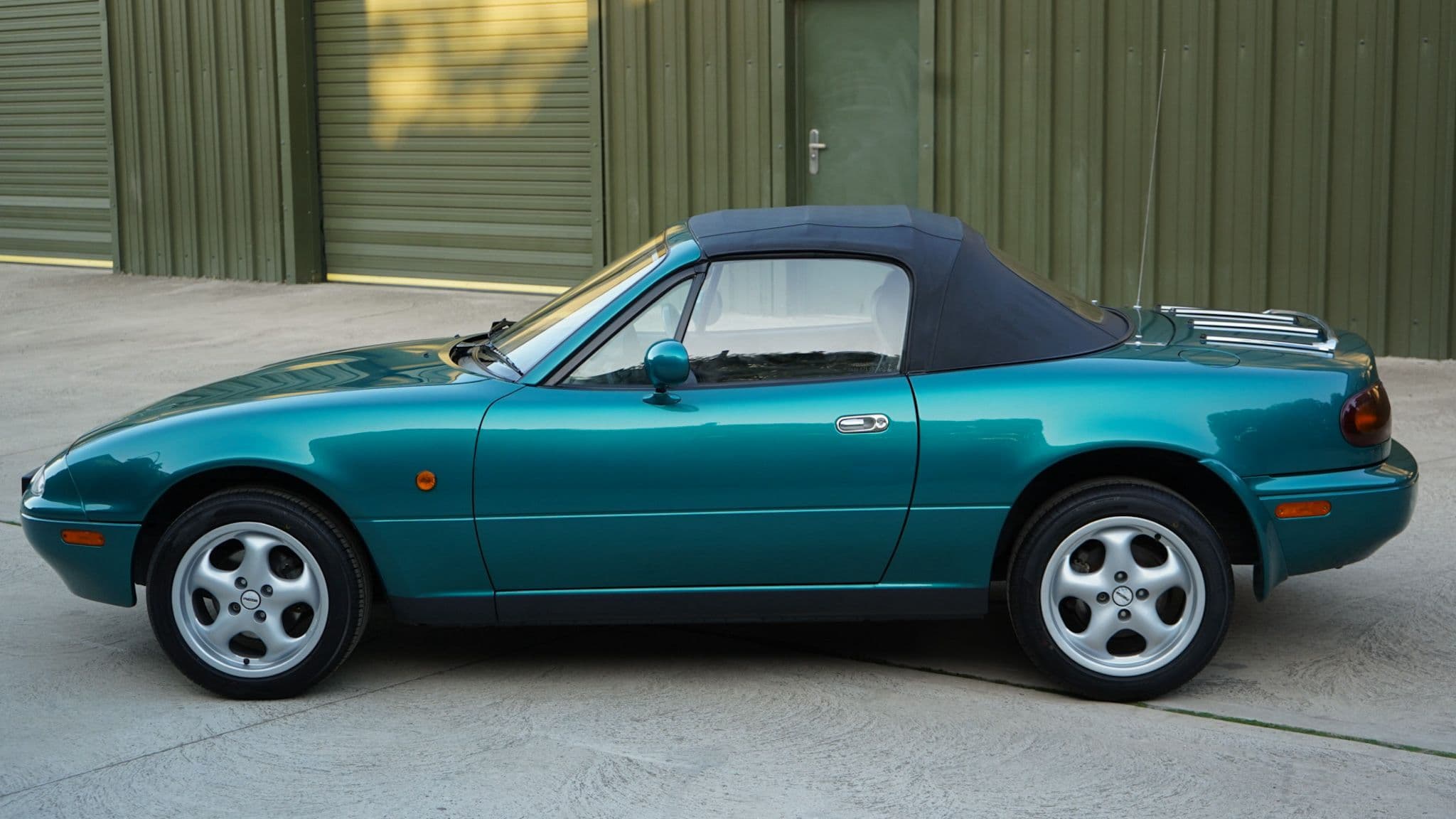
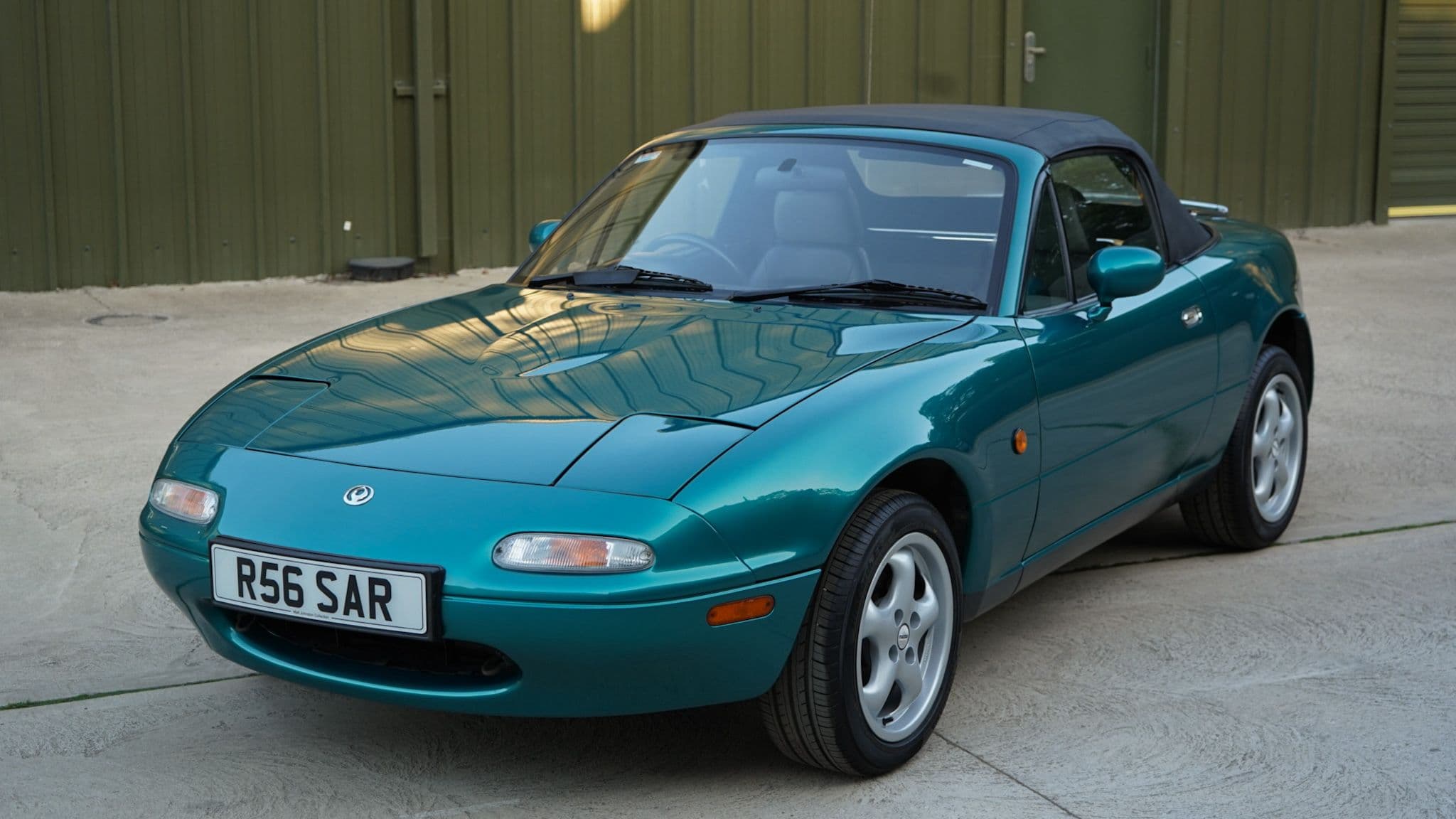
The first generation established nearly every visual and mechanical idea people still associate with an early MX-5: compact proportions, two seats, a fabric roof, pop-up headlamps and a naturally aspirated four-cylinder engine driving the rear wheels through a short manual gearbox.
The initial car used a 1.6-litre engine. The later 1.8-litre development brought important changes, but those changes need to be read by market and year rather than treated as one universal Mk1 specification.
That matters particularly in the UK. Mazda sold the car here from 1990, while Japan knew the first-generation model as the Eunos Roadster. Japanese-market special editions could carry equipment that was not part of an ordinary UK car, and UK grades evolved independently.
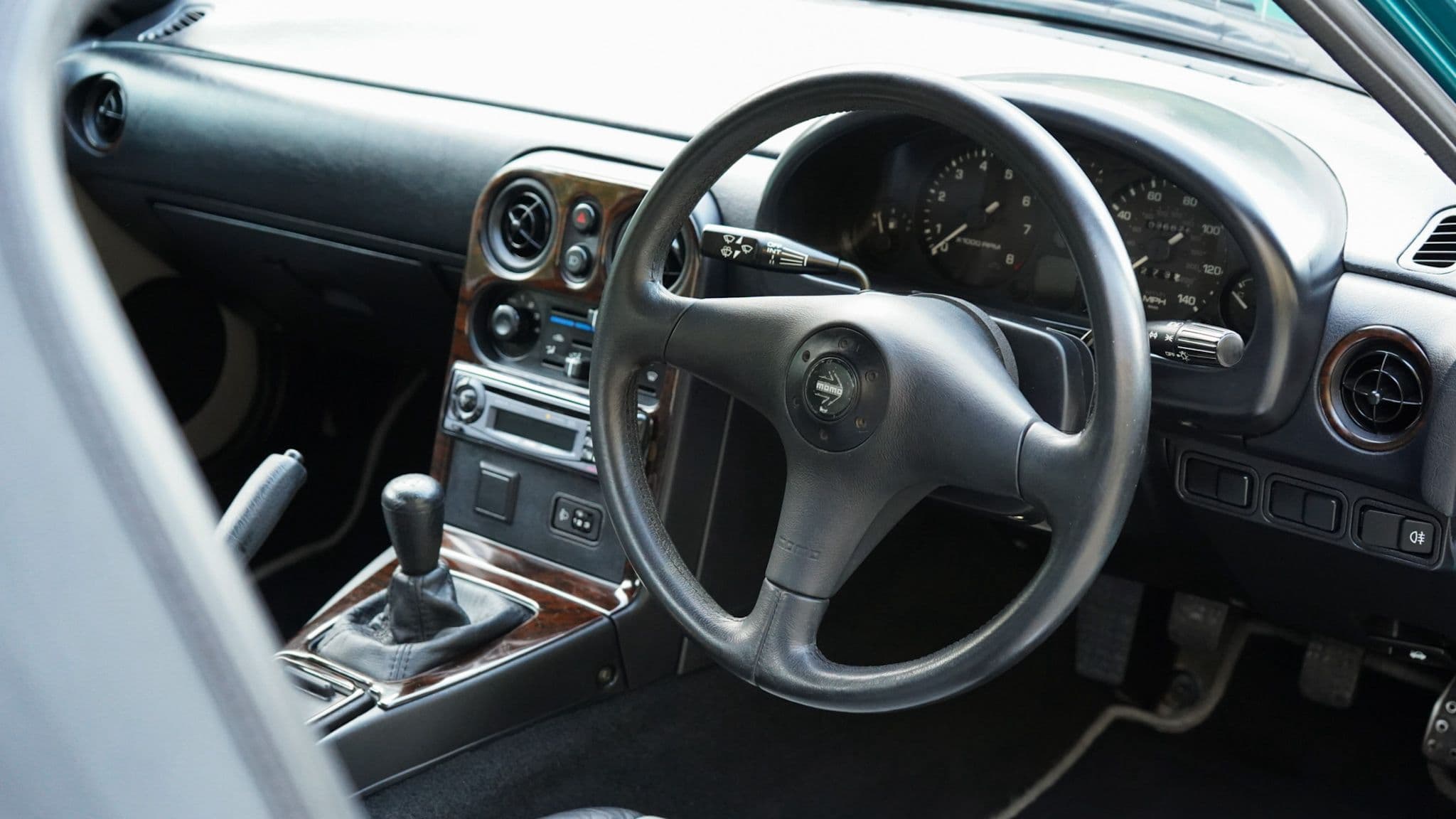
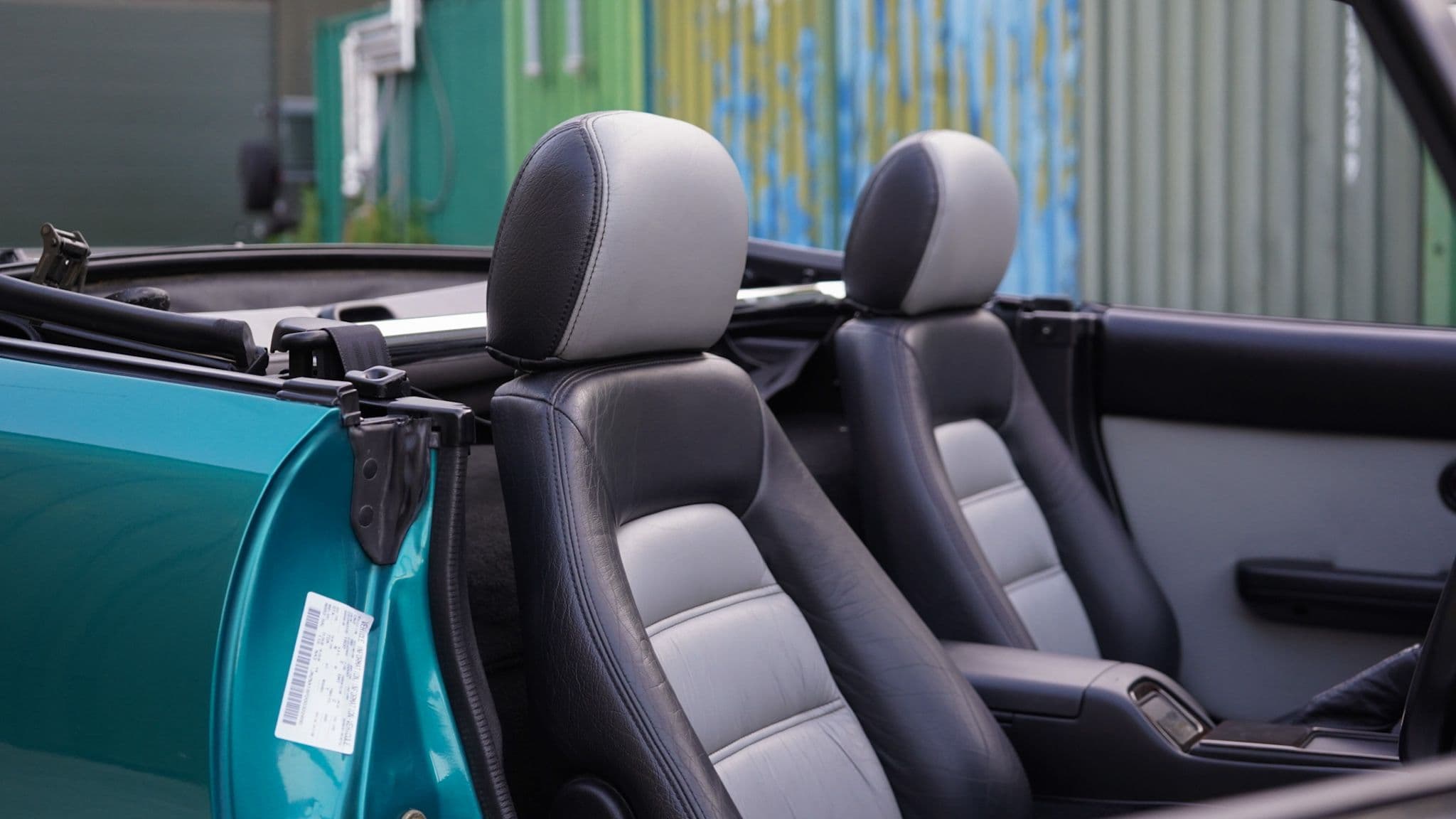
TMJC's two 1995 examples show the distinction clearly. Its exceptionally low-mileage UK 1.8iS was supplied by Christchurch Mazda and retains extensive original documentation. Its Japanese R-Limited is an imported Eunos Roadster with a factory special-edition specification. Same year and same broad generation does not mean same factory identity.
For the UK trim question, see the Mazda MX-5 Mk1 1.8iS guide. The Eunos R-Limited vs UK MX-5 guide explains why Japanese and British descriptions should not be mixed casually.
NB / Mk2: evolution rather than a change of mission
Mazda describes 1998 as the first full redesign of the MX-5. The easiest visual distinction is the loss of the NA's pop-up headlamps, but the important point is continuity underneath the styling change.
The NB remained a compact, front-engined, rear-wheel-drive two-seat roadster. Engines, chassis tuning, safety equipment and trim moved on, and different markets again received different combinations. That is why broad claims such as “all Mk2s have the same 1.8” or “the six-speed defines an NB” are too blunt to be useful.
For a buyer, the generation name tells you which family of parts and engineering you are dealing with; the exact year, market and derivative still decide the specification.
NC / Mk3: the biggest visual and packaging change
The third-generation MX-5 entered production in May 2005. Mazda called it the latest evolution of the lightweight open two-seater rather than an attempt to reinvent the model's job.
The NC is visibly larger and more mature than the NA and NB, with a new platform and different engine range. It also introduced one of the most important body developments in the MX-5 story. From 2006 Mazda added a Power Retractable Hard Top, giving buyers an electrically folding rigid roof without turning the MX-5 into a conventional fixed-roof coupe.
That roof option is a good example of why a model-wide specification table can become misleading. A soft-top NC and a retractable-hardtop NC belong to the same generation but differ in roof mechanism, mass and some ownership considerations.
ND / Mk4: making the car lighter again
Mazda unveiled the fourth generation in September 2014 for global rollout from 2015. Its development motto was “Innovate in order to preserve”: add modern crash, emissions and convenience requirements without losing the lightweight response that had defined the original.
Mazda UK described the production car as the lightest MX-5 since the first generation, using SKYACTIV engineering and the company's KODO design language. European cars were offered with naturally aspirated 1.5- and 2.0-litre petrol engines, but outputs and availability have changed during the ND's long production life, so those numbers belong with a model year rather than one timeless MX-5 specification.
The ND also produced the most visually distinctive roof derivative in the model's history: the MX-5 RF. Revealed in 2016 and sold in the UK from 2017, the Retractable Fastback uses a powered multi-section hardtop and fixed-looking rear buttresses. It remains an MX-5, not a separate model line.
MX-5, Miata, Roadster and Eunos Roadster: what is the difference?
The names mostly tell you where and when the car was sold, not that you are looking at four unrelated sports cars.
Mazda uses MX-5 for Europe and many other export markets. In Japan, current corporate material calls the model the Mazda Roadster. For the first generation, however, Mazda's own history says Japanese sales began under the Eunos Roadster name. In North America, Mazda used Miata as the market name.
That distinction matters when buying parts or checking originality. A Japanese Eunos Roadster may have different trim, options, differential or special-edition hardware from a same-year UK Mazda MX-5. The market name is therefore the start of identification, not the end of it.
What stayed the same across four generations?
The useful continuity is conceptual rather than numerical.
Every generation has remained a two-seat, front-engined, rear-wheel-drive sports car centred on low mass and direct driver involvement. Mazda has repeatedly updated structure, engines, suspension, safety and electronics, but it has not turned the MX-5 into a high-output grand tourer or a 2+2.
The gearbox is another part of the model's identity, but not every MX-5 has the same transmission. Manuals dominate the enthusiast story, while automatic availability has varied by generation and market. The same caution applies to limited-slip differentials: some trims and special editions received them, but an MX-5 badge on its own does not prove which differential is fitted.
How successful has the MX-5 been?
Mazda announced the one-millionth MX-5 on 25 April 2016, with that car having been built three days earlier. The company said the milestone had taken 27 years from the start of mass production in April 1989.
By July 2024 Mazda UK said more than 1.2 million MX-5s had been produced at Ujina and more than 135,000 sold in the UK. Those are dated cumulative milestones rather than a final production total: the fourth generation remained in production afterwards.
The longevity is more useful than the headline number. Few sports-car names have survived through four complete generations while remaining recognisably the same type of car.
Special editions matter more on an MX-5 than they first appear
The MX-5 has accumulated a very large number of market-specific limited editions. Some are mainly colour and trim packages; others add meaningful chassis, differential, wheel or drivetrain differences.
That means “limited edition” should never be treated as a specification on its own. The useful questions are: which market, which year, how many were built, and what equipment did Mazda actually attach to that edition?
The 1995 Japanese R-Limited is a good example. It was a distinct Eunos Roadster special edition; its particular specification should not be transferred to an ordinary Japanese Roadster or a UK 1.8iS simply because the cars look similar.
Which MX-5 generation should you research?
If you are trying to identify a car rather than simply choose the styling you prefer, start with a few obvious clues:
- Pop-up headlamps: first-generation NA/Mk1.
- Fixed headlamps with compact original-era proportions: usually NB/Mk2.
- Larger third-generation body, with optional folding hardtop: NC/Mk3.
- KODO-era body from 2015, including the RF fastback-style roof option: ND/Mk4.
Then move from generation to exact market, engine and trim. Registration year alone is not enough around changeovers, imports require their original market to be understood, and an aftermarket badge or wheel should never overrule documentary evidence.
The NA / Mk1 is where UK grades and Japanese Roadster editions make those identification questions especially important.
What to inspect when buying an older MX-5
There is no single fault list that applies equally to a 1990 NA and a late ND. The generations are too different in age, structure and systems.
For an early car, shell condition and corrosion can dominate the buying decision. Classic & Sports Car highlights sills and rear wheelarches on the NA, while modifications are common enough that originality and quality of previous work deserve proper scrutiny. On later generations the known checks change, and a generation-specific buyer's guide is more useful than transferring an NA checklist forward by habit.
Across all of them, establish what the car actually is before pricing its specification. Confirm generation, original market, engine, gearbox, differential where relevant, special-edition identity and the quality of any modifications. A well-documented standard car and a well-built modified car can both be good purchases; confusion about which is which is the problem.
Sources and further reading
- The Matt Johnston Collection — 1995 Mazda MX-5 1.8iS
- The Matt Johnston Collection — 1995 Mazda MX-5 R-Limited
- Mazda — MX-5 history and original development
- Mazda — Roadster naming: MX-5 in Europe and Miata in North America
- Mazda — one-millionth MX-5
- Mazda — third-generation production begins
- Mazda — fourth-generation MX-5 unveiled
- Mazda UK — MX-5 RF European debut
- Mazda UK — 35 years of MX-5
- Classic & Sports Car — Mazda MX-5 NA buyer's guide
Model lineage
Where this car sits
TMJC media
Explore the car in detail
Sell, consign or editorial
Thinking of selling or consigning a special car?
Continue with TMJC for a discreet conversation, professional presentation and collector-focused support.
Enquire now