Published guide
Eunos Roadster V-Special, S-Special, S-Limited and R-Limited explained
How four Japanese-market Eunos Roadster grades differ, how they evolved from 1.6 to 1.8 litres, and what actually helps authenticate one.
Overview
How four Japanese-market Eunos Roadster grades differ, how they evolved from 1.6 to 1.8 litres, and what actually helps authenticate one.
The names V-Special, S-Special, S-Limited and R-Limited do not form a neat four-step Eunos Roadster trim hierarchy. They appeared at different points in the first-generation Roadster's life, served different purposes and, crucially, did not all mean “limited edition”.
Mazda's own chronology is unusually helpful here. V-Special began as a luxury-led version with tan leather and Nardi wood trim. S-Special arrived later as the sporty branch with chassis and suspension changes. S-Limited was then an explicitly limited 1,000-car derivative using the S-Special chassis, while R-Limited appeared in the 1.8-litre era as another 1,000-car S-Special-based special with shorter gearing and a more focused driveline package.
For a buyer, chronology tells you more than a list of colours and wheels. On a thirty-year-old imported Roadster, wheels, seats, steering wheels, dampers, spoilers and badges can all have been changed. Build period, chassis family, Japanese paperwork and a coherent factory specification are stronger evidence than one desirable part.
The four names at a glance
| Grade | Mazda's chronology | What matters most | Production-count position |
|---|---|---|---|
| V-Special | Introduced in 1990; green/tan/Nardi theme, black added later; continued into the 1.8-litre era | Luxury/trim-led continuing grade whose specification changed with the range | Mazda does not present it as one numbered fixed-volume run |
| S-Special | Introduced in 1992 as the sporty branch; continued when the 1.8-litre engine joined the range | Strengthened/chassis-led specification; early cars use Bilstein/BBS/Nardi package, later cars need phase-specific evidence | Not one frozen 1.6-litre specification or one stated production total |
| S-Limited | Late 1992, based on the S-Special chassis, black exterior/red interior | A distinct NA6CE-era limited derivative | Mazda states 1,000 units |
| R-Limited | 1995, based on S-Special, navy body/roof and red interior, 4.300 final drive and 15-inch wheels | NA8C 1.8-litre response-focused limited derivative | Mazda states 1,000 units |
The exact V-Special, S-Special, S-Limited and R-Limited references keep the detailed specification evidence separate. The comparison here is how those names relate to one another.
V-Special: “Special” does not automatically mean limited edition
Mazda's English MX-5 chronology places the V-Special in 1990 and describes the original version with a green exterior, tan leather seats and Nardi wooden steering wheel and shift knob. Black body paint was added the following year. Mazda later carried V-Special into the 1.8-litre range rather than replacing it with a completely new identity.
V-Special is often swept into lists headed “Japanese limited editions”, but Mazda's current Classic Mazda parts-information table gives a more nuanced picture: in its NA6CE service table, V-Special sits on the regular-model side, while J-Limited, S-Special and S-Limited occupy the limited-car columns.
That table is a parts-service eligibility tool rather than a production ledger, so it should not be overread. But combined with Mazda's chronology it is strong evidence against describing every V-Special as though it belonged to one numbered limited run.
The specification also evolved. Japanese period-catalogue records for the 1991–92 phase show both five-speed manual and four-speed automatic V-Specials, and both Neo Green and Brilliant Black. The manual and automatic records do not even carry identical drivetrain details. A manual gearbox, an LSD or green paint therefore cannot be used as a universal V-Special authenticity test.
TMJC has handled the 1992 Brilliant Black WIW4742, showing that the iconic green-and-tan image is not the only period-correct V-Special presentation. Its present equipment and seller-described options still belong to that individual car, not to every V-Special.
S-Special: the sporty branch spans both 1.6 and 1.8 litres
Mazda's chronology introduces S-Special in 1992 as the sporty derivative, identifying a strengthened chassis, Bilstein dampers, BBS aluminium wheels, a Nardi leather-wrapped steering wheel and shift knob, and rear spoiler. Surviving period Mazda S-Special brochure material supports that early handling-led package.
Mazda also records that the 1.8-litre engine was added to the base model, S-Special and V-Special in 1993. S-Special then continued through later range revisions, including Type I and Type II forms in the 1995 facelift line-up.
So “S-Special specification” is incomplete unless it is tied to a build phase. An early NA6CE 1.6 and a later NA8C 1.8 can both legitimately be S-Specials. Applying the early car's engine, differential or equipment list universally is the wrong way to authenticate a later example.
TMJC-associated L943XLO was advertised as a 1993 1.8 S-Special. Whatever one thinks of its individual condition or fitted parts, its existence illustrates the identification problem perfectly: dismissing it because an earlier S-Special reference says 1.6 litres would confuse a phase-specific specification with the grade itself.
S-Limited: an explicit 1,000-car derivative
S-Limited is different. Mazda's chronology explicitly describes a limited edition introduced at the end of 1992 using the S-Special chassis, with black body paint, a red interior and 1,000 units.
S-Limited did not replace S-Special, and it is not simply another spelling of it. It is a bounded derivative built from the sporty branch.
The familiar black/red/gold-BBS presentation can support the car's story, but none of those removable items should carry the whole authentication burden. Wheels can be refinished or swapped; leather can be retrimmed; steering wheels and strut braces move between cars. A coherent Japanese identity/build record is more persuasive than a complete-looking collection of bolt-on parts.
TMJC-associated H19RPE has circulated as a 1993 S-Limited even though Mazda places the model's introduction in late 1992. That is not, by itself, a contradiction. Registration year, import paperwork and build timing are different questions; the car's actual Japanese chassis/build evidence is what resolves them.
R-Limited: later, 1.8-litre and more mechanically specific
R-Limited arrived in 1995, again using S-Special as its base. Mazda's chronology gives it a navy body and roof, red interior, 1,000-unit programme, 4.300 final drive and 15-inch wheels.
The period R-Limited brochure goes further. It records a 1,839 cc engine with 130 PS, five-speed manual gearbox, lightweight flywheel, torque-sensing limited-slip differential, 4.300 final gearing, 15-inch BBS wheels with Bridgestone RE010 tyres and a response-focused suspension package. Peak power is not the interesting part: the shorter final drive, flywheel, differential, tyres and chassis tuning explain why the car feels different without needing a special higher-output engine claim.
R-Limited should also not be confused with the earlier RS Limited. Mazda's chronology places RS Limited in 1994, based on S-Special, and period RS material shows that some of the response-focused ideas — including shorter gearing and a lightweight flywheel — appeared there before R-Limited. The names are close; the cars are not interchangeable.
TMJC's own 1995 R-Limited retains Japanese/import paperwork alongside the broad R-Limited package. Its mileage, ownership history and maintenance remain facts about that car, not factory specification for the whole run.
For a direct Japan-versus-UK comparison, see R-Limited versus the UK MX-5 1.8iS.
Why Mazda's own dates do not always match perfectly
There is a small but instructive archive problem. Mazda's English MX-5 chronology places V-Special in July 1990, S-Special in July 1992 and the 1.8-litre range change in July 1993. Mazda Newsroom Japan's Roadster genealogy gives August 1990, September 1992 and September 1993 respectively.
Those sources agree on the sequence and the model years that matter to the family tree, but they do not agree on every exact month. Without a source explicitly reconciling announcement, production and retail dates, the sensible approach is not to invent an explanation or choose whichever month is convenient.
For an individual car, this is another reason to prefer chassis/build evidence and surviving Japanese documentation over statements such as “they changed in September, therefore this car cannot be genuine”. The exact month may depend on what event a source is recording.
A better way to identify an imported Eunos Roadster
Start with the car, not the accessories.
First establish that the shell and paperwork are consistent with a Japanese-market Roadster and identify the correct build/chassis phase. For these cars, the NA6CE/NA8C distinction is more informative than a registration year applied after the car reached Britain.
Then look for evidence of the grade itself: original Japanese documentation, historic service records, export/auction material where trustworthy, build/grade information and paint/trim codes. Only after that should you use the visible specification to test whether the story hangs together.
A sensible order is:
- Chassis and build phase — establish the underlying NA6CE/NA8C context before applying a specification list.
- Japanese provenance — old manuals, service records, export paperwork and other period documents can connect the car to its original identity.
- Period-correct grade specification — compare against the correct phase, not a generic internet checklist.
- Mechanical corroboration — gearbox, differential, final drive, suspension and bracing matter where the source actually scopes them to that grade and year.
- Removable visual cues — BBS wheels, Nardi controls, Bilstein dampers, coloured leather, spoilers, badges and stereos should come last.
A replacement steering wheel does not erase a genuine S-Special. A set of BBS wheels does not create one. A retrimmed interior can reduce originality without changing the underlying grade, while a beautifully assembled clone can still lack the documentary identity of the factory derivative it resembles.
Why the names are so easy to misunderstand
The four cars evolved through the same basic Roadster family, and Mazda reused themes deliberately. V-Special's Nardi/trim-led character, S-Special's sporty chassis direction, S-Limited's red-interior treatment and the later R-Limited's mix of red trim and response-focused hardware create genuine visual and mechanical overlap.
At the same time, the base car itself changed. The Japanese Roadster moved from the 1.6-litre phase into 1.8 litres, and later range updates spread some formerly distinctive ideas more widely. A component that is special in one year may be ordinary in another.
That is why a simple “edition = list of parts” approach ages badly. The durable identity is the combination of grade, date, chassis family, market and evidence.
The four grades in one sentence each
V-Special: the luxury/trim-led continuing grade; iconic tan leather and Nardi wood, but not one numbered fixed-volume edition.
S-Special: the sporty branch; early Bilstein/BBS/Nardi identity, but it continues across the 1.6-to-1.8 transition and must be read by phase.
S-Limited: a genuine 1,000-car black/red limited derivative built from the S-Special chassis in the late-1992 period.
R-Limited: a separate 1995 1,000-car, S-Special-based 1.8 derivative whose shorter gearing, lightweight flywheel, LSD and 15-inch package make the mechanical story as important as the red interior.
The parent Mazda MX-5 NA reference keeps the wider generation history separate from these Japanese-market grade questions.
Sources and further reading
Related car
Cars covered in this guide
Explore the cars this guide covers, with model information, history and related TMJC guidance.
 Eunos Roadster S-Limited (Japan)
Comparison
Eunos Roadster S-Limited (Japan)
ComparisonExplore model details, specifications, history and related guidance for Mazda MX-5 NA (Mk1) Eunos Roadster S-Limited (Japan).
Comparison
Eunos Roadster V-Special (Japan)
ComparisonExplore model details, specifications, history and related guidance for Mazda MX-5 NA (Mk1) Eunos Roadster V-Special (Japan).
Comparison
Eunos Roadster S-Special (Japan)
ComparisonExplore model details, specifications, history and related guidance for Mazda MX-5 NA (Mk1) Eunos Roadster S-Special (Japan).
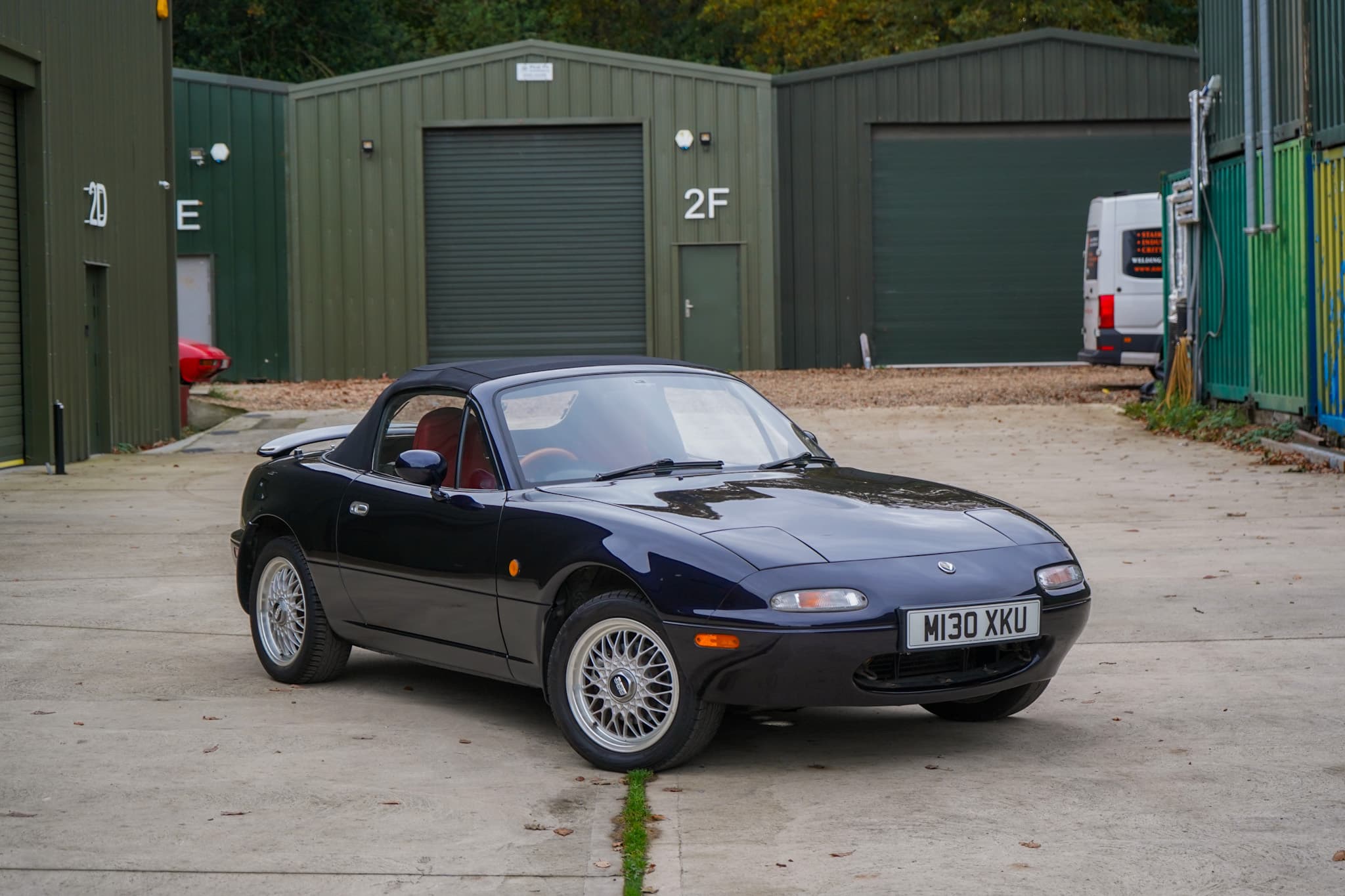 Eunos Roadster R-Limited (Japan)
Comparison
Eunos Roadster R-Limited (Japan)
ComparisonExplore model details, specifications, history and related guidance for Mazda MX-5 NA (Mk1) Eunos Roadster R-Limited (Japan).
Editorial information
The Matt Johnston Collection
Research and editorial from TMJC Garage.
Research and editorialTMJC Garage
Reviewed byMatt Johnston
Last reviewed20 September 2026
Published byThe Matt Johnston Collection