Published guide
Eunos Roadster R-Limited vs UK MX-5: key differences
Eunos Roadster vs UK MX-5 explained: what the 1995 R-Limited added, how Japanese-market identity differs from trim, and what buyers should verify.
Overview
Eunos Roadster vs UK MX-5 explained: what the 1995 R-Limited added, how Japanese-market identity differs from trim, and what buyers should verify.
This guide covers Eunos Roadster R-Limited (Japan) and links directly to the relevant car record for further detail.
An Eunos Roadster is the Japanese-market version of the first-generation Mazda MX-5, not a different underlying sports car. Mazda sold the NA in Japan through its Eunos dealer channel and called it the Eunos Roadster. The important complication is that Japan received its own grades and special editions, so an imported Eunos can have equipment and gearing that a same-year UK MX-5 never had.
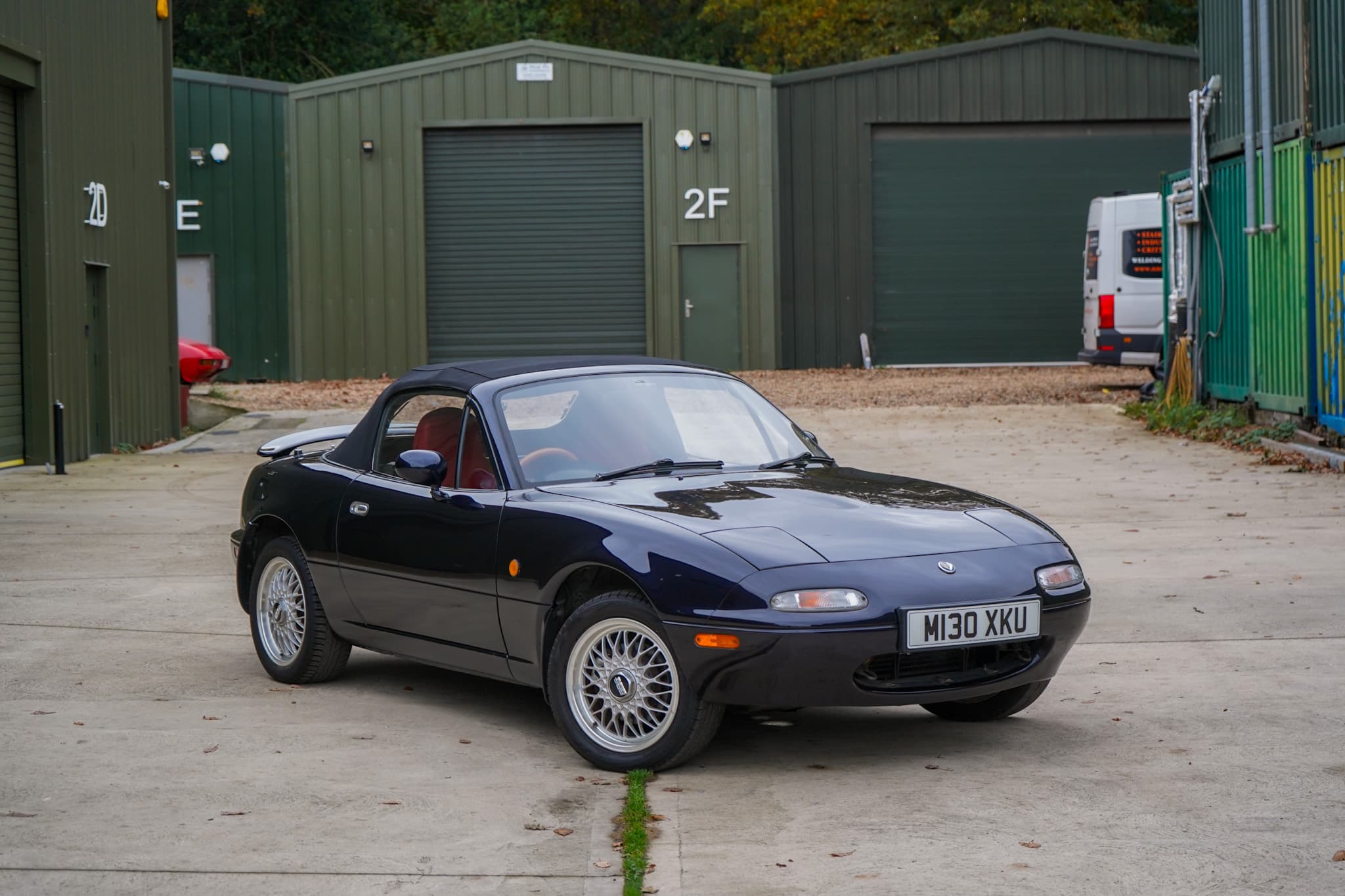
The 1995 R-Limited is a good example. Mazda did not merely give it different badges and leather. Its period brochure specifies a 4.300 final drive, lightweight flywheel, torque-sensing limited-slip differential, tuned suspension, 15-inch BBS wheels and a distinctive red-leather/wood-trim cabin. Those details are why a UK-market 1.8iS is not a safe specification substitute, even though both cars are 1.8-litre, right-hand-drive Mk1s from the same year.
Eunos Roadster vs MX-5: the short answer
| Question | Answer |
|---|---|
| Is a Eunos Roadster a different chassis from an MX-5? | No. It is Mazda's Japanese-market version of the same first-generation roadster programme. |
| Why the Eunos name? | Mazda sold the car in Japan through its Eunos sales channel from 1989. |
| Are all Eunos Roadsters better equipped than UK MX-5s? | No. Japanese grades varied significantly. Compare the exact year and grade. |
| Did every Eunos have an LSD? | No safe assumption should be made from the Eunos badge alone. LSD fitment depends on grade and year. |
| What is special about the 1995 R-Limited? | Mazda's brochure specifies a limited 1,000-car package with distinct chassis, gearing, wheel, trim and driveline equipment. |
| Does an mph speedometer mean a car was UK supplied? | No. Imported Roadsters are often converted or re-faced for UK use. |
Why Mazda called it the Eunos Roadster
Mazda's own history is clear about the naming. The lightweight roadster went on sale in the United States in 1989, then launched in Japan that September as the Eunos Roadster. Eunos was one of Mazda's domestic sales channels at the time.
That matters because Eunos is often spoken about in the UK as though it denotes a mechanically uprated version of the MX-5. It does not. It tells you the car was built for the Japanese market. To know what hardware it should have, you still need the grade, year and original specification.
A standard Japanese Roadster, an S-Special and an R-Limited can all wear Eunos badges while having different equipment. In the same way, a UK 1.8i and 1.8iS share the MX-5 name without being identical trims.
What Mazda actually put on the 1995 R-Limited
The useful evidence is the period R-Limited brochure, because it removes the need to reverse-engineer the specification from decades of classified adverts.
Mazda described the R-Limited as a 1,000-car limited edition. Its core specification included:
- 1,839cc DOHC 16-valve engine;
- 130 PS at 6,500 rpm;
- five-speed manual gearbox;
- 4.300 final-drive ratio;
- lightweight flywheel;
- torque-sensing limited-slip differential;
- four-wheel double-wishbone suspension with a harder performance tune;
- Bilstein-developed dampers;
- 195/50R15 Bridgestone Potenza RE010 tyres;
- forged 15 x 6-JJ BBS wheels;
- red leather seats and coordinated red cabin trim;
- Nardi wood steering wheel and shift knob;
- power steering and power windows.
The brochure also pairs Satellite Blue Mica paint with a dark-blue hood and the red interior. This is not just a cosmetic special edition: the gearing, flywheel, differential, suspension and wheel/tyre package change how the car responds.
The 4.300 final drive is not a trivial detail
A numerically higher final-drive ratio makes the gearing shorter. Mazda specifically promoted the R-Limited's 4.300 ratio as a way to sharpen response from the 1.8-litre engine. The brochure claimed roughly a four-to-five per cent improvement in third-gear overtaking acceleration over the comparison setup.
That is a more useful explanation than saying an R-Limited simply feels sportier. It helps a buyer understand why two otherwise similar NA8C cars can feel different without having different headline engine capacities.
The lightweight flywheel changes response, not peak power
The lighter flywheel is another example of a feature that can be misdescribed. It does not magically raise the engine's quoted peak power. Its purpose is to reduce rotational inertia, allowing engine speed to rise and fall more readily. Mazda explicitly tied the feature to throttle response.
If an advert claims an R-Limited's flywheel as evidence of a more powerful engine, that is the wrong way to describe the factory change.
The limited-slip differential is grade-specific evidence
Mazda's brochure specifies a torque-sensing limited-slip differential for the R-Limited. That is strong evidence for this grade. It is not evidence that every Japanese Eunos Roadster came with the same differential.
This distinction matters because UK import folklore often compresses several separate ideas into one sentence: Eunos cars have LSDs, better suspension and more equipment. Some do. Some do not. The exact Japanese grade is the useful identity.
R-Limited vs a UK 1.8iS
TMJC happens to have an unusually useful real-world comparison: a 1995 Japanese R-Limited and a 1995 UK-market 1.8iS.
Both are right-hand-drive, first-generation 1.8-litre cars. That is roughly where the simple comparison ends.
| Area | 1995 Eunos R-Limited | UK MX-5 1.8iS context |
|---|---|---|
| Original market | Japan | United Kingdom |
| Factory identity | Eunos Roadster R-Limited | Mazda MX-5 1.8iS |
| Engine | 1.8-litre DOHC | 1.8-litre DOHC |
| Gearbox | 5-speed manual | 5-speed manual |
| Final drive | 4.300 stated by Mazda brochure | Do not infer R-Limited gearing from the UK trim name |
| LSD | Torque-sensing LSD stated by Mazda brochure | Verify from UK-period documentation/car evidence rather than assuming equivalence |
| Flywheel | Lightweight factory item | Not an R-Limited-equivalent identity clue |
| Suspension | Performance tune; Bilstein-developed dampers | 1.8iS had its own UK sports-positioning context, but is not the same package |
| Wheels | 15-inch forged BBS | UK 1.8iS specification should be checked by model year |
| Interior | Red leather/red trim, Nardi wood controls | UK trim and equipment differ |
| Odometer origin | kilometres | miles on a UK-supplied car |
The point is not that one is universally better. The point is that they are different factory propositions. A buyer should compare the cars they actually are, not translate every Japanese grade into the nearest UK badge.
How to identify a genuine R-Limited
No single bolt-on component proves the identity. BBS wheels, Nardi controls and red seats can all be swapped onto another Roadster. Verification should build from several independent layers.
1. Start with Japanese identity paperwork
Import/export papers, Japanese manuals, auction or ownership material and chassis/model-code evidence are more useful than a UK advert title. They help establish that the car was a Japanese-market Roadster before anyone starts judging trim pieces.
TMJC's R-Limited is useful here because it retains Japanese history and import/export paperwork alongside its later UK documentation.
2. Check the original colour and interior combination
The period R-Limited brochure presents Satellite Blue Mica, a dark-blue hood and red interior as a defining combination. That makes paint/interior consistency useful supporting evidence.
However, colour alone is not proof. Cars are repainted, interiors get replaced and special-edition parts move between cars.
3. Verify the mechanical package
The stronger clues are the ones that are harder to fake accidentally:
- 4.300 final-drive setup;
- torque-sensing LSD;
- lightweight flywheel;
- correct suspension/damper specification;
- correct wheel and tyre size;
- chassis bracing where applicable.
Even here, remember that thirty-year-old sports cars are frequently modified. Finding a modern aftermarket differential or replacement dampers does not establish what the car left Mazda with.
4. Then inspect the visible R-Limited hardware
The red leather cabin, Nardi wood wheel and knob, and forged 15-inch BBS wheels are valuable originality details. They are also precisely the attractive items that are often removed, damaged or retrofitted.
For a collector-grade car, originality means more than ticking a list of names. Wheel dimensions, finish, trim material and signs of later replacement all matter.
What does 1,000 built mean, and where does 894 come from?
This is a good example of why production numbers deserve source labels.
Mazda's own R-Limited brochure calls it a limited run of 1,000 cars. That is the number TMJC should treat as the strongest currently supported production total.
A second figure appears repeatedly in UK enthusiast material and adverts: 894 Satellite Blue cars, with the remaining 106 said to have been Chaste White. The arithmetic is tidy and the claim is widespread, but an accessible primary Mazda production ledger confirming that colour split has not yet been found in this research.
So the careful formulation is:
Mazda documented the R-Limited as a 1,000-car limited edition. A widely repeated enthusiast breakdown says 894 were Satellite Blue and 106 were Chaste White, but that colour split still deserves primary-source confirmation.
That is more useful than quietly turning the most repeated advert number into a factory fact.
Import details that can confuse identification
Kilometres versus miles
A Japanese-market Roadster's original odometer records kilometres. Hagerty notes that cars imported into Britain often have an mph speedometer face or conversion. Therefore an mph display today does not prove UK origin, and a mileage figure should be reconciled with import documents and historic MOT records.
TMJC's R-Limited is a good example of why the units matter: its displayed history includes kilometres as part of the provenance chain after Japanese use.
The rear number-plate panel
One of the easiest visual clues is at the back of the car. Japanese Eunos Roadsters use the taller/narrower Japanese-format rear plate recess, while UK MX-5s use a different plate treatment. Badges and reflectors can also differ.
These details are useful for recognising an import at a glance, but they still do not identify the exact Japanese grade.
Air conditioning and equipment are not universal rules
Japanese-market cars are often described as higher spec. In aggregate there is some basis for the reputation, and many imported cars do carry equipment that was uncommon on UK examples. But the Roadster range included multiple packages and special editions.
A buyer should ask which Japanese grade is this?, not simply is it a Eunos?.
TMJC's two 1995 cars show why paperwork matters
The most interesting comparison is not a theoretical spec sheet. TMJC's two cars reached the same country by very different routes.
The UK 1.8iS was supplied new in Britain and survives with unusually strong original documentation. The R-Limited began life in Japan, later came to the UK, and retains Japanese/import material as part of its history.
That means the evidence needed to establish originality is different. A UK car can be checked against UK dealer and registration history. A Japanese import needs a joined-up chain across Japanese identity, export/import evidence, odometer units and UK history after arrival.
For a broader framework on interpreting invoices, ownership history and specification evidence, see TMJC's collector-car provenance guide.
What to check before buying a Eunos R-Limited
- Identity before options. Establish that the car is genuinely the claimed Japanese grade before valuing special-edition parts.
- Japanese and import documentation. Look for a coherent chain rather than relying on the V5 description alone.
- Odometer units. Determine when, if ever, the speedometer/odometer presentation was altered and reconcile kilometres with later UK records.
- Original colour and trim. Check paint codes, repaint history and whether the red R-Limited interior is period-correct.
- BBS wheels. Verify the correct 15-inch specification, not merely that a BBS badge is present.
- Differential and gearing. Confirm what is actually fitted today rather than assuming the drivetrain remains untouched.
- Flywheel and clutch history. A clutch replacement is an obvious point at which the factory flywheel could have been changed.
- Suspension. Identify current dampers and springs and distinguish original-type replacement from generic aftermarket suspension.
- Rust and structural repairs. JDM origin does not make a thirty-year-old Roadster immune from corrosion, especially after years on salted UK roads.
- Removed original parts. On a special edition, missing wheels, trim, steering wheel or other factory-specific components can matter materially to originality.
The useful way to think about Eunos versus MX-5
Eunos Roadster answers where the car was originally sold. R-Limited answers which Japanese grade it was and what factory package it received.
Keeping those two questions separate prevents most of the common mistakes. An imported Roadster is not automatically an R-Limited, not every Eunos shares the same differential or suspension, and a UK 1.8iS is not simply the same car with different badges.
For the 1995 R-Limited specifically, Mazda left enough period documentation to define the important hardware. That gives buyers a much better starting point than folklore: verify the identity, then verify how much of that factory specification is still on the car.
Sources and further reading
Related car