TMJC assistance
Want TMJC to help with this vehicle?
Sourcing, consignment and valuationContinue to the main TMJC website and speak directly with the collection team.
Variant
UK Mazda MX-5 Mk1 1.8iS specs, equipment and Torsen evidence, including the unresolved 1994-95 differential-fitment boundary.
TMJC guide
UK Mazda MX-5 Mk1 1.8iS specs, equipment and Torsen evidence, including the unresolved 1994-95 differential-fitment boundary.
The Mazda MX-5 1.8iS was the higher-specification regular 1.8-litre Mk1 sold in the UK. It did not use a different-displacement engine and 1.8iS was not, by itself, the name of a limited edition.
What the S did signify was a more expensive sports/equipment grade. The evidence is clearest when the shared 1.8-litre changes are separated from the features that actually distinguish an iS.
| Area | What the evidence supports | Important caveat |
|---|---|---|
| UK introduction | 1.8-litre cars arrived in 1994; the 1.8iS is described as a Sports pack with stiffer suspension | This is UK-market chronology, not Japanese Eunos specification |
| Position in range | A UK range sheet with prices correct 8 March 1995 lists the 1.8i at £14,495 and the 1.8iS at £17,395 | Named limited editions such as California were separate identities |
| Steering | Mazda's 1995 UK range sheet lists power steering as standard on the 1.8iS | Power steering alone cannot prove a car is an iS after 30 years of parts swaps |
| Differential | Autolink's Torsen listing identifies a 4.1:1 unit for UK Mk1 1.8iS cars from 1995-98; a separate Autolink open-differential listing also claims UK 1.8 fitment through 1995, while period Mazda UK brochures do not explicitly name the LSD | The specialist listings conflict around 1995 and the 1994 launch-year fitment remains unresolved; verify the individual car |
| Suspension | Stiffer Sports-pack suspension is specifically associated with the iS | Dampers and springs are frequently replaced, so present hardware still needs checking |
| ABS / brakes | Mazda's 1995 UK range sheet lists ABS as standard on the iS; a March 1997 factory table gives 255 mm ventilated front / 251 mm solid rear discs for the 1.8 cars | Keep the later brake dimensions scoped to the later brochure rather than back-projecting them blindly |
| Wheels | Mazda's 1995 UK range sheet specifies 14 x 6.0 alloys with 185/60R14 tyres on the iS | Wheel design and tyres are easily replaced; individual-car originality still needs checking |
The recurring mistake is to turn any one row of that table into a foolproof identity test. A genuine iS should make sense as a package, backed by period paperwork and the physical car.
The 1.8-litre MX-5 reached the UK in 1994. Classic & Sports Car's chronology describes the wider 1.8 development with a stiffened shell and places the 1.8iS Sports pack with stiffer suspension alongside it.
That distinction matters. Features associated with the later 1.8-litre NA are sometimes advertised as if they prove iS trim. They do not.
The driver's airbag is a good example: it belongs to the later 1.8-era story rather than being a clean S badge decoder. The same caution applies to the close, short-feeling five-speed shift. That gearchange is part of the wider MX-5 character, not a unique iS gearbox identity.
The iS is better understood as the sports/equipment specification applied to the UK 1.8, not as a separate engine derivative.
Period UK sales literature now gives a date-specific answer. Mazda's range sheet says its prices were correct at time of going to press on 8 March 1995: the regular 1.8i was £14,495, while the 1.8iS was £17,395.
That is a £2,900 gap before options and accessories. The same page places the iS in insurance group 13 against group 12 for the 1.8i, reinforcing that it was a distinct higher-specification regular grade rather than a decorative suffix.
Later retrospective sources quote £17,595 for the iS. That may reflect another point in the price cycle, but it should not be merged into the dated March 1995 snapshot. For a May-1995 car such as TMJC's example, the £17,395 brochure figure is the more useful contemporary reference.
Calling every iS a special edition is still misleading. Mazda separately sold named limited editions during the same period; the regular 1.8iS sat in the normal range above the 1.8i.
The UK 1.8iS story starts before the strongest Torsen evidence does.
Classic & Sports Car places the 1.8iS Sports pack in the UK range in 1994. Fast Car is more specific, describing the 1.8i and 1.8iS as arriving together in May 1994. An independent brochure archive also catalogues a 20-page Great Britain Mazda MX-5 brochure from May 1994, reference MCAG838, followed by later GB editions carrying the same reference in 1995.
Fast Car's launch-period description is useful because it separates the higher equipment grade from the core 1.8 mechanical package. It lists power steering, electric windows and mirrors, ABS, wider 6x14 wheels and trim upgrades among the iS additions, but does not identify a Torsen or LSD as part of that initial list.
Factory service literature fills in one important part of the story without closing the UK trim question. Mazda's 1994 MX-5 workshop manual has dedicated procedures for both a standard differential and a torque-sensing limited-slip "TORSEN" LSD; its technical-data section gives the Torsen a 4.100 reduction ratio. That proves the 4.1:1 Torsen hardware belonged to the 1994-era MX-5 service family. The pages do not, however, assign it specifically to the UK 1.8iS grade, so the workshop manual cannot be turned into a claim that every 1994 UK iS received one.
Autolink's Torsen listing begins at 1995, stating that its 4.1:1 unit applies to UK Mk1 1.8iS cars from 1995-98. A separate Autolink listing for an open 4.1:1 differential says that unit was fitted to all UK 1.8 Mk1 cars from 1994-95.
That overlap matters. The specialist catalogue is internally inconsistent for 1995, so it would be too strong to turn either listing into a universal rule. On a 1994 or 1995 car, the differential should be treated as an evidence question: check original paperwork where available, then verify the hardware and ratio on the car itself. This is not evidence that a 1994 or 1995 iS could not have had a Torsen; it means the current source set does not settle the boundary cleanly.
This is the question that produces the most contradictory internet answers.
MX-5 specialist Autolink states in its Torsen listing that a 4.1:1 unit was fitted to all UK Mk1 1.8iS cars from 1995 to 1998. However, its separate open-differential listing says a 4.1:1 open unit was fitted to all UK 1.8 Mk1 cars from 1994 to 1995. Those two claims overlap in 1995, so the catalogue cannot by itself settle a 1995 iS.
That same application note is useful because it does not simply say all 1.8 MX-5s had the same LSD. It distinguishes Japanese-market R-Limited, RS-Limited and VR-Limited cars, which it identifies with the shorter 4.3:1 version. Mazda's period R-Limited brochure independently documents a 4.300 final drive for that Japanese special edition.
So the evidence supports a much more precise distinction:
The useful complication is that period UK Mazda sales literature is now readable. A range sheet with prices correct on 8 March 1995 gives a detailed standard-equipment list for the 1.8iS, but it does not name a Torsen or limited-slip differential. A separate March 1997 Mazda Cars (UK) brochure goes further: it has a full equipment matrix and technical table, gives the 1.8iS a 4.100 final gear ratio, and still does not identify the differential type.
That absence should not be turned into proof that the cars had open differentials. Neither brochure contains a dedicated differential-type row, and sales literature can omit components that a parts catalogue or build record would document more precisely. The correct conclusion is therefore narrower: Autolink supports a 4.1:1 Torsen for 1996-98 and gives conflicting 1995 application data; Mazda's period UK brochures confirm the surrounding specification but do not themselves identify the differential type.
On an individual car, verify the differential anyway. Thirty years is ample time for a Torsen to have been installed, removed or replaced.
For the Japanese-market comparison, see Eunos Roadster R-Limited vs UK MX-5: key differences.
The recovered UK range sheet is more useful than reconstructing the grade from surviving cars. For the 1.8iS it says everything fitted to the 1.8i, then adds:
The ordinary 1.8i itself already inherited the 1.6i equipment and added a suspension brace bar, door pockets and locking centre console. That cumulative structure matters: an iS was a package built on the 1.8i, not a separate engine derivative.
A March 1997 Mazda Cars (UK) brochure independently shows the same basic hierarchy and adds a later technical reference: 255 mm ventilated front discs and 251 mm solid rear discs for the 1.8-litre cars. Those brake dimensions belong to the later brochure and should not be silently back-dated to every 1995 car.
For the period around TMJC's May-1995 car, Mazda's UK range sheet specifies 14 x 6.0 alloy wheels with 185/60R14 tyres and a locking wheel-nut set. That is stronger evidence than inferring factory fitment from a surviving car three decades later.
The brochure does not identify the wheel manufacturer by name, so it should not be used to turn Enkei into a universal 1.8iS claim. TMJC's individual car is described with lightweight Enkei alloys, but wheel design and provenance still need to be checked car by car.
Tyres are even more transient. A current 185/60R14 fitment can agree with the period specification without being original, while another tyre size on a restored car may simply reflect later replacement choices. Use the brochure for the period size, then use documentation and physical inspection for the individual wheel set.
For this period, Mazda's own UK range sheet answers the question directly: 130 bhp at 6,500 rpm and 112 lb-ft at 5,000 rpm from 1,839 cc. The ordinary 1.8i on the same page carries the same engine-output figures.
That makes the important point clearer than arguing over later 128-versus-130 figures. The iS was not being sold as a higher-output engine tune; its extra value sat in chassis and equipment specification. Retrospective sources that quote roughly 128 bhp may be using a different conversion or reference convention, but the period UK sales figure for early 1995 is 130 bhp.
Mazda's March 1997 brochure later prints 131 bhp (98 kW) and 114 lb-ft for both 1.8-litre grades. That small change is another reason to keep period specification attached to a date rather than pretending every printed figure across the NA run is identical.
TMJC previously handled a Classic Red UK 1.8iS supplied by Lansdown Mazda in Bath on 1 August 1994. What makes that car useful here is not another modern specification list. TMJC recorded that it still had its original bill of sale, order form and accessory list.
The historical TMJC listing records a total invoice of £19,699.35 and says more than £2,200 of additional accessories were ordered. Those included a hard top, alarm and central locking, rear and full tonneau covers, premium mats, a hard-top wall bracket and a hard-top cover.
That is evidence about one individual order, not a factory equipment table for every 1994 iS. But it exposes an important trap when checking originality: a feature can have been on the car from first delivery without being standard equipment on the grade.
That distinction matters for hard tops, security systems, central locking and other items that are easily folded into a later advert's list of standard equipment. It also means the £19,699.35 total should not be quoted as the 1.8iS list price; it was an accessory-heavy individual invoice.
For an early iS, original paperwork can therefore answer two different questions. The model/grade on the invoice or warranty record helps establish what the car is. The accessory lines help establish how that particular car was ordered. Current fitted equipment comes third, because parts can subsequently be added, removed or replaced.
This 1994 file does not settle the launch-year Torsen question. The accessible listing does not reproduce enough of the order sheet to show whether a limited-slip differential was standard, optional or separately itemised. The 1994-versus-1995 evidence boundary above therefore remains in place rather than being filled with an assumption.
Use evidence in the order that is hardest to fake or accidentally alter.
The wider principle is the same one used in our classic-car provenance checklist: contemporaneous documents and the actual vehicle outrank a later seller's specification list.
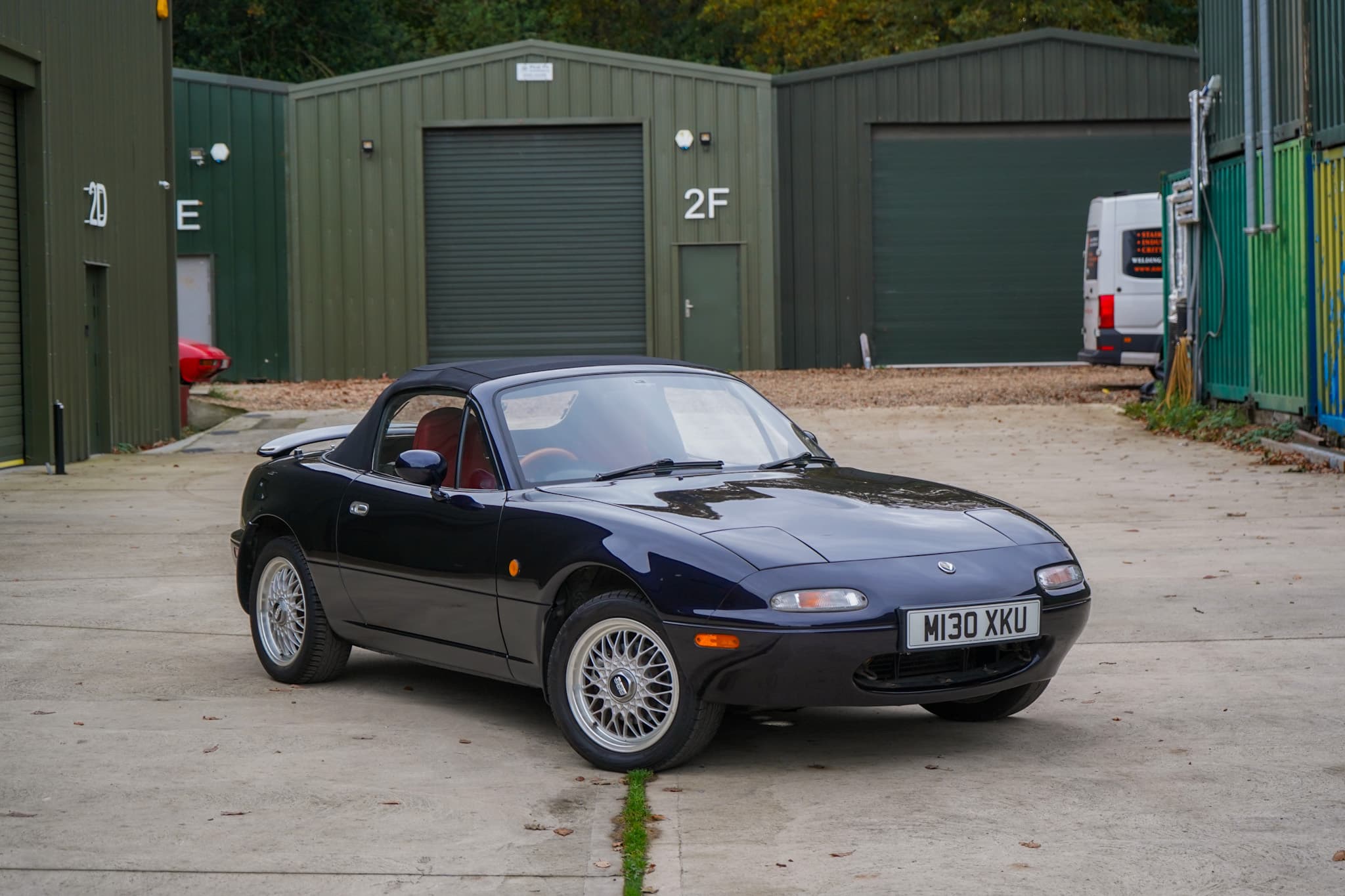
The Matt Johnston Collection has handled a UK-supplied 1.8iS registered on 22 May 1995 with unusually complete original documentation. The car retains Mazda manuals and booklets, multiple keys and much of the sort of original trim and equipment that is frequently lost or modified on Mk1s.
That makes it a valuable worked example because its paperwork can be compared with the physical car. Its individual mileage, Chaste White paint, original radio and later maintenance history remain facts about that car, not the entire iS production run.
Its preservation also highlights why originality work on an iS should focus on agreement between the period paperwork and the car itself rather than on rarity claims. A Torsen, Enkei wheels or an iS badge can all move between cars; a coherent period document trail is harder to manufacture accidentally.
For the deeper trim-history investigation, see Mazda MX-5 Mk1 1.8iS: what did the S mean?.
Editorial information
Research and editorial from TMJC Garage.
Research and editorialTMJC Garage
Reviewed byMatt Johnston
Last reviewed15 September 2026
Published byThe Matt Johnston Collection
Model lineage
TMJC Guides
TMJC assistance
Continue to the main TMJC website and speak directly with the collection team.
Sell, consign or source
Continue with TMJC for a discreet conversation, professional presentation and collector-focused support.
Enquire now