TMJC assistance
Want TMJC to help with this vehicle?
Sourcing, consignment and valuationContinue to the main TMJC website and speak directly with the collection team.
Model
Porsche 944 history from the 924 GTP development path to the S2, with transaxle context, documented timing-drive distinctions and practical buyer checks.
Generation directory
Choose a 944 generation to see its production years, body styles, engines, chassis changes and variants.
TMJC guide
Porsche 944 history from the 924 GTP development path to the S2, with transaxle context, documented timing-drive distinctions and practical buyer checks.
The Porsche 944 was unveiled at Frankfurt in September 1981 and entered production in 1982. It kept the front-engine, rear-transmission architecture Porsche had established with the 924, but added a new Porsche four-cylinder engine, wider bodywork and enough development of its own to become a distinct model family.
By the time production ended in 1991, Porsche says it had built 163,302 examples. No previous Porsche model had sold as quickly, and after the 944's first year of sales it accounted for more than half of Porsche production.
That commercial success can make the 944 look obvious in retrospect. Its development was anything but. Before customers could buy one, Porsche had already raced a prototype of the future car at Le Mans under a 924 GTP name.
Both dates appear in Porsche's own history, but they describe different events.
Porsche unveiled the Type 944 at the Frankfurt IAA in September 1981. Its current model history then describes the 944 as first launched in 1982 and says the series was in production from 1982 to 1991.
The dates describe different stages:
| Date | What happened |
|---|---|
| 1981 | World premiere at the Frankfurt Motor Show |
| 1982 | Series-production / launch period used by Porsche's current 944 history |
| 1991 | End of 944 production |
So a reference calling the 944 a 1981 introduction is not necessarily contradicting one that gives 1982 as the first production year. The first is normally talking about the public reveal; the second about the production car reaching the market.
The family resemblance is real. Porsche says the 944 was developed on the basis of the 924 Carrera, and its production shape carried forward the more muscular direction of the wide-bodied 924 Carrera GT prototype. The widened rear arches are the obvious visual clue.
Underneath, the relationship is more interesting than a body conversion.
The 924 had already established Porsche's four-cylinder transaxle formula: a water-cooled engine at the front, with the gearbox and differential at the rear. The 944 retained that architecture but introduced a newly developed Porsche 2.5-litre four-cylinder engine. Porsche positioned the car between the entry-level 924 and the 911 SC rather than treating it as a cosmetic 924 derivative.
The transition was also tested in competition before the 944 badge reached customers.
At the 1981 24 Hours of Le Mans, Walter Röhrl and Jürgen Barth drove a car officially entered as a 924 GTP. Porsche's own museum history now describes it much more plainly: it was a prototype of the future 944, fitted with the newly developed 2.5-litre engine.
The 944 had not yet been homologated under its own identity, so the prototype competed under the 924 name. It finished seventh overall. That class result is less contradictory than it first appears. Racing Sports Cars' detailed 1981 results record the Barth/Röhrl car first in GTP+3.0 but third in the wider GTP classification. That gives a plausible explanation for Porsche's later wording: its 2021 Museum account calls the car a class winner, while its 2026 chronology says third in class. The current Automobile Club de l'Ouest results database uses a different modern category label, IMSA GTP, and gives category rank four, so historical class labels should not be flattened into one unqualified number. Seventh overall is the uncontested result; any class placing needs its subclass or division label attached.
This changes the usual 924-to-944 story. Porsche was not merely taking a finished 924 road car and adding arches and a larger engine. The Carrera programme and the Le Mans prototype formed part of the development path into the new model.
There is a particularly neat connection for TMJC readers. The collection has handled a 1980 924 Le Mans special edition, so the Porsche 924 Le Mans guide sits immediately before this transition in period. The 1981 GTP competition car is a different machine and should not be confused with that road special edition, but the names show how quickly Porsche was evolving the transaxle idea at the time.
“Half a 928 engine” is memorable shorthand, but Porsche describes the relationship more precisely.
The original 944's naturally aspirated 2.5-litre inline-four was based on the right cylinder bank of the 928's V8. Porsche also used two Lanchester balance shafts to reduce the vibration that becomes increasingly difficult to manage in a large inline-four.
That is more precise than imagining that Porsche simply removed four cylinders from an existing production V8 and installed the remainder unchanged. The 944 engine was a newly engineered four-cylinder whose underlying concept came from one bank of the 928 unit.
Porsche's engineering history also highlights digital engine electronics and L-Jetronic fuel injection. Together with the balance shafts, they help explain why the 944 was an important step away from the externally sourced engine association that had coloured some perceptions of the early 924.
Porsche itself says the 928-derived engine helped the 944 gain acceptance from the start as a “real” Porsche. That old argument matters less now than it did in period, but it explains why the engine's provenance features so heavily in histories of the car.
The engine is at the front, but the gearbox and differential are at the rear axle. A driveshaft runs through a rigid central tube between them.
Porsche's current technical explanation gives two reasons for doing this. First, separating two of the car's heaviest assemblies helps distribute mass between the front and rear axles. Second, the rigid tube joining the front and rear assemblies contributes to the structure of the car.
For a sports car, the practical result is unusually important. Porsche associates the layout with near-even axle loading and neutral, predictable handling, while the long hatchback body still provides two small rear seats and a genuinely useful luggage area.
This is why describing the 944 purely by engine output misses much of what owners value. Its identity comes as much from balance, steering response and usable packaging as from straight-line performance.
The 944 became a family rather than remaining one fixed specification. Porsche's own chronology makes the sequence clear.
| Period | Development |
|---|---|
| 1982 | Production 944 arrives after the September 1981 reveal |
| 1985 | 944 Turbo joins the range |
| 1986 | Four-valve 944 S expands the naturally aspirated line; 944 Turbo Cup begins |
| 1988 | 211 PS 944 S2 replaces the S; limited 944 Turbo S also appears |
| 1989 | 250 PS Turbo S engine moves into the regular Turbo; S2-based Cabriolet introduced |
| 1991 | Final 944s produced; 163,302 total for the series |
One power figure cannot describe the whole 944 range. An early naturally aspirated 944, a Turbo, an S and an S2 may share the same underlying model identity while differing materially in engine, brakes, body details and driving character.
It also explains why year matters when researching a car. “Porsche 944” is only the beginning of an identification, not the complete specification.
The 944 S2 is the naturally aspirated end point of the model's development and the branch TMJC has direct first-party experience with.
Porsche's current transaxle chronology places the S2's introduction in 1988, while Porsche Classic lists the derivative as model years 1989-91 and says the S2 replaced the 944 S in model year 1989. Those dates describe different conventions rather than two different versions of the S2.
For the engine, Porsche gives the water-cooled 2,990 cc, 16-valve inline-four as producing 211 PS at 5,800 rpm and 280 Nm at 4,100 rpm. Porsche Classic calls it the largest-displacement four-cylinder engine used in a production passenger car at the time.
Porsche Classic also gives useful outward identification cues: the S2 uses the 944 Turbo bodyshell and rear diffuser, with integrated fog and main-beam lamps below the indicators and an air intake between them. Those details help distinguish an S2 from the earlier S or 2.7, but they are not enough to authenticate a particular car on their own. Porsche's own Classic page is inconsistent over the exact model year of a later rear-spoiler change, so that detail is better checked against period documentation for the individual car rather than treated as a universal dating shortcut.
That 3.0-litre capacity is not just trivia. Porsche's own retrospective contrasts the S2 with the earlier 2.5-litre Turbo and notes the naturally aspirated car's stronger response when pulling away, before a turbocharged engine has built the speed needed to deliver boost.
The S2 therefore answers a different question from the Turbo. It was not an attempt to imitate the Turbo without a turbocharger; it was Porsche pushing the naturally aspirated four-cylinder route much further.
Porsche also says fewer than 9,400 S2 Coupés and 7,000 Cabriolets were produced between 1988 and 1991. Those are rounded manufacturer figures, so they are best treated as context rather than converted into an artificially exact rarity claim.
The S2 is also a good example of why a buyer should distinguish factory documentation from widely repeated maintenance advice.
Porsche Classic's genuine-parts catalogue identifies the 3.0-litre S2 engine as M44.41. On the same 944 parts spread, Porsche separately lists a camshaft timing belt whose engine applicability includes M44.41 and a balance-shaft belt for the 944 family.
Porsche's own technical history explains why there are two belt circuits. The large four-cylinder uses counter-rotating balance shafts to suppress secondary vibration; those shafts have their own toothed-belt drive. A second timing-belt path handles the camshaft/water-pump drive. Porsche says the established basic belt-drive concept remained in use when the four-valve 944 S and 944 S2 arrived.
Both. The two systems do different jobs.
Porsche Classic's parts evidence establishes a camshaft timing belt for the M44.41 S2 engine as well as the separate balance-shaft belt. Porsche's factory workshop literature then shows the two camshafts installed in a timing chain and gives a dedicated procedure for the spring-loaded chain tensioner. The same workshop material says that if a broken toothed belt has caused piston-to-valve damage, the timing chain must also be replaced and the sprockets and chain tensioner inspected.
So describing the S2 simply as a “timing-belt engine” or a “timing-chain engine” loses useful information. The external toothed-belt drive and the internal chain between the camshafts are separate parts of the valve-drive system.
That changes the paperwork question when buying one. An invoice saying only “timing chain done” does not establish that the camshaft timing belt was replaced. Conversely, “belts done” does not prove that the inter-cam chain and tensioner were inspected or renewed. Ask for dated invoices that identify the work rather than relying on one catch-all phrase.
There is now a manufacturer-backed numeric answer, but it needs a market label. Porsche Cars North America's Classic maintenance sheet PNA CLA 162 F covers the 944 Series from model year 1985/2 to 1991. It calls for the camshaft and balance-shaft drive-belt tension to be checked and adjusted every 15,000 miles / 24,000 km. For the 944 S2 and Turbo, model years 1989–91, it separately calls for the camshaft drive belt to be replaced every 45,000 miles / 72,000 km, followed by a condition and tension check 2,000–2,500 miles after replacement.
Porsche Cars North America's 2019 maintenance-checklist bulletin lists PNA CLA 162 F as the Classic 944 Series sheet and says these checklists represent maintenance and lubrication schedules issued by Porsche Cars North America for servicing to factory recommendations. That makes the 45,000-mile figure substantially stronger than a generic internet interval.
This is explicitly a Porsche Cars North America schedule, so its scope matters. It should not be rewritten as proof that every UK-market S2 used an identical factory interval. TMJC's 1989 example is right-hand drive, so its own market-specific handbook, warranty/service booklet and dated invoices remain the stronger evidence for how that individual car was meant to be maintained and what work it has actually received.
Modern preventive practice may also be more conservative now that these cars are decades old. UK specialist Braunton Engineering currently advises changing 944 belts at 30,000 miles or four years, whichever comes first. That is useful present-day specialist advice, not a Porsche factory interval. Keeping those two layers separate avoids turning a sensible modern workshop policy into false period specification.
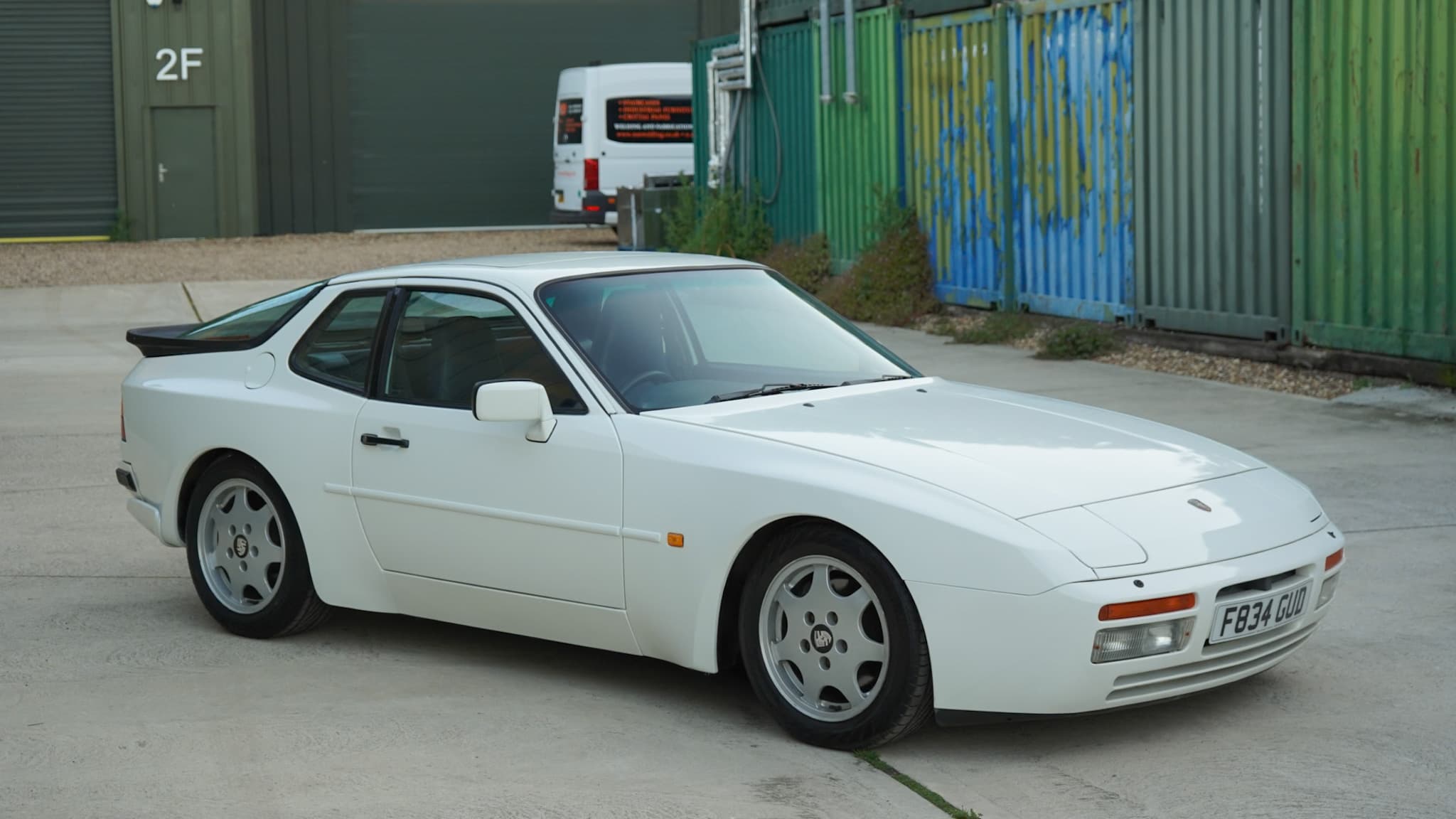
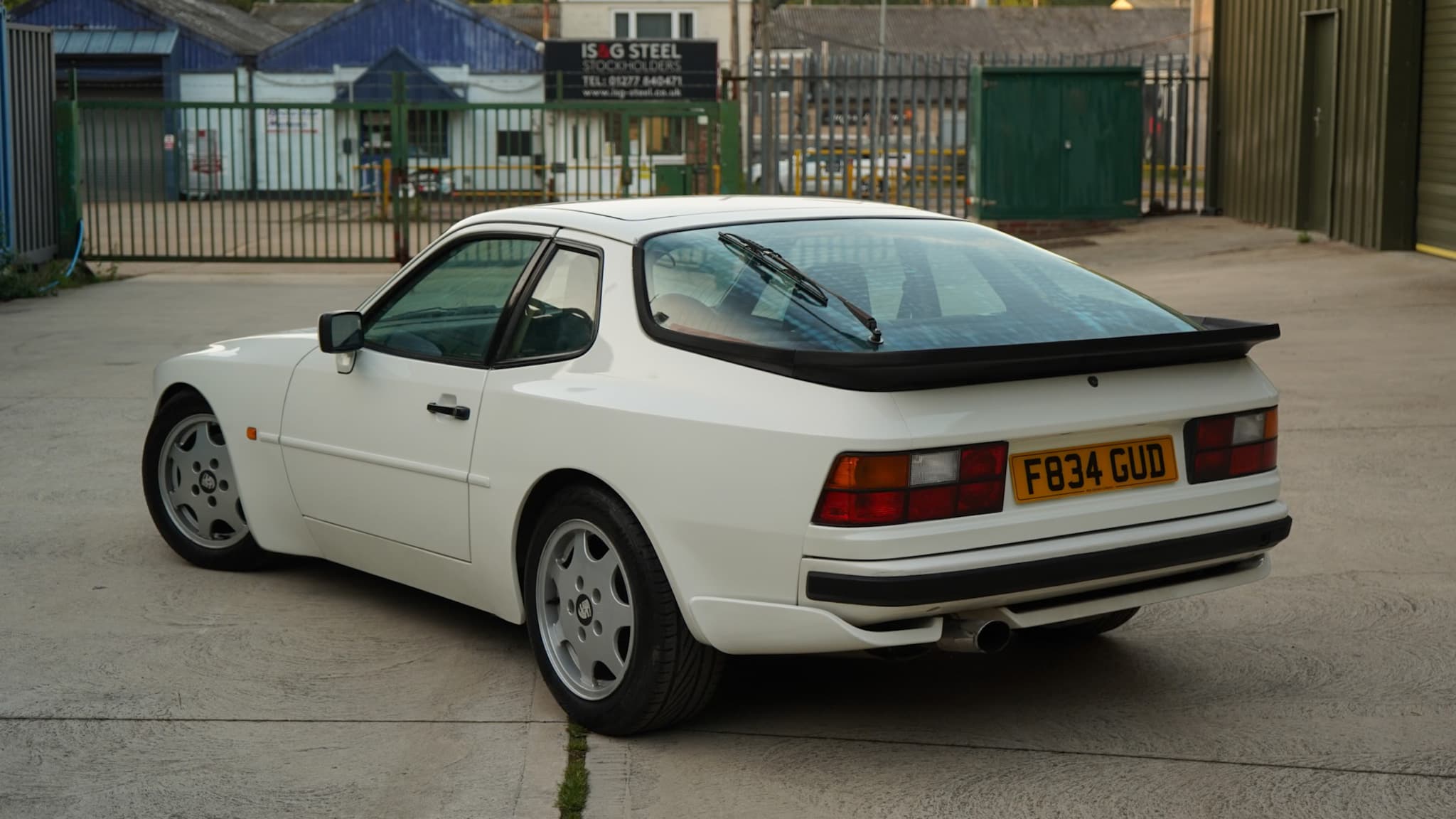
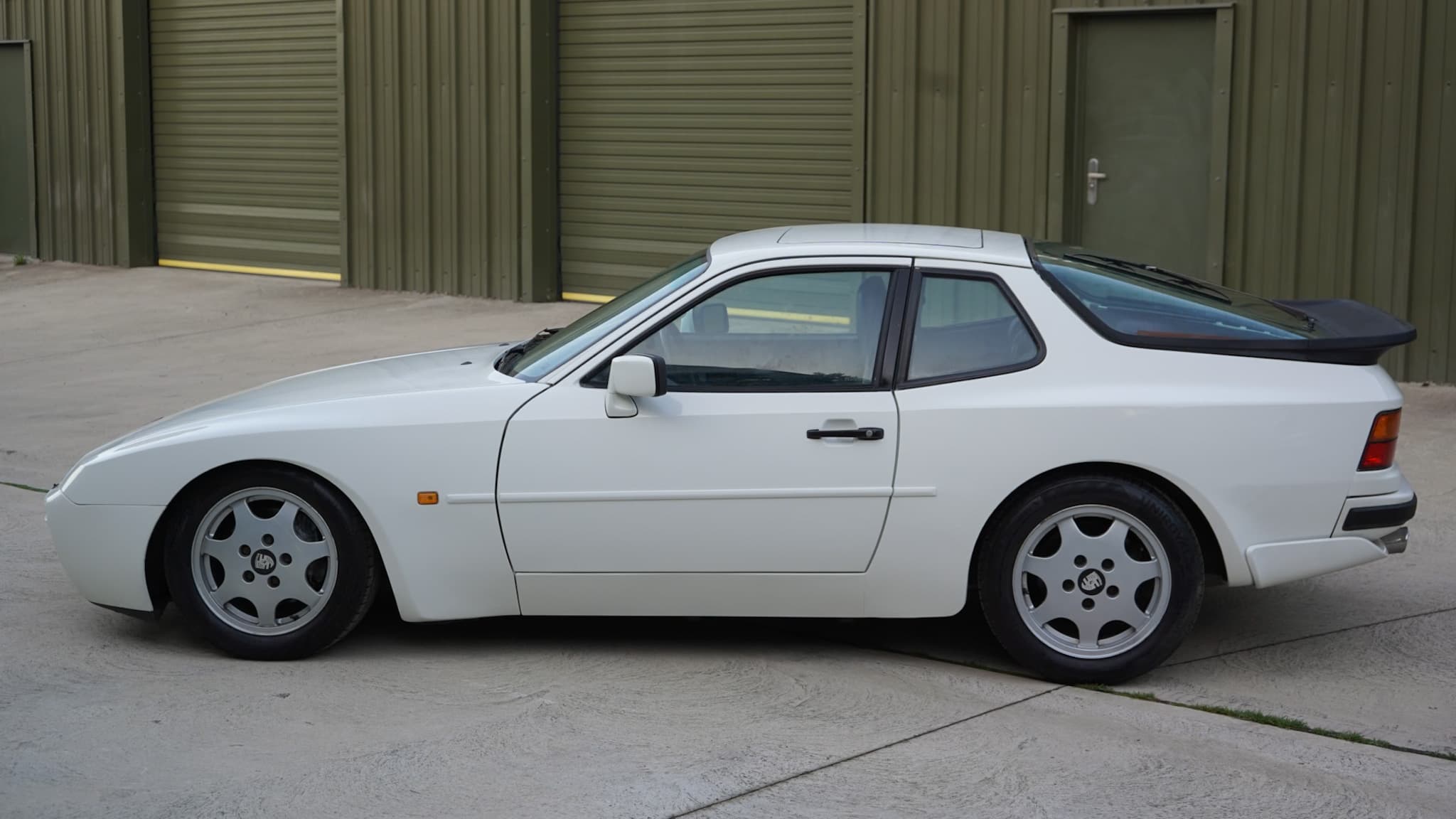
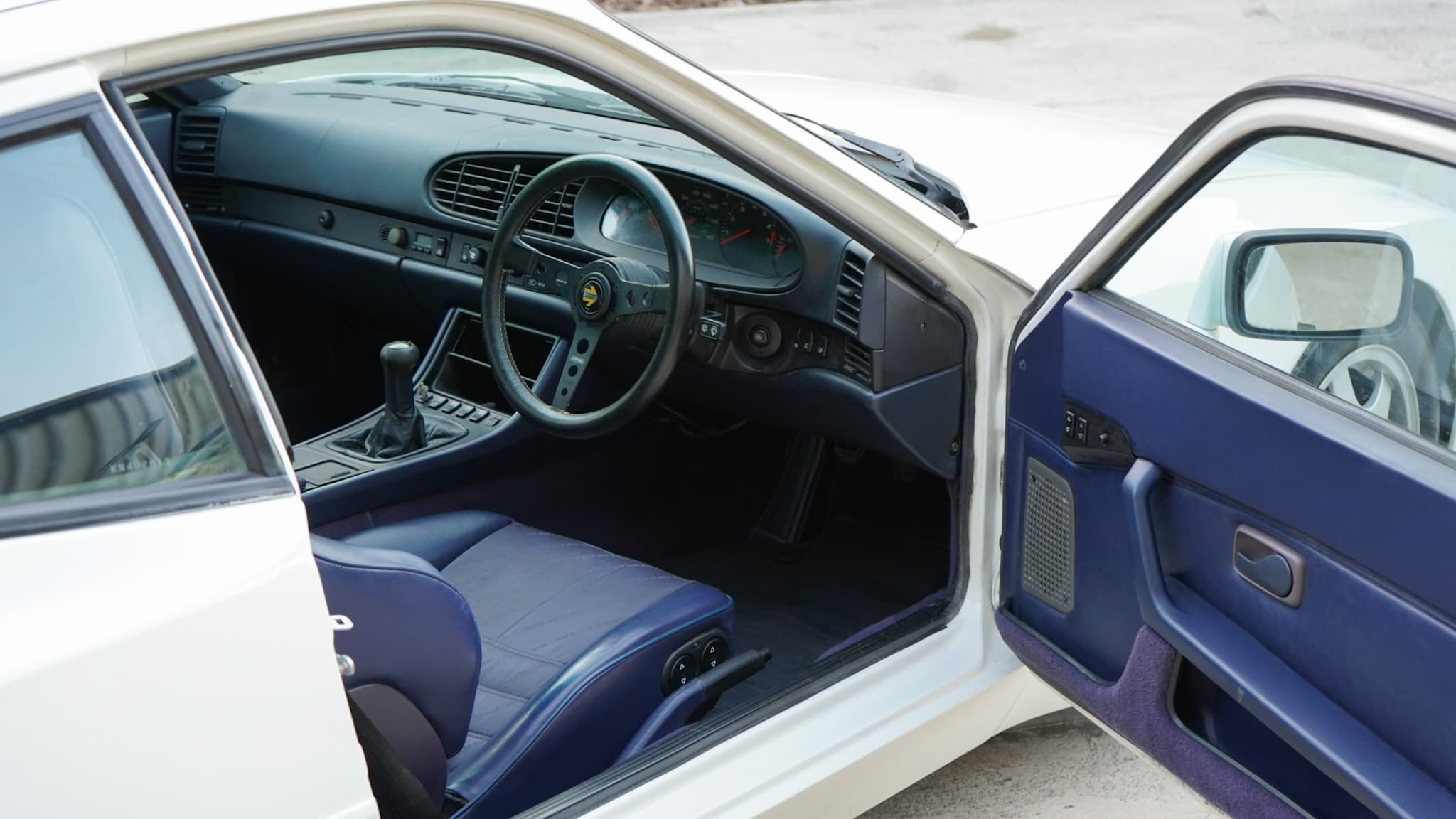
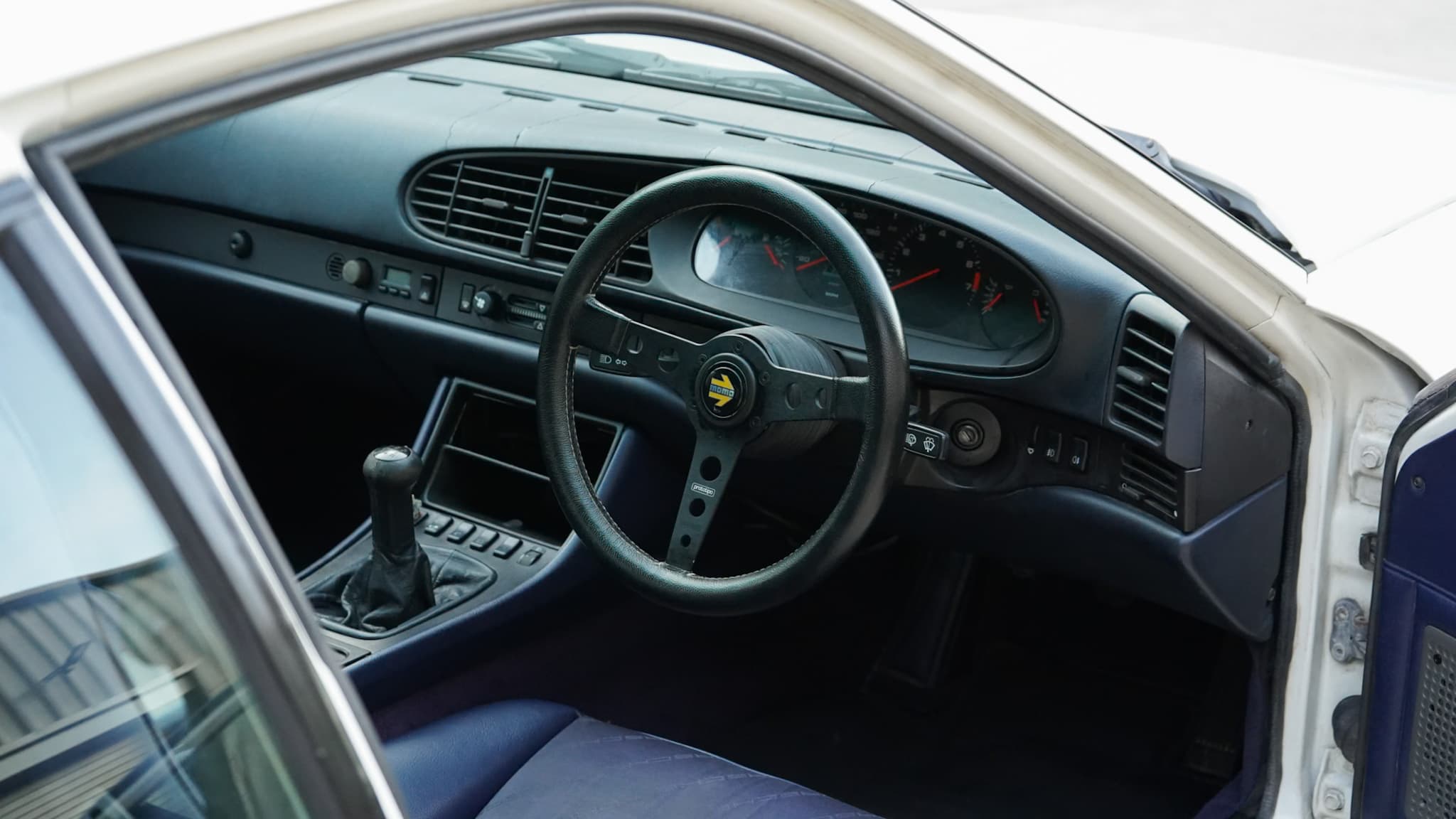
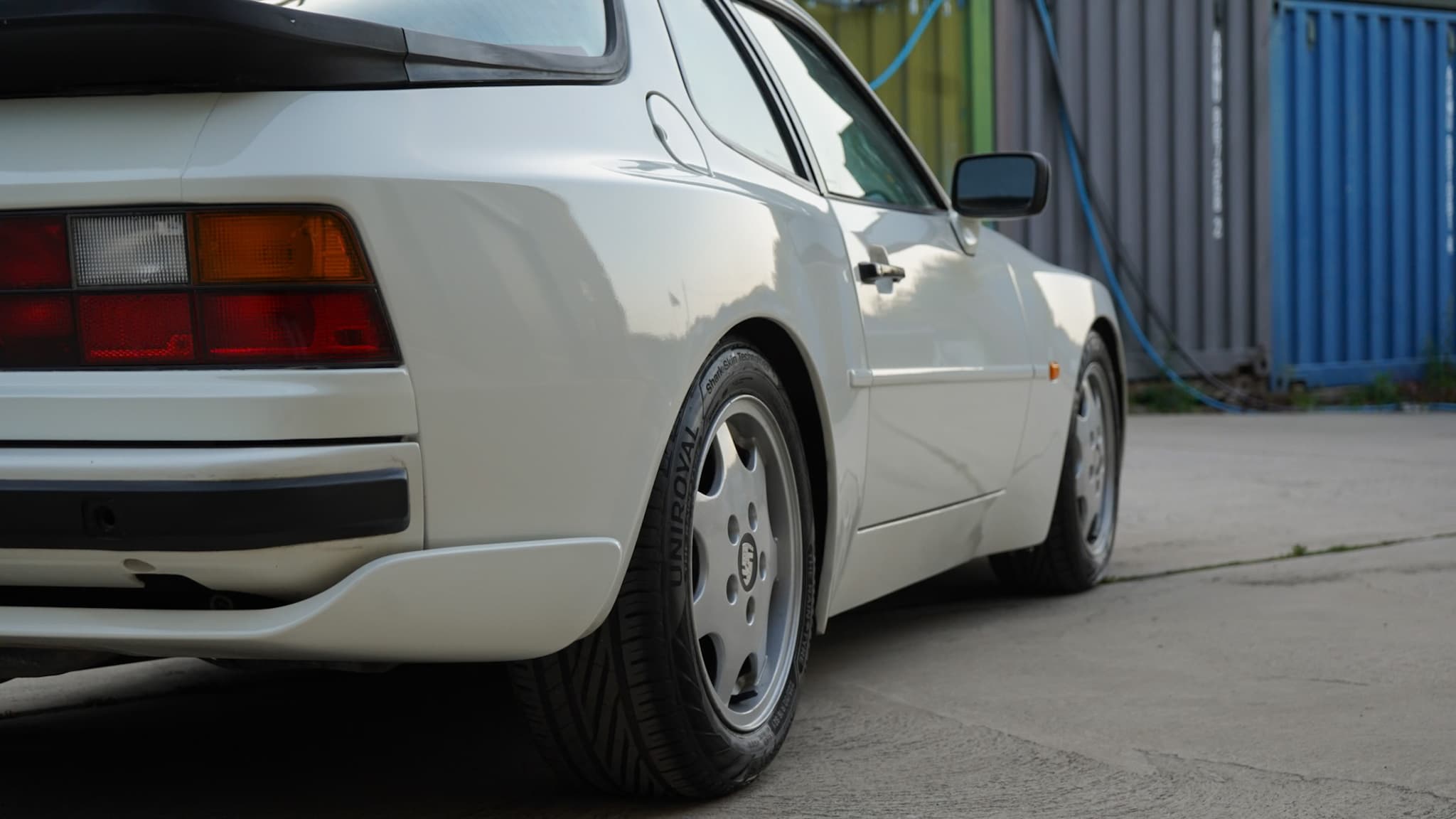
The Matt Johnston Collection has handled a 1989 right-hand-drive 944 S2 Coupé with a manual gearbox and 3.0-litre inline-four.
The car makes the late-944 branch concrete, but its individual details do not generalise to the model. Its white paint, blue trim, mileage and individual history belong to that specific example.
Factory model history answers what Porsche offered; chassis records, option information, service history and physical inspection answer what a particular car actually is today.
For the S2 in particular, that means avoiding the temptation to authenticate a car from a Turbo-style nose, wheel design or a badge alone. Parts move between cars, specifications vary by year and market, and three decades of maintenance can alter even a genuine car substantially.
The production number tells part of the story. Porsche records 163,302 944s by the time the series ended in 1991.
More revealing is the speed of its early success. Porsche says dealers received 30,000 orders in the first production year, and after the first year of sales the 944 accounted for around 51% of total Porsche production. Porsche Museum material says no previous Porsche had sold so well or so quickly.
That success expanded the car from one model into Turbo, S, S2 and Cabriolet derivatives. It also gives the 944 an important place in Porsche history that is easy to miss when the story is told almost entirely through the 911.
The Porsche model history is therefore broader than a rear-engined story. During the 1980s, the front-engined transaxle cars were a substantial part of what Porsche actually built and sold.
Before comparing values or specifications, establish the identity of the car in front of you.
Start with the year and derivative. Then establish its original market, engine, transmission and option specification from evidence appropriate to that car. A 944 S, S2 and Turbo are not interchangeable specification labels, and even cars carrying the same derivative name changed through production.
For a potential purchase, service and provenance records matter at least as much as a visually correct set of period parts. Porsche Classic's own S2 restoration account specifically discusses continuous history, accident status, toothed-belt maintenance and whether restoration work can be documented. That is a better model for evaluating a classic than treating low mileage or cosmetic originality as sufficient on its own.
Begin with the structure, even though Porsche galvanised the body. Hagerty UK's 944 guide highlights the wheelarches, wings and sills as corrosion areas and recommends inspecting underneath rather than treating a tidy upper body as proof of a sound shell.
Read the service file against the exact derivative. Every 944 needs clear evidence for the relevant belt work; on the 16-valve S and S2, references to the cam chain, tensioner or pads must be kept separate from the external camshaft and balance-shaft belts. A vague invoice saying only “belts” or “chain” does not prove that all relevant work was completed.
On a test drive, listen for transmission whine, check that gear selection is clean rather than vague, and assess whether ageing suspension has actually been renewed. These are screening checks, not a substitute for an inspection by a specialist familiar with front-engined transaxle Porsches. The collector-car provenance checklist gives a document-led framework for checking the individual car. For derivative-specific detail, continue to the 944 II generation, the 944 S2 specifications and buying guide, or the 944 S2 vs Turbo comparison.
The Porsche 944 was revealed in 1981, produced from 1982 to 1991, and developed from Porsche's 924 Carrera/transaxle programme rather than appearing as an unrelated replacement.
Its new four-cylinder was based on the right bank of the 928 V8; a prototype of the future car had already been tested at Le Mans in 1981 under the 924 GTP name; and the range eventually grew through Turbo, S, S2 and Cabriolet versions.
The late 3.0-litre S2 shows how far that original idea evolved, while the total of 163,302 cars shows how commercially important the model became.
Editorial information
Research and editorial from TMJC Garage.
Research and editorialTMJC Garage
Reviewed byMatt Johnston
Last reviewed20 September 2026
Published byThe Matt Johnston Collection
Model lineage
TMJC photography
TMJC Guides
TMJC assistance
Continue to the main TMJC website and speak directly with the collection team.
Sell, consign or source
Continue with TMJC for a discreet conversation, professional presentation and collector-focused support.
Enquire now