Published guide
Porsche 944 S2 vs Turbo: what actually differs?
A like-for-like Porsche 944 S2 vs late Turbo comparison, including the 1989 250 PS Turbo change, performance, engine response, shared body cues and timing-drive differences.
Overview
A like-for-like Porsche 944 S2 vs late Turbo comparison, including the 1989 250 PS Turbo change, performance, engine response, shared body cues and timing-drive differences.
This guide covers 944 and links directly to the relevant car record for further detail.
The Porsche 944 S2 and 944 Turbo sit close together in the late 944 range, but many comparisons start with the wrong Turbo. The original 944 Turbo arrived with 220 PS. The S2 came later with 211 PS, but by then Porsche had already introduced a 250 PS Turbo S, and for model year 1989 the regular 944 Turbo inherited that 250 PS engine.
So if you are comparing a late S2 with a contemporary late Turbo, the useful comparison is 211 PS naturally aspirated S2 versus 250 PS Turbo — not 211 versus 220.
That makes the Turbo clearly faster on paper. It does not make the S2 a lesser version of the same idea. The S2's 3.0-litre naturally aspirated engine responds differently, its 16-valve timing system creates a different maintenance question, and its use of the Turbo bodyshell means the two cars can look more alike than their engines suggest.
For the broader model history, see our Porsche 944 reference.
Which Turbo should you compare with a 944 S2?
Start with model year.
Porsche's own chronology separates three stages that often get blended together in adverts and comparison articles:
- the 944 Turbo launched in 1985 with 220 PS;
- the 944 Turbo S arrived for model year 1988 with 250 PS; and
- for model year 1989, Porsche says the regular 944 Turbo received the Turbo S engine.
The S2 also belongs to this late period. Porsche Classic lists it as MY1989-91, while Porsche's historical chronology places its introduction in 1988.
That means an early 220 PS Turbo can be a perfectly valid car to compare with an S2 if those are the two cars in front of you, but it is not the correct specification to use for every late Turbo. If a seller says only 944 Turbo, establish the model year before borrowing performance figures.
944 S2 vs late 944 Turbo: the factory numbers
Using Porsche's S2 specification and the Porsche Museum's model-year 1989 Turbo Coupé data gives a clean late-car comparison:
| 944 S2 | 944 Turbo, MY1989 | |
|---|---|---|
| Engine | 3.0-litre four-cylinder, 16-valve, naturally aspirated | 2.5-litre four-cylinder, turbocharged |
| Displacement | 2,990 cc | 2,479 cc |
| Power | 211 PS at 5,800 rpm | 250 PS |
| 0-100 km/h | 7.1 s | 5.9 s |
| Top speed | 240 km/h | 260 km/h |
| Layout | Front engine, rear transaxle, rear-wheel drive | Front engine, rear transaxle, rear-wheel drive |
The difference is large enough that it should not be disguised with vague language: the late Turbo is the quicker car. Porsche's Museum sheet gives it a 1.2-second advantage to 100 km/h and another 20 km/h of maximum speed.
But those figures still do not explain the whole driving difference.
Why can the S2 feel more immediate even though the Turbo is faster?
A Porsche Newsroom-hosted Porsche Klassik S2 retrospective makes a useful distinction. It describes the 3.0-litre four-valve naturally aspirated engine as having better driveaway response than the 2.5-litre two-valve turbo, because the turbocharged engine needs engine speed before boost has fully built.
That is not a claim that the S2 accelerates harder overall. Porsche's own 0-100 km/h figures show the opposite. It is a distinction between initial throttle response and maximum acceleration once the Turbo is working in its stronger part of the rev range.
For a road buyer, that difference is more informative than saying one car has more character. The S2 makes its performance without waiting for boost. The Turbo uses forced induction to produce a much stronger headline result. Which sensation you prefer is subjective; the engineering difference is not.
Porsche gives the S2 280 Nm at 4,100 rpm. We have deliberately not filled the Turbo side of the table with a torque figure taken from a different body-year reference just to make the grid look complete. The dedicated MY1989 Turbo Coupé Museum sheet used above does not print torque, so the comparison keeps its source boundaries visible.
Does the S2 really share the Turbo body?
Yes. Porsche Classic says the S2 used the more substantial Turbo bodyshell and rear diffuser, and its model archive gives the S2 the same broad late front treatment: integrated fog and main-beam lamps beneath the indicators with an air opening between them.
That matters when identifying cars because the familiar smooth late 944 nose is not proof that the engine is turbocharged. An S2 can legitimately wear much of the visual language people associate with the Turbo.
The Turbo still has its own derivative history and detail changes — including the later rear-wing change — but body appearance should be corroboration, not the foundation of an identity claim. Establish the chassis/model record and engine specification first, then use body details to see whether the car is coherent with that record.
It is especially important on cars that have been restored or modified. Bumpers, wings, wheels and badges are all easier to swap than the underlying factory identity.
The service-history question is different on the S2
Both late cars need serious attention to timing-belt history. Porsche Cars North America's Classic schedule PNA CLA 162 F covers the 944 Series MY1985/2-91 and, specifically for 944 S2/Turbo MY1989-91, calls for camshaft drive-belt replacement every 45,000 miles / 72,000 km, with a condition/tension check 2,000-2,500 miles after replacement. It also specifies periodic camshaft and balance-shaft belt tension checks.
That is useful manufacturer evidence, but it is North-American factory guidance. It should not be silently converted into a universal UK interval. For a British car, its market-specific handbook/service booklet, dated invoices and current specialist advice remain important.
The S2 then adds another piece of hardware that makes seller shorthand dangerous. Porsche parts material identifies the S2's 3.0-litre engine as M44.41 and shows its camshaft timing belt. Porsche factory workshop literature also shows an internal timing chain linking the two camshafts, with its own chain tensioner.
So on an S2:
belts doneshould mean something specific and documented; andtiming chain doneis a different job and does not prove the external camshaft drive belt was replaced.
The late Turbo uses a two-valve single-overhead-cam layout, so it does not have the S2's twin-cam interconnection to account for. That does not make the Turbo cheap or maintenance-free: it adds turbocharging and associated induction/boost hardware instead. It simply means the two cars present different technical questions.
A useful comparison therefore asks what work has actually been done to each car rather than trying to rank them with a generic more reliable label.
Is an S2 just the cheaper alternative to a Turbo?
That is the wrong way to frame the model.
Porsche itself describes the S2 as the naturally aspirated development of the 944 taken much further: a 3.0-litre, four-valve engine producing 211 PS, with the Turbo-style body and the same underlying transaxle philosophy. At the time, Porsche highlighted the 3.0 as an unusually large production four-cylinder.
The late Turbo answers a different brief. Its 2.5-litre engine uses turbocharging to reach 250 PS and materially stronger straight-line performance. Porsche's MY1989 Museum sheet also records sports suspension, standard ABS, internally ventilated brakes all round and 16-inch wheels inherited from the Turbo S for that reference specification.
The S2 therefore makes most sense as the final naturally aspirated 944 route, not as a Turbo that failed to receive a turbocharger. A buyer who values immediate naturally aspirated response can prefer the S2 without pretending it is as fast. A buyer who wants the strongest acceleration has a straightforward reason to prefer the late Turbo.
What should you verify before buying either one?
First establish what year and derivative you are actually looking at. That sounds obvious, but it prevents most of the specification errors in this comparison.
For an S2, verify that the car's identity and 3.0-litre 16-valve specification agree with its records, then read the timing history in detail. Ask when the toothed belts were changed, what was included and whether any inter-cam chain/tensioner work is separately documented. Do not accept timing done as a complete description.
For a Turbo, establish whether it is an early 220 PS car, a Turbo S, or a regular MY1989-on 250 PS Turbo before using performance or equipment figures. On a modified car, separate factory identity from later boost, turbocharger, intercooler, suspension or wheel changes.
On both cars, service continuity, accident/repair history, corrosion and the quality of previous work matter more than winning a specification-sheet argument. The Porsche Newsroom-hosted S2 restoration retrospective starts from history and condition rather than assuming that a desirable badge makes a good car.
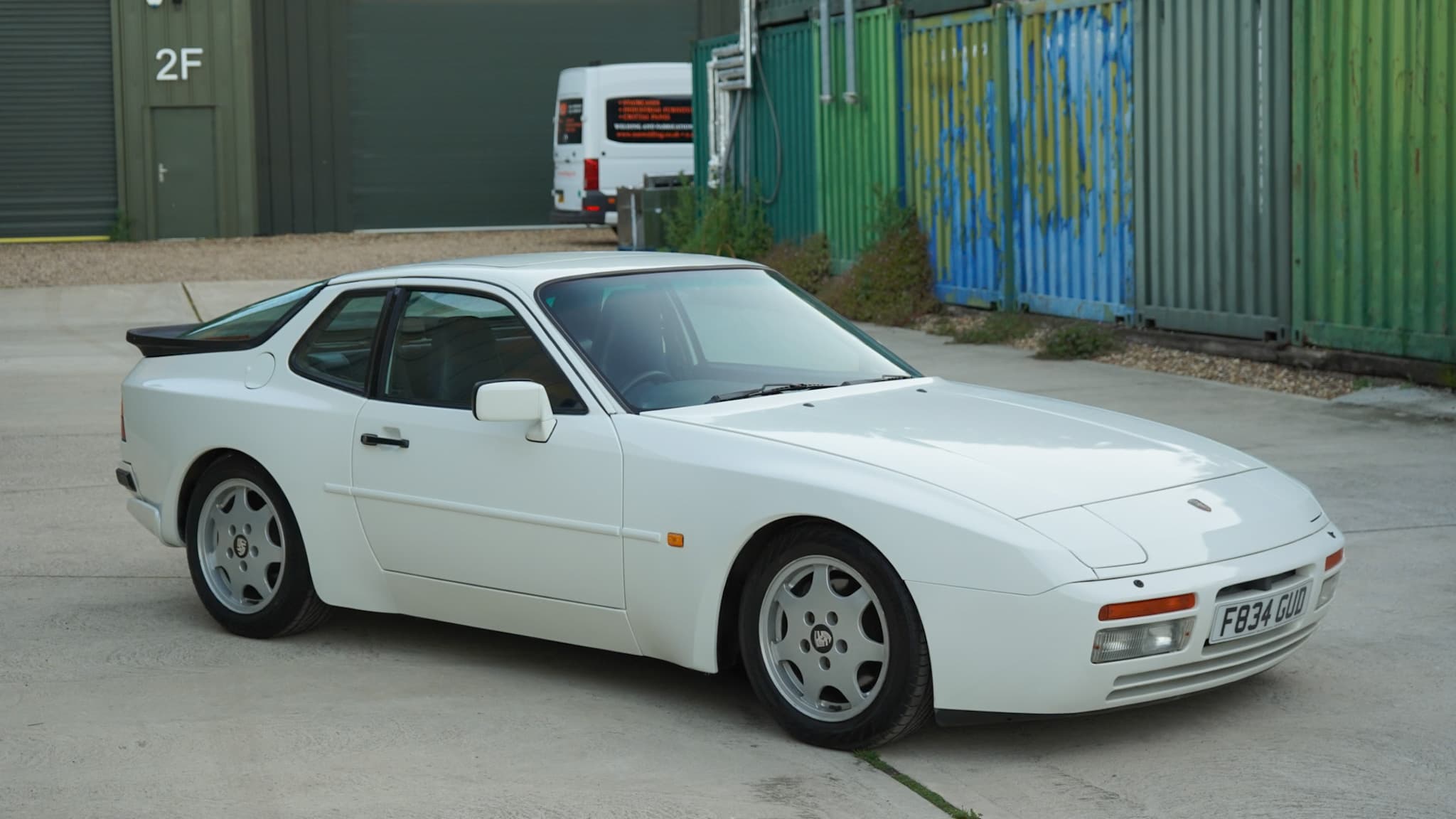
TMJC's 1989 944 S2
The Matt Johnston Collection has handled a 1989 right-hand-drive manual 944 S2 with the 3.0-litre four-cylinder. It is a useful real-world anchor for this comparison because 1989 is exactly the point at which Porsche's regular Turbo had moved to the 250 PS Turbo S engine.
That does not let us generalise the TMJC car's colour, mileage, condition or individual history to every S2. Its relevance is narrower and more useful: TMJC has handled a genuine example from the late 944 period in which the S2 and 250 PS Turbo sat alongside one another.
So which is the better 944: S2 or Turbo?
There is no evidence-based universal answer, but there is a much better way to make the decision than comparing badges.
Choose the late Turbo if the priority is the stronger factory performance envelope: Porsche's MY1989 figures are 250 PS, 5.9 seconds to 100 km/h and 260 km/h.
Choose the S2 if the appeal is the 3.0-litre naturally aspirated response and the late Turbo-bodied 944 without forced induction. Porsche itself notes the immediate driveaway character of the S2's engine, even while the published performance numbers favour the Turbo.
Then judge the actual cars. A well-documented S2 with clear timing history is a different proposition from a neglected one, just as a correct late Turbo is different from a heavily modified car with unclear boost and maintenance history.
The most useful first question is therefore not S2 or Turbo? It is which S2, which Turbo, and what does the evidence say about this particular car?
Sources and further reading
- The Matt Johnston Collection — 1989 Porsche 944 S2
- Porsche Classic — Model 944
- Porsche Classic — Model 944 Turbo
- Porsche Museum — Porsche 944 Turbo Coupé, Model Year 1989
- Porsche Newsroom — Glass dome: 944 S2
- Porsche — transaxle model chronology
- Porsche Cars North America — 944 Series maintenance schedule, PNA CLA 162 F
- Porsche Classic ORIGINALE 01 — 944 parts coverage
Related car