TMJC assistance
Want TMJC to help with this vehicle?
Sourcing, consignment and valuationContinue to the main TMJC website and speak directly with the collection team.
Variant
Factory specs, 991.1-vs-991.2 identification, standard equipment, manual vs PDK, Targa roof operation and used-car checks.
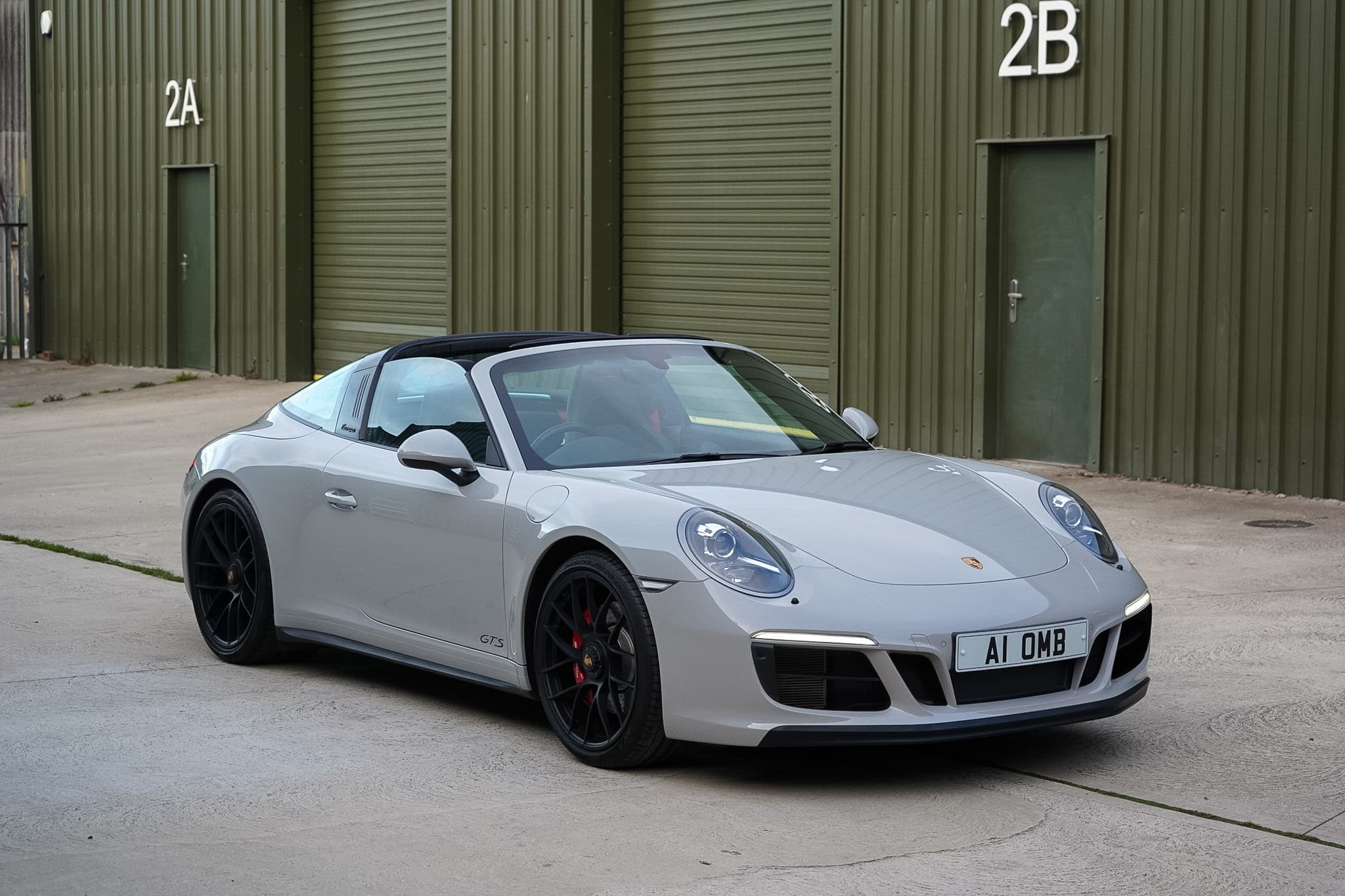
TMJC guide
Factory specs, 991.1-vs-991.2 identification, standard equipment, manual vs PDK, Targa roof operation and used-car checks.
The Porsche 911 Targa 4 GTS (991.2) is the turbocharged second-phase version of Porsche's 991-generation Targa GTS. The Targa 4 GTS badge itself first appeared in 2015 on the naturally aspirated 991.1; Porsche then introduced the updated 991.2 GTS family for March 2017 in Germany, with the Targa again offered only with all-wheel drive.
For the 991.2, Porsche used a 3.0-litre turbocharged flat-six producing 331 kW / 450 PS and 550 Nm, with a seven-speed manual or optional seven-speed PDK. The fully automatic Targa roof and wide all-wheel-drive body remained defining parts of the package.
Used-car adverts blur both points surprisingly often: a 991 Targa 4 GTS is not automatically a 991.2, and a long feature list can make standard GTS equipment look like paid options.
| Item | Factory launch specification |
|---|---|
| Generation | Porsche 911 Type 991, updated 991.2 phase |
| Body style | Targa |
| Engine | 3.0-litre turbocharged flat-six |
| Power | 331 kW / 450 PS |
| Torque | 550 Nm from 2,150-5,000 rpm |
| Drivetrain | All-wheel drive |
| Transmission | Seven-speed manual or optional seven-speed PDK |
| PASM | Standard |
| Sport Chrono | Standard |
| Sports exhaust | Standard |
| Wheels | 20-inch centre-lock GTS wheels in black finish |
Porsche launched the revised GTS family for March 2017 in Germany. Exact UK registration dates and country-specific comfort equipment should be checked against the individual car's build record rather than inferred from the launch release.
Porsche's period 2017 US technical sheet goes well beyond the headline power figure. For the Targa 4 GTS it lists six cylinders, four valves per cylinder, direct fuel injection, a 91.0 mm bore, a 76.0 mm stroke, 10.0:1 compression and a 7,500 rpm maximum engine speed. Porsche's own current Finder technical data for a 2017 991 II Targa 4 GTS instead lists the same 91.0 mm bore with a 76.4 mm stroke. Because those manufacturer sources differ on the precision of the stroke figure, treat 76.0 mm as the rounded period US-sheet value rather than a universally exact measurement.
The standard steel braking hardware is substantial: 350 mm front and 330 mm rear discs, with six-piston front and four-piston rear aluminium monobloc fixed calipers. Porsche specifies 20-inch centre-lock wheels at 9J x 20 ET51 front and 12J x 20 ET63 rear, carrying 245/35 ZR20 front and 305/30 ZR20 rear tyres.
Physical dimensions in Porsche's technical data are 4,528 mm long, 1,852 mm wide excluding mirrors, 1,291 mm high and 2,450 mm in wheelbase. These figures are useful when checking a car, wheel fitment or transport/storage dimensions because they belong to the Targa 4 GTS column rather than being borrowed from a Carrera Coupé.
Porsche Cars North America's sheet also quotes different weight and performance figures by gearbox: 3,495 lb curb weight and 191 mph top track speed for the manual, versus 3,539 lb and 190 mph for PDK, with 0-60 mph in 3.9 seconds manual or 3.5 seconds for PDK using Launch Control. Those are US-market technical-data figures and should not be relabelled as UK homologation numbers or used to turn 0-60 mph into 0-62 mph. TMJC's individual PDK example is listed at 0-62 mph in 3.7 seconds.
The 991.2 GTS moved away from the naturally aspirated engine used by its predecessor. Porsche's updated GTS used a 3.0-litre turbocharged six-cylinder boxer, with revised turbocharging raising output to 450 PS.
For the Targa, the other defining mechanical fact is the driven axle layout: there was no rear-wheel-drive Targa GTS equivalent. Porsche's model was the Targa 4 GTS, using all-wheel drive.
Maximum torque was 550 Nm across a broad 2,150-5,000 rpm range, which is one reason the 991.2 GTS feels materially different from the earlier naturally aspirated GTS even before gearbox choice is considered.
Porsche offered the GTS models with a seven-speed manual or optional PDK.
That wording is worth preserving. PDK is very common on used Targa 4 GTS cars, but common is not the same as standard. A PDK car tells you something about the original configuration and should be verified against the VIN-linked build data or original invoice.
Performance figures also depend on gearbox and equipment, so do not apply the quickest PDK acceleration number to a manual car.
No. Rear-axle steering was optional on the 991.2 Targa 4 GTS. It should not be added to a car's specification simply because it wears a GTS badge.
Current GTS material can make this easy to misread. Porsche's 2024 911 update says rear-axle steering came as standard on the new GTS for the first time. That later 992-generation specification should not be back-applied to the 2017-2019 991.2.
A current Porsche Approved listing for a 2018 991 II Targa 4 GTS provides a period-car cross-check: Porsche Finder places rear-axle steering under that car's Included Options, before a separate Standard Equipment list. Period road-test material also describes the system as optional.
For a used 991.2, verify rear-axle steering from the individual build record or VIN-linked specification. A dealer advert can omit equipment, and photographs do not reliably prove whether the system is fitted.
TMJC's own 2018 example lists front-axle lift but does not state rear-axle steering, so it should not be silently added to that car.
Porsche's launch material makes several desirable features part of the GTS identity rather than individual-car extras:
Those features are still important. They are just poor evidence that one used GTS was more heavily optioned than another.
For the deeper standard-versus-option breakdown, see TMJC's 991.2 Targa 4 GTS options guide.
The Targa 4 GTS did not begin with the 991.2. Porsche unveiled the first version at the Detroit motor show in January 2015, during the naturally aspirated 991.1 phase. That earlier car made 316 kW / 430 PS and already combined all-wheel drive, the automatic Targa roof, Sport Chrono, PASM, sports exhaust and black 20-inch centre-lock wheels.
The 2017 991.2 version is mechanically easy to separate once the engine specification is known: Porsche replaced the previous naturally aspirated GTS engine with the 3.0-litre turbocharged flat-six, raising output to 331 kW / 450 PS and torque to 550 Nm.
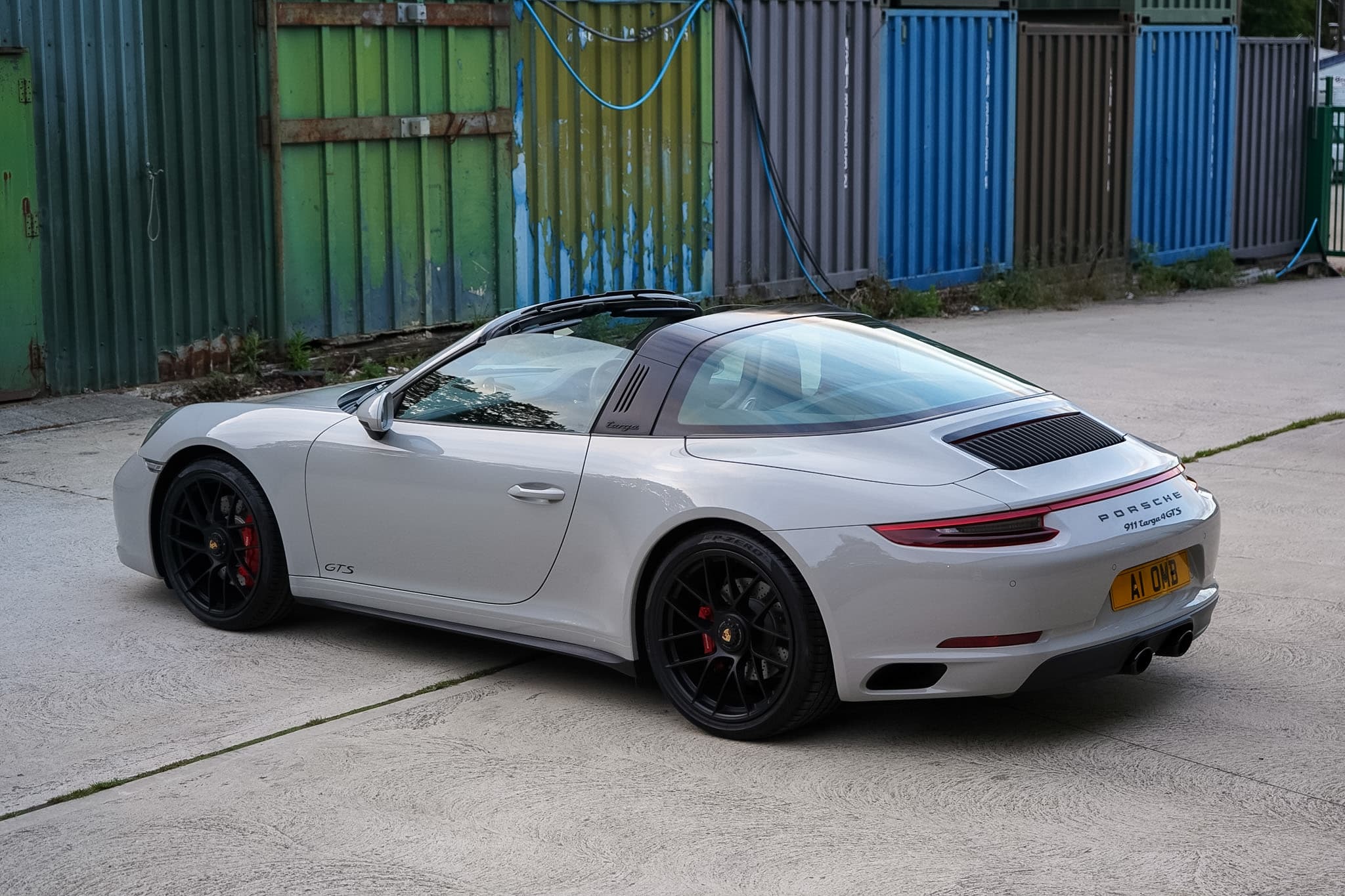
The Targa bar also helps distinguish the two phases. Porsche's 2015 launch describes the first Targa 4 GTS with a silver rollover bar carrying black targa lettering. For the 2017 GTS update, Porsche says the Targa bar itself was supplied in black for the first time on the GTS. The later car also received the 991.2 GTS rear treatment with smoked tail lights and central black twin sports-exhaust outlets.
Those cues are useful when checking photographs, but they are not a substitute for the car's VIN-linked build data. Paint, replacement trim and retrofitted parts can blur visual identification, and registration year alone should not be used to decide whether a car is 991.1 or 991.2.
Porsche's 2017 launch release says PASM is standard on all GTS models, then makes a narrower statement that the GTS Coupés receive the PASM sports chassis lowering the body by 10 mm.
Current Porsche Finder GB data for 991 II Targa 4 GTS cars also describes the Targa's standard PASM as having a 10 mm-lower ride height. Those statements should not be forced into a false contradiction.
The Targa had standard PASM, and Porsche's own later Targa data supports a 10 mm-lower ride height, while the launch release uses the specific PASM sports chassis package wording for the Coupés. If the exact chassis package or option code matters, check the individual build record.
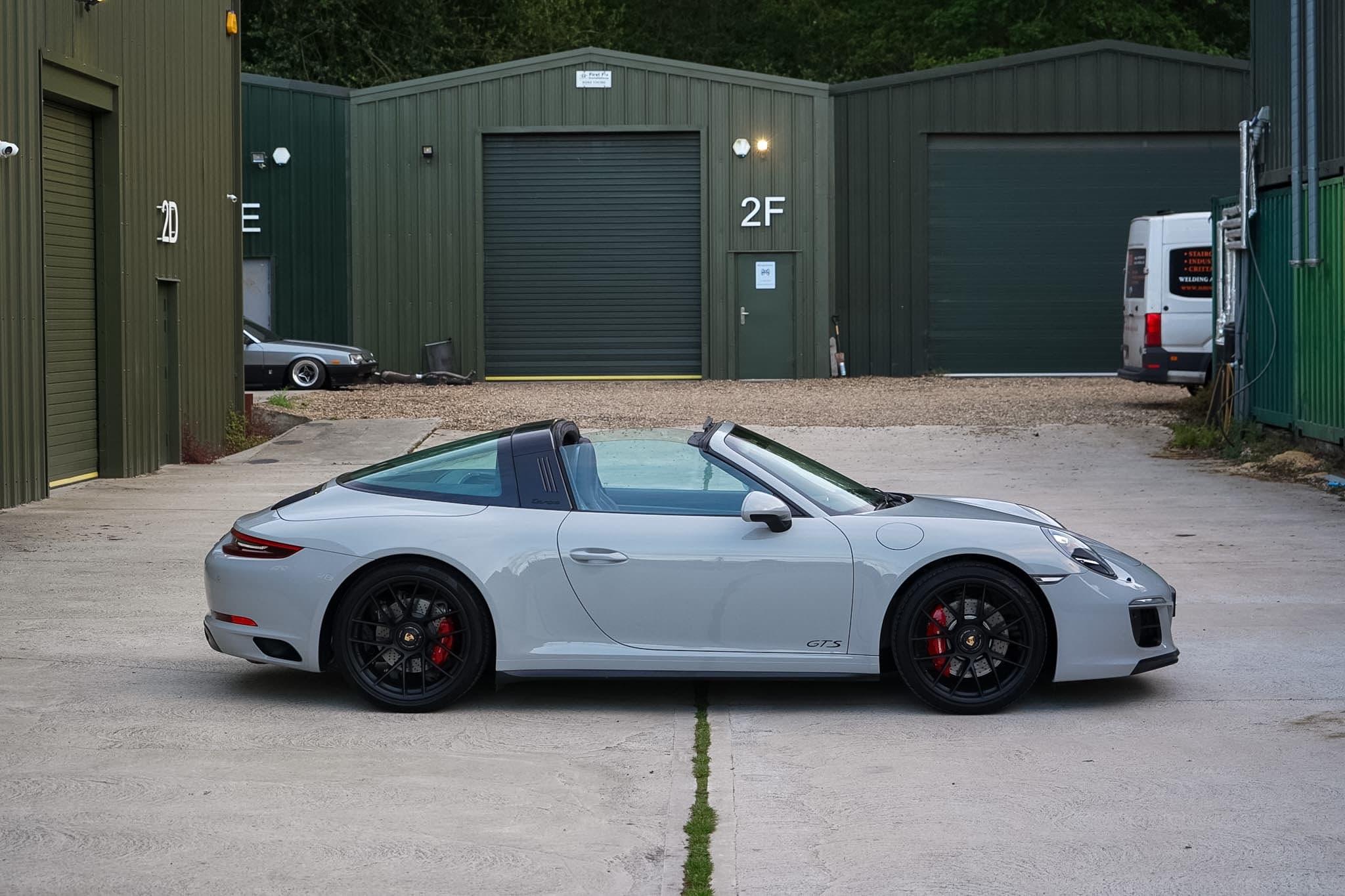
The 991 brought back the visual idea of the classic fixed Targa bar but paired it with a fully automatic roof mechanism. Porsche describes two major moving elements: the soft roof section and the glass rear window. At the start of the cycle, the rear glass lifts and moves backwards, flaps in the Targa bar release the roof mechanism, and the fabric roof folds into a Z-shape behind the rear seats before the glass closes again.
Porsche says the roof can open or close in about 19 seconds while the car is stationary. For a used-car inspection, do not only press the switch once: watch the complete glass and roof movement in both directions, listen for abnormal noises, check that the roof and rear glass settle evenly, inspect seals and drainage areas, and ask about any prior adjustment or repair work.
The complex mechanism is part of what makes the Targa distinct from a Cabriolet or Coupé; it is also why roof condition deserves its own check rather than being buried inside a generic bodywork inspection.
The black 20-inch centre-lock wheels are part of the 991.2 GTS factory package, not simply a visual extra. Porsche's 2017 launch material describes the new GTS models with 20-inch wheels using a central locking device, while Porsche Technical Information 44/19 covers 991 Carrera, Targa and Turbo models from model year 2017 and explicitly includes the 911 Targa 4 GTS in its wheel and tyre tables.
For the GTS group, that bulletin records 245/35 ZR20 front and 305/30 ZR20 rear tyres and includes the 9J x 20 ET51 front / 12J x 20 ET63 rear centre-lock wheel combination. More importantly for ownership, Porsche specifies 600 Nm (444 lb-ft) when mounting a wheel using the central lock.
For a used-car buyer, that makes wheel and tyre history worth checking properly. If the wheels have been removed for tyres, brakes or suspension work, ask who removed and refitted them and whether the workshop followed Porsche's centre-lock procedure with suitable torque equipment. A recent tyre invoice is useful, but it does not by itself show how the wheels were refitted.
The 600 Nm figure is a service-reference point, not a complete DIY instruction. Porsche's vehicle-specific repair information should govern the full removal and installation process.
Porsche's Manufacturer's Certificate 35/21 gives a stronger replacement-tyre check than simply looking for the right size. The 2021 document covers 991 Carrera, Targa and Turbo models from model year 2017 and explicitly groups the 911 Targa 4 GTS with the Carrera GTS and Carrera 4 GTS for its approved tyre combinations.
For the standard 20-inch GTS sizes — 245/35 ZR20 front and 305/30 ZR20 rear — Porsche's approved summer list includes Pirelli P Zero N1, Pirelli P Zero Corsa N0 and Michelin Pilot Sport 4S N0 combinations. That is more specific than treating any tyre with a Porsche-style marking as equivalent.
Porsche also gives a direct mixed-tyre warning: use the same tyre make and type, the same speed index and the same N specification code across the vehicle. The document explains that the full N-code — N0, N1, N2 and so on — should appear on the sidewall near the tyre designation.
For a buyer, inspect all four sidewalls rather than checking tread depth alone. A car can have the correct nominal sizes yet still have a mismatched make, construction or Porsche specification code after piecemeal replacement. Ask for tyre invoices where useful, but verify what is actually fitted.
The approval list is dated, not timeless: 35/21 itself replaced Porsche's earlier 44/19 wheel-and-tyre bulletin. If tyres are being replaced now, use current vehicle-specific Porsche approval information rather than assuming a 2021 list is the final word.
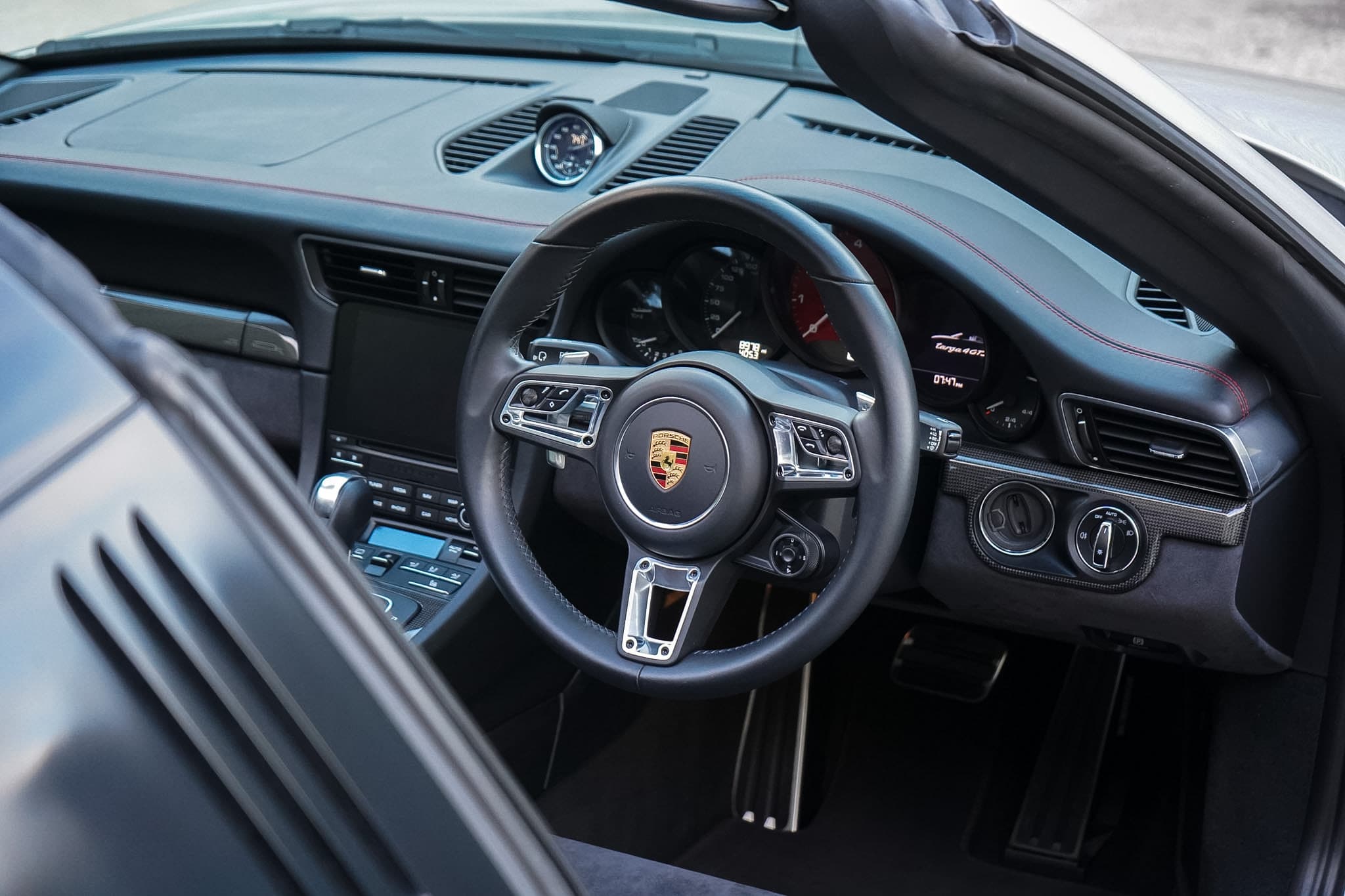
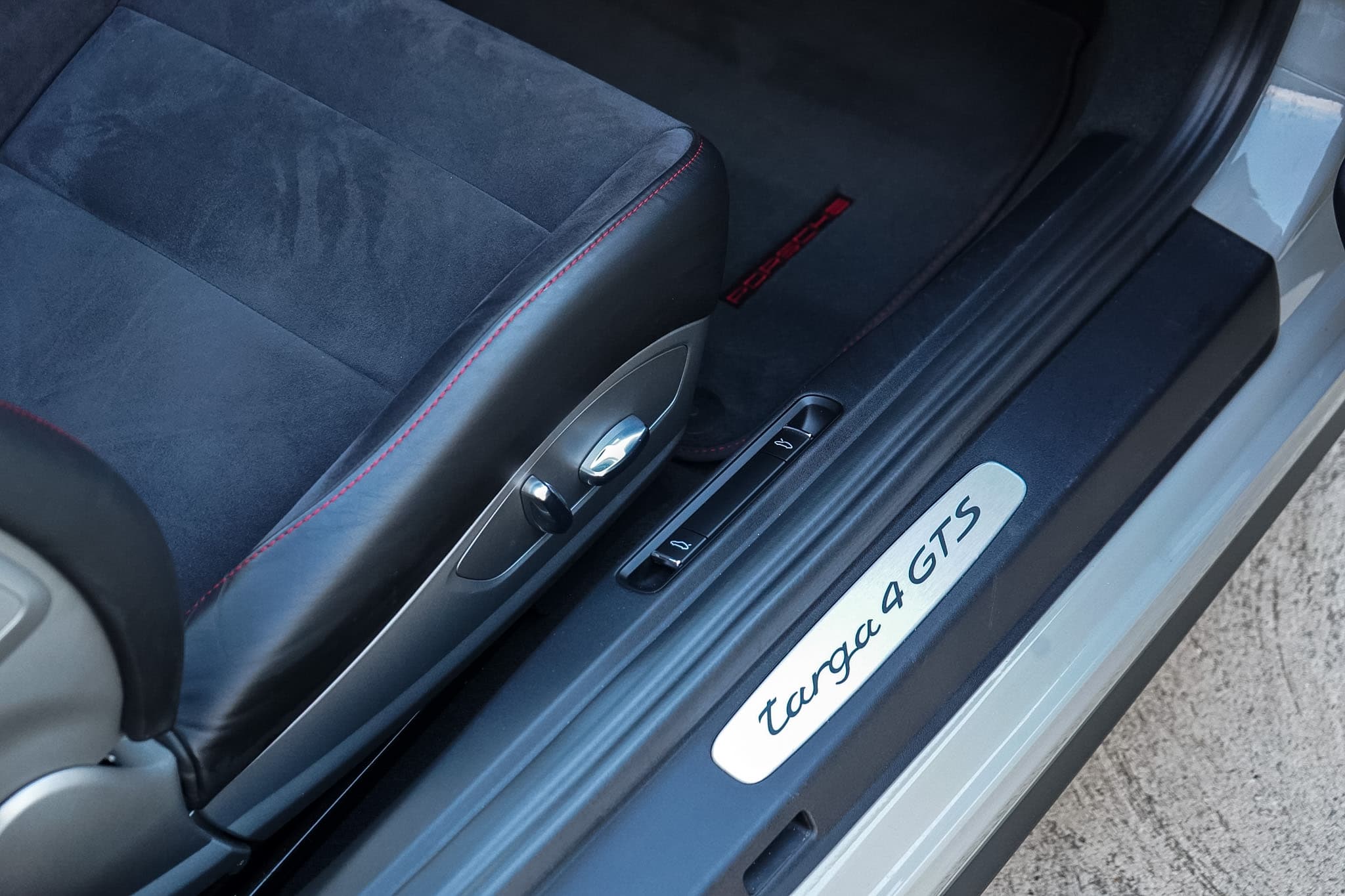
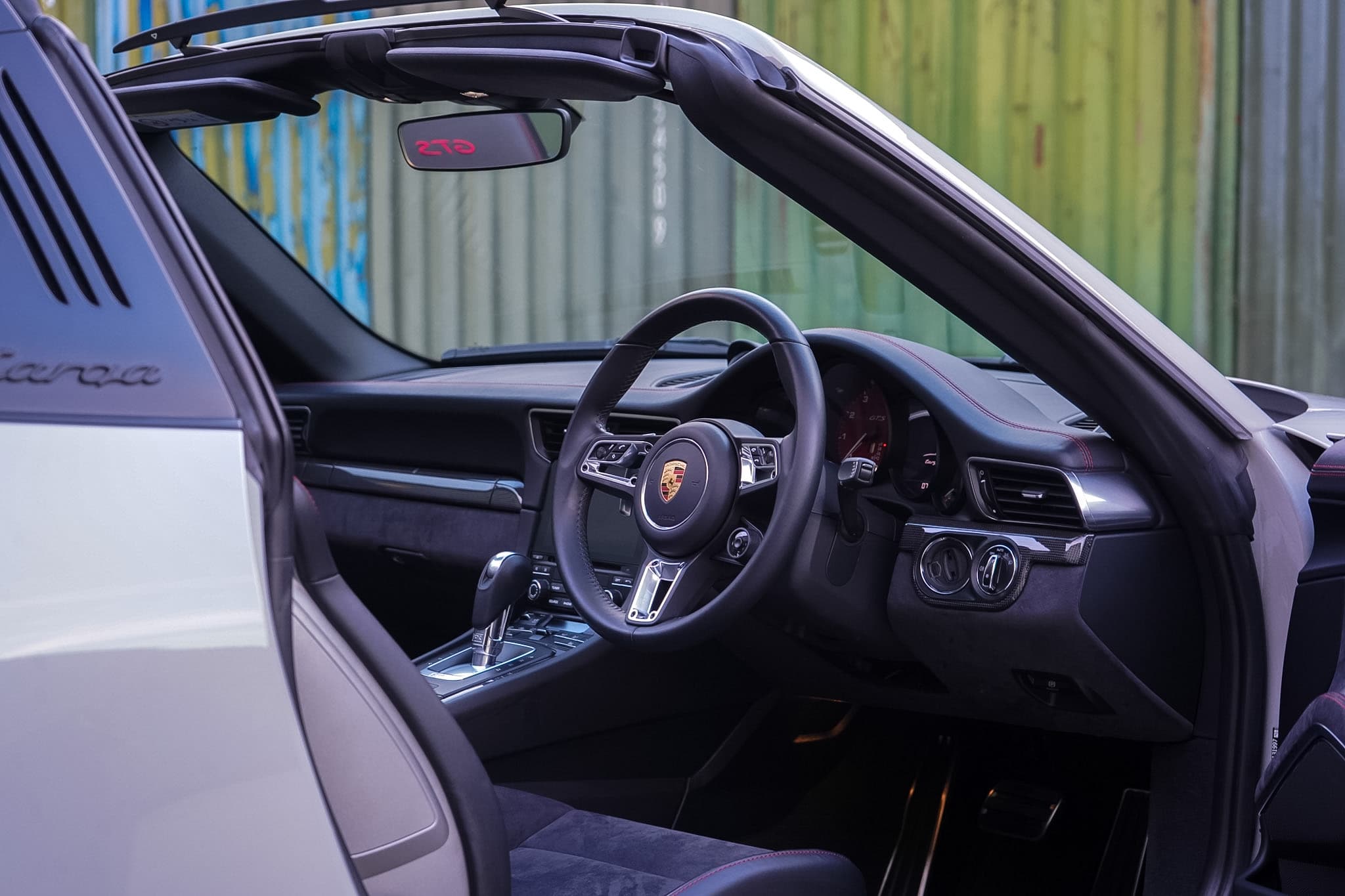
The Matt Johnston Collection has a 2018 right-hand-drive PDK Targa 4 GTS finished in Chalk with a Black/Carmine Red interior. At listing it showed 8,978 miles, with full service history and a May 2026 minor service recorded.
The car's equipment list includes front-axle lift, heated seats, carbon-fibre interior trim, two-zone climate control, BOSE audio and ParkAssist with reversing camera. Those are the kinds of individual features that matter when comparing two used cars.
The same listing also highlights Sport Chrono, sports exhaust, SportDesign treatment and black Turbo S-style centre-lock wheels. Porsche's factory material shows those sit within the GTS baseline or standard wheel treatment. That is why an advert's feature list should not be treated as a paid-options invoice.
Specialist 991.2 buyer evidence broadens the inspection list, but it should not be misrepresented as Targa 4 GTS-specific failure statistics. PistonHeads reports occasional PDK fault warnings or skipped even gears, some water-pump leakage on late-2017/early-2018 cars, suspension-bush or upper-mount noises, rear alignment/tyre-wear issues, steel-disc cracking around drilled holes or squeal, and front-axle-lift pump replacements on some cars fitted with lift.
For a test drive, PDK shifts should feel consistently fast and smooth. Cycle PASM through its modes and make sure the change in damping is perceptible. Inspect the inner and outer shoulders of all four tyres rather than judging tread depth from one edge, and check that the tyres are appropriate Porsche N-rated fitments. On a lift-equipped car, operate the system repeatedly and check for warnings or hesitation.
These checks sit alongside ordinary service-history, recall/campaign and accident-repair verification. They are reasons to inspect carefully, not reasons to assume every 991.2 will develop the same issues.
For the wider generation context, see the Porsche 911 991 generation guide and the broader Porsche 911 model guide.
Editorial information
Research and editorial from TMJC Garage.
Research and editorialTMJC Garage
Reviewed byMatt Johnston
Last reviewed18 September 2026
Published byThe Matt Johnston Collection
Model lineage
TMJC photography
TMJC Guides
TMJC assistance
Continue to the main TMJC website and speak directly with the collection team.
Sell, consign or source
Continue with TMJC for a discreet conversation, professional presentation and collector-focused support.
Enquire now