Published guide
Porsche 991.2 Targa 4 GTS: standard vs optional
What came standard on the 991.2 Targa 4 GTS, which extras were optional, and why Porsche's own PASM/10 mm wording needs careful reading.
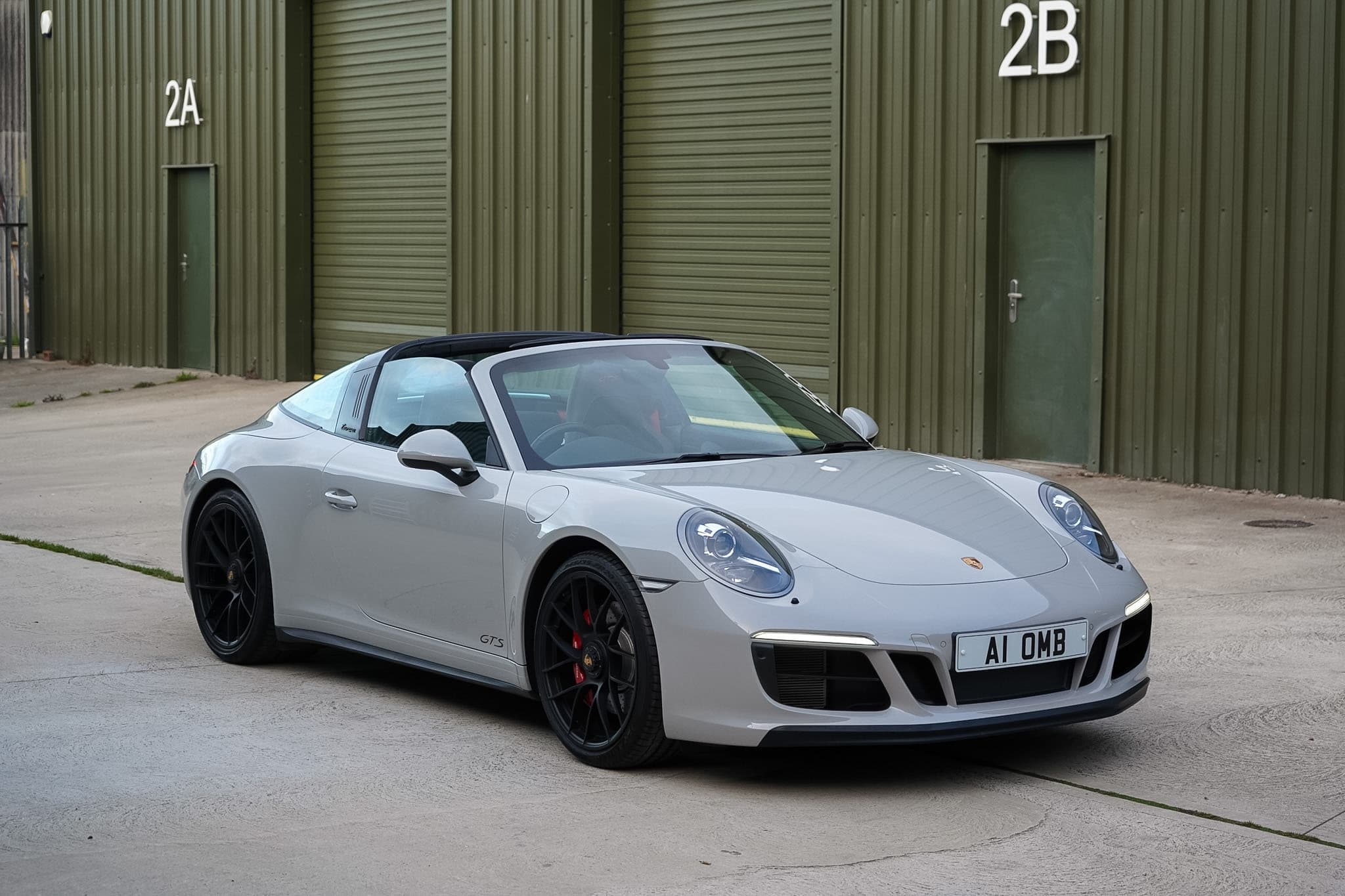
Overview
What came standard on the 991.2 Targa 4 GTS, which extras were optional, and why Porsche's own PASM/10 mm wording needs careful reading.
This guide covers Targa 4 GTS (991.2) and links directly to the relevant car record for further detail.
A used Porsche advert can make a well-specified 911 look even more heavily optioned than it really is. The 991.2 Targa 4 GTS is a good example because the GTS already left the factory with much of the equipment that buyers actively look for: more power, Sport Chrono, sports exhaust, PASM, the wide body, centre-lock wheels and a distinctive interior treatment.
That creates a simple problem when comparing cars. A long feature list is not necessarily a long options list.
For the 991.2 Targa 4 GTS, the useful question is therefore not “how many features does this car have?” It is which features came with every GTS, which were choices made by the first owner, and which details need the individual build record before you can classify them confidently?
The 991.2 Targa 4 GTS in one paragraph
Porsche introduced the second-generation 991 GTS range for 2017. The Targa 4 GTS combined the electrically operated Targa roof with the wide all-wheel-drive body and a 3.0-litre twin-turbo flat-six producing 331 kW / 450 PS and 550 Nm. It was all-wheel drive by definition: unlike the Carrera GTS Coupé and Cabriolet, there was no rear-wheel-drive Targa GTS.
Porsche offered a seven-speed manual or optional PDK. That transmission choice is the first reminder that “GTS” was a package, not a fixed specification.
For the wider 911 family and generation sequence, see our Porsche 911 model guide.
What Porsche included with the GTS
Porsche's January 2017 launch material gives the cleanest starting point because it describes the GTS range before individual cars were configured.
| Factory GTS feature | What the Porsche launch material says |
|---|---|
| Engine | 3.0-litre turbo flat-six, 331 kW / 450 PS |
| Torque | 550 Nm from 2,150-5,000 rpm |
| Drivetrain | Targa 4 GTS uses all-wheel drive |
| PASM | Standard on all GTS models |
| Sport Chrono | Standard |
| Sports exhaust | Standard |
| Body | Wide all-wheel-drive body across the GTS family |
| Wheels | 20-inch centre-lock wheels in silk-gloss black |
| Exterior | SportDesign front apron, smoked rear lights, black detailing and GTS graphics |
| Targa detail | Targa bar supplied in black |
| Seats/interior | Sports Seats Plus with GTS logos and extensive Alcantara treatment |
This matters because several of those items are regularly repeated in sales adverts as specification highlights. They are still worth mentioning: they are part of why somebody wants a GTS in the first place. But they do not, on their own, prove that one car was ordered with more factory options than another GTS.
The suspension detail that is easy to get wrong
There are two similar descriptions that should not be treated as interchangeable:
- PASM — Porsche Active Suspension Management;
- PASM sports chassis — the more overtly sporting chassis configuration with the additional ride-height reduction described by Porsche for the GTS Coupés.
Porsche's 2017 GTS launch release says PASM was included as standard on all GTS models. It then makes a narrower statement: the GTS Coupés feature the PASM sports chassis, lowering the body by 10 mm.
That body-style qualifier matters, but Porsche's own records add a second layer. The current Porsche Approved Finder for a UK 2017 991 II Targa 4 GTS explicitly labels its next section as default Standard Equipment for the trim and lists Porsche Active Suspension Management (PASM) with ride height lowered by 10 mm. A separate UK 2018 Targa 4 GTS Porsche Approved listing repeats the same standard-equipment wording.
That does not make the launch release wrong. It shows that Porsche uses two pieces of language that should not be collapsed into one. The January 2017 launch release reserves the term PASM sports chassis for the GTS Coupés, while Porsche Finder's current default-equipment data describes the Targa's standard PASM as having a 10 mm-lower ride height.
The safest conclusion is therefore narrower: a 991.2 Targa 4 GTS had PASM as standard, and Porsche's current Targa model data supports a 10 mm lower ride height, but do not automatically label its suspension as the same Coupé PASM sports-chassis package solely from the shared number. If the exact chassis package or option code matters, check the VIN-linked build record or original order documentation.
This also changes how TMJC's example should be read. Its listing describes adaptive Sport suspension with a 10 mm lowered ride height as GTS-standard. That statement is consistent with Porsche Finder's current default-equipment data; what remains uncertain is the precise package terminology, not whether a Porsche source exists for a 10 mm-lower Targa ride height.
PDK was a choice, not part of the GTS baseline
Porsche's launch material describes the GTS models as available with the seven-speed manual or optional PDK.
That makes transmission one of the easiest individual-car differences to establish. A PDK Targa 4 GTS and a manual Targa 4 GTS share the core GTS identity, but the gearbox tells you something about how the original buyer configured the car.
Contemporary road tests underline the point. Car and Driver's manual Targa 4 GTS and PDK Targa 4 GTS were both recognisably GTS cars, but their option sheets and driving characters were not identical.
For a buyer, the important question is not which gearbox the internet declares “best”. It is whether the gearbox suits the intended use, whether the car's history supports its mileage and condition, and whether the asking price reflects the specification people actually value.
A TMJC car shows why feature lists need decoding
TMJC's 2018 991.2 Targa 4 GTS is a useful worked example. It is a right-hand-drive PDK car in Chalk with a Black/Carmine Red GTS interior and fewer than 9,000 miles at the time of the listing. TMJC records a full service history and identifies a substantial individual specification including front-axle lift, GT Sport steering wheel, heated seats, carbon-fibre interior trim, two-zone climate control, BOSE audio and ParkAssist with reversing camera.
The same listing also describes Sport Chrono, sport exhaust and SportDesign treatment. Those are important characteristics of the car, but Porsche's factory launch information shows that they also belong to the standard GTS package. It also mentions Turbo S wheels in Satin Black: Porsche's launch material already places 20-inch black centre-lock wheels in the GTS baseline, and current UK Porsche Finder data identifies the standard 991.2 Targa 4 GTS wheels as 20-inch 911 Turbo S forged alloys in satin black. Do not count those wheels as a paid extra without VIN-linked build evidence.
That distinction is useful when you see a claim such as “£X of options”. The number should be supported by the original invoice, order form, Porsche build record or option-code list. You cannot reliably calculate it by assigning a retail price to every feature named in an advert, because some of those features were already included in the GTS base price.
Which extras materially change the car?
Not every optional item deserves the same weight in a buying decision.
Chassis and driving options
Rear-axle steering is one of the recurring discussion points among 991.2 GTS buyers. Contemporary test cars show it was available as an extra rather than universal GTS equipment. Owners debate how essential it is, especially on a Targa that is being used primarily on the road.
Treat that as a preference question after establishing the facts. Verify whether the individual car has it, then decide whether you value its low-speed manoeuvrability and high-speed behaviour enough to prioritise it over another car with better history or condition.
Likewise, front-axle lift can matter enormously to one owner and almost not at all to another. A buyer facing steep driveways or aggressive ramps may value it highly. Its presence should be verified on the individual car rather than assumed from trim level.
Transmission
PDK materially changes how you interact with the car and also changes the acceleration figures commonly quoted in adverts. Keep manual and PDK performance claims separate rather than applying the quickest GTS number to every car.
Seats and interior
The GTS already brought its own Sports Seats Plus/Alcantara identity, but buyers could go further with alternative seat, leather and interior packages. These choices can matter disproportionately on a used car because changing them later is neither cheap nor necessarily desirable.
Convenience and audio
Features such as heated seats, parking assistance, reversing camera, upgraded audio and climate-related equipment can make a Targa easier to live with, but they do not make the underlying GTS mechanically more authentic. They belong in the individual-car comparison, not the definition of what a GTS is.
How to verify a 991.2 Targa 4 GTS specification
A sensible check has four layers.
1. Start with the factory GTS baseline
Know what Porsche included before looking at the advert. This stops standard equipment being counted twice and helps expose descriptions copied from another 911 derivative.
2. Get the individual build evidence
Prefer the original order/invoice, Porsche build record or a reliable option-code/specification output tied to the car's VIN. This is where you establish PDK, rear-axle steering, lift, seat choices, interior packages, audio and other individual equipment.
3. Confirm the hardware on the car
Paperwork can be incomplete and cars can change during their lives. Confirm the visible controls, wheels, brakes, seats, trim and other physical equipment. If something expensive matters to the purchase decision, verify it rather than relying on a headline.
4. Keep specification separate from condition
A rare option does not compensate for poor maintenance, accident history or a neglected roof mechanism. Specification tells you what the car is; condition and history tell you whether this example is worth buying.
The same principle applies to mileage: recorded distance should be considered separately from calendar-time maintenance, storage evidence and the quality of the service history.
Common mistakes when reading a GTS advert
| Mistake | Better approach |
|---|---|
| Counting Sport Chrono as a paid extra | Recognise it as part of the 991.2 GTS baseline |
| Counting sports exhaust as a paid extra | Recognise the standard GTS sports exhaust |
| Treating every “10 mm lower” reference as the same chassis package | Porsche Finder describes the Targa's standard PASM as 10 mm lower, while the launch release reserves “PASM sports chassis” wording for the Coupés |
| Assuming PDK because most cars for sale have it | Verify gearbox; PDK was optional |
| Treating every feature in an advert as an option | Reconcile the list against factory baseline and build evidence |
| Choosing options before history/condition | Verify provenance, servicing, roof operation and condition first |
What a good advert or history file should let you answer
By the end of the paperwork review, you should be able to answer straightforward questions:
- Is this definitely a 991.2 Targa 4 GTS rather than a Targa 4S described with GTS-style equipment?
- Which features are inherent to the GTS?
- Which options were actually ordered on this VIN?
- Does the car still carry that equipment?
- Are any wheels, seats, trim or chassis components later changes?
- Does the service and ownership history support the mileage and condition?
A long specification is attractive. A properly decoded specification is more useful.
Sources and further reading
- Porsche Newsroom — The new Porsche 911 GTS models
- Porsche Finder GB — 2017 Porsche 911 Targa 4 GTS (991 II), default standard equipment (retrieved 9 September 2026)
- Porsche Finder GB — 2018 Porsche 911 Targa 4 GTS (991 II), default standard equipment (retrieved 9 September 2026)
- The Matt Johnston Collection — 2018 Porsche 911 991.2 Targa 4 GTS
- Car and Driver — 2017 Porsche 911 Targa 4 GTS Manual
- Car and Driver — 2017 Porsche 911 Targa 4 GTS PDK Automatic Tested
The Porsche launch material is the authority for the factory GTS baseline used here. Country-specific comfort equipment and individual option codes should still be checked against the build record for the exact car.
Related car