Production
- Global production
- 2,000 units
- UK supplied
- 288 units
Variant
The R56 MINI John Cooper Works GP was a 2,000-car series. European factory data gives 160 kW / 218 PS; MINI USA rated US-market cars at 211 hp.
At a glance
TMJC guide
The R56 MINI John Cooper Works GP was a 2,000-car series. European factory data gives 160 kW / 218 PS; MINI USA rated US-market cars at 211 hp.
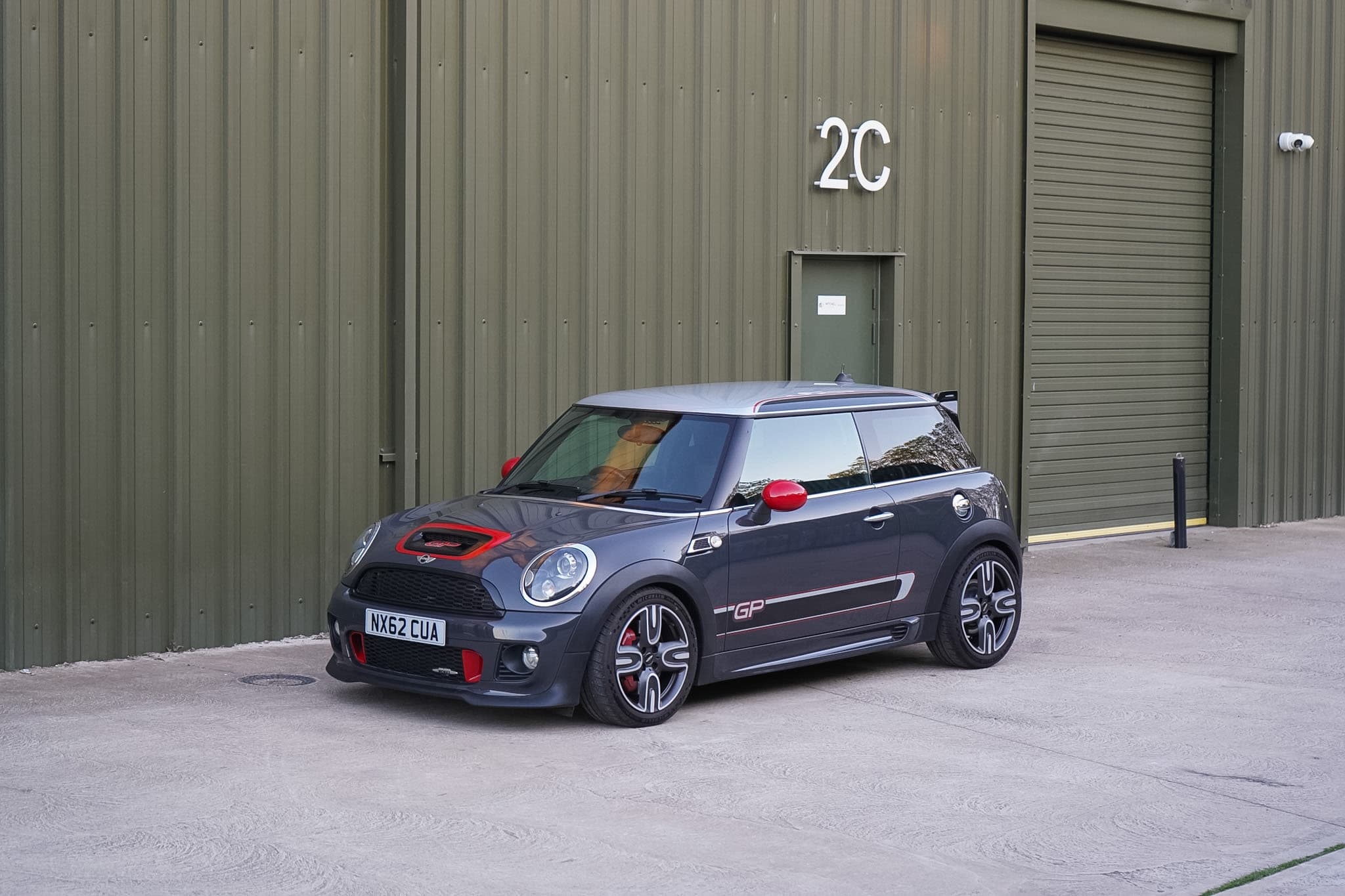
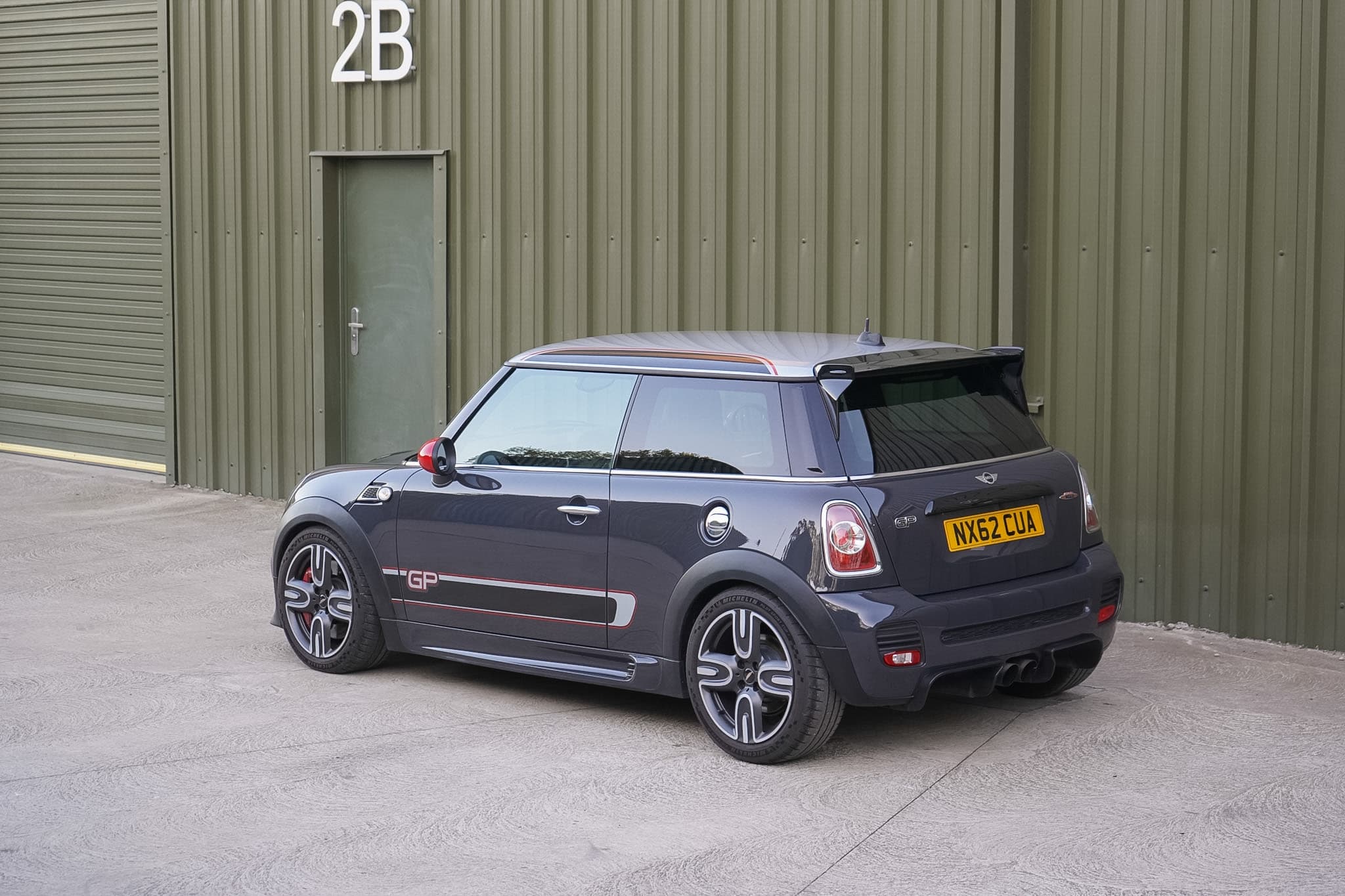
The R56 MINI John Cooper Works GP is a limited, track-focused factory derivative of the second-generation MINI Hatch. Often called the GP2 by enthusiasts to distinguish it from the earlier R53-based GP and the later GP generation, it combines a two-seat cabin, adjustable coilover suspension, larger brakes, bespoke wheels and tyres, and model-specific aerodynamics. European factory material gives 160 kW / 218 PS; MINI's English-language release renders the same factory figure as 218 hp, while period evo coverage quotes 215 bhp. MINI USA published 211 hp for US-market cars, so power figures and units need to stay attached to their source and market.
MINI's 2012 launch material said production would begin later that year with a maximum of 2,000 cars. A 2019 MINI retrospective closes that loop: it says the two previous GP generations were each manufactured in a small series of 2,000 units. TMJC records 288 UK-supplied examples. That limited production matters, but the engineering changes are what separate a genuine GP from an ordinary R56 John Cooper Works wearing GP-style parts.
Factory data gives the GP a 1.6-litre turbocharged four-cylinder engine producing 160 kW at 6,000 rpm. German MINI material expresses that output as 218 PS; the English-language release writes 218 hp. Standard maximum torque is 260 Nm from 1,750 rpm, with an overboost function briefly raising that to 280 Nm from 2,000 rpm. Drive goes through a six-speed manual gearbox.
| Specification | R56 John Cooper Works GP |
|---|---|
| Factory production | 2,000 cars; production began in 2012 |
| UK supply | 288 UK-supplied cars (TMJC) |
| Seats | 2 |
| Engine | 1.6-litre turbocharged inline-four |
| European factory output | 160 kW / 218 PS at 6,000 rpm (English release: 218 hp) |
| US factory output | 211 hp at 6,000 rpm |
| US allocation | 500 cars (MINI USA) |
| Torque | 260 Nm; 280 Nm temporary overboost |
| Transmission | 6-speed manual |
| UK/European DIN unladen weight | 1,160 kg |
| US curb weight | 1,185 kg / 2,612 lb (MINI USA technical data) |
| UK/European 0-100 km/h | 6.3 seconds |
| US 0-60 mph | 5.9 seconds (Nov 2012 launch release; Sep pre-launch said 6.1 s) |
| US 0-100 km/h | 6.2 seconds (Sep technical data) |
| Top speed | 242 km/h / 150 mph |
| Standard sports tyre | 215/40 R17 |
The UK/European performance figures above use MINI's 5 September 2012 factory release. MINI USA's 28 November 2012 North American release instead rates the US car at 211 hp, quotes 0-60 mph in 5.9 seconds and says 500 of the 2,000 global cars were allocated to US customers. Those acceleration tests are not directly equivalent, and the power figures belong to different factory market releases. Specialist figures should therefore stay secondary to the applicable manufacturer data.
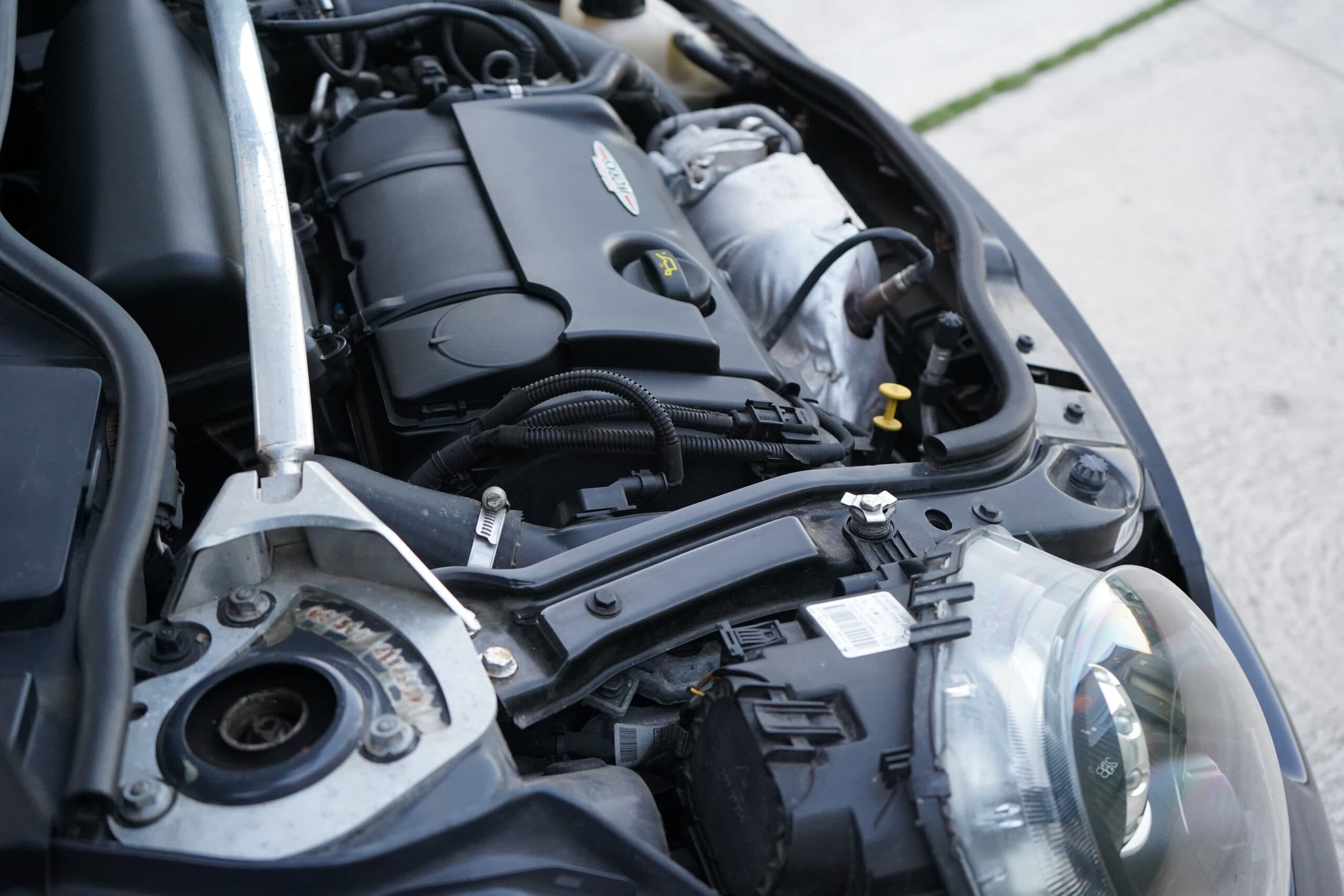
The GP's four-cylinder engine uses twin-scroll turbocharging, direct petrol injection and fully variable valve control. MINI described reinforced pistons, a strengthened cylinder head, sodium-filled exhaust valves and other changes intended to support sustained high-load use.
The important distinction is not simply the headline 218 hp. The GP package was developed as a whole: engine calibration, chassis, tyres, braking and aerodynamics were tuned together. MINI's Nürburgring Nordschleife development time of 8 minutes 23 seconds was 18 seconds quicker than the preceding GP, a useful period illustration of how much the chassis package mattered.
MINI's UK parts catalogue identifies the GP-specific R56 LCI application as N18, distinguishing it from the N14 used in earlier parts of the wider R56 JCW range. BMW Group Portugal's November 2012 R56 technical data goes further: its 218 cv MINI John Cooper Works GP column identifies the engine platform as N18B16T0. BMW Group / MINI USA's September 2012 GP technical sheet independently gives the same N18B16T0 code for the US-market car. With the suffix now supported by primary technical data in two markets, use N18B16T0 as the GP engine code while still confirming an individual car by VIN before ordering parts, making software changes or judging originality.
The cleanest factory anchor is 160 kW. German MINI material specifies 160 kW / 218 PS, while the English-language MINI release writes 160 kW / 218 hp. Converted conventionally, 160 kW is about 215 bhp, which aligns with period evo coverage. Those labels are often mixed in adverts, but PS and bhp are not the same unit: 218 PS is not 218 bhp. Retain the source's unit rather than silently relabelling the number.
MINI's own launch material shows why GP2 specifications should not be copied between markets without qualification. The UK/European release gives 160 kW / 218 hp at 6,000 rpm, 260 Nm with 280 Nm temporary overboost and 0-100 km/h in 6.3 seconds. MINI USA's North American release gives 211 hp at 6,000 rpm, 192 lb-ft with 207 lb-ft overboost and 0-60 mph in 5.9 seconds. Both quote a 150 mph / 242 km/h top speed.
MINI USA also states that 500 cars from the 2,000-unit global run were allocated to US customers. Its release notes that the US car's horsepower was lower than the 2006 GP under newer emissions standards. That does not make the 211 hp and 218 hp figures interchangeable: when checking an imported car, period specification sheet or dyno claim, use the factory information for that market and confirm the individual car by VIN.
The accompanying September US technical sheet also lists 1,185 kg / 2,612 lb curb weight, while MINI's global/UK material calls the European figure 1,160 kg DIN unladen weight. Those labels and markets are not identical measurement contexts, so the numerical difference should not be presented as a simple 25 kg equipment penalty.
MINI USA's own 2012 material is not completely consistent on acceleration. Its September pre-launch release says 0-60 mph in 6.1 seconds, while the attached US technical sheet leaves the 0-60 field blank and gives 0-100 km/h in 6.2 seconds. The later November North American premiere quotes 0-60 mph in 5.9 seconds. Keep those as dated factory claims rather than averaging them. The UK/global 6.3-second 0-100 km/h figure is a separate market record and a different test from 0-60 mph.
The GP was the first MINI production model to receive an individually adjustable coilover suspension from the factory. Ride height could be lowered by up to 20 mm, while the geometry used more front camber, reduced front toe-in and increased rear camber compared with the regular John Cooper Works setup.
The brake package is equally specific. MINI's factory release lists six-piston fixed front calipers with 330 x 25 mm ventilated front discs, backed by 280 x 10 mm rear discs. The lightweight GP wheels are 7.5 x 17 H2 ET45, normally fitted with high-grip 215/40 R17 sports tyres; MINI also listed a 205/45 R17 alternative for wetter or colder conditions.
Those components are important originality markers. A used GP may have received replacement dampers, different wheel offsets, conventional road tyres or brake conversions during its life. None automatically makes a car poor, but each changes how closely it matches the factory package and should be documented.
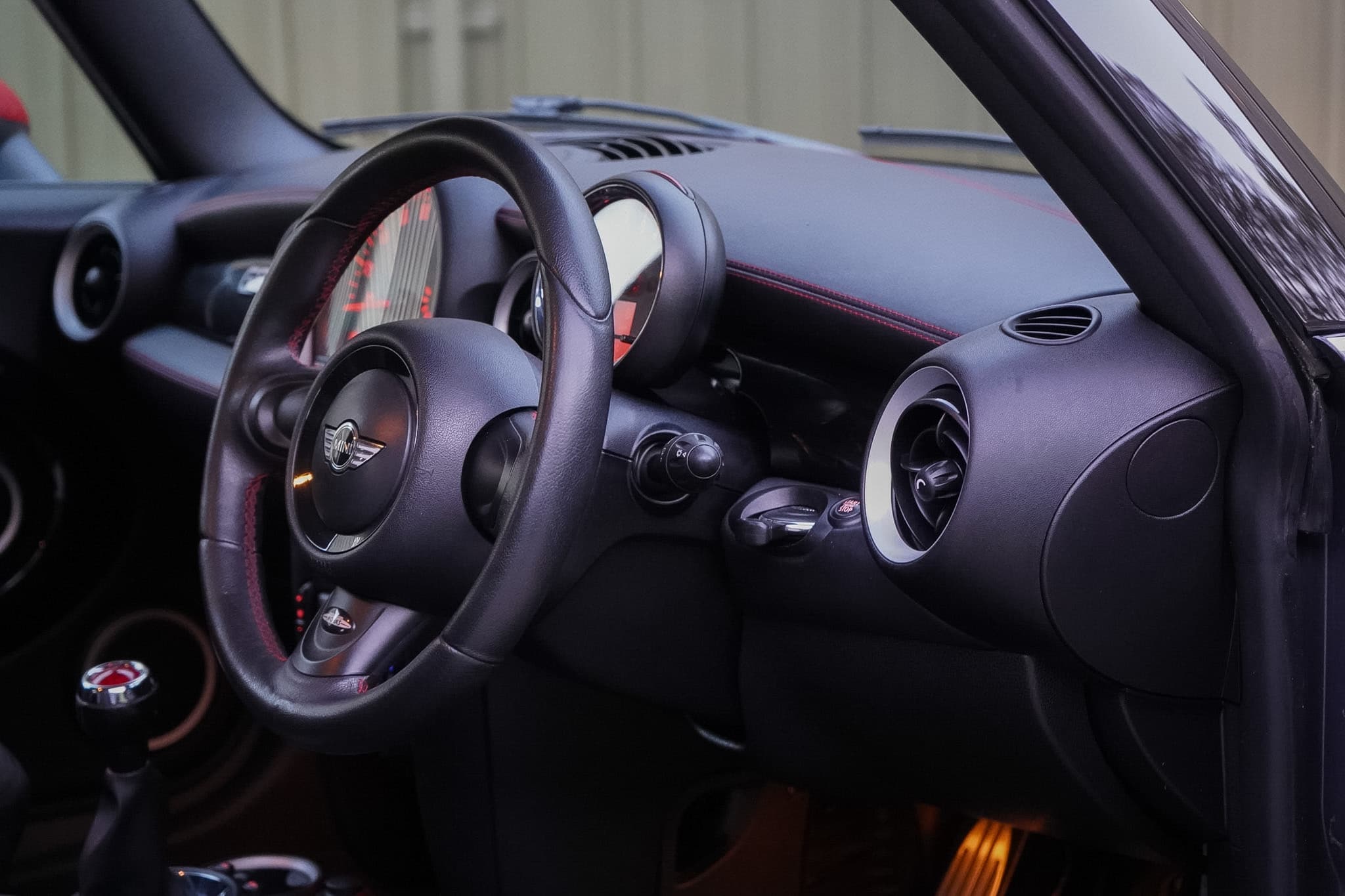
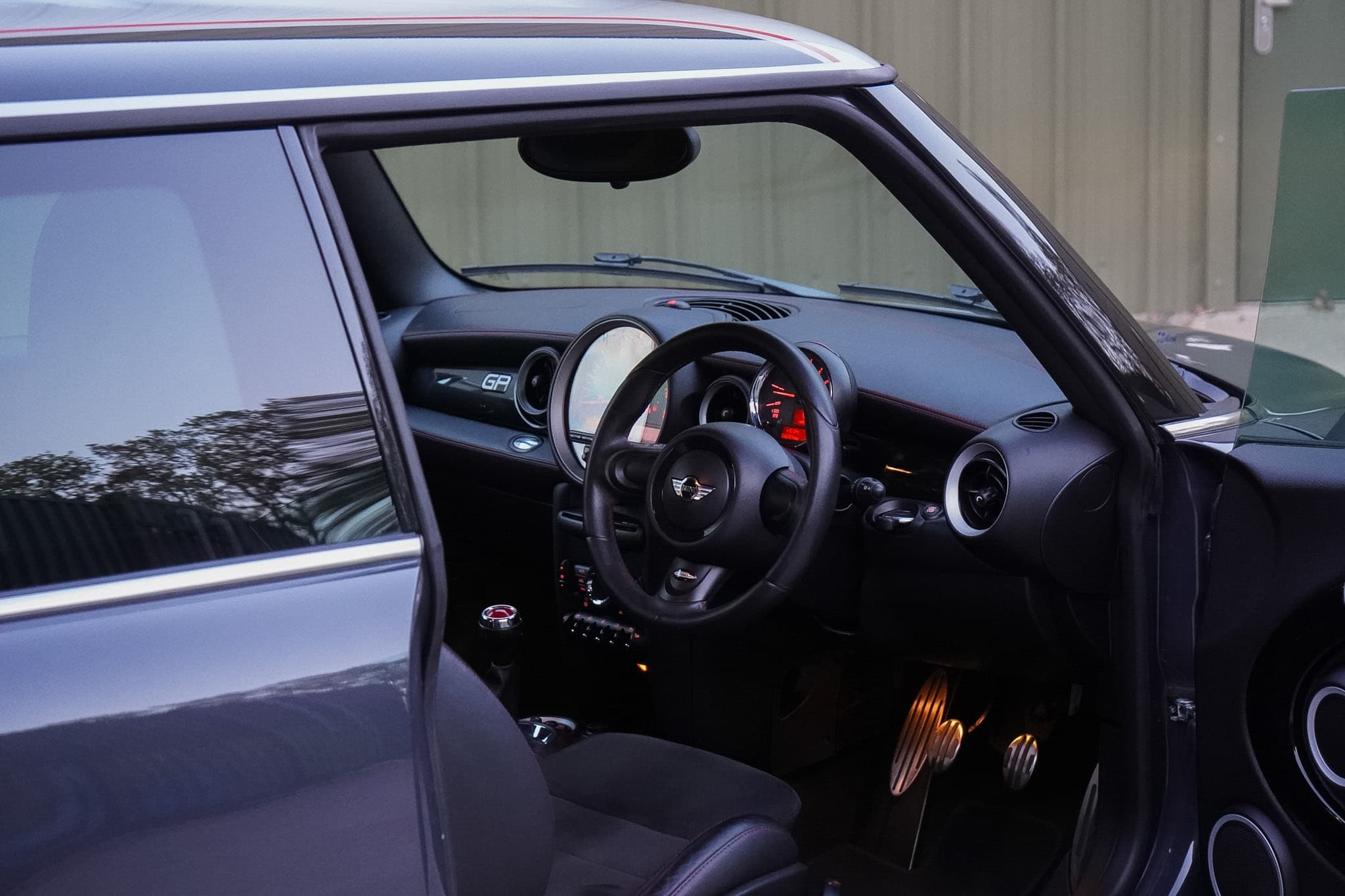
The GP is a genuine two-seater: MINI deleted the rear bench and fitted a cargo guard behind the front seats. Recaro sports seats, GP-specific trim and a special stability-control mode reinforce the track-biased brief.
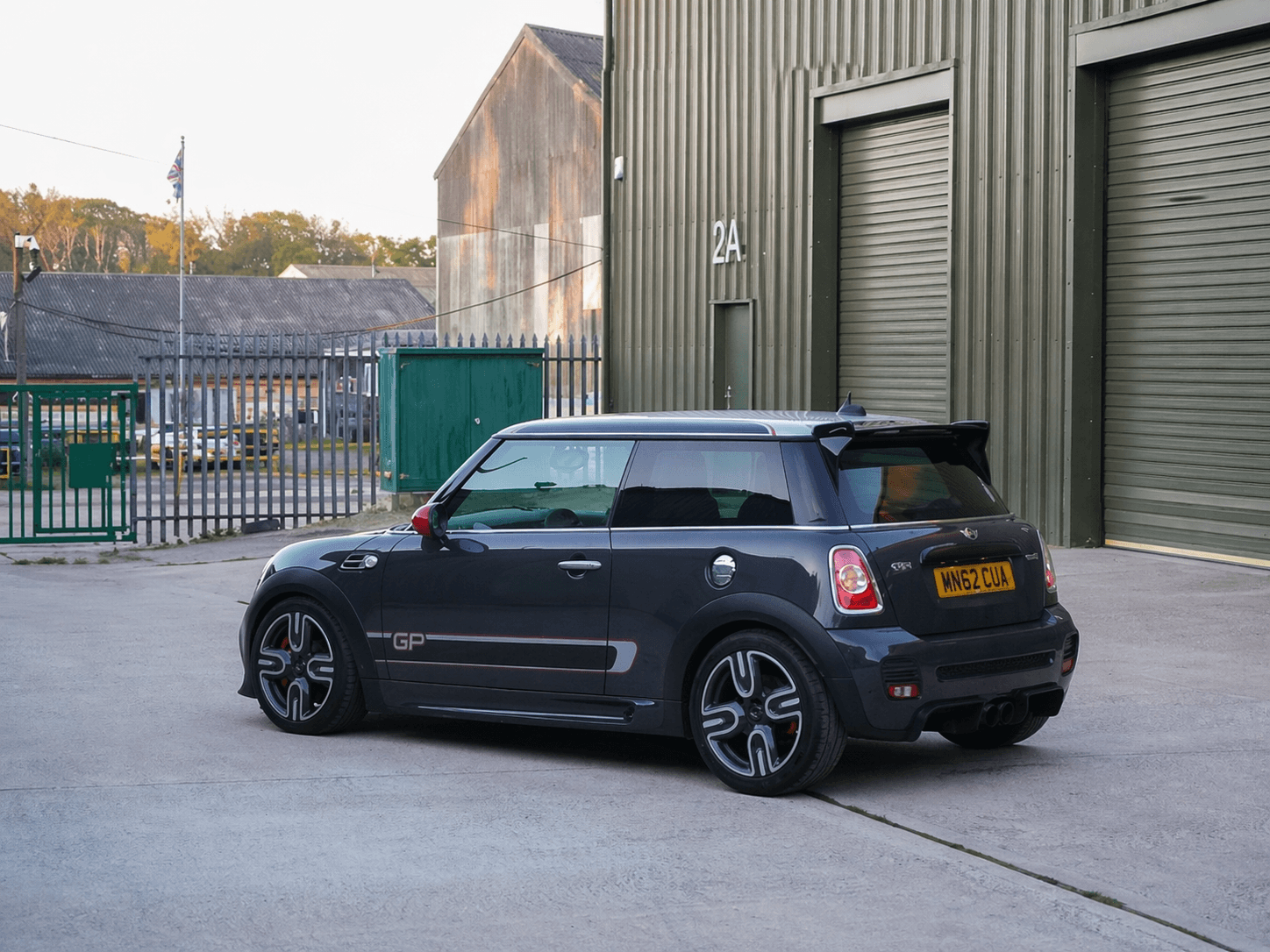
The exterior treatment is functional as well as visual. MINI said the rear diffuser, underbody treatment and roof-edge spoiler reduced rear-axle lift by 90 per cent, while broader aerodynamic work reduced drag by six per cent. Thunder Grey metallic, contrasting red details and GP graphics were part of the factory identity.
That makes bodywork inspection especially important. Replacement splitters, damaged undertrays, non-standard spoilers or missing decals can be expensive or difficult to return to the correct specification, and previous track use or accident repair deserves the same scrutiny as engine history.
The GP is not just a higher-output JCW. Its two-seat layout, suspension geometry, adjustable coilovers, brake package, wheel-and-tyre specification, aero treatment and stability-control calibration form a substantially different factory package.
Independent period testing by evo highlighted the same areas: the six-piston brakes, 330 mm front discs, aggressive geometry, bespoke tyres and lack of rear seats were central to the car's sharper, less compromised character. In other words, the collectible identity sits in the complete specification rather than one badge or ECU map.
For the wider second-generation Hatch context — including ordinary Cooper, Cooper S and John Cooper Works derivatives — see the MINI Hatch R56 reference.
A GP buyer has two overlapping jobs: check the underlying R56 performance-car mechanicals and verify that the expensive GP-specific parts and provenance are still present.
Start with cold-start behaviour, oil level and consumption history, cooling-system health, fuel-system behaviour and evidence of regular servicing. R56 JCW buying guides discuss timing-chain, oiling, fuel-pump, cooling and turbo-related issues across the broader family, but build date and exact engine specification matter; do not assume every earlier N14-era problem automatically applies to every GP.
Then concentrate on the hardware that makes the GP special:
For a deeper factory-correctness process, use the MINI GP2 originality guide, which focuses specifically on identity, paint, modifications, paperwork and provenance.
TMJC's first-party example is a 2013 right-hand-drive six-speed car, number 1210 of 2,000. Its listing records long-term ownership, main-dealer history, factory paint readings and an unmodified specification. Those details are valuable as a worked example of collector due diligence, but they belong to that individual car rather than to every GP2.
The same distinction applies to mileage, ownership count, paint condition and service work: they can demonstrate what strong provenance looks like without becoming model-wide technical facts.
The GP2 belongs under the second modern MINI Hatch generation, R56. It followed the limited R53-based GP and pushed the factory track-day idea further through chassis tuning rather than simply chasing a much larger power number. A later GP would revisit the concept with substantially more output and a different platform.
For the broader marque and model chronology, follow MINI, MINI Hatch and R56. For this exact car, the useful questions are narrower: is it genuinely a GP, does the specification still match the factory package, and does its history support the condition and originality being claimed?
Editorial information
Research and editorial from TMJC Garage.
Research and editorialTMJC Garage
Reviewed byMatt Johnston
Last reviewed14 September 2026
Published byThe Matt Johnston Collection
Specifications
Model lineage
TMJC photography
TMJC Guides
TMJC assistance
Continue to the main TMJC website and speak directly with the collection team.
Sell, consign or source
Continue with TMJC for a discreet conversation, professional presentation and collector-focused support.
Enquire now