Published guide
Paint depth gauge readings: what do they really prove?
How to interpret automotive paint-thickness readings, including PPF-covered cars, without confusing one micron number with proof of original paint or accident history.

Overview
How to interpret automotive paint-thickness readings, including PPF-covered cars, without confusing one micron number with proof of original paint or accident history.
A paint-depth gauge can tell you how thick the coating stack is at the point you measure. It cannot, on its own, tell you why the paint is that thick, whether a panel has been in an accident, or whether every layer is factory-original.
When buying a collector car, paint meters are excellent at finding patterns worth investigating, but a single reading should not become a verdict. The question is not “is this number inside the factory range?” It is “does the pattern of readings make sense for this car, these panel materials and the history being claimed?”
Instrument manufacturer DeFelsko is unusually explicit on this point: there is no absolute correct paint thickness for every car. It gives roughly 100-180 microns (4-7 mils) as a typical factory range, but also documents much wider values depending on manufacturer, model and panel, including cars rectified with additional paint at the factory.
So if somebody tells you that 120 microns always means original and 220 microns always means accident repair, the rule is too simple.
What does a paint-depth gauge actually measure?
On a conventional metal body panel, a paint-thickness gauge measures the distance between its probe and the underlying metal. Depending on the instrument and substrate, it normally uses a magnetic principle for steel or an eddy-current principle for non-ferrous metal such as aluminium.
What matters is what sits inside that distance. A normal total-thickness gauge does not look through the paint and label separate layers as primer, base coat, clear coat, repaint and filler. DeFelsko notes that the reading can include the whole coating system, including original layers, later paint, filler and even material on the surface.
The number is useful, but not self-explanatory.
A reading of 250 microns might be evidence of refinishing. It is not a diagnosis of why the refinishing happened. A cosmetic scratch, a production-line correction, an older panel repair and a full restoration can all leave a different coating history from untouched factory paint.
Is there a normal factory paint thickness in microns?
There is a broad reference range, but not a universal pass/fail number.
DeFelsko says factory paint is often around 100-180 microns, while also warning that there is no single right value across manufacturers and models. Its examples include substantially thinner and thicker factory areas, and it notes that manufacturers may repaint cars at the factory where defects are found.
That is why the shape of the data matters more than one threshold.
If one steel door reads consistently around the same level as the adjacent steel panels and then a small area suddenly rises sharply, that change deserves attention. If an entire panel is consistently much higher than comparable panels, a repaint becomes a reasonable possibility to investigate. If the values are unusually low in a local area, previous polishing or a naturally thin coating may be relevant.
None of those patterns is a substitute for looking at the car and its paperwork.
Consistency is usually more informative than one spot reading
A proper paint inspection is a map, not a single number on the bonnet.
Take several readings across comparable areas rather than searching for one convenient value. Look for repeatable trends within the same panel and compare panels made from the same type of substrate. Abrupt local changes are often more informative than small differences between distant parts of the car.
DeFelsko's own guidance places the emphasis on consistency. Small variations across a panel can be normal; much greater thickness can indicate rework. Elcometer similarly markets its automotive meter around identifying patterns associated with hidden rework, respray and filled panels.
The wording matters: indicate, suggest and prompt further inspection are stronger and more defensible than prove.
What do high paint-depth readings mean?
Higher readings commonly raise three questions.
Has the panel been repainted? A materially thicker and consistent panel can indicate additional coating layers.
Is there filler or a local repair beneath the finish? Very high local readings can be consistent with repair material under the paint. Some gauges also stop reading when the coating stack exceeds their measuring range.
Does the history explain it? A documented cosmetic repaint is different from an unexplained local repair. Factory rectification is different again. The gauge cannot tell those stories apart by itself.
So the next step after finding a high area is documentary and visual: inspect colour/texture, edges and shut lines, compare adjacent readings, look for invoices or restoration photographs, and ask exactly what work was carried out.
What do low readings mean?
Low readings also need context.
Detailing and paint correction remove material from the top of the paint system. DeFelsko notes that polishing, sanding and buffing can reduce clear-coat thickness, and that visual inspection alone is a poor way to quantify how much coating remains.
A low number can therefore be useful to a buyer or detailer, but it does not automatically mean the panel is defective. Different panels and paint systems can start at different thicknesses, and a conventional gauge is still reporting total coating depth rather than directly telling you how much clear coat remains.
That is another reason not to apply a generic internet threshold to an unfamiliar car.
Steel, aluminium and plastic panels need different measurement methods
Before comparing readings, know what the panel is made from.
For steel, automotive coating gauges commonly use magnetic measurement. For aluminium, they use an eddy-current method. Instruments such as the Elcometer 311 FNF and DeFelsko metal gauges can switch or select the correct method for those substrates.
Plastic, fiberglass and other non-metal body panels are different. A normal magnetic/eddy-current metal gauge cannot simply be assumed to work on them. DeFelsko's automotive inspection kits pair a metal probe with an ultrasonic PosiTector 200 probe specifically so non-metal automotive substrates can also be measured.
This matters on cars with mixed construction. A buyer should not compare a metal door reading with a plastic bumper reading as though the instrument and substrate were identical, and a “no reading” on a non-metal panel is not evidence that the car is full of filler.
What if the car has paint protection film (PPF)?
Clear paint-protection film changes the measurement problem because the gauge does not know that the transparent material above the paint is there for protection rather than refinishing. On a metal panel, a conventional magnetic or eddy-current coating gauge measures the non-magnetic or non-conductive material between its probe and the metal substrate. Elcometer explicitly lists plastics and rubbers among coatings measurable over steel, and non-conducting coatings over aluminium.
That means a polyurethane PPF layer is part of the measured stack on a wrapped metal panel. The displayed number is no longer a useful shorthand for bare paint thickness.
The scale of that effect can be large. 3M's technical data for one current Scotchgard Pro Series 200 film gives a representative film-with-adhesive thickness of 7.8 mil, or 0.20 mm — about 200 microns. That figure belongs to that product, not to every PPF on the market, but it is already comparable with or greater than the broad 100-180 micron factory-paint range often quoted for unwrapped cars.
So a reading of, say, 300 microns on a PPF-covered steel bonnet does not mean the underlying paint is 300 microns thick, and it should not be compared directly with an uncovered door using a bare-paint threshold. Likewise, simply subtracting a catalogue film thickness from every reading is too neat: different films have different constructions, adhesive contributes to the stack, installation is not a laboratory thickness standard, and the original paint thickness underneath may never have been recorded.
A better approach is to establish which panels are wrapped, compare like with like, keep installation paperwork, and use any trustworthy pre-installation inspection or paint map if one exists. Where the film stops at an edge or a panel is intentionally unwrapped, that can help explain why neighbouring readings differ, but the physical finish and provenance still need to support the conclusion.
TMJC's 2022 Porsche 992.1 GT3 is a useful real-world example because its listing records full PPF. The listing does not publish a pre-film paint map, film brand or film thickness, so those details cannot be reconstructed after the fact. The defensible conclusion is simply that paint-depth readings on a fully protected car need a different baseline from an unwrapped one.
This also matters when somebody advertises a PPF-covered collector car as having factory paint. PPF can preserve an original finish, but the film itself does not prove what is underneath it. The strongest originality case combines installation history, any pre-installation inspection, visual evidence at edges and apertures, bodywork records and a coherent set of measurements made with the film state understood.
TMJC's 2022 Porsche 992.1 GT3 listing provides the first-party example of a modern collector car sold with full PPF.
Check that the gauge itself is giving meaningful readings
A paint meter is only useful if the instrument is appropriate for the substrate and behaving correctly.
DeFelsko recommends checking gauge accuracy against a known reference, such as an uncoated piece and supplied thickness shims where appropriate to the instrument. Elcometer supplies check pieces and calibration/check material with its automotive meter.
For a buyer, a digital number is not impressive by itself. Ask what gauge was used, whether it is suitable for both steel and aluminium if the car contains both, and whether the operator has checked that it reads sensibly on a known reference.
Repeatability is valuable too. If the same point gives wildly different readings with careful repeat measurements, fix the measurement problem before interpreting the car.
Can a paint gauge prove original paint?
Not by itself.
A consistent set of plausible readings is supporting evidence for an original-paint claim. It becomes much stronger when it agrees with the rest of the car: factory finish in edges and apertures, credible panel gaps, appropriate ageing, no suspicious masking lines, no contradictory repair invoices, and a history that supports the claim.
Conversely, a high reading does not prove serious accident damage. A car can have a local cosmetic repaint with no structural significance. It can also have undergone a high-quality, fully documented restoration where original paint is not the objective at all.
The best description is therefore precise. “Paint-depth readings are consistent across the measured steel panels and no repaint was identified during this inspection” is more useful than “all original” when the evidence does not reach that far.
For the broader documentary side of an inspection, see the collector-car provenance checklist.
TMJC example: using paint readings as part of a wider originality case
The Matt Johnston Collection's current listing for a 2013 MINI GP2 R56 is a good example of how paint-meter evidence can be used proportionately.
TMJC says paint-depth readings support a factory-paint finish across the panels it assessed. But that is not the only evidence the listing gives. It also points to main-dealer service history, original accessories and manuals, numbered stickers and the original bill of sale when describing the car as factory-correct.
That is the stronger method. The gauge contributes one piece of physical evidence to a wider provenance case.
The actual per-panel readings are not published on the listing, so it would be wrong to infer a universal GP2 factory micron value from that car. It would also be wrong to turn TMJC's individual-car assessment into a claim about every GP2.
The same listing records a three-stage machine polish and ceramic protection as preparation. Without before-and-after measurements, there is no basis for calculating how much coating was removed or added. Again, the disciplined approach is to use only the evidence that exists.
TMJC's MINI GP2 listing is useful because it shows paint readings sitting alongside paperwork and originality details rather than replacing them.
A repaint is not automatically bad provenance
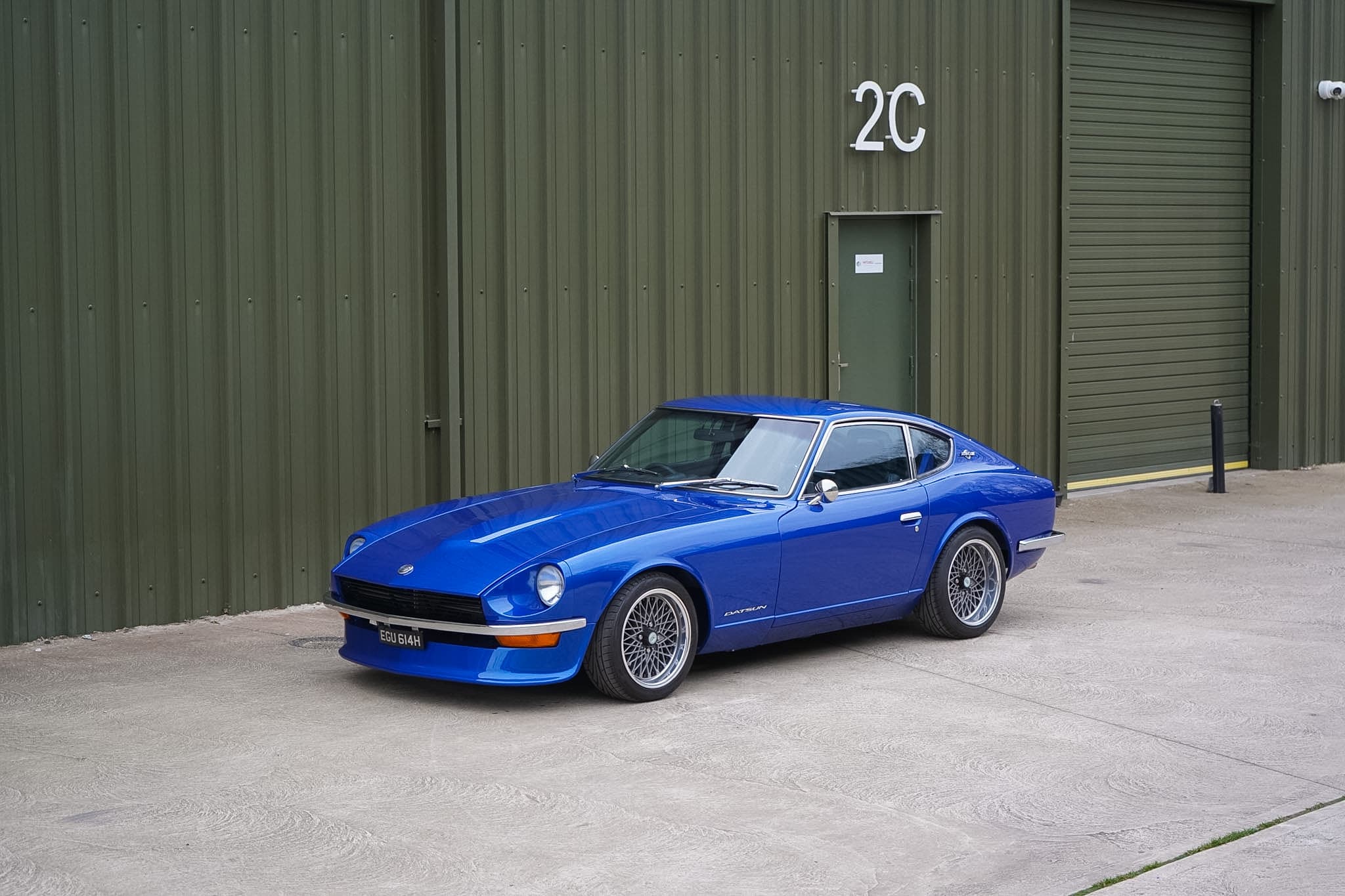
TMJC's Datsun 240Z Restomod makes the opposite point.
Its first-party build history says the shell was stripped to bare metal, acid dipped and fully prepared for paint during a seven-year restoration/restomod. The car is accompanied by more than 100 invoices and a detailed build record.
Nobody should expect that car to return an untouched-factory-paint story. Its value proposition is the documented quality and scope of the restoration, not the preservation of 1970 paint.
When reading any paint-gauge report, “repainted” and “poorly documented” are not synonyms. A known, photographed and invoiced repaint can be much easier to assess than an apparently original car with unexplained local thickness changes and no supporting history.
A practical buyer evidence hierarchy
When paint originality matters to the purchase, build the conclusion from several layers of evidence.
1. Start with the claim. Is the seller saying “original paint”, “mostly original”, “one cosmetic repaint”, “restored” or simply “excellent paint”? Those are different claims and require different proof.
2. Identify the panel material. Know whether you are measuring steel, aluminium or a non-metal panel and whether the gauge is designed for it.
3. Map multiple readings. Look for consistent patterns and sudden changes, not a magic single number.
4. Inspect the physical finish. Edges, shuts, masking lines, overspray, fasteners, seam sealer, texture and panel alignment can help explain what the readings are showing.
5. Match the pattern to paperwork. Body-shop invoices, restoration photographs, insurance records, historic photographs and long-term ownership files can turn a suspicious number into an explained event—or expose a contradiction.
6. Escalate important uncertainty. If originality or structural history materially affects the price, a professional body inspection is better than stretching a handheld meter beyond what it can prove.
The low-mileage classic car buying guide uses the same principle in another context: a single attractive number is only as good as the evidence around it.
Questions worth asking when a seller provides paint readings
Ask for the actual readings or inspection map, not only the sentence “paint checked”. Ask which panels were measured, what substrate they are, what meter was used, and whether any panels could not be measured with that instrument.
If one panel is different, ask whether there is an invoice or known story for it. If the car has been restored, ask for photographs from bare metal through preparation and paint. If the claim is “factory paint”, ask what other evidence supports that conclusion.
A good seller should be able to distinguish what is known from what is inferred.
What paint-depth readings can actually tell you
Paint-depth gauges are valuable because they make hidden coating differences measurable. They are not valuable because they turn collector-car history into one green-or-red number.
Use the gauge to find patterns. Use the panel material to understand the measurement. Use the visual inspection and provenance file to explain the pattern. Then describe the conclusion at the level the evidence actually supports.
That approach is slower than quoting a universal micron threshold, but it is much more useful when the difference between original paint, a cosmetic repaint and a repaired panel can matter to both condition and value.
Sources and further reading
Related car
Cars covered in this guide
Explore the cars this guide covers, with model information, history and related TMJC guidance.
John Cooper Works GP2Provenance
John Cooper Works GP2
ResearchExplore model details, specifications, history and related guidance for MINI Hatch R56 John Cooper Works GP2.
 240Z
Provenance
240Z
ResearchExplore model details, specifications, history and related guidance for Datsun 240Z.
Editorial information
The Matt Johnston Collection
Research and editorial from TMJC Garage.
Research and editorialTMJC Garage
Reviewed byMatt Johnston
Last reviewed26 October 2026
Published byThe Matt Johnston Collection