TMJC assistance
Want TMJC to help with this vehicle?
Sourcing, consignment and valuationContinue to the main TMJC website and speak directly with the collection team.
Manufacturer
A guide to Jensen model history, from the 541 and C-V8 to the Interceptor, FF and Jensen-Healey, with company continuity kept distinct.
Model directory
Choose a Jensen model family to compare its generations, engines, body styles and collector context.
TMJC guide
A guide to Jensen model history, from the 541 and C-V8 to the Interceptor, FF and Jensen-Healey, with company continuity kept distinct.
Jensen's name belongs to two connected traditions: building bodies and complete cars for other manufacturers, and producing distinctive grand tourers in small numbers under its own badge. From West Bromwich, the company moved through hand-built pre-war cars, lightweight glass-fibre GTs, Chrysler-powered C-V8s and the Italian-shaped Interceptor. Its most adventurous engineering statement was the FF, which paired full-time four-wheel drive with an early anti-lock braking system.
Alan and Richard Jensen were modifying and bodying cars before the Jensen Motors name existed. Companies House records the legal entity that later carried the Jensen Motors Limited name as incorporated on 31 May 1922, before the brothers joined the West Bromwich coachbuilder W.J. Smith & Sons in 1931.
The Jensen identity came later. The Jensen Museum and West Bromwich local history both place the change from W.J. Smith & Sons to Jensen Motors Ltd in 1934, after the brothers had transformed the Smith business; the Museum also places the first true Jensen production-car programme at a 1934 prototype followed by production in 1935. For a collector, the useful distinction is that 1922 is the predecessor company's legal incorporation date and 1934 is the Jensen Motors marque and company-identity milestone. The two dates describe different things and should not be collapsed into one legal event.
Jensen never fitted the mould of a large-volume car maker. Its own cars sat alongside substantial work for bigger manufacturers. At Carter's Green and later the larger Kelvin Way works, Jensen built Austin-Healey bodies and completed other contract work including the Volvo P1800 and Sunbeam Tiger.
Volvo's own history records that Pressed Steel supplied P1800 bodies while Jensen painted and assembled them. Production moved to Sweden in spring 1963 after 6,000 Jensen-built cars. Accounts differ over responsibility for the contract's quality and logistics problems, so the transfer is clearer than any single explanation for it.
This dual business shaped Jensen's character. It brought production expertise and revenue, while the own-brand cars gave the company room to explore materials, performance and grand-touring ideas that were unusual for a manufacturer of its size.
Yes. Jensen's role was in manufacturing Austin-Healey bodies, rather than creating a Jensen-badged version of the car. The Jensen Museum records that the contract arrived in 1952. An initial run of aluminium bodies was hand-built at Carter's Green across 1952-53, before Austin-Healey 100 body production moved onto a production basis there during 1953.
The contract mattered well beyond the cars themselves. Jensen's archive says the workload exposed the limits of Carter's Green and helped drive the much larger Kelvin Way factory project. Austin-Healey work was therefore part of the production base that allowed Jensen to operate at a scale far beyond the volumes of its own-badge grand tourers.
For a surviving Austin-Healey, Jensen involvement is a body-manufacturing and provenance point, not a change of marque. For Jensen history, the opposite lesson is useful: contract manufacturing was central to the skills, capacity and factory investment behind the company's own cars.
Jensen's core post-war car-making operation was in West Bromwich, but it did not stay in one factory. Carter's Green had been the company's home from the Jensen Motors name change in 1934. As subcontract work expanded — particularly the Austin-Healey programme — the older works became too small, prompting a much larger complex a few miles away at Kelvin Way.
The Jensen Museum records Kelvin Way being built in stages between 1954 and 1958, with some production starting there as early as 1955. Machinery, tooling and staff moved across progressively; by the early 1960s the transfer was complete and Carter's Green closed. That overlap matters when dating factory history: it was a staged move, not a single clean changeover year.
Kelvin Way was more than a final-assembly address. Archive plans and employee accounts place body and chassis drawing offices, development, trimming, machining, metal forming, finishing and several assembly lines within the complex. The Interceptor and FF line progressed from chassis and body-in-white work through trim and wiring to engine and transmission installation, road test and final inspection. Volvo P1800, Sunbeam Tiger and later Jensen-Healey activity also occupied parts of the site at different times.
That factory history helps explain Jensen's unusual identity: own-brand grand tourers and contract manufacturing shared a relatively integrated, low-volume engineering operation. For an individual car, however, factory provenance should still be established from chassis and documentary evidence rather than inferred from its model name or registration year.
Jensen reused names and developed some cars across more than one calendar year, so a single “model year” can be misleading. The dates below follow the Jensen Museum's production chronology; for the 541, Classic & Sports Car's account helps separate its 1953 prototype, 1954 launch and 1955 start of series production.
| Period | Main Jensen-badged cars | How to read it |
|---|---|---|
| 1936-45 | S-type and H-type | Early Jensen-badged tourers before post-war series production. |
| 1946-57 | PW and first Interceptor | The PW ran from 1946-52; the first Interceptor overlapped it from 1950 and is separate from the better-known 1966 car. |
| 1955-63 | 541, 541 De Luxe, 541R and 541S | A glassfibre-bodied GT family whose public debut and launch preceded series production. |
| 1962/63-66 | C-V8 | The 541 successor spans a 1962-63 introduction and production transition, so sources differ according to the milestone they date. |
| 1966-76 | Interceptor, including Mk III, plus FF | The second Interceptor line used rear-wheel drive; the related FF added Ferguson four-wheel drive and Maxaret anti-lock braking. The detailed 7.2 V8 page covers a later Mk III variant. |
| 1972-76 | Jensen-Healey and GT | The Jensen-Healey was the open sports car; the short-lived GT was its more luxurious fixed-head development. |
Later S4 Interceptors, the S-V8 and present-day continuation businesses belong to the post-1976 revival story discussed below; they should not be read as uninterrupted production by the original Jensen Motors company.
The 541 family made Jensen's post-war engineering identity visible. The Jensen 541 Register and marque archive describe a glass-fibre body over a Jensen chassis, with an Austin straight-six, developed through the 541, Deluxe, R and S. Show and production dates vary between sources, so the family is better understood as a mid-1950s to early-1960s progression than forced into one oversimplified launch year.
The Jensen Museum's development history places Chrysler V8 power at the heart of the C-V8 that followed. It retained the glass-fibre GT approach while changing the engine character. That Anglo-American combination became a Jensen hallmark: British chassis and coachbuilding knowledge, the torque of a large American engine, and a cabin intended for fast long-distance travel.
The famous Interceptor that followed the C-V8 was not simply a Vignale design. Jensen selected a proposal from Carrozzeria Touring; Vignale then developed production details and built the first steel bodies in Italy. Jensen transferred body production to West Bromwich as the model settled into series manufacture.
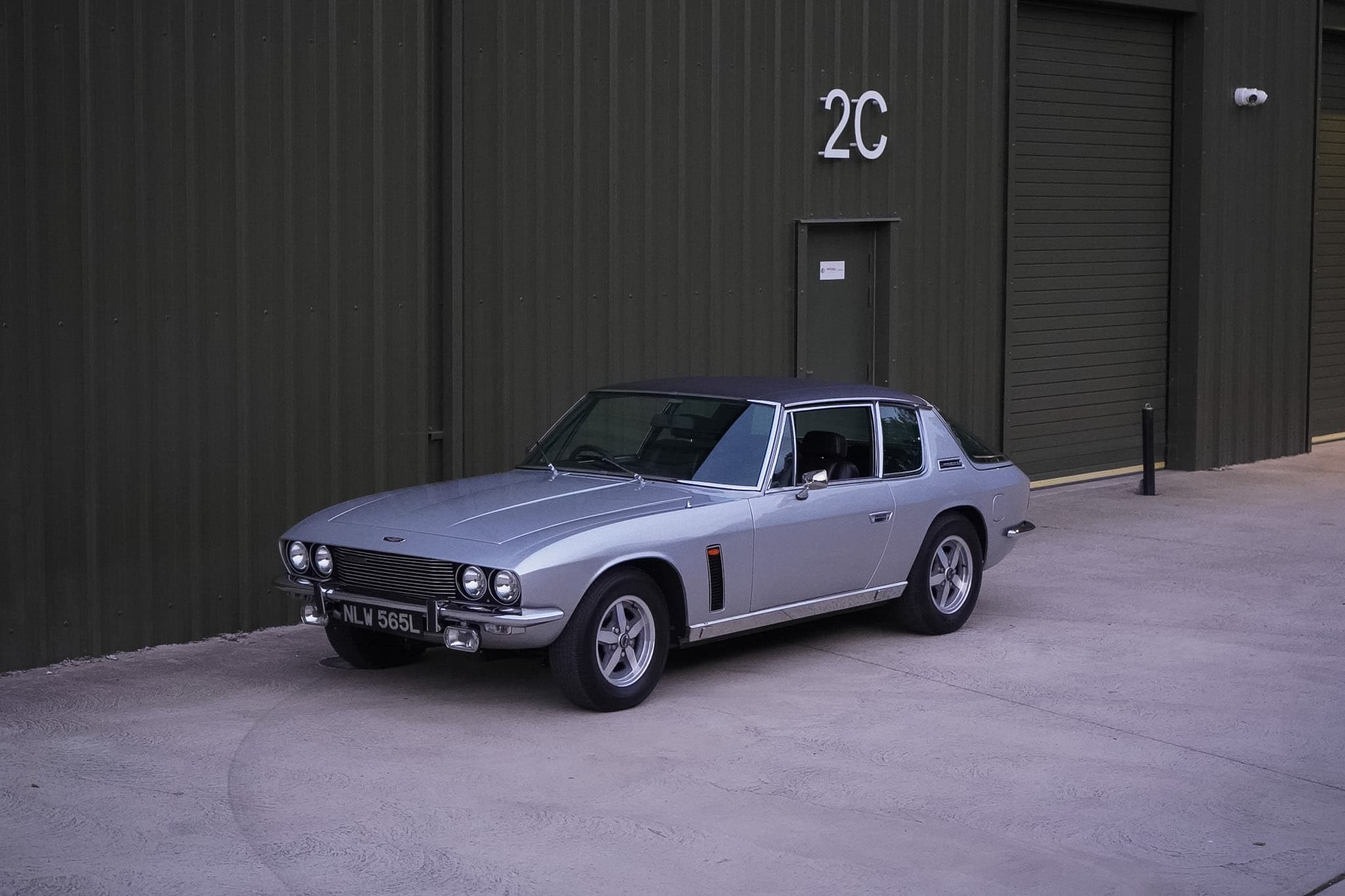
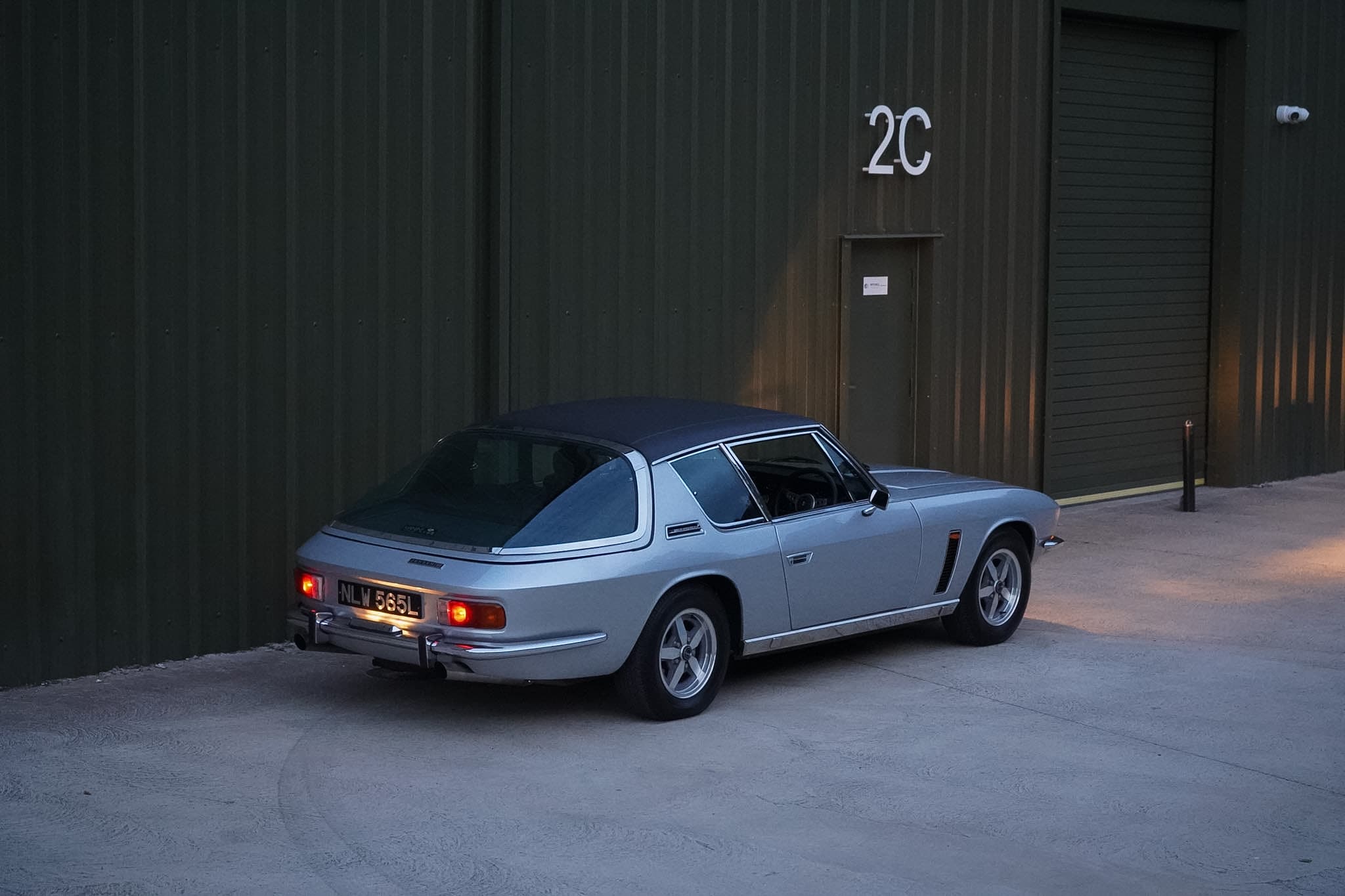
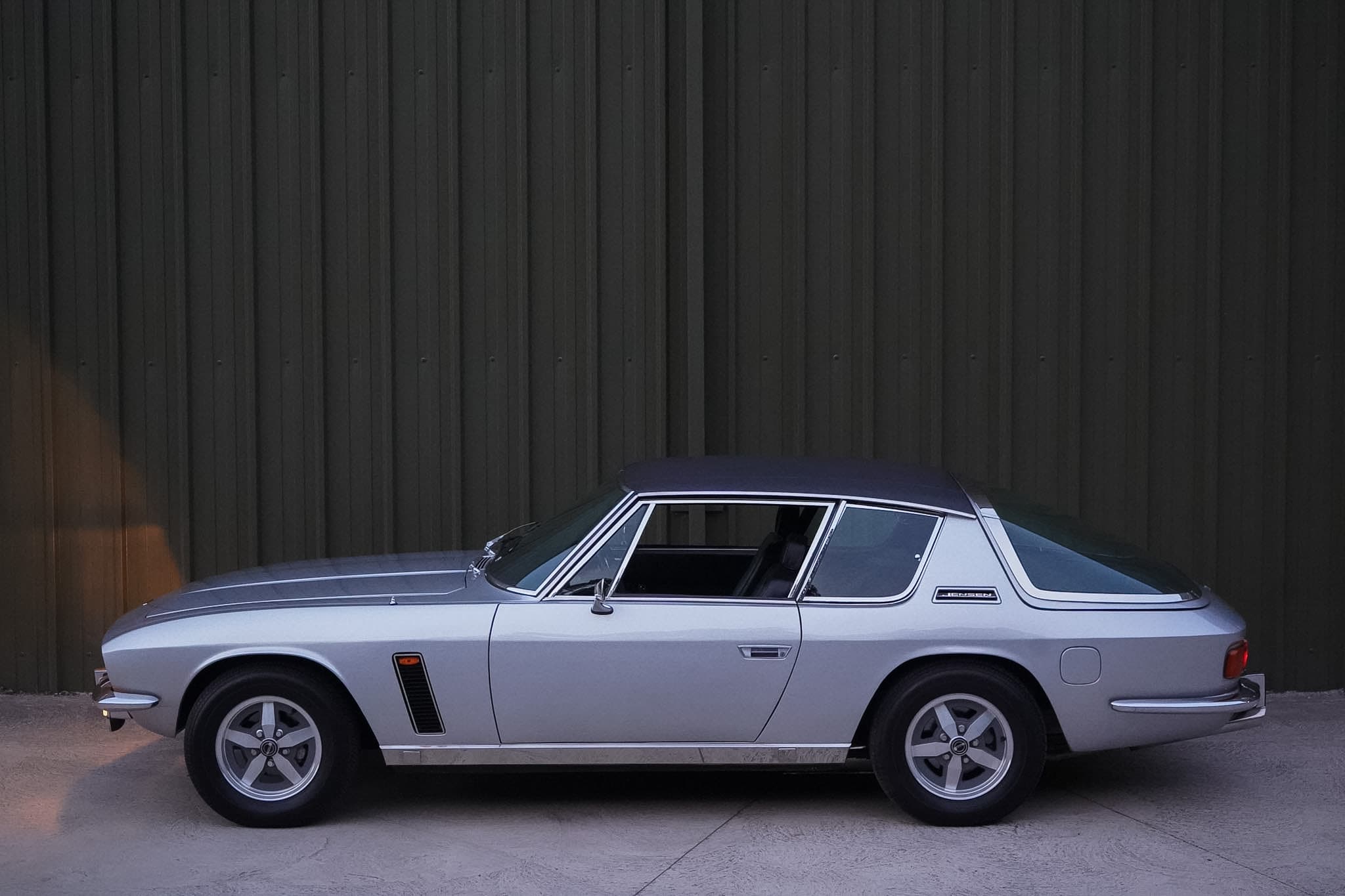
Launched in 1966, the new Interceptor retained important C-V8 chassis ancestry but replaced its predecessor's glass-fibre shell with a steel body and a large, distinctive rear window. Chrysler V8 power remained central. The result was less a conventional sports car than a rapid four-seat grand tourer, designed to cover distance with pace and comfort.
The Jensen Interceptor model reference follows the full family. The Mk III deserves separate treatment because its engine, trim and derivative chronology differs from the earlier cars.
The FF was the Interceptor's technically ambitious relation. Its initials stood for Ferguson Formula, the full-time four-wheel-drive system developed with Harry Ferguson Research. It also used Dunlop's mechanical Maxaret anti-lock braking system.
The FF is widely credited as the first series-production passenger car to combine full-time four-wheel drive with anti-lock braking. A CV8-based development car appeared before the steel-bodied production FF, and Maxaret worked differently from a modern electronic ABS system. What remains clear is that Jensen put the two systems into a road-going passenger car decades before their combination became commonplace.
The FF also shows the scale of Jensen's ambition. The company was small, yet it tried to solve traction and braking at a systems level rather than treating performance as engine output alone.
By the end of the 1960s Jensen needed more than its large V8 grand tourers and contract-production work. The Austin-Healey body contract had ended, and Donald Healey had already begun work on a possible successor sports car. The project that became the Jensen-Healey therefore represented a deliberate move into a smaller, lighter and potentially higher-volume part of the market.
The development path was not straightforward. Jensen and Healey explored several engine options before settling on Lotus's new twin-cam four-cylinder. The production Jensen-Healey was presented in 1972. It was a very different proposition from the Interceptor: an open two-seat sports car intended to sit below the V8 GT in price, size and character rather than replace it. Early development and quality problems hurt the programme, while later Mk II cars incorporated substantial improvements.
The relationship with Donald Healey did not last for the whole production run. He and his sons left the Jensen board in 1973. In 1975 Jensen developed the Jensen GT, a closed shooting-brake derivative of the Jensen-Healey platform. The Healey name was dropped from the production GT, reflecting that changed relationship.
This programme matters to Jensen history because it shows the company trying to broaden both its customer base and production volume at exactly the point when its traditional business was under pressure. It should not, however, be treated as a one-line explanation for Jensen's collapse: the company was also dealing with falling Interceptor demand, capital pressure, warranty costs, excess capacity and wider economic disruption.
The Interceptor continued through Mk II and Mk III development, joined by the SP and later Convertible and Coupé. Exact totals vary between respected marque sources: even the overall 1966-76 Interceptor count differs by one, while Convertible and Coupé figures diverge more substantially. About 6,400 Interceptors is a useful scale, but not a precise production ledger.
Jensen also broadened its range with the Jensen-Healey from 1972 and the short-lived GT. Financial strain was evident before the oil shock; the National Motor Museum places the eventual failure in its aftermath, while detailed marque histories also record management, production and warranty pressures. The balance between those factors is disputed. A receiver and manager was appointed on 15 September 1975, and the original Jensen Motors ceased trading in May 1976.
The Jensen Museum's production chronology records later Interceptor S4 and S-V8 phases. Because the original company had already ceased trading, those belong to separate revival chapters rather than uninterrupted manufacture by the original West Bromwich business.
The original West Bromwich Jensen Motors did not continue uninterrupted into today's business. After the original company ceased trading in May 1976, parts, service and later revival projects carried the Jensen name forward through separate businesses and programmes.
The first important revival grew out of Jensen Parts & Service. The Jensen Museum records a pre-production Interceptor S4 based on an existing Mk III and, by 1984, the first newly built S4 saloon and Convertible; the business had become Jensen Cars Ltd. A later attempt to relaunch Jensen around the S-V8 reached production at Speke in 2001-02, but that venture was also short-lived. Exact S-V8 totals are awkward because unfinished cars were completed later, so the useful point here is the separate programme rather than a single headline number.
Jensen International represents another distinct chapter. Its current classic-car business describes the Interceptor R as a restored and extensively re-engineered original Interceptor, while the new Jensen operation now presents the all-new Interceptor GTX as a track-focused development car for planned road-going GTR and GT models. The distinction is explicit: the current Jensen site says the new car was not conceived as a continuation car, and its footer states that Jensen Works Ltd is not affiliated or connected with any former producer of Jensen cars.
For a collector, the badge therefore does not establish corporate continuity. An original 1960s-70s Interceptor, an S4, an S-V8, an Interceptor R and a new-build Jensen can all belong to the wider marque story while having very different manufacturer, completion and provenance histories. Establish who actually built, completed or re-engineered the individual car before treating period, factory or originality claims as comparable.
Jensen's appeal lies partly in contrasts: craft production and bold engineering, British interiors and American V8s, restrained company scale and unusually ambitious cars. The 541 and C-V8 show the marque before the steel Interceptor; the FF adds engineering importance; the Interceptor, SP, Convertible and Coupé offer distinct collector propositions within the best-known family.
Specialist buyer guides from Hagerty and Classic & Sports Car make Interceptor ownership strongly condition-led. Structural corrosion, cooling, wiring, body alignment and scarce model-specific trim can turn a superficially complete car into a major project. The TMJC Jensen Interceptor Mk III restoration guide explains the evidence and inspection priorities in more detail.
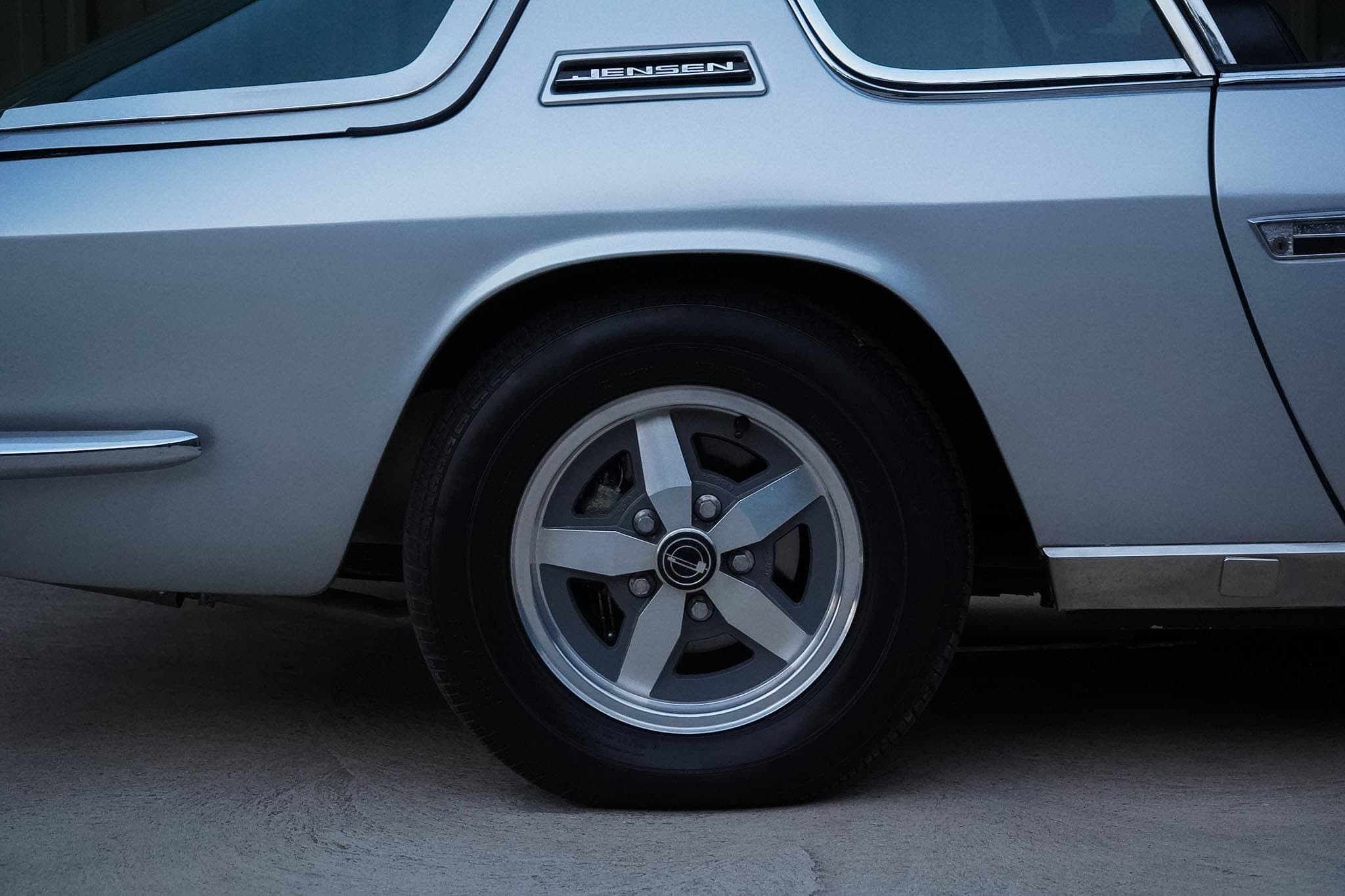
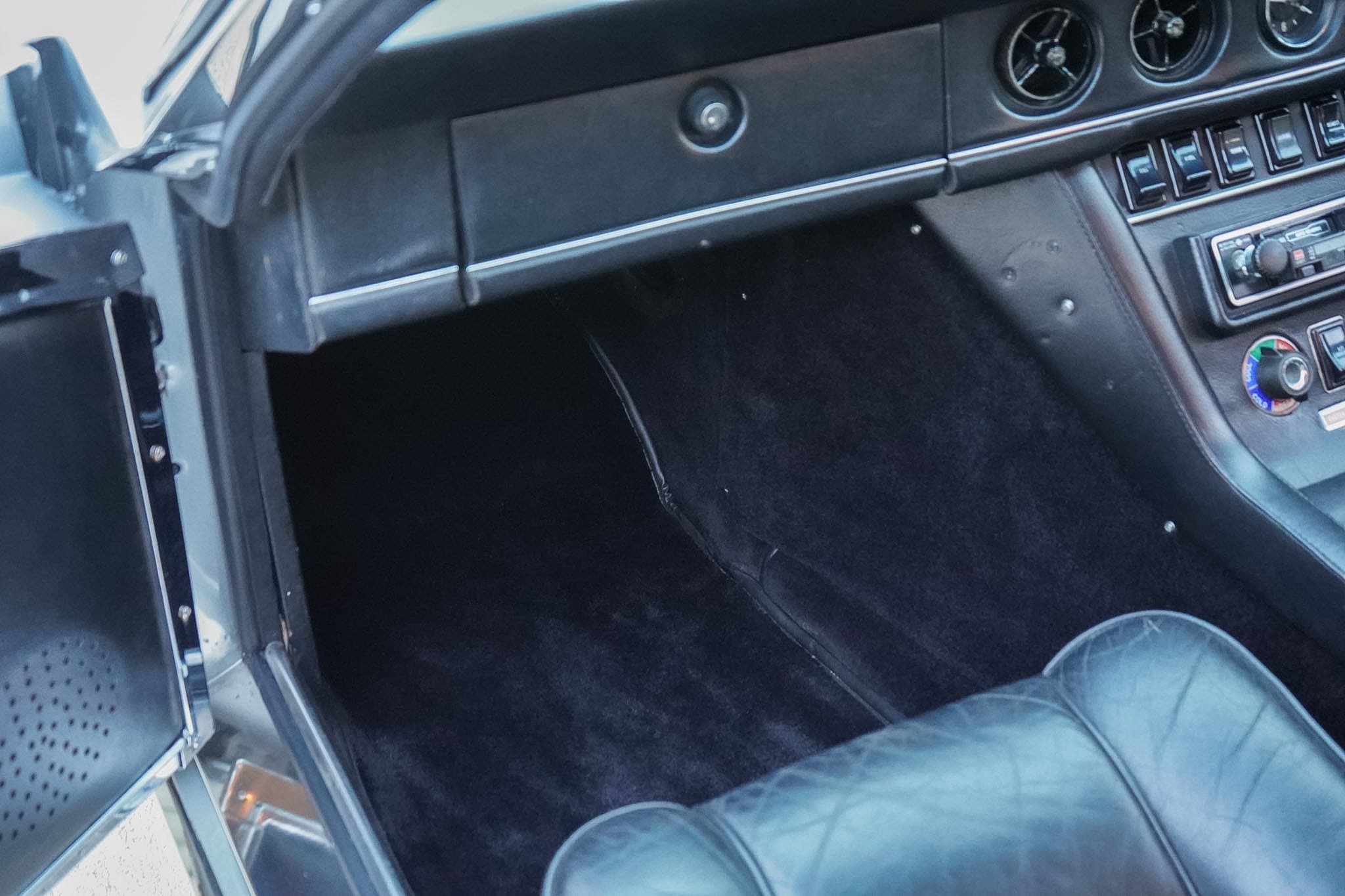
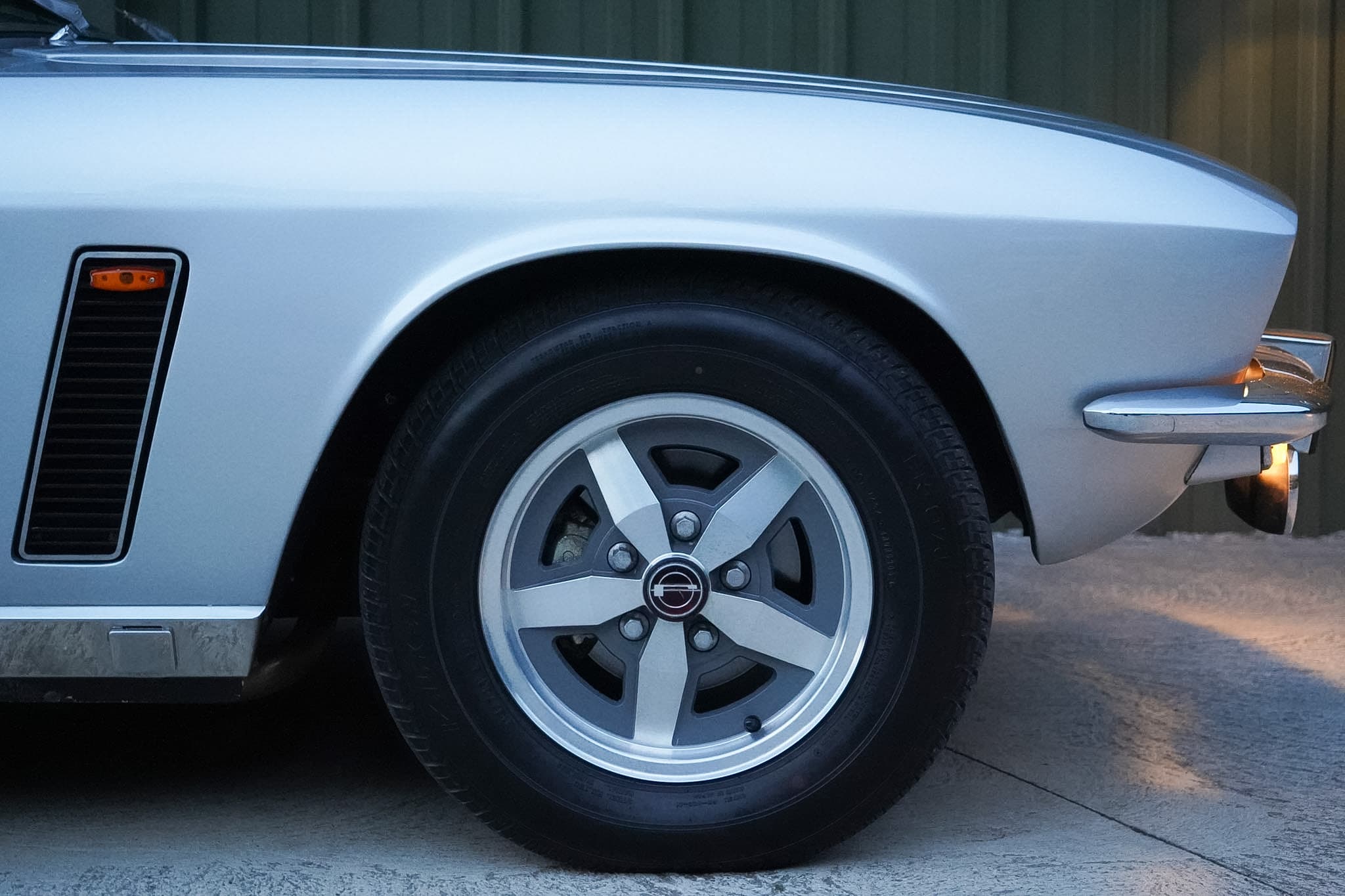
TMJC's own 1972 Mk III provides real-world context for that process. Its restoration and history belong to that individual vehicle, not to every Jensen, but they show why invoices, photographs, chassis identity and the quality of metalwork deserve as much attention as paint and specification.
Editorial information
Research and editorial from TMJC Garage.
Research and editorialTMJC Garage
Reviewed byMatt Johnston
Last reviewed26 October 2026
Published byThe Matt Johnston Collection
TMJC photography
TMJC Guides
TMJC assistance
Continue to the main TMJC website and speak directly with the collection team.
Sell, consign or source
Continue with TMJC for a discreet conversation, professional presentation and collector-focused support.
Enquire now