Published guide
Datsun 240Z vs 260Z vs 280Z: how to identify an S30
How to tell a Datsun 240Z, 260Z and 280Z apart using chassis codes, serial context, original market and two-seat/2+2 identity — not badges alone.
Overview
How to tell a Datsun 240Z, 260Z and 280Z apart using chassis codes, serial context, original market and two-seat/2+2 identity — not badges alone.
The 240Z, 260Z and 280Z all belong to Nissan's first-generation S30 Z-car family, which is exactly why identifying an old one can be less straightforward than the badges suggest.
A useful inspection does not start with the bumpers. It starts with the car's original market, stamped chassis or car number, build/serial context and body type. Engine and transmission evidence come next. Lamps, badges, vents, wheels and bumpers are supporting clues because five decades of restoration and modification can change them surprisingly easily.
There is an especially good reason to work in that order: Nissan used HLS30 in factory documentation for both the 240Z and, later, the North American 280Z. A model code can therefore be essential evidence without being the whole answer.
For the individual histories, see the 240Z, 260Z and 280Z references.
The short version: what separates the three?
| Model context | Strong factory identity clues | Engine/fuelling baseline | Body choices | Market warning |
|---|---|---|---|---|
| 240Z | HLS30 appears on left-hand-drive factory material; HS30 appears in right-hand-drive/non-US contexts | L24, carburettors | Two-seat | Gearbox, equipment and launch timing differ by market |
| 260Z | RLS30 two-seat in period Nissan parts material; RS30 also appears in Nissan's own history; GR(L)S30 identifies the 2+2 family | L26, carburettors | Two-seat and 2+2 | A one-year 1974 story describes the US, not every market |
| 280Z, North American S30 | HLS30 two-seat and GHLS30 2+2 in Nissan's 1976 bulletin | L28, electronic fuel injection | Two-seat and 2+2 | The S30 280Z was a North American model; Fairlady 280Z can mean an S130 in Japan |
That table is deliberately about identity rather than headline power. Power figures, transmissions, bumpers and emissions hardware all change with market and year. They are poor foundations for a universal three-car specification table.
The important trap: HLS30 can describe a 240Z or a 280Z
Nissan's 1972 Datsun 240Z Sports service manual lists HLS30 configurations with the L24 engine. It also lists HS30 right-hand-drive applications and European five-speed configurations.
Four years later, Nissan's 1976 Datsun 280Z service bulletin again uses HLS30 for the two-seat car — now with the L28 engine and electronic fuel-injection era around it. The bulletin applies from serial HLS30 270001 for the two-seater and GHLS30 030001 for the 2+2.
That means a bare HLS30 is not a complete answer to the question 240Z or 280Z?.
The proper question is:
- what is the complete stamped number?
- what build or model-year period does it belong to?
- what was the car's original market?
- does the type plate and paperwork tell the same story?
This also explains why model-code legends need to be read in context. Nissan's 1976 280Z bulletin explains G as 2+2, H as L28 and L as left-hand drive for its model-variation table. But the older Nissan 240Z manual has already shown HLS30 attached to an L24 car. The 1976 legend is useful for the 1976 model table; it is not a timeless alphabet that can be projected backwards across every S30.
The 260Z gives a clearer factory breakpoint
A 1973 Nissan genuine-parts catalogue is unusually useful because it covers the transition from 240Z to 260Z in the same document.
Its application list gives:
- HLS30 L24 2 SEATER — up to July 1973;
- RLS30 L26 2 SEATER — from August 1973;
- GRLS30 L26 2+2 SEATER — from October 1973.
The same catalogue illustrates HLS30 and RLS30 car-number locations on the cowl/dash panel and L24/L26 engine-number locations on the cylinder block.
Those dates need one qualification. They are parts-catalogue application dates, not a promise that every country changed its showroom range on the same day. They are still very useful because they show how Nissan itself separated the L24 two-seat application from the L26 two-seat and new 2+2 applications.
Nissan's own Safari Rally history provides another period identity point by calling its 1974 competition car a Fairlady 260Z RS30. FIA/JAF material for the 260Z 2+2 uses GR(L)S30. Taken together, these records make the R/GR branch much more useful than trying to identify a 260Z from a wing badge alone.
Two-seat and 2+2 must be separated before you compare dimensions
The 260Z introduced a 2+2 alongside the familiar two-seat body. The 280Z continued with both.
That matters because a common comparison error is to quote a later 2+2 dimension as though every 260Z or 280Z had grown by the same amount.
A period Datsun 280Z brochure gives the distinction clearly:
| 280Z body | Overall length | Wheelbase | Seating |
|---|---|---|---|
| Two-seat | 173.2 in | 90.7 in | 2 |
| 2+2 | 185.4 in | 102.6 in | 4 |
The 12-inch wheelbase increase belongs to the 2+2. A two-seat 280Z is not simply a stretched early Z because the badge number is larger.
The body code helps here too. Nissan's 1976 bulletin uses GHLS30 for the North American 280Z 2+2, while FIA/JAF documentation uses GR(L)S30 for the 260Z 2+2 family. On a modified car, those identities are more persuasive than rear seats that could have been removed or trim that could have been changed.
Is every 260Z a 1974 car?
No. That is a US-market answer accidentally turned into a global one.
The 260Z had a very short life in the United States before the fuel-injected 280Z arrived. Britain followed a different chronology. A contemporary Motor Sport road test covered the 260Z in April 1974, and the magazine was still reporting in December 1977 that the 260Z was to be made freely available in Britain again, quoting prices for both the two-seater and 2+2.
So 1974 260Z can be a useful US shorthand, but it is not a safe rule for a British car.
This is why registration year should come after original market when you are identifying an S30. A later UK 260Z is not automatically misbadged because an American specification site says the 260Z ended after one model year.
Is every 280Z an S30?
Not if you ignore the market attached to the name.
The Datsun 280Z discussed in the North American export sequence is the later S30. After the first full Z-car model change in 1978, Nissan introduced the S130.
In overseas markets that new generation became the 280ZX. In Japan, however, Nissan's own heritage material shows the S130 range using Fairlady 280Z naming.
So these two statements can both be true:
- a North American Datsun 280Z is an S30;
- a Japanese Fairlady 280Z can be an S130.
If a parts advert, auction description or search result says only 280Z, ask which market and which chassis family before treating the name as complete identification.
What can you learn from the engine?
The engine is a strong clue, but it is not the shell's birth certificate.
The basic progression is useful:
- 240Z — L24;
- 260Z — L26;
- North American S30 280Z — L28 with electronic fuel injection.
If an unknown car has an L28 and EFI, that is important evidence. It still does not prove the shell left Nissan as a 280Z, because engine swaps are common across the S30 family. The same caution applies to the gearbox. Nissan's 1976 280Z bulletin lists four-speed manual and automatic configurations, while the 1977 factory service manual separately includes both four-speed and five-speed transmission sections. A five-speed therefore needs model-year and market context before it is treated as either factory equipment or a later conversion.
Record the engine number and type separately from the chassis number. Then ask whether old invoices, registration/import documents and restoration records explain how those two pieces of evidence came together.
Visual clues help, but use them last
Factory visual differences were real. In its April 1974 road test, Motor Sport noted that the 260Z could be distinguished from the 240Z by details including front-wing badges and revised rear lamp treatment with separate reversing lights.
Those clues are still useful on an unmodified car. They are weak primary identity evidence on a fifty-year-old restoration.
Owners routinely backdate later S30s with earlier-style bumpers. Lamps, dashboards, glass, wheels and badges can be replaced. A later engine and gearbox can be fitted. Steering position can even be converted.
A sensible hierarchy is therefore:
- stamped chassis/car number;
- type plate and period factory documentation for that serial range;
- original-market and import/registration history;
- two-seat or 2+2 shell identity;
- engine number, engine family and fuelling system;
- gearbox and driveline specification;
- bumpers, lamps, badges, vents, trim and wheels.
A visual clue that agrees with the paperwork strengthens the case. A visual clue that conflicts with the paperwork is a reason to investigate, not an excuse to rewrite the car's identity.
Can you identify a 240Z, 260Z or 280Z from one photograph?
Sometimes. Reliably, not always.
A standard car photographed clearly from several angles may show enough correct body, lighting and bumper details to make a strong provisional call. A restomod or backdated car can defeat that approach completely.
For a purchase, concours claim or high-value originality question, ask for photographs of the stamped chassis/car number and type plate as well as the exterior. Then check the complete number against the correct period and market evidence.
That answer is less satisfying than a list of three bumper shapes, but it is much harder to fool.
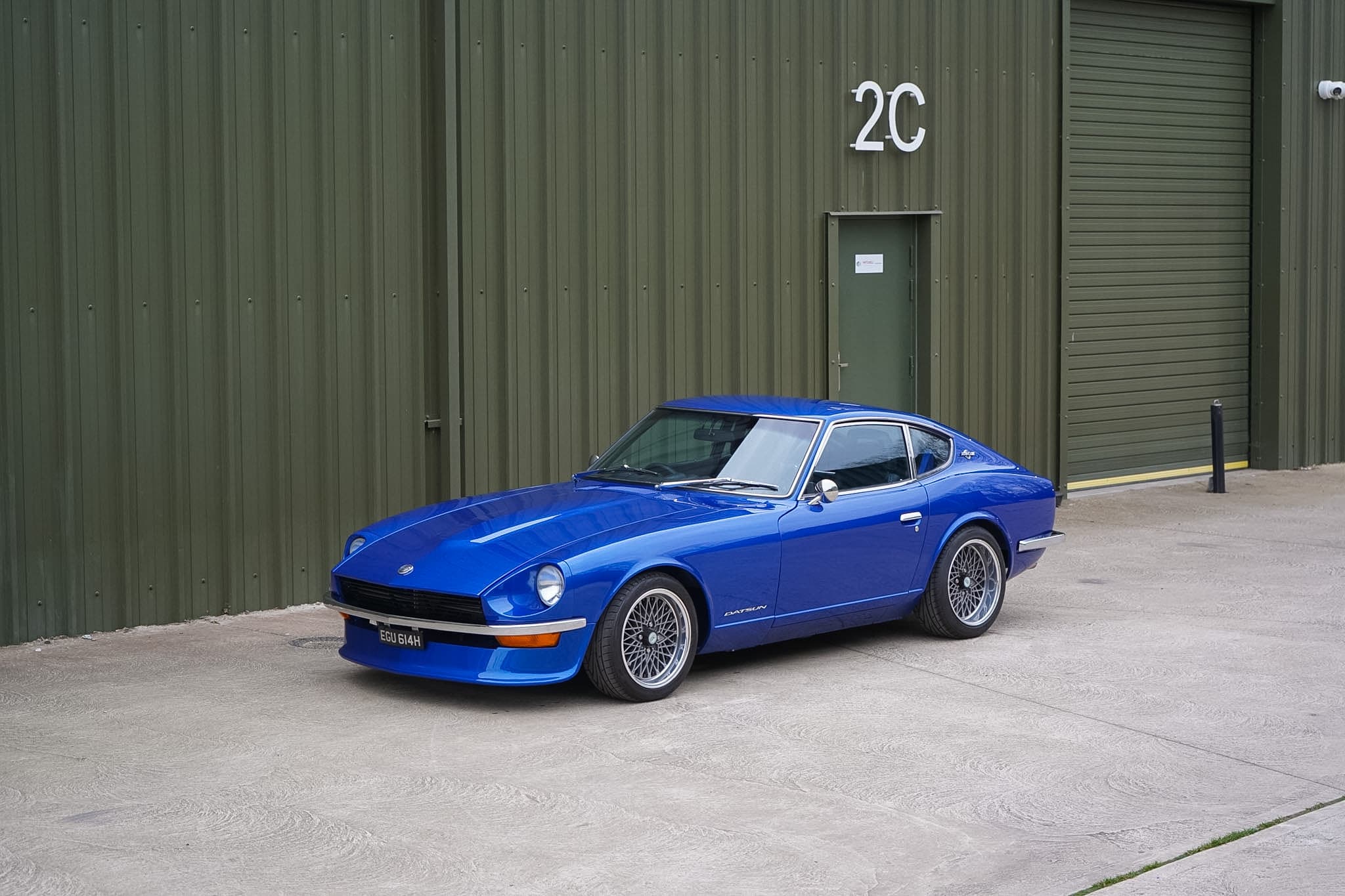
TMJC's 240Z is a useful real-world example
TMJC's current 1970 240Z Restomod shows why factory identity and current specification need to be kept separate.
TMJC records the car as a US import. It was later converted to right-hand drive. Its original L24 was rebuilt and substantially modified, while a Nissan Silvia five-speed was fitted as part of the restomod programme.
Look only at the car as it sits today and you could wrongly treat right-hand drive and five speeds as evidence of how it left Nissan. The documented history gives the better answer: those are later changes to a car whose original market and underlying identity pre-date them.
For a deeper inspection framework for modified examples, see the 240Z restomod buying guide.
A practical S30 identification checklist
When inspecting a car advertised as a 240Z, 260Z or 280Z:
- photograph the chassis/car number before relying on the advert title;
- photograph the type plate separately and compare the identifiers;
- establish the original country/market and route into the UK if it is an import;
- establish build/model-year or serial context from factory material;
- confirm two-seat versus 2+2 body before comparing dimensions;
- record engine type and engine number rather than assuming the badge matches the fitted engine;
- record the gearbox and differential, and verify a five-speed against the correct model-year and market evidence before calling it original or a conversion;
- use exterior details as corroboration, not the starting point;
- ask for restoration photographs and invoices where major shell, steering or driveline work has been done;
- keep factory identity and current specification as two separate descriptions.
That method is slower than identifying a Z from its bumper. It is also much more useful when the car is worth buying.
Sources and further reading
- Nissan 1972 Datsun 240Z Sports service manual
- Nissan genuine-parts catalogue: HLS30, RLS30 and GRLS30
- Nissan 1976 Datsun 280Z Service Bulletin Vol. 231
- Datsun 1977 280Z Service Manual (S30 Series)
- Period Datsun 280Z brochure
- Nissan Heritage: Safari Rally results, including the 1974 RS30
- FIA Historic Database: Datsun 260Z 2+2
- Motor Sport: The Datsun 260Z, April 1974
- Motor Sport: Return of Z, December 1977
- Nissan: 50 years of Z-car history
Related car
Cars covered in this guide
Explore the cars this guide covers, with model information, history and related TMJC guidance.
 240Z
Comparison
240Z
ComparisonExplore model details, specifications, history and related guidance for Datsun 240Z.
Comparison
280Z
ComparisonExplore model details, specifications, history and related guidance for Datsun 280Z.
 260Z
Comparison
260Z
ComparisonExplore model details, specifications, history and related guidance for Datsun 260Z.
Editorial information
The Matt Johnston Collection
Research and editorial from TMJC Garage.
Research and editorialTMJC Garage
Reviewed byMatt Johnston
Last reviewed15 September 2026
Published byThe Matt Johnston Collection