Published guide
Classic car MOT exemption: what it means when buying one
The 40-year rule, substantial changes, voluntary MOTs and why MOT, historic tax and ULEZ exemption are three different things to verify.
Overview
The 40-year rule, substantial changes, voluntary MOTs and why MOT, historic tax and ULEZ exemption are three different things to verify.
If a classic car is advertised as MOT exempt, that tells you something about its testing requirement. It does not tell you that the car is mechanically sound, structurally healthy, original or correctly described.
For buyers in England, Scotland and Wales, a vehicle can qualify as a vehicle of historical interest for MOT purposes if it was built or first registered more than 40 years ago and it has not been substantially changed in the previous 30 years. The substantial-change test matters as much as the age threshold.
That makes MOT exemption a provenance question as well as an administrative one. On an old car with a long restoration or modification history, you want to know not only whether it is old enough, but what has changed, when it changed and what evidence supports the keeper's declaration.
What does MOT exempt actually mean?
The current Department for Transport criteria apply in England, Scotland and Wales. They say a vehicle does not need an MOT if it was built or first registered more than 40 years ago and no substantial changes have been made in the last 30 years.
If the keeper cannot confirm that the vehicle has not been substantially changed, the guidance says they must not claim the exemption.
An exempt vehicle still has to be roadworthy. That is not a technicality. GOV.UK's roadworthiness guidance says the driver remains responsible for making sure a vehicle is safe to drive, and that a car can be unsafe even if it has a current MOT certificate.
So there are two mistakes worth avoiding:
- “MOT exempt” does not mean “condition checked”. It means the vehicle does not currently require the normal annual MOT if it meets the exemption rules.
- “Has an MOT” does not mean “nothing is wrong with it”. An MOT is a defined roadworthiness and environmental test at a point in time, not a full restoration audit, originality inspection or warranty.
For a collector car, the best evidence file usually goes much further than either label.
The 40-year rule is not just an age rule
Calling it the “40-year MOT exemption” can obscure the substantial-change test.
The official substantial-change guidance looks at the technical characteristics of major components. It discusses areas such as the chassis or monocoque, axles and running gear, steering, suspension and engine, while also setting out alterations that can be acceptable in particular circumstances.
That means it is unsafe to use either of these shortcuts:
- “It has been modified, so it cannot be MOT exempt.”
- “It is over 40 years old, so it must be MOT exempt.”
Both are too crude. The nature of the alteration, its age and the detailed criteria matter.
For a restored or modified classic, ask for the evidence that lets you understand the changes. Useful material can include dated invoices, restoration photographs, build sheets, specialist reports, old MOT certificates, engine or gearbox invoices and correspondence relating to DVLA updates.
If a change affects information shown on the V5C, such as an engine replacement, the DfT guidance also points to the separate requirement to notify DVLA. MOT status and registration accuracy are related evidence questions, but they are not the same decision.
MOT exemption, historic tax and ULEZ exemption are different
Adverts often group these together because an older car can qualify for more than one concession. They should still be checked separately.
MOT exemption
For Great Britain, the current core test is more than 40 years old plus no substantial change in the previous 30 years, subject to the detailed historic-vehicle criteria.
Historic vehicle tax
Vehicle tax uses a separate rolling historic threshold and an application process. As of 1 April 2026, GOV.UK says a vehicle built before 1 January 1986 can apply to stop paying vehicle tax. If its build date is unknown, first registration before 8 January 1986 can qualify under the current rule.
Even when no payment is due, the vehicle still has to be taxed. The keeper applies for the historic vehicle tax class; “free tax” does not mean no tax transaction at all.
London ULEZ exemption
ULEZ is another regime again. Transport for London currently lists two historic-vehicle categories that are exempt from ULEZ: vehicles built before 1 January 1973, and vehicles over 40 years old that have been successfully registered with DVLA in the historic vehicle tax class.
That does not turn TfL's rule into an MOT rule. A car can satisfy a ULEZ historic category for a reason that tells you nothing about whether its modifications meet the DfT substantial-change test.
When an advert says “MOT, tax and ULEZ exempt”, read it as three claims to understand, not one combined certificate.
What can the MOT history tell you on an exempt classic?
The GOV.UK MOT history service is still useful even when a car no longer needs an annual test.
For cars, vans and motorcycles in Great Britain, the online history can show tests from 2005 onwards, including pass/fail results and recorded mileage. It can also show defects and minor problems, and with the V5C number you can see where a test was carried out.
Look for patterns such as:
- mileage progression that broadly agrees with the history file;
- repeated advisories that may show a problem being deferred over several years;
- corrosion comments that can be compared with later restoration invoices or photographs;
- changes in usage before and after restoration;
- a point at which annual testing stopped after the car became eligible for exemption.
But the gaps need sensible interpretation.
A 1970s car may have decades of history that will never appear in the online service because the searchable car history only goes back to 2005. And a legitimately exempt vehicle may have no recent annual tests because it no longer has to be presented every year.
So no recent MOT is not automatically a red flag. It is a prompt to ask what other current condition evidence exists.
Is a voluntary MOT worth having?
It can be.
The DVSA MOT inspection manual explicitly allows owners of qualifying historic vehicles to request a statutory test voluntarily. The test is registered on the MOT testing service and carried out in the normal way.
For a buyer, a recent voluntary MOT can be useful because it gives you:
- a dated, standardized test record;
- a recorded mileage point;
- a list of any defects or advisories found within the MOT scope;
- another document to compare with the seller's description and the maintenance file.
It is still not a substitute for a proper pre-purchase inspection where the value or complexity of the car justifies one. A specialist inspecting an old car can examine areas that matter to that particular model, restoration or modification history and which are outside the normal MOT's purpose.
A good seller of an MOT-exempt car should be able to discuss condition evidence without relying on the exemption itself as reassurance.
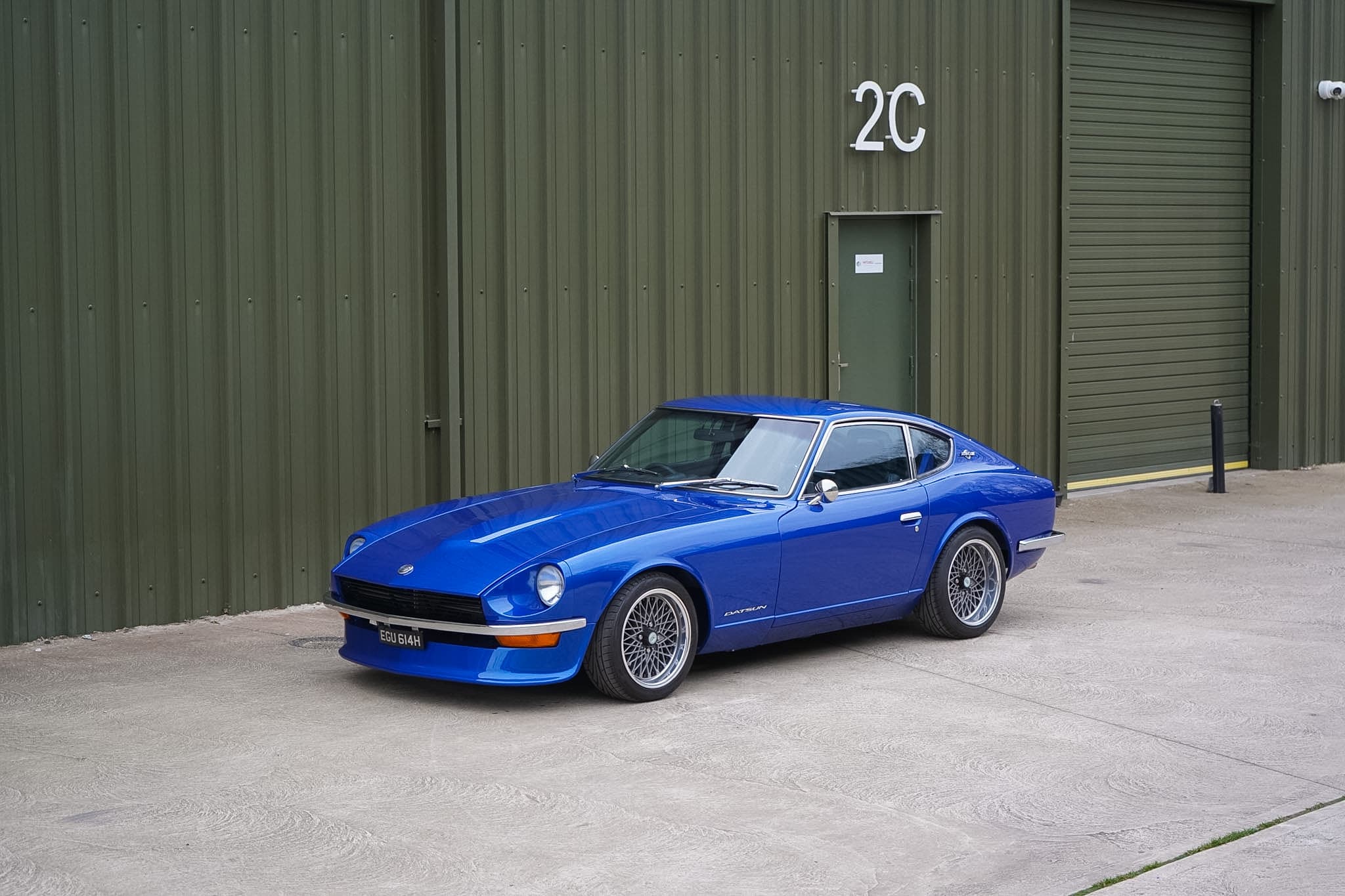
TMJC example: 1970 Datsun 240Z Restomod
The Matt Johnston Collection's 1970 Datsun 240Z Restomod is a good example of why these categories need separating.
TMJC describes the car as “Historic Vehicle - MOT, Tax and ULEZ Exempt”. The same listing is unusually detailed about its build: it describes a US import, a seven-year nut-and-bolt restoration, a bare-metal and acid-dip process, conversion to right-hand drive, rebuilding and modifying the original L24 engine, standalone management and individual throttle bodies, a Nissan Silvia five-speed gearbox, electric power-assisted steering and more than 100 invoices.
That documentation matters because the car is heavily restored and modified rather than untouched.
TMJC's advert is evidence of how the car was described, not a fresh legal determination of its current MOT status. A buyer should check that the claimed status and modification history reconcile with the paperwork and current official criteria.
The ULEZ part is easier to separate conceptually. The car is described as a 1970 example, and TfL currently exempts vehicles built before 1 January 1973. That is a London charging rule; it does not answer the MOT substantial-change question.
You can read the Garage reference for the Datsun 240Z alongside the individual TMJC car's build history.
What should you check before buying an MOT-exempt classic?
Build the picture from several independent pieces of evidence.
1. Check what DVLA currently holds
Use the DVLA vehicle information service and compare the registration, date of first registration, year of manufacture, engine size, fuel type, tax status and other relevant details with the V5C and the car in front of you.
Do not assume an advert or old invoice is more current than the registration record.
2. Check the available MOT history
Look at the mileage sequence, failures, advisories and recurring defects. Remember the online car history begins in 2005, so older paperwork can add context the digital record cannot provide.
If testing stops, establish whether that timing makes sense for the car's exemption status rather than treating the gap itself as proof of a problem.
3. Understand the modifications
For a modified car, create a simple chronology: what changed, approximately when, who did the work and what invoices or photographs support it.
Then compare those changes with the current DfT substantial-change criteria. If the position is unclear, the government guidance recommends seeking advice from a historic-vehicle expert rather than guessing.
4. Separate condition from legal testing status
Look for current evidence of structural, braking, steering, tyre and mechanical condition. That might be a voluntary MOT, a specialist inspection, recent workshop invoices or a combination of them.
A legal exemption from annual testing is not evidence that those areas have recently been examined.
5. Check tax and charging-zone claims independently
If the advert says the car is in the historic tax class, verify the DVLA position. If ULEZ exemption matters to you, use TfL's current checker and rules rather than assuming every MOT-exempt classic receives the same London treatment.
Rules and rolling date thresholds can change, so check the live official services close to purchase.
What about substantially modified vehicles over 40 years old?
This is where paperwork matters most.
The DfT guidance contains detailed tests and acceptable alterations; it is not a blanket ban on modification. Separate current DVLA guidance on modified and reconstructed vehicles also affects how changes are notified and how vehicle identity is treated.
For example, current DVLA modified-vehicle guidance says an MOT needs to be provided when submitting a modification for a vehicle over 40 years old. That is a procedural requirement around submitting the modification; it should not be simplified into a claim that every modified historic car permanently loses all possibility of MOT exemption.
If you are buying a restomod, engine-swapped car, converted car or heavily reconstructed classic, ask for enough documentation to understand both its physical build and its registration history.
Northern Ireland is different
The detailed DfT historic-vehicle criteria linked above explicitly apply to England, Scotland and Wales. Northern Ireland has its own DVA testing system and processes.
There is also a historic-vehicle annual-testing exemption in Northern Ireland, but buyers and owners should use current nidirect MOT guidance rather than assuming every Great Britain procedure is identical.
How to read “MOT exempt” in an advert
Treat it as one line in the evidence file, not the conclusion.
For a straightforward, largely original classic, the status may be uncomplicated. For a restored or modified car, it is worth understanding how the build history sits against the current rules. In either case, roadworthiness, provenance and condition still need their own evidence.
The strongest purchase file is the one where the V5C, MOT history, restoration invoices, modification chronology, current condition and seller's description all tell the same story.
Related car
Cars covered in this guide
Explore the cars this guide covers, with model information, history and related TMJC guidance.
240ZBuying guide
240Z
PurchaseExplore model details, specifications, history and related guidance for Datsun 240Z.
Editorial information
The Matt Johnston Collection
Research and editorial from TMJC Garage.
Research and editorialTMJC Garage
Reviewed byMatt Johnston
Last reviewed18 September 2026
Published byThe Matt Johnston Collection