Published guide
Datsun 240Z restomod buying guide: what to check
How to assess a modified Datsun 240Z: shell identity, RHD conversion, drivetrain integration, DVLA evidence, MOT status and shakedown.
Overview
How to assess a modified Datsun 240Z: shell identity, RHD conversion, drivetrain integration, DVLA evidence, MOT status and shakedown.
A good restomod can make a 240Z faster, easier to use and better suited to modern roads without losing the character that made the S30 appealing in the first place. A poor one can hide rust, confused identity and incompatible systems behind expensive parts.
The useful question is therefore not “is it modified?” It is “can I understand what the car was, what changed, who changed it, and whether the finished systems work together?”
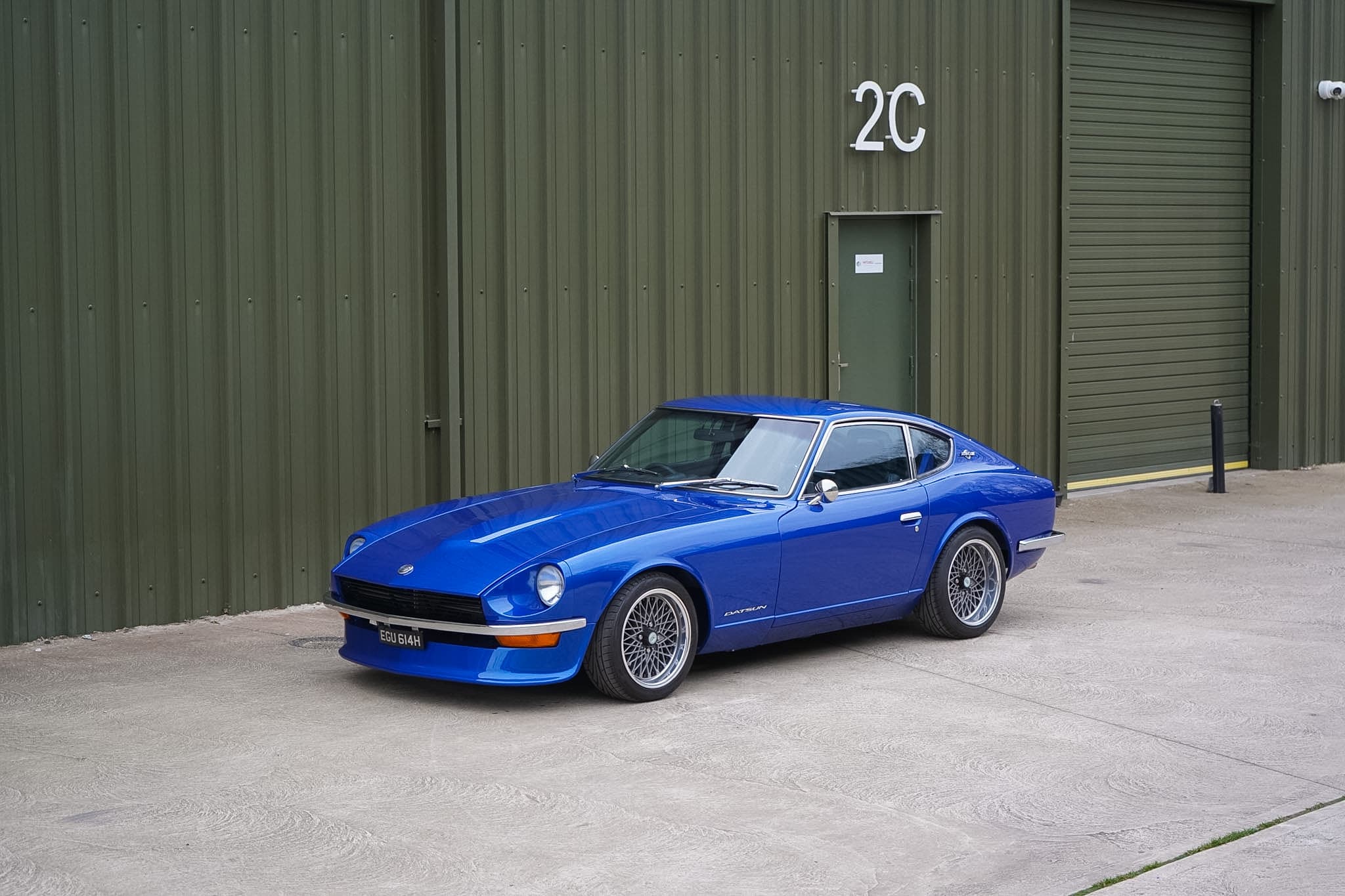
TMJC's 1970 Datsun 240Z is a useful case study because the build is unusually traceable: the listing describes a US-imported shell, a multi-year bare-metal restoration, more than 100 invoices, an RHD conversion, a rebuilt L24 with modern management, a later Nissan five-speed gearbox, electric power steering and a second specialist development phase. Those are facts about that individual car, not a template for how every 240Z should be built.
Start with the base car, not the modifications
Before valuing throttle bodies, suspension or trim, establish the car underneath them.
Nissan's own history places the S30/Fairlady Z at the start of the Z lineage in 1969, with the 2.4-litre Datsun 240Z developed particularly for export markets such as North America. That matters because a US-origin HLS30, a Japanese-market car and a UK-supplied example did not necessarily begin with the same gearbox, trim or detail specification.
For a modified car, record:
- chassis/VIN identity and where the stamped number is located;
- original market and steering position;
- approximate import/export chronology;
- original engine and transmission type if known;
- current engine and transmission;
- major body, suspension, steering and brake changes;
- when the shell restoration and later modification phases occurred.
Do this before deciding whether anything is “correct”. A four-speed gearbox may make sense on a US-origin car while a five-speed fitted later may be a deliberate upgrade. Context changes the meaning of the part.
For the wider model history, use the Datsun 240Z reference. This Guide is about judging a modified example rather than reconstructing the entire production chronology.
Use factory identifiers to prove what the car began as
A steering conversion can make a car look like a different market version without changing the identity of the shell it started with. Period Nissan documentation gives useful checks before you assess the rest of a 240Z restomod.
The 1970 Datsun 240Z factory service manual distinguishes HLS30-U as a left-hand-drive USA/Canada model, HLS30 as left-hand drive and HS30-U as right-hand drive. For U.S. cars it shows an identification number at the instrument panel and a body-number plate at the right-front strut housing. Nissan's parts catalog also shows the car number on the cowl dash panel, the engine number on the cylinder block, and the type plate on the hood-ledge/suspension-bracket area.
That means a buyer should use several pieces of evidence together:
- record the stamped car/chassis number exactly as found;
- compare it with the type plate, V5C, import paperwork and old photographs;
- record the engine number and compare it with the plate/build history rather than assuming “original engine” from appearance;
- inspect the metal around identity locations for repairs or replacement panels and ask for photographs if restoration work affected those areas;
- establish the original market independently of the car's current steering position.
This is particularly important on an RHD-converted 240Z. A conversion can be entirely legitimate and well executed, but moving the controls to the right does not turn a US-origin shell into a factory-RHD HS30. The build file should describe the conversion as a later engineering phase while the underlying chassis/import identity remains traceable.
TMJC describes its example as a US-imported car later given a full RHD conversion. The public listing does not show its chassis number or identity plates, so the correct due-diligence step is to request and inspect that evidence rather than infer the exact serial from the advert.
Inspect the shell before the parts list
A 240Z is a steel monocoque, so the integrity of the shell matters more than the retail value of the components bolted to it. Classic & Sports Car's 240Z/260Z buying guidance puts rust and poor structural repair near the top of the risk list and specifically warns buyers to inspect chassis rails and suspension mountings.
On a restomod, go further. Ask for photographs from before paint and during metalwork. Look for evidence of:
- floor, sill and chassis-rail repairs;
- inner-wing and suspension-pick-up repairs;
- previous accident damage;
- corrosion around mounting points;
- transmission-tunnel or firewall changes;
- reinforcement added for suspension, seatbelt or steering changes;
- whether repaired sections reproduce the original structure or materially change it.
A bare-metal restoration invoice is useful, but photographs and an underside inspection tell you what was actually found and how it was repaired. Fresh paint is the end of the process, not evidence of what is beneath it.
A “dry-state shell” or imported donor can be a good starting point. It is not a substitute for checking the metal yourself.
Build an engineering dependency map
A restomod is a network of systems. Changes that look independent on a specification sheet often affect one another.
For every major upgrade, ask two questions:
- What changed directly?
- What else had to change for it to work properly?
More engine output can require different fuelling, cooling, ignition, exhaust, clutch and differential thinking. A transmission swap can change mounts, prop-shaft length, tunnel clearance, clutch actuation and gearing. Wider wheels affect steering effort, scrub radius, arch clearance and suspension geometry. Power-assisted steering adds installation, electrical and steering-column questions.
A serious build file should let you trace those dependencies. A parts list that says “five-speed gearbox, coilovers, big brakes, ECU” is not yet an engineering explanation.
Treat an RHD conversion as a complete system
Right-hand-drive conversion is particularly easy to describe too casually. It should not be judged by whether the steering wheel is on the right and the dashboard looks tidy.
Inspect how the conversion handles:
- steering rack/column geometry and joints;
- pedal box and brake/clutch actuation;
- master-cylinder and hydraulic routing;
- wiring loom changes;
- heater, ventilation and wiper arrangements;
- dashboard structure and switchgear;
- seat and belt mounting relationship to controls;
- any holes, welding or structural changes around steering/braking mounting points.
Drive the car slowly as well as quickly. Check steering self-centring, assistance consistency, brake feel, pedal alignment and whether anything binds or contacts through the full steering range.
TMJC's example is represented as a full RHD conversion and later received electric power-assisted steering. That makes it a useful reminder that conversion and later usability upgrades should be understood as separate phases, each with its own evidence.
Engine and gearbox changes: judge the installation, not the headline
A modified 240Z may retain its original L-series engine, use a rebuilt or enlarged version, or carry an entirely different powertrain. The due-diligence method is the same.
For the engine, establish:
- engine identity and displacement claimed;
- who rebuilt or installed it;
- compression/leak-down information where relevant;
- oil pressure and cooling behaviour;
- fuel-system design and hose quality;
- ECU/ignition hardware and calibration records;
- dyno sheet provenance rather than just the peak number;
- cold start, hot restart and low-speed manners.
Classic & Sports Car notes that standard L-series engines are durable when maintained but still require checks for cooling problems, head-gasket symptoms, cam wear and oil pressure. A modified engine deserves at least the same mechanical scrutiny, plus an understanding of the new management and fuel system.
For the gearbox and driveline, check mount fabrication, prop-shaft work, clutch operation, differential/UJ noise, gearing and tunnel clearance. A later five-speed can improve usability, but “Nissan gearbox” does not by itself prove a professional installation.
TMJC's car combines a rebuilt original L24 with standalone management, individual throttle bodies and a later Nissan five-speed. The relevant evidence is the documented chain of work, not the idea that those specific components are universally desirable.
Suspension, brakes, steering and wheels must agree with each other
Lowering a car, changing wheel width and adding modern dampers alters more than appearance.
During inspection, check:
- damper and spring specification front and rear;
- bush condition and material;
- anti-roll-bar and mounting changes;
- wheel/tyre size and offsets;
- tyre clearance at full lock and suspension compression;
- alignment print-outs if the suspension is adjustable;
- steering effort and kickback;
- brake balance, pedal travel and hydraulic condition;
- evidence of cracking or corrosion around suspension mounts.
The road test should feel coherent. A 240Z that tramlines badly, will not self-centre, locks one axle early or bottoms over normal roads may have expensive hardware but poor setup.
Ask whether anyone aligned and corner-weighted the finished car after the final configuration. Even if the answer is no, the question tells you whether setup was treated as part of the build or left to the next owner.
Electrical and engine-management work should be documented
Modern ECUs, electric steering, upgraded audio, electric fans and additional pumps can improve usability but create a second electrical architecture on top of a 1970s loom.
Look for:
- labelled fuse and relay arrangements;
- sensible cable protection and routing;
- proper bulkhead grommets;
- clean grounds/earths;
- alternator capacity appropriate to the added loads;
- ECU make/model and access to calibration files;
- wiring diagrams for non-standard circuits;
- diagnostic connector/access information;
- invoices identifying who installed and mapped the system.
A beautiful engine bay with undocumented wiring can become difficult to fault-find years later. The best restomod documentation explains how the next technician can service the car.
UK registration evidence matters on a structurally modified classic
For a UK-registered restomod, the V5C and modification history should make sense alongside the physical car.
Current DVLA guidance distinguishes a repair or restoration back to manufacturer specification from a structural modification that changes a chassis, monocoque bodyshell or frame away from that specification. The August 2026 INF318 guidance gives examples relevant to modified classics, including changes to load-bearing structures and, for monocoque vehicles, alterations to a firewall or transmission tunnel to accommodate a different transmission.
Not every mechanical upgrade enters the structural-modification route. But DVLA separately says changes that affect information recorded on the V5C — such as replacing the engine — must be notified. Treat those as two questions: did the build include a structural modification that must be notified using the modified-vehicle process, and do any other changes require the V5C details to be updated?
Ask to see, where relevant:
- the current V5C and whether recorded engine/body details agree with the car;
- photographs preserving the original VIN/chassis identity and showing significant modifications;
- records of structural work;
- the V627/3 modified-vehicle statement and DVLA correspondence where the car has been structurally modified;
- evidence of the current MOT required for the relevant notification. Under the current INF318 guidance, a vehicle over 40 years old needs an MOT when a modification is submitted to DVLA even if it would otherwise be MOT-exempt.
An MOT is not a guarantee of continuing roadworthiness. DVLA states that the keeper remains responsible for making sure the vehicle is safe to drive.
Because registration rules can change, check the current GOV.UK guidance rather than relying on an old forum explanation or a builder's memory.
MOT exemption on a modified 240Z: age alone is not enough
Historic vehicle tax and MOT exemption are related to age, but they are not the same test. In Great Britain, current Department for Transport guidance says a vehicle over 40 does not need an MOT only if it has not been substantially changed during the previous 30 years, unless an acceptable-change exception applies. If the keeper cannot confirm that the vehicle has not been substantially changed, the guidance says not to claim the exemption.
For cars, the substantial-change test looks at main components including the chassis or frame, monocoque bodyshell, axles/running gear and engine. The guidance specifically says that changing the type or method of suspension or steering counts as a substantial change. It also contains important exceptions: period-type modifications can be acceptable, as can some changes made to improve efficiency, safety or environmental performance, and certain same-basic-engine or original-equipment engine changes.
That means a modified 240Z cannot be judged from the length of its specification list alone. A five-speed gearbox, RHD conversion or assisted steering system does not give you enough information by itself. You need to know what was physically altered, when it was altered, and whether the relevant work falls within the current substantial-change definition or one of its exceptions.
TMJC's 1970 restomod makes the distinction concrete. Its listing describes a full RHD conversion, a later Nissan five-speed gearbox, electric power-assisted steering and other work completed within the last decade, while also describing the car as MOT-exempt. Those public details create a sensible verification question, but they do not establish the legal answer. The listing does not show whether the conversion involved relevant structural changes, how the steering alteration is treated under the acceptable-change rules, or what declaration and DVLA evidence supports the exemption.
If an MOT exemption is claimed on a modified historic car, ask for:
- the basis on which the keeper considers the car a vehicle of historical interest;
- the V112 declaration history where available;
- evidence showing when the relevant modifications were made;
- photographs/invoices showing whether the monocoque, firewall, tunnel, steering or suspension structure was altered;
- any expert or marque-specialist opinion used to assess substantial-change status;
- DVLA correspondence for structural or V5C-notifiable changes where applicable.
Do not confuse this with historic vehicle tax. Current GOV.UK guidance allows qualifying cars built before 1 January 1986 to enter the historic tax class from April 2026, subject to its own conditions. A zero vehicle-tax bill therefore does not, by itself, prove that a substantially modified car is MOT-exempt.
Even when exemption is valid, the car must remain roadworthy and an owner can still choose a voluntary statutory MOT. For a complex restomod, an independent inspection can be more informative than relying on exemption status as a quality signal.
Read invoices by phase and by system
TMJC describes more than 100 invoices across the development of its 240Z. Volume helps, but organisation is what turns paperwork into evidence.
Create two views of the build:
By time
- donor/import stage;
- strip and shell restoration;
- initial mechanical assembly;
- conversion/modification phase;
- later specialist corrections or upgrades;
- post-build servicing and snagging.
By system
- structure/body;
- engine/fuelling/management;
- transmission/driveline;
- cooling;
- brakes;
- suspension/steering;
- electrical;
- interior/safety equipment.
This makes repeated rework visible. Replacing the same component three times may represent careful development, or it may show that the original engineering decision never worked. The invoices alone do not tell you which; dates, mileage and workshop notes help.
For a broader method of ranking documents, see the collector-car provenance checklist.
Post-build mileage is part of the evidence
A new build with ten miles on it and a mature build with 5,000 sorted miles present different risks.
Low mileage after completion is not automatically bad. It simply means the next owner may inherit more of the shakedown process. Ask:
- how many miles have been covered since final assembly;
- how many since the most recent major change;
- whether long trips or hot-weather use have tested the cooling system;
- what faults appeared during shakedown;
- who corrected them;
- whether the ECU was remapped after mechanical changes;
- whether wheel alignment or suspension settings changed after settling.
TMJC states its example has covered only 1,027 miles since completion. That is useful case-study context, but a buyer should still understand what those miles consisted of and what was learned from them.
Commission an inspection that understands modified cars
A normal classic-car inspection can identify rust, leaks and worn components. A good restomod inspection also asks whether the engineering choices make sense together.
Ideally the inspector should be comfortable with S30 structure and with modified cars. They should be willing to examine fabrication, wiring, geometry, fuel lines, hydraulic routing, steering joints and ECU installation rather than only comparing the vehicle against standard factory specification.
If possible, put the car on a lift. A large proportion of the expensive questions live underneath: rails, floors, suspension mounts, brake/fuel lines, prop-shaft clearance, exhaust routing and the quality of welded repairs.
A practical 240Z restomod viewing checklist
Identity and shell
- VIN/chassis identity agrees with documents.
- Original market and import history make sense.
- Restoration photographs show the shell before paint.
- Rails, floors and suspension points can be inspected.
- Structural alterations are documented.
Powertrain
- Engine identity/build invoices are available.
- Cooling and oil pressure are healthy.
- Fuel and management systems are serviceable and documented.
- Gearbox/prop/differential installation is quiet and correctly aligned.
Chassis systems
- Suspension specification is known.
- Alignment and tyre wear are sensible.
- Steering operates consistently lock-to-lock.
- Brakes stop straight with a stable pedal.
- Wheels clear body and suspension throughout travel.
Electrical and usability
- Added circuits are fused and labelled.
- ECU/map information is available.
- Charging system supports added electrical loads.
- Heater/wipers/lights/gauges work properly after conversion.
Paper trail
- Build invoices have dates, suppliers and meaningful descriptions.
- Major phases can be tied to owners/workshops and mileage.
- V5C details agree with the modified car.
- Required structural-modification evidence is present where applicable.
- Post-build snagging is documented rather than hidden.
What would make us walk away?
The biggest warning signs are not non-standard parts. They are untraceable decisions.
Be cautious when a car combines several of these:
- unclear chassis identity;
- structural welding hidden by fresh underseal with no photographs;
- major RHD/steering changes with no record of who performed them;
- engine-management hardware with no map or installer details;
- gearbox or drivetrain swaps with vibration, contact or poor fabrication;
- repeated overheating or electrical faults dismissed as “normal for a modified classic”;
- current documents that do not describe obvious changes to the car;
- almost no shakedown mileage after a complex build;
- a huge claimed spend but little itemised evidence.
A well-built restomod should become easier to understand as you inspect it. If each answer creates two more unexplained changes, price the uncertainty accordingly.
The best restomods remain understandable
Originality and modification are not opposites of quality. A standard 240Z can be badly restored, and a heavily modified 240Z can be engineered beautifully.
The strongest modified cars preserve a clear base identity, show their structural work, document why systems changed, use competent specialists, keep registration evidence aligned with the physical vehicle and have enough post-build use to demonstrate that the package functions as a whole.
That is the standard worth applying to a 240Z restomod: not how long the specification list is, but how convincingly the finished car explains itself.
Sources and further reading
- The Matt Johnston Collection — Datsun 240Z Restomod
- Nissan — Z: 50 years of excitement
- Nissan Heritage Collection — Datsun 240Z
- Classic & Sports Car — Datsun 240Z / 260Z buyer's guide
- GOV.UK — INF318: making changes to a vehicle
- GOV.UK — structurally modified vehicles
- Nissan Motor Co., Ltd. — Datsun 240Z Sports Service Manual, S30 chassis and body
- Nissan Motor Co., Ltd. — Datsun 240Z Parts Catalog, car and engine number
- GOV.UK — Historic (classic) vehicles: MOT exemption criteria
- GOV.UK — Declaration of exemption from MOT (V112)
- GOV.UK — Historic vehicle tax exemption
Related car
Cars covered in this guide
Explore the cars this guide covers, with model information, history and related TMJC guidance.
240ZRestomod guide
240Z
ResearchExplore model details, specifications, history and related guidance for Datsun 240Z.
Editorial information
The Matt Johnston Collection
Research and editorial from TMJC Garage.
Research and editorialTMJC Garage
Reviewed byMatt Johnston
Last reviewed11 September 2026
Published byThe Matt Johnston Collection