TMJC assistance
Want TMJC to help with this vehicle?
Sourcing, consignment and valuationContinue to the main TMJC website and speak directly with the collection team.
Variant
AMG GT C Roadster specs, R190 identity, GT R-derived chassis hardware, early-vs-facelift differences and originality checks.

TMJC guide
AMG GT C Roadster specs, R190 identity, GT R-derived chassis hardware, early-vs-facelift differences and originality checks.
The Mercedes-AMG GT C Roadster is the R190 roadster derivative that sits between the regular AMG GT and the more extreme GT R. Its significance is not just the 410 kW / 557 PS output. Mercedes-AMG gave the GT C a wider rear body, active rear-axle steering, an electronically controlled rear differential, adaptive AMG RIDE CONTROL suspension and a larger wheel, tyre and brake package.
For an early car, that hardware is the useful definition of the model. It also explains why treating a GT C as merely a tuned GT misses much of what Mercedes changed.
| Factory specification | Early AMG GT C Roadster |
|---|---|
| Chassis / body | R190 Roadster |
| Engine | 3,982 cc V8, twin turbo |
| Output | 410 kW / 557 PS (about 549 bhp) |
| Torque | 680 Nm |
| Gearbox | AMG SPEEDSHIFT DCT 7G |
| Driven wheels | Rear-wheel drive |
| 0-100 km/h | 3.7 sec |
| Maximum speed | 316 km/h / about 196 mph |
| DIN kerb weight | 1,660 kg |
| Rear differential | Electronically controlled limited-slip differential |
| Suspension | AMG RIDE CONTROL adaptive sports suspension |
| Rear-axle steering | Standard |
| Wheels | 9.0J x 19 front / 12.0J x 20 rear |
| Tyres | 265/35 R19 front / 305/30 R20 rear |
| Brake discs | 390 mm front / 360 mm rear |
Those numbers come from Mercedes-AMG's own Roadster material. Exact equipment and some engine-management details changed during the first-generation car's life, so a 2017 car should not automatically be described using the later facelift specification.
Explore Mercedes-Benz or step up through the AMG GT model and R190 Roadster generation.
The first-generation AMG GT is often referred to casually as the C190. That is correct for the coupe family, but it is incomplete for an open car.
Mercedes-Benz's own model-series material lists AMG GT as C190 and AMG GT Roadster as R190. Mercedes media from the Roadster's launch likewise identifies the GT C Roadster as R190.
That distinction is useful when looking for parts, technical material or build information. If the car in front of you is a GT C Roadster, R190 is the body-series identity to start with. Calling every first-generation AMG GT a C190 can send a buyer into coupe-specific information that does not necessarily apply to the Roadster shell, roof or equipment.
Mercedes' launch comparison makes the answer unusually clear.
The ordinary GT Roadster used a mechanical rear limited-slip differential, conventional AMG sports suspension, 19-inch wheels front and rear and 360 mm front brake discs. The GT C moved to an electronically controlled rear differential, adaptive AMG RIDE CONTROL, larger 19/20-inch wheels and 390 mm front brake discs.
It also received active rear-axle steering, technology Mercedes had introduced on the GT R. At lower speeds the rear wheels can steer in the opposite direction to the fronts to improve agility; at higher speeds the system can work in the same direction to increase stability. The point is not the steering-system novelty in isolation. It works as part of a wider chassis package designed to make the GT C more responsive without turning it into the uncompromising top GT R.
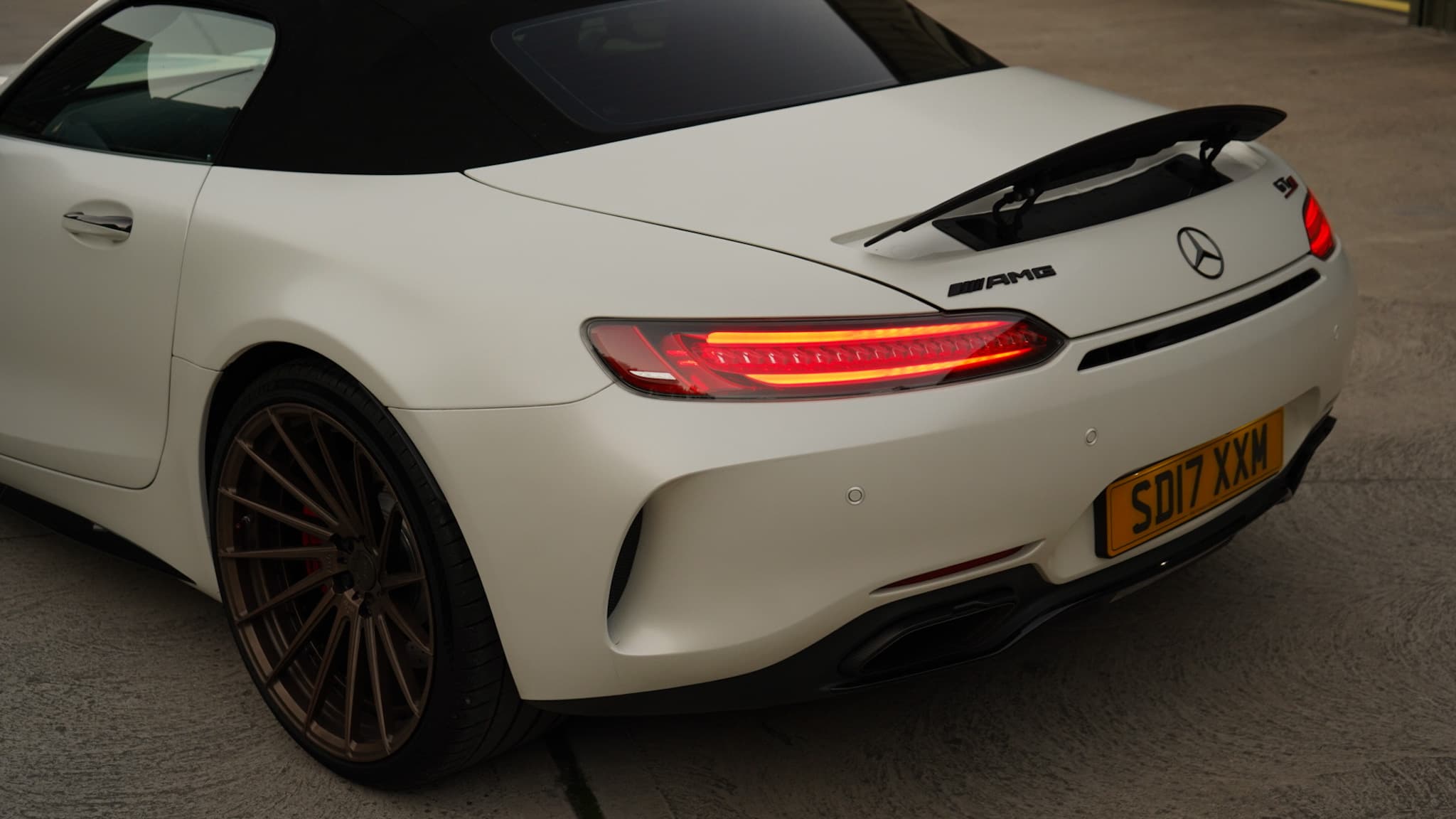
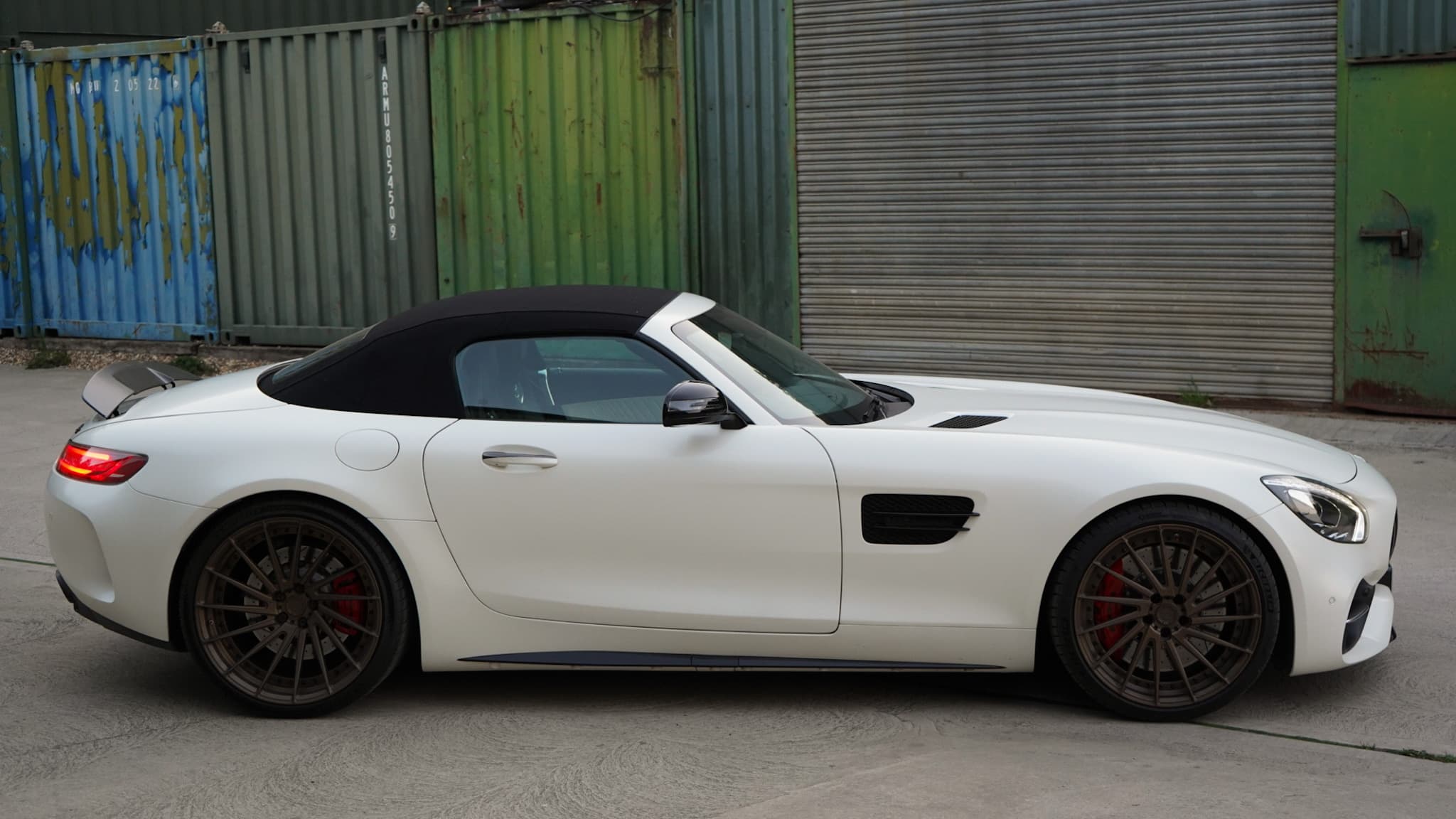
The body itself makes room for the extra hardware. Mercedes-AMG says the GT C Roadster's new aluminium rear side panels make it 57 mm wider at the rear than the regular GT Roadster, allowing a wider rear track and 305-section rear tyres.
That broader rear stance is therefore more than a styling cue. It is connected directly to the chassis specification.
No. Mercedes-AMG's original Roadster material gives the GT C 390 mm front and 360 mm rear high-performance composite discs as its normal factory brake specification. The same manufacturer release says both Roadster models could be ordered with the AMG ceramic high-performance composite braking system, using 402 x 39 mm front and 360 x 32 mm rear discs and specially finished calipers marked “AMG Carbon Ceramic”.
That distinction matters for originality and replacement-cost checks. Ceramic hardware should be verified against the VIN/build sheet rather than assumed from the model badge, wheel design or caliper appearance alone. On a modified car, inspect the disc material and condition and retain invoices as well as the option record, because brake hardware can be retrofitted or replaced over time.
TMJC's archived 2017 car advert lists its factory equipment and extensive later modifications but does not name the ceramic brake option. That absence does not prove what is physically fitted today; it is another reason to separate the advert, the factory build data and the current car when authenticating expensive brake hardware.
This is a small specification trap that causes a surprising amount of confusion.
Mercedes-AMG quotes the GT C at 410 kW / 557 PS. British road tests commonly describe the same early car as having about 549 bhp. Those numbers do not describe two different factory tunes.
PS is metric horsepower; bhp is mechanical horsepower. Converting Mercedes' 557 PS figure gives roughly 549 bhp. When a UK review calls the GT C a 549 bhp car, it is normally expressing the same 410 kW factory output in a different unit.
For comparison work, it is safest to retain Mercedes' original kW/PS figure and only convert it when useful.
The GT C uses AMG's 3,982 cc twin-turbo V8 with the turbochargers mounted inside the V of the cylinder banks. The arrangement keeps the turbochargers close to the exhaust ports and allows a compact engine package.
Drive goes to the rear wheels through the AMG SPEEDSHIFT DCT 7G, but the gearbox is not bolted directly behind the engine in the conventional front-engined layout. Mercedes places the dual-clutch transmission at the rear axle in a transaxle arrangement and connects it to the front-mid-mounted engine through a torque tube.
That layout helps put drivetrain mass toward the rear and is fundamental to the way the first-generation AMG GT is packaged. It is also why a GT C should not be thought of simply as a large front-engined convertible with extra power.
The GT C's electronically controlled rear differential can vary its locking behaviour more actively than the mechanical unit used in the standard GT Roadster. Alongside it, AMG RIDE CONTROL continuously adjusts damping to the driving situation, speed and road surface.
Mercedes also gave the GT C a fifth drive programme, RACE, beyond the Comfort, Sport, Sport+ and Individual settings offered on the normal GT Roadster at launch.
The combination matters more than any one component. Wider tyres provide the contact patch; the electronic differential manages torque across the rear axle; adaptive damping controls the body; and rear steering changes the car's response according to speed. This is the engineering reason the GT C sat meaningfully above the entry Roadster even before looking at the power figure.
The R190's fabric roof is a three-layer design supported by a lightweight magnesium, steel and aluminium structure. Mercedes says it can open or close in roughly 11 seconds and can be operated at speeds of up to 50 km/h.
Turning the AMG GT into a Roadster also required reinforcement. Mercedes describes extra strengthening around the open body's structure while retaining extensive aluminium construction. An integrated aluminium cross-member and rollover protection sit behind the occupants.
These are roadster-specific details and another reason the R190 identity is useful. A coupe article cannot simply be reused for the open car without checking the structure and equipment.
The headline numbers stayed remarkably stable, which makes the detail easy to miss.
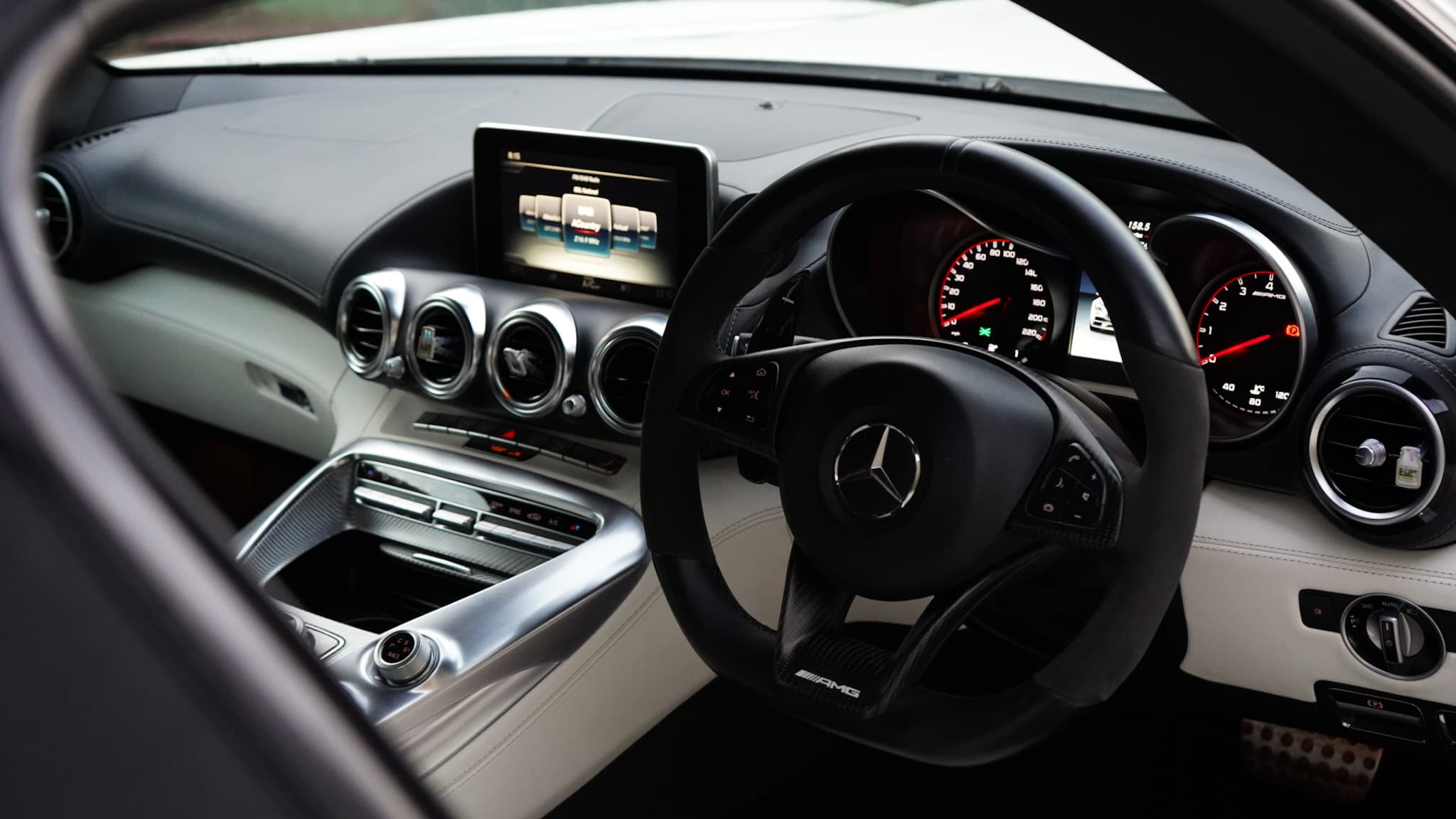
Mercedes' September 2016 launch data gives the GT C Roadster 680 Nm from 1,900 to 5,750 rpm. Its November 2018 facelift material still quotes 410 kW / 557 PS and 680 Nm, but gives the torque band as 2,100 to 5,500 rpm. The facelift also brought changes such as AMG DYNAMICS, a revised steering wheel, digital instrumentation and redesigned centre-console controls.
That means a listing which combines 2017, AMG DYNAMICS and the later torque band deserves checking. It may simply be using a later specification sheet rather than describing the actual car.
For a pre-facelift example, build date and original order documentation are more useful than copying the newest first-generation GT C data available online.
A surviving archived advert from The Matt Johnston Collection provides a useful real-world example of why factory specification and current condition should be separated.
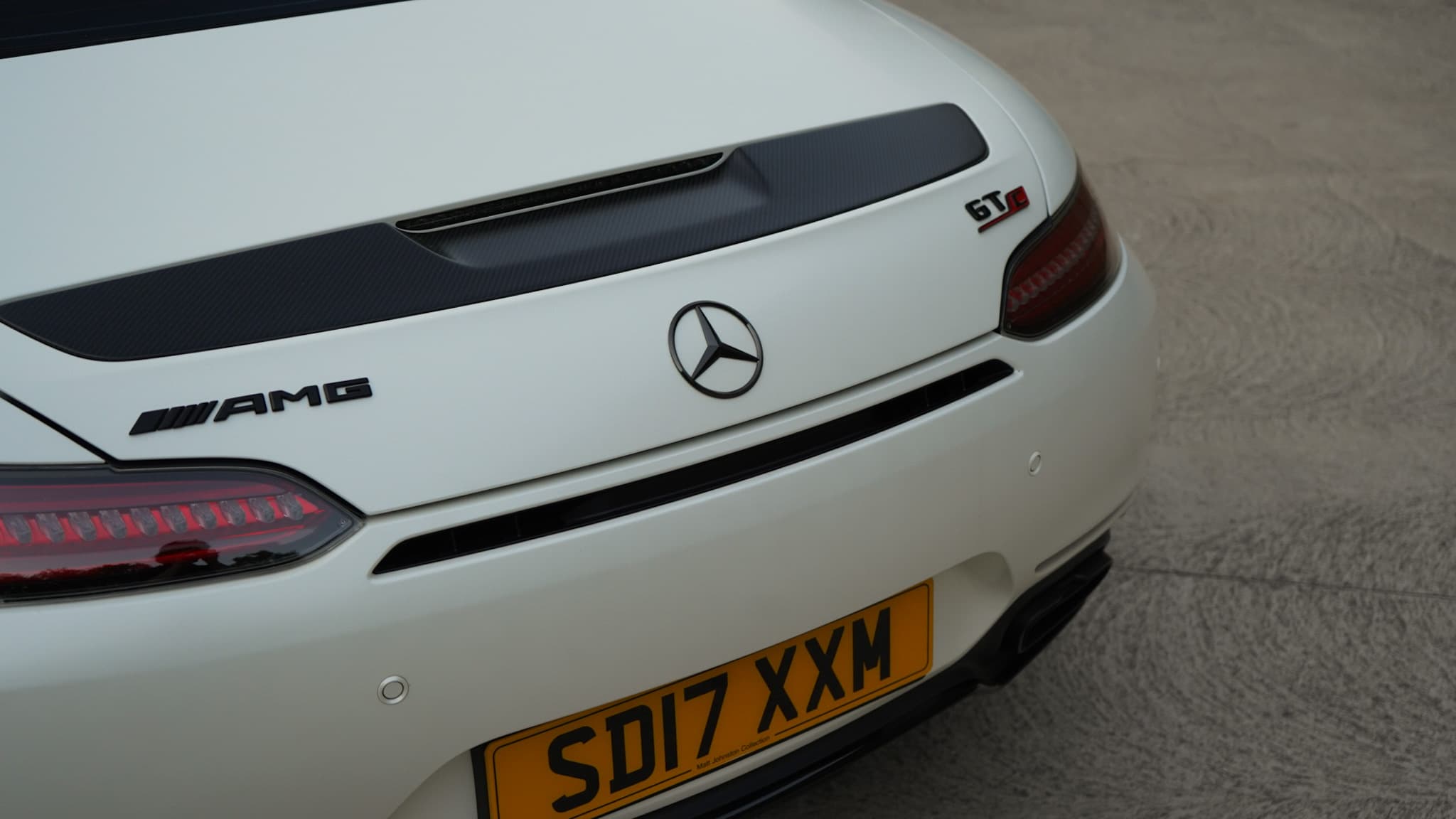
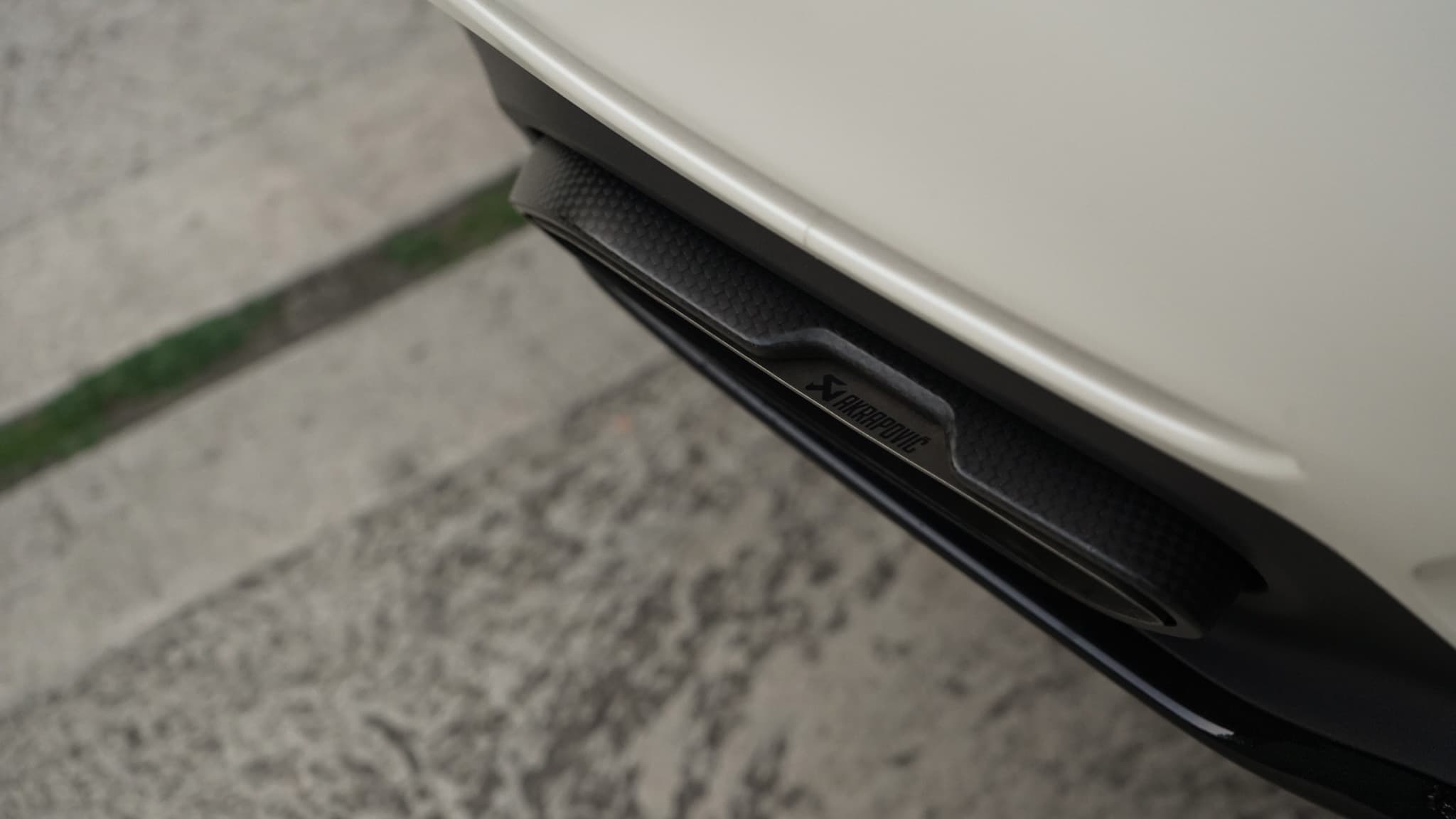
The car is described as a 2017 right-hand-drive GT C convertible originally supplied through Mercedes-Benz Epsom. The advert lists substantial factory equipment, but it also records later changes including RENNtech software and hardware, an Akrapovic exhaust, KW suspension, ADV.1 20/21-inch wheels, matte-white PPF and added carbon parts.
That does not make it a poor example. It makes it a good illustration of the question a buyer actually needs to answer: what is factory GT C hardware, what was factory option equipment on this chassis, and what was fitted later?
The archived advert says the modifications represented more than £30,000 of later spending. For an originality-focused buyer, invoices for those changes and retained original parts can matter just as much as the presence of desirable aftermarket equipment.
There is also a small warning about relying on syndicated advert fields. The archived page displays one mileage in its header and a different figure in the description. Without the odometer/service file, it is better not to repeat either number as authoritative.
Start with identity and build data. Confirm the VIN, R190 series, build date and original specification. This becomes particularly important on modified cars because wheels, suspension, exhausts and software are easy to change while the model badge remains the same.
Check that the major GT C-defining hardware is present and behaving correctly: rear-axle steering, the electronic rear differential, AMG RIDE CONTROL and the correct brake system. Warning lights or fault codes around those systems deserve proper diagnosis rather than assumption.
Inspect the roof through a complete open-close cycle, including seals, drains, fabric condition and the mechanism's operation. A roadster that lives outside or has been stored damp can create different ownership questions from a coupe.
On the drivetrain side, service history matters more than an attractive engine-bay photograph. Confirm fluid and scheduled maintenance, look for evidence of software tuning, and establish whether exhaust/downpipe or ECU work has changed the car from factory calibration.
If the car has non-standard wheels or suspension, check tyre clearances, alignment history and whether the original parts survive. A GT C left the factory with a deliberate combination of rear steering, adaptive damping, wide tyres and electronic differential control; changing one part of that package can alter how the whole car behaves.
Finally, separate condition, specification and provenance. A highly modified car can be exceptionally well maintained. A visually standard car can still have undocumented software or accident repair. The strongest file is the one that explains what changed, when and why.
Not quite. It borrows meaningful GT R ideas, particularly rear-axle steering and the wider rear hardware, but it is its own derivative rather than a GT R with a fabric roof.
Mercedes positioned the GT C between GT S and GT R. Its brief combines serious chassis hardware with the open-top Roadster body and a more road-biased role than the most track-focused member of the original family.
That is why the C badge matters. The most interesting differences are underneath the headline power figure.
Editorial information
Research and editorial from TMJC Garage.
Research and editorialTMJC Garage
Reviewed byMatt Johnston
Last reviewed20 September 2026
Published byThe Matt Johnston Collection
Model lineage
TMJC photography
TMJC assistance
Continue to the main TMJC website and speak directly with the collection team.
Sell, consign or source
Continue with TMJC for a discreet conversation, professional presentation and collector-focused support.
Enquire now