TMJC assistance
Want TMJC to help with this vehicle?
Sourcing, consignment and valuationContinue to the main TMJC website and speak directly with the collection team.
Variant
BMW E36 328i specifications, M52B28 engine data, saloon, Coupé, Convertible and Touring dates, performance differences and buying checks.
TMJC guide
BMW E36 328i specifications, M52B28 engine data, saloon, Coupé, Convertible and Touring dates, performance differences and buying checks.
The BMW E36 328i is the later 2.8-litre six-cylinder version of the third-generation 3 Series, introduced as BMW moved on from the 325i-era range in the mid-1990s. BMW Group Archive gives the core engine specification as 2,793 cc, 142 kW / 193 bhp at 5,300 rpm. A detailed ADAC manufacturer-data record identifies the engine as M52B28 and gives 280 Nm at 3,950 rpm.
That specification is only the start of identifying a good 328i. The badge appeared on saloon, Coupé, Convertible and Touring bodies, and BMW's own archive gives different production windows and performance figures for them. A useful 328i reference therefore needs to separate the engine that the cars share from the body-, market- and transmission-specific details that they do not.
For the broader platform story, see the BMW E36 generation guide. For the full family chronology, see BMW 3 Series history.
| Item | Evidence-led specification |
|---|---|
| Engine family | BMW M52 on ECE E36 328i applications |
| Engine code | M52B28 in ADAC's manufacturer-data record |
| Configuration | Inline-six |
| Displacement | 2,793 cc |
| Output | 142 kW / 193 bhp at 5,300 rpm |
| Torque | 280 Nm at 3,950 rpm in ADAC's German four-door manual record |
| Valve arrangement | Four valves per cylinder in the ADAC record |
| Camshaft drive | Timing chain in the ADAC record |
| Driven wheels | Rear-wheel drive |
BMW describes the 2.8-litre unit as a lightweight-alloy six-cylinder and says the 323i and 328i replaced the previous 325i position when the new large six-cylinder range arrived. The change was important less because headline horsepower jumped dramatically than because the later model brought the new 2.8-litre engine into the top non-M E36 range.
A single 1995–1999 label is convenient, but BMW's own archive is more precise:
| Body style | BMW archive production | BMW archive top speed |
|---|---|---|
| Four-door / saloon-style 328i | 06/1994–11/1998 | 236 km/h (147 mph) |
| 328i Coupé | 12/1994–04/1999 | 236 km/h (147 mph) |
| 328i Convertible | 12/1994–09/1999 | 230 km/h (143 mph) |
| 328i Touring | 12/1994–05/1999 | 230 km/h (143 mph) |
There is another useful wrinkle in those dates. BMW's narrative says the 323i and 328i replaced the 325i in 1995, while the archive's production metadata begins in 1994 for some bodies. Likewise, BMW describes the Touring as launching in 1995 even though its production record starts in December 1994.
For a buyer, that is a reminder to distinguish production date, public launch and first registration. They can be different dates, especially around a model change.
BMW UK application data ties ECE-market E36 328i cars to the M52 engine family. ADAC's technical record for a German four-door manual goes further and identifies the engine as M52B28.
In that record the naturally aspirated petrol straight-six has six cylinders, four valves per cylinder, fuel injection and a timing chain. The quoted output is the same 142 kW / 193 PS found in BMW's archive, with 280 Nm at 3,950 rpm.
Those engine figures are much more useful as 328i identifiers than a seller's description such as “2.8 straight-six” on its own. They also give you a basis for checking whether a car still has the engine type expected for the derivative rather than a later swap that has simply inherited the original badge.
Engine identity still does not answer every question. A replacement engine can be perfectly acceptable if it is documented and appropriate; for a collector car, the important point is that the history explains what happened.
Yes. BMW AG workshop material for the E36 328i with the M52 engine includes a dedicated VANOS adjustment-unit procedure under variable camshaft timing. So an E36 328i being described as having VANOS is not, by itself, a sign that somebody has fitted a later engine.
The important distinction is single/intake VANOS versus Double VANOS. BMW Group Archive gives a particularly clear comparison on the Z3 2.8, which used the same M52B28 engine family: the earlier M52B28 used variable camshaft control on the intake camshaft, while the later M52TU revision added Double VANOS. BMW technical training describes the same development more generally, saying Double VANOS was first introduced on the M52B20TU and added variable exhaust-camshaft timing to the earlier two-setting intake system.
BMW's E46 328i Touring archive then identifies its M52B28TÜ engine and variable Double VANOS explicitly. That successor is a useful warning against treating all late-1990s 328i engines as one specification.
For an E36 328i, the practical description is therefore: M52B28 with the earlier intake-cam VANOS system, not the later M52TU Double VANOS arrangement. If an individual car has a replacement engine, establish what is actually fitted from the engine identity and build/repair records rather than inferring it from first-registration year. TMJC's car being supplied in September 1998 does not, on its own, prove an engine production date or technical-update status.
BMW's archive shows why performance needs a body-style qualification. The saloon-style 328i and Coupé are listed at 236 km/h (147 mph), while the Convertible and Touring are listed at 230 km/h (143 mph).
ADAC's German-market four-door manual record adds a manufacturer figure of 7.3 seconds from 0–100 km/h. It also gives a five-speed manual, 1,320 kg EU kerb weight, 2,700 mm wheelbase and 205/60R15 tyres for that specific specification.
Those are useful reference numbers, but they should not be copied across every 328i. Convertible structure, Touring bodywork, transmission choice, market equipment and model-year specification can all change weight or performance. The safest way to read a period performance figure is to ask: which body, market and gearbox did it describe?
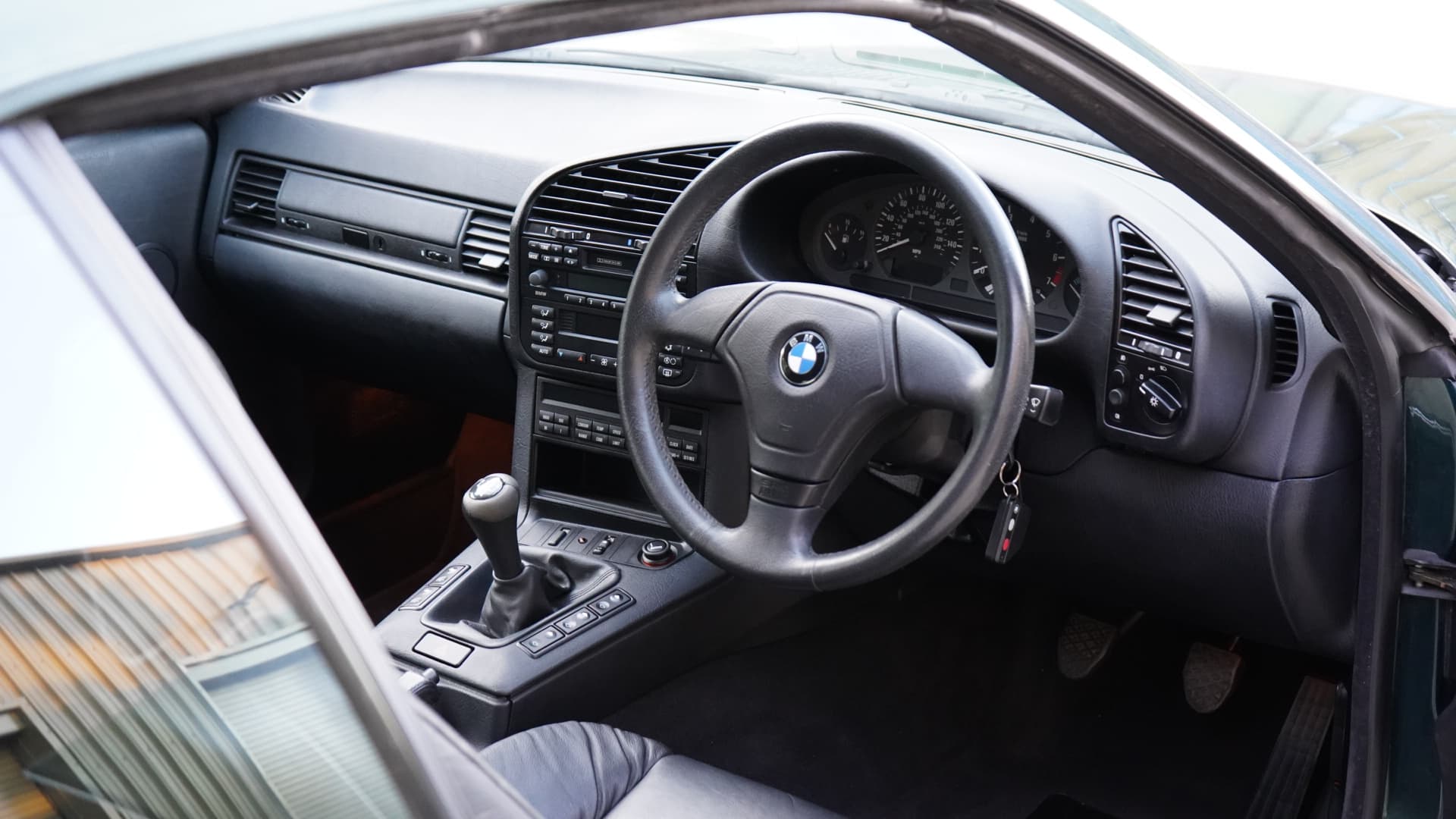
TMJC's own 1998 328i is a right-hand-drive manual, while ADAC's detailed German reference is also a five-speed manual. For a manual car, check the clutch engagement, gear selection when cold and hot, propshaft/driveline behaviour and differential noise rather than judging it from a short stationary test.
A gear knob or M-style trim is not proof of factory specification. On an E36, wheels, suspension, steering wheels, lights, seats and exterior trim have often been changed over decades of relatively inexpensive ownership. Where originality matters, a build/specification record and period invoices are much stronger evidence than the parts currently visible in a sales photograph.
The engine is mounted at the front and drives the rear wheels. That conventional BMW layout is part of the appeal, but it also means a car that has spent years being drifted, tracked or heavily modified deserves a more searching inspection of the shell, rear mounting areas and driveline.
For a later manual E36 328i, the strongest application evidence points to BMW designation S5D 320Z, a five-speed ZF gearbox. BMW AG's transmission-designation table explicitly states that the Z suffix denotes ZF (Zahnradfabrik Friedrichshafen) and identifies the S5D 320Z as a ZF C-transmission in the S5-31 family. The same table identifies the S5D 250G as Getrag, which is why “ZF or Getrag?” is a meaningful question rather than two names for the same gearbox.
A current BMW ETK mirror for European manual 328i saloon model code CD11 associates that application with the S5D 320Z. An OE-catalogue view for a 1997 328i saloon also lists BMW exchange five-speed gearboxes as S5D 320Z. That is useful evidence for later cars, including the period of TMJC's 1998 factory-manual example.
There is an important chronology caveat. BMW's generic TIS designation table says S5D 310Z up to September 1995 and S5D 320Z from September 1995, while the current ETK mirror attaches S5D 320Z to a European 328i application whose production metadata begins in 1994. Those are different kinds of evidence. A current parts catalogue can include replacement and supersession coverage, so it should not be used on its own to prove which gearbox every very early 328i left the factory with.
For a 1998 manual 328i, the evidence converges on S5D 320Z / ZF S5-31 as the expected transmission family. For an early car, or whenever originality materially affects value, use the VIN-linked build record or BMW Group Classic specification record together with the identification on the gearbox itself. A gearbox that fits is not automatically the gearbox the car was built with.
TMJC's public listing establishes that its 1998 328i is a factory manual, but it does not publish a gearbox serial number or transmission code. We therefore use it as the real-world reason for the check, not as proof that the individual gearbox currently fitted is original.
Do not use the Sport name as proof that an E36 328i left the factory with a mechanical LSD.
BMW Group UK's history of the E36 says Automatic Stability Control (ASC) was offered as an option and that from 1997 it was extended to ASC+T, adding brake intervention to the earlier engine-power intervention. That establishes the traction-control chronology at generation level, but it does not say that one system universally replaced a limited-slip differential on one exact UK 328i Sport changeover date.
Surviving build-data examples show why the distinction matters. An owner-posted specification for a UK/England-market 328i Sport produced on 6 December 1995 lists S209 Limited Slip Differential (25%), together with S337 M Sport package and S704 M Sport suspension. A separate UK Sport produced on 4 June 1998 lists S214 Automatic Stability Control+traction, again with the M Sport package and suspension, while S209 does not appear in the posted equipment list.
Those are individual-car records hosted in owner discussions, not a factory population ledger. They are useful evidence that buyers can encounter different factory-recorded configurations, but they do not prove that every early Sport had S209, every later Sport lacked it, or that ASC+T and an LSD were universally mutually exclusive.
For a car you are buying, start with the VIN-linked BMW specification or a BMW Group Classic Digital Birth Certificate and look for the recorded option equipment. Then identify the differential actually fitted and reconcile any replacement or upgrade with invoices. A mechanical LSD fitted today can be desirable without proving factory originality; a Sport badge, M suspension or registration year cannot settle the question on its own.
TMJC's September 1998 Park Lane-supplied 328i gives this question useful real-world context, but its public listing does not publish an S209/S214 code or differential identity. We therefore do not infer the individual car's differential specification from its registration date.
TMJC's 1998 car is a factory manual, but manual was not the only original E36 328i configuration. BMW UK's current parts/application data includes ECE E36 328i production codes on parts conditioned on option 0205 Automatic transmission. A separate BMW manual-shift part is explicitly conditioned on that automatic option being absent.
BMW AG workshop material preserved in a TIS mirror goes a step further. Within the E36 328i M52 workshop set, BMW provides dedicated repair procedures for the A5S 310Z automatic transmission. That is useful technical evidence for identifying an automatic 328i, but it is not a reason to assume every automatic 328i in every body style and market used an identical transmission specification. If originality matters, use the VIN-linked build record and the gearbox identification on the car.
The buying check is different from the manual-car check above. Drive an automatic from cold and again when fully warm, make sure engagement and shifts are clean, and investigate transmission warnings, abnormal noises or poor shift behaviour rather than accepting them as normal for an old automatic. Classics World's current E36 guide also recommends paying attention to fluid and filter history rather than relying on the idea that an old automatic needs no service.
This distinction matters on a collector car because a present-day manual or automatic tells you how the car is configured now; the build record tells you how it left BMW.
If originality matters, BMW's own archive can provide more useful evidence than a seller's description. BMW Group Classic says its Digital Birth Certificate for vehicles from the 1980s onwards can include the chassis and engine numbers, production and delivery dates, special equipment and transmission number.
For an E36 328i, that can answer several questions this page deliberately does not flatten into one specification. It can help establish whether the car was built as a manual or automatic, separate its production and delivery dates from its first-registration date, and give you BMW's archived engine, transmission and equipment record to compare with what is fitted now.
That is particularly useful on a modified or late-registered car. A manual gear lever does not prove a factory manual, and a 1998 registration does not by itself establish an engine-production date. Start with the BMW record, then compare it with the car's identifying numbers, invoices and repair history.
The certificate is not a mechanical inspection and does not prove that every component currently on the car is original. Its value is that it gives the present-day inspection a documented as-built reference point. TMJC's 1998 328i retains original handbooks, manuals and a service booklet, but those individual-car records are not being stretched into a complete factory build sheet here.
The E36 328i's most famous technical question is the cylinder-bore material used during M52 production. It is important, but it should not swallow the rest of the buying decision.
BMW primary material confirms the M52 application and basic 2.8-litre specification, but does not give an exact UK/ECE Nikasil-to-iron-liner changeover. The often-cited week-10-1998 / March 1998 date therefore remains specialist historical evidence rather than a BMW factory-confirmed cutoff.
Our separate BMW E36 328i Nikasil guide deals with that question in detail. The useful buying sequence is simple: establish the car's actual build date and engine history, then assess the engine that is fitted. If uncertainty materially affects the purchase, cylinder-sealing evidence such as a properly interpreted compression or leak-down test is more useful than a registration-year shortcut.
A seller saying “late car”, “Alusil” or quoting an engine marking should not end the investigation by itself.
Start with structure rather than specification. Inspect wheelarches, sills, jacking areas, the windscreen surround, boot seams and the underside for corrosion or old repairs. Look at panel gaps and paint consistency as well: an E36 can be mechanically healthy yet still be an expensive proposition if previous accident or corrosion work was poor.
Ask for evidence of cooling-system maintenance rather than relying on a clean engine bay. Radiator components, hoses, water-pump history and any past overheating deserve attention on an ageing six-cylinder BMW. A documented refresh is more useful than a list of parts somebody says are “known to fail”.
Check rear mounts/top mounts, suspension bushes and front control-arm condition, then look at tyre wear and alignment. Lowered cars or those on non-standard wheels should be assessed for the quality of the changes and whether the geometry was set up afterwards.
Start the car from cold if possible. Listen and watch for poor idle, warning lights, smoke, leaks and signs of overheating, but do not diagnose Nikasil from one symptom. Confirm the expected engine identity and look through the history for replacement-engine or short-block work.
On a manual, test the clutch and every gear under sensible load. Listen for driveline knocks or bearing/differential noise and check that modifications have not introduced vibration or poor geometry. If the car has a different transmission or differential from its original specification, establish what was fitted and why.
Decide what originality means for the car you are buying. A reversible wheel or suspension change is a different issue from an engine swap, structural modification or missing model-specific interior. The more money you are paying for preserved specification, the more documentary evidence should support it.
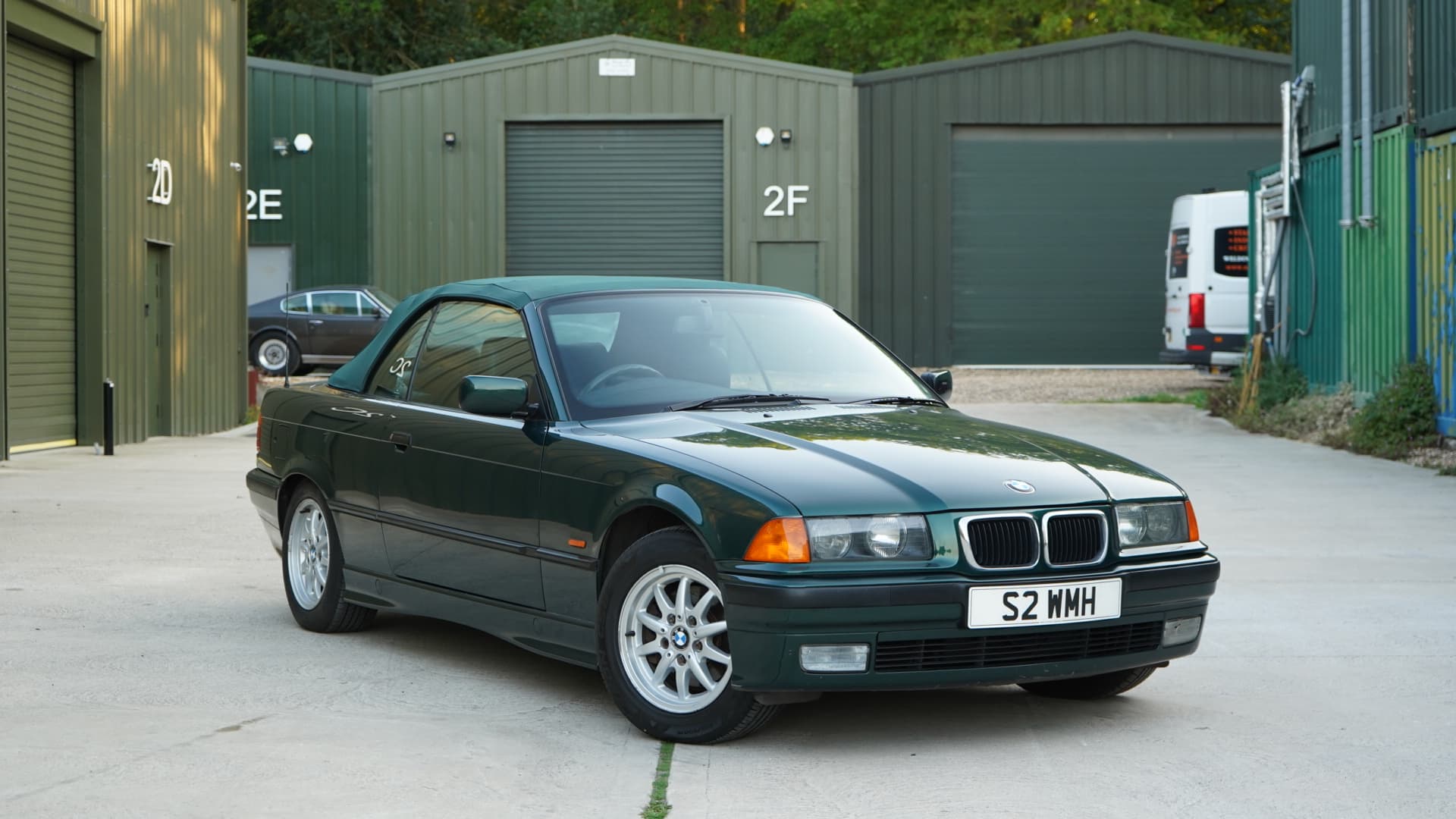
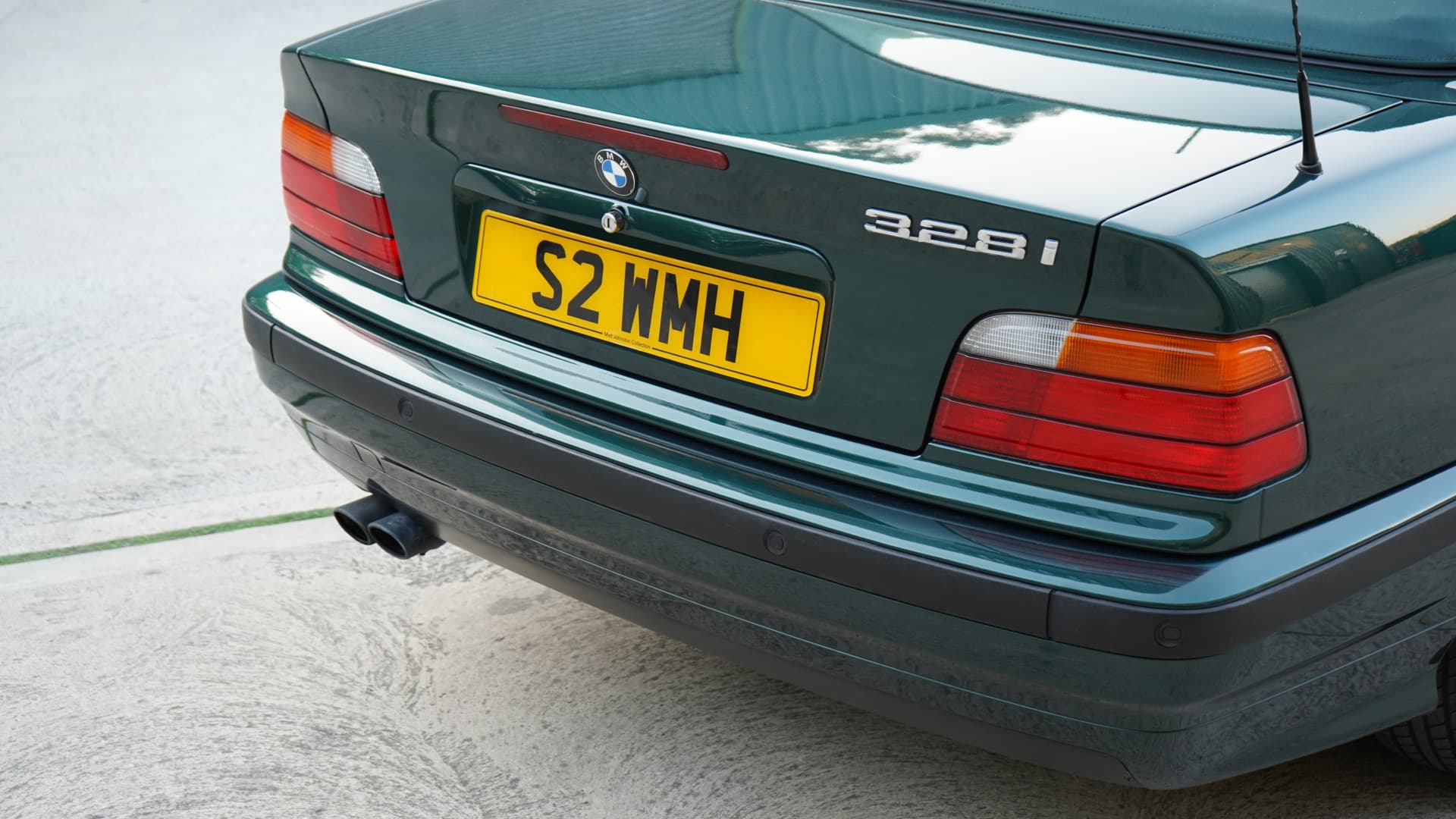
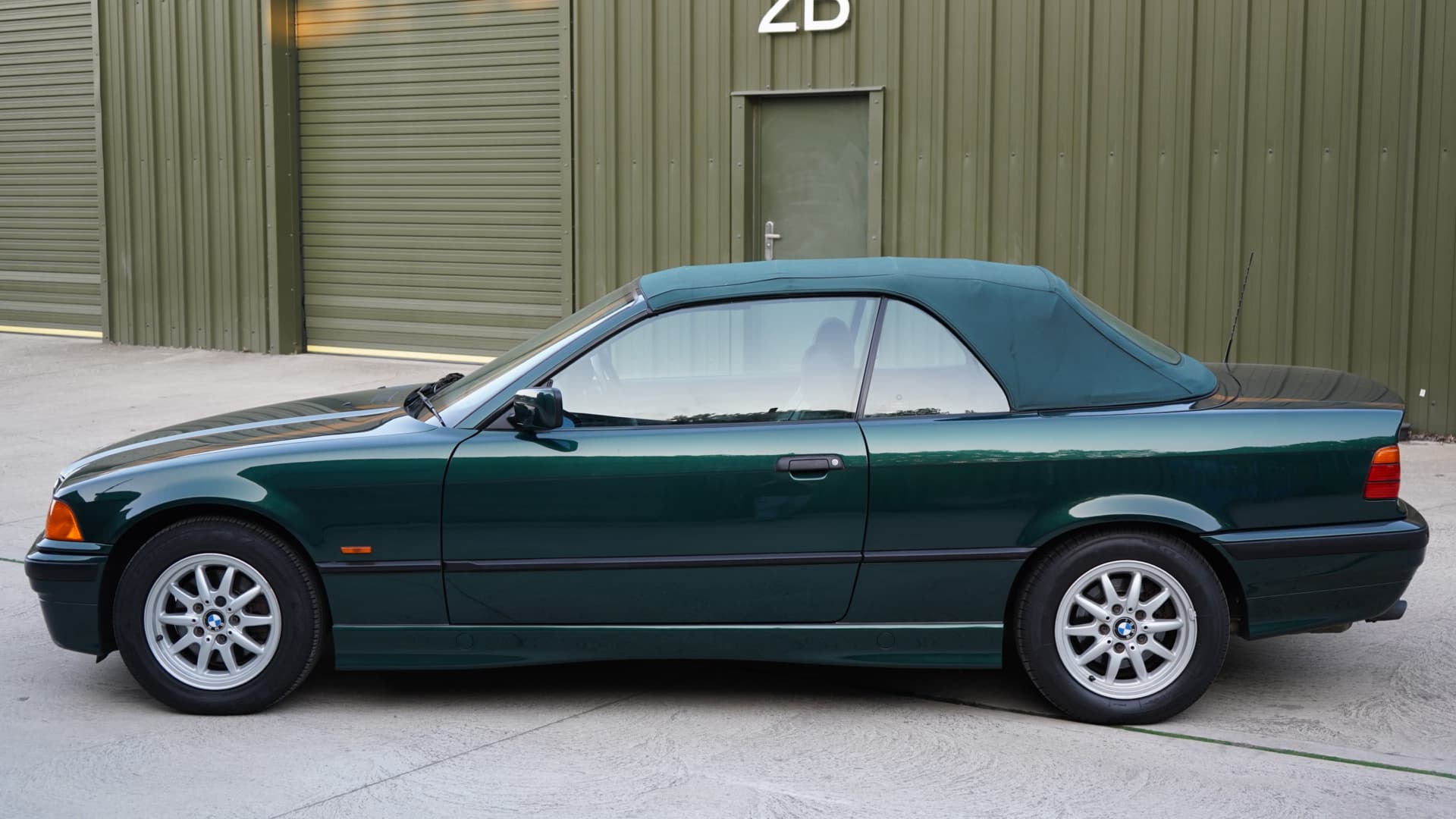
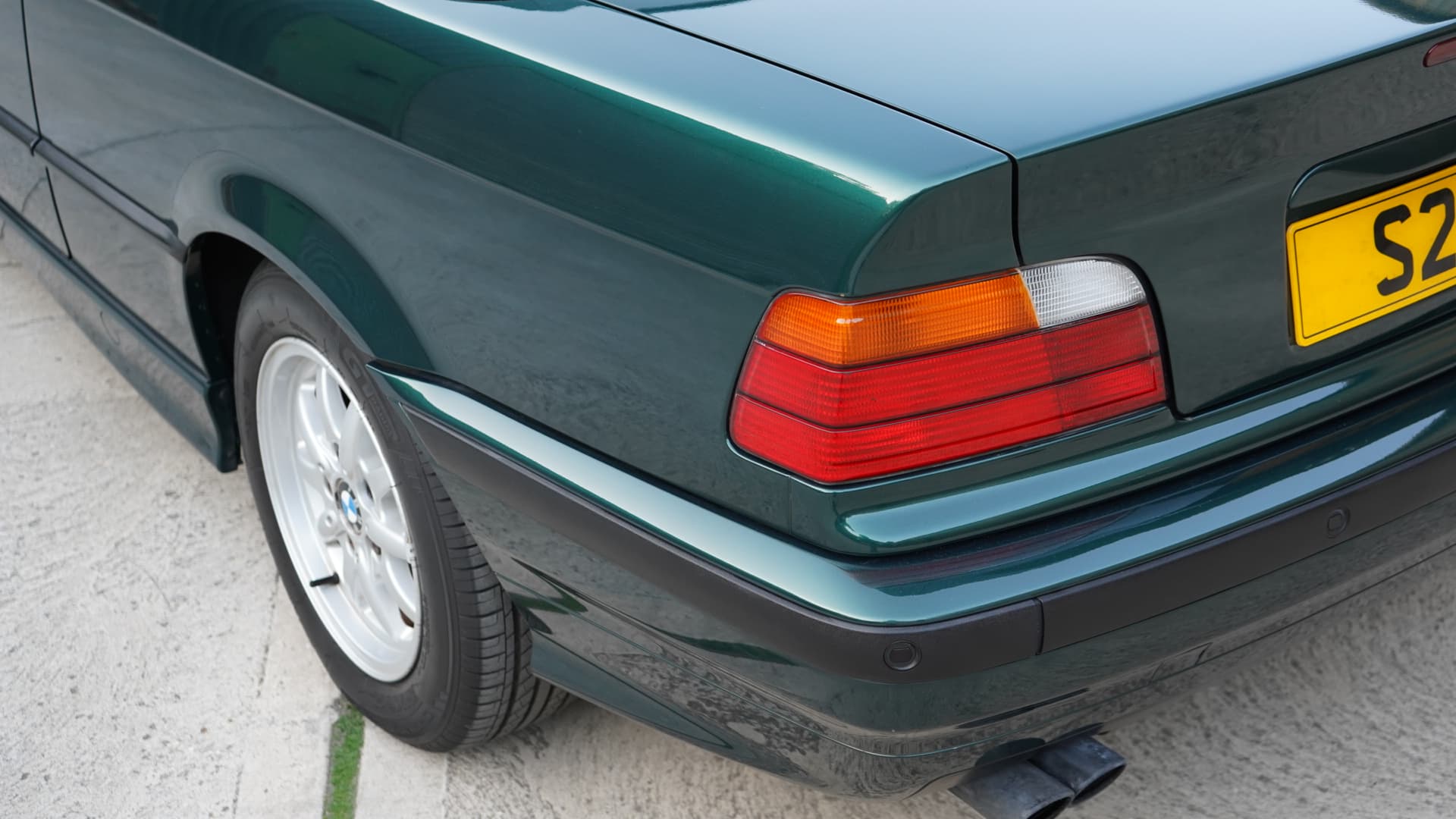
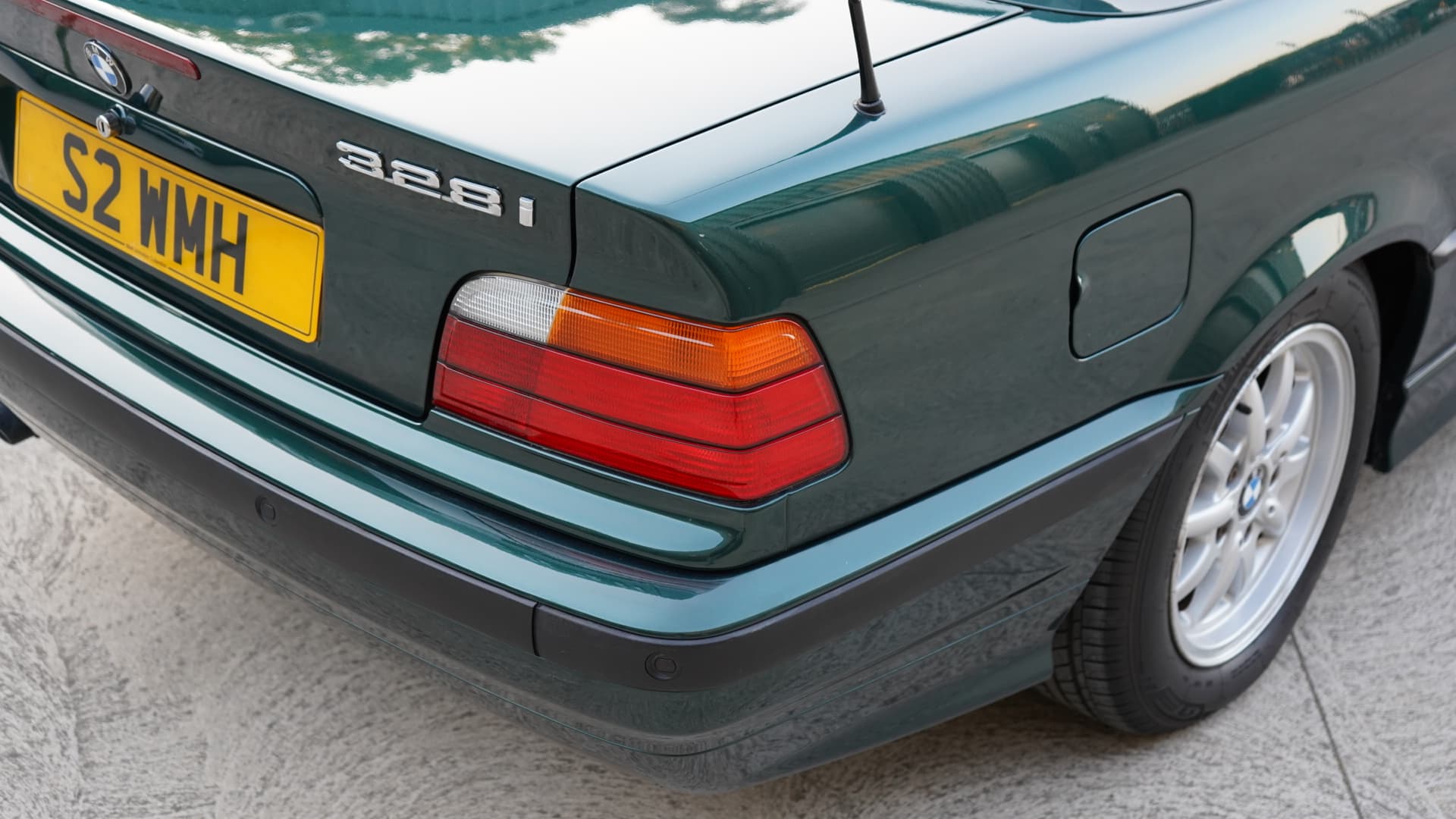
TMJC's own example shows why provenance matters more than a single attractive specification line. It is a 1998 right-hand-drive manual 328i, supplied new by BMW Park Lane on 10 September 1998, with 94,628 miles recorded on the listing.
The file includes original handbooks, manuals and service booklet. TMJC records early maintenance with BMW Barrons of Farnborough and later work with BMW specialist Chris Plummer, alongside long ownership and continued annual use/MOT history.
Those details are confidence signals about this individual car. They are not universal 328i specification, and the September registration date is not being used as proof of its exact engine production week or bore material. That distinction is worth preserving: provenance should narrow uncertainty, not be stretched beyond what the documents actually establish.
Before comparing prices, make sure the cars are actually comparable. A saloon, Coupé, Convertible and Touring share the 328i badge and basic engine specification, but they are different collector propositions. Body condition, gearbox, originality, options, history and quality of previous modification can matter more than a small mileage difference.
For a driver-focused car, a well-maintained example with coherent mechanical history may be more attractive than a lower-mileage car that has spent long periods neglected. For an originality-led collection, factory specification and documentation may justify paying more even when another car drives similarly.
The 328i is appealing because it combines the later E36 six-cylinder engine with the classic front-engine, rear-drive 3 Series layout. Buying well means looking past the badge: confirm the body and engine you actually have, understand its chronology, and let the condition and history of that particular car decide the rest.
Editorial information
Research and editorial from TMJC Garage.
Research and editorialTMJC Garage
Reviewed byMatt Johnston
Last reviewed12 September 2026
Published byThe Matt Johnston Collection
Model lineage
TMJC photography
TMJC Guides
TMJC assistance
Continue to the main TMJC website and speak directly with the collection team.
Sell, consign or source
Continue with TMJC for a discreet conversation, professional presentation and collector-focused support.
Enquire now