TMJC assistance
Want TMJC to help with this vehicle?
Sourcing, consignment and valuationContinue to the main TMJC website and speak directly with the collection team.
Generation
BMW E36 3 Series explained: production years, five main body styles, the rare Baur Topcabriolet, engine changes and buying checks.
Variant directory
Choose an exact E36 derivative for engine, gearbox, performance, dimensions, equipment and buying-context detail.
TMJC guide
BMW E36 3 Series explained: production years, five main body styles, the rare Baur Topcabriolet, engine changes and buying checks.
The BMW E36 is the third generation of the 3 Series, replacing the E30 at the start of the 1990s. BMW's current history places the generation in 1990–2000, while BMW Group Archive gives the broad production span as July 1990 to August 2000.
That does not mean every E36 body style ran for ten years. The saloon arrived first, followed by the Coupé, Convertible, Compact and Touring at different points. Engines changed too, from early four- and six-cylinder petrol units through diesels and the later aluminium six-cylinder phase that included the 328i.
For a buyer today, start by identifying the exact body, engine and build period before applying a generic E36 checklist.
BMW's own records use different dates depending on whether they are describing presentation, production or market launch. That is why seemingly contradictory E36 timelines can both contain part of the truth.
| Body style | BMW chronology | What to know |
|---|---|---|
| Saloon | From 1990 | The first E36 body. BMW Archive gives 07/1990–11/1998 for the saloon as a body family. |
| Coupé | Presented around 1991; current BMW history describes a 1992 launch | A distinct two-door body, not simply a saloon with two doors; lower roof and frameless doors. |
| Convertible | 1993 | Full four-seat open model; later cars and roof systems need body-specific checks. |
| Compact | 1994 | Shorter hatchback derivative with important rear-suspension differences from the rest of the E36 range. |
| Touring | Launched in 1995 | Fifth main body variant; BMW Archive metadata begins some Touring production in late 1994. |
Do not force one month onto the whole generation. A 1998 E36 saloon, a 1999 Coupé and a 2000 Compact can all be legitimate E36s even though the first E46 saloons were already appearing before the final E36 derivatives had finished.
For the broader family sequence before and after the E36, see the BMW 3 Series generation guide.
No. The E36 was built in more than one country, and the production plant cannot safely be inferred from the badge, steering position or destination market alone.
BMW Group Plant Regensburg records 1,187,502 E36 3 Series Sedans built there from 1990 to 1999. In South Africa, BMW’s later historical review says Plant Rosslyn built 84,876 third-generation 3 Series cars from 1992 to 1997. An earlier BMW South Africa release gave a different estimate — around 92,000 cars from 1994 to 1998 — so the exact Rosslyn total and date range should not be treated as perfectly settled even within BMW’s own retrospective material.
The E36 also has an important place in BMW’s American manufacturing history. BMW Group says the debut vehicle from Plant Spartanburg was an Alpine White 318i Sedan; its current archive identifies the first Spartanburg-built car as a third-generation 3 Series in 1994. That proves some E36s were built in the United States, but it does not mean every US-market E36 came from Spartanburg.
For an individual car, use build/VIN or factory documentation when assembly origin matters. TMJC’s 1998 328i was supplied by BMW Park Lane, but a UK supplying dealer does not by itself identify the factory that assembled the car.
The familiar E36 list — Saloon, Coupé, Convertible, Compact and Touring — is not quite the whole period story. Baur of Stuttgart also converted the four-door E36 into a Topcabriolet, and BMW Group Archive records it as a car that could be ordered through ordinary BMW dealers.
It was not the same thing as BMW’s own two-door full Convertible. The Baur retained its side-window frames and roll bar. A rigid panel over the front seats could be removed, while the soft rear roof section and heated-glass rear window could fold back separately. BMW describes four possible roof configurations and records 311 cars built from November 1992 to November 1996, with 316i, 318i, 320i and 325i engines.
The Baur arrived before BMW’s full E36 Convertible, which BMW records from March 1993. For a buyer or researcher, the precise description is therefore neither “normal factory Convertible” nor “random aftermarket chop”: it is a Baur coachbuilt conversion sold through the BMW dealer network.
Community discussions still regularly ask whether an E36 Baur is “factory”. BMW’s archive treats the Baur as its own period product; verify the individual car’s BMW and coachbuilder documentation rather than judging it from the roof alone.
BMW’s own archive is a good example of why E36 date tables need labels. Its E36 Coupé overview says the independently styled two-door model launched in the marketplace in 1992 and was discontinued in 1998, while the same page’s separate Production field reads 10/1990–04/1999. Other exact Coupé entries use 1991 as a presentation or launch milestone.
The archive does not explain why those date conventions differ. Treat presentation, market launch, archive production range and registration date as different pieces of evidence. If an exact car’s chronology matters, its VIN/build information and period paperwork are more useful than forcing every source into one model-year label.
The BMW Z3 really does have an E36 connection, but it is better described as a separate Z model derived from E36 engineering than as another ordinary 3 Series body style.
BMW Group Archive calls it the BMW Z3 (E36) model series and says the roadster was based on the 3 Series E36. BMW records shared chassis, drivetrain and interior elements, with the shortened floor assembly plus the front and rear axles taken from the E36 Compact. BMW Group PressClub also uses E36/7 for the Z3 Roadster in its own archive material.
That explains why E36 terminology follows the Z3 into parts catalogues and enthusiast discussion. It does not mean the Z3 should be added as a sixth body style in the Saloon/Coupe/Convertible/Compact/Touring table above. BMW treated it as its own Z model series, and Z3 production continued after the normal E36 3 Series succession was already under way.
Shared E36 ancestry can explain why components and engineering ideas overlap, but fits an E36 is not enough evidence that a part fits every Z3 or every E36 3 Series derivative. Use the exact model, build information and part number when compatibility matters.
The E36 was a substantial redesign rather than a mild evolution of the E30. BMW's current 3 Series history describes a longer wheelbase and wider track, with more rear-seat room and a lower, smoother body shape. BMW Archive's saloon record quantifies the wheelbase increase at 13 cm over the predecessor.
The visual change was just as obvious. The E36 moved away from the upright proportions and exposed round lamps of the E30 towards a smoother nose with twin headlights behind shared covers. Inside, the driver-oriented BMW layout remained, but the car was positioned as a more refined compact executive model.
That extra refinement did not remove the rear-wheel-drive character that made the 3 Series distinctive. Instead, BMW broadened the idea across family saloons, Coupés, Convertibles, an estate and the Compact hatchback.
BMW's current retrospective describes a central-control-arm rear axle as a major E36 chassis development, giving the mainstream cars more sophisticated rear-wheel location than their predecessors. Power steering was standard from the 318i level, and BMW says ABS became mandatory from 1992. Optional ASC traction control followed, with the extended ASC+T system adding rear-brake intervention from 1997.
There is an important exception to the normal E36 suspension shorthand: the Compact does not share the same rear layout as the saloon, Coupé, Convertible and Touring. Hagerty's E36 guide notes that the short hatch retained an earlier E30-style rear arrangement for packaging reasons.
For parts, alignment, handling comparisons and originality, “E36 rear suspension” is not one completely interchangeable specification.
A generation-wide engine list can become misleading quickly, because engines arrived and disappeared at different times and varied by market. Engine-family changes are more informative than one enormous specification table.
| Period / phase | Representative E36 engines | Why it matters |
|---|---|---|
| Launch phase | 316i and 318i four-cylinders; 320i and 325i six-cylinders | Establishes the early petrol range and the 325i as the initial senior non-M six-cylinder. |
| Early/mid 1990s | 325td and 325tds diesels; later 318tds | Diesel became part of the E36 story rather than a later retrofit to the range. |
| Later six-cylinder phase | New lighter aluminium sixes, including 323i and 328i | The 328i belongs to the later E36 period rather than the launch specification. |
| Performance derivatives | M3 variants | Their engine outputs, chassis specification and market differences are substantial enough to deserve derivative-specific treatment. |
BMW's 2025 retrospective gives the launch petrol outputs as 100 PS for the 316i, 113 PS for the 318i, 150 PS for the 320i and 192 PS for the 325i, then records the later 328i at 193 PS. Those numbers help explain the evolution, but they should not be read as the specification of every E36 carrying a similar badge in every market and year.
The later M52 six-cylinder cars also create the best-known E36 engine-material question. Rather than repeating registration-year folklore here, the BMW E36 328i Nikasil guide explains why build date, engine history and mechanical evidence matter more than a simple “early versus late” rule.
BMW's current 50-year history says that by 2000 about 2.75 million E36s had rolled off the production line. Treat that as the rounded manufacturer total it is, not as a chassis-by-chassis registry count.
Individual derivative numbers are narrower and sometimes much better defined. For example, BMW Group Archive records separate production windows and totals for particular M3, Compact or Touring derivatives. Those belong with the relevant body or variant rather than being added together casually to manufacture a different generation total.
Condition and originality questions change with the shell. A Convertible adds hood operation, seals and rear-screen condition. A Compact has different rear-suspension architecture. Coupés have frameless doors and different body trim. Touring cars add an estate rear structure and load area. Even when engines overlap, the physical car is not interchangeable.
It is also worth checking whether the car still matches the identity in its paperwork. E36s spent many years as relatively inexpensive rear-wheel-drive cars, so suspension swaps, differential changes, M-style body conversions, wheel changes and track/drift use are not unusual. None automatically ruins a car, but they make evidence more important than badges.
Hagerty UK's E36 buying guide highlights several recurring inspection areas:
A clean upper body is not enough. Look underneath, inspect jacking areas properly and check whether previous corrosion repairs are structural repairs or cosmetic cover-ups. Crash history also deserves care because surviving E36s include cars that have seen track and drift use as well as ordinary road use.
Hagerty also recommends attention to cooling-system and water-pump history on several engines. The exact weak points differ across the engine range, so look for evidence of recent model-appropriate maintenance rather than assuming one replacement schedule applies to every E36.
Start with the VIN/build information, then compare those details with the body, engine, gearbox and equipment actually fitted. Check:
A modified E36 can be an excellent car, but an originality premium should be supported by more than factory-looking trim.
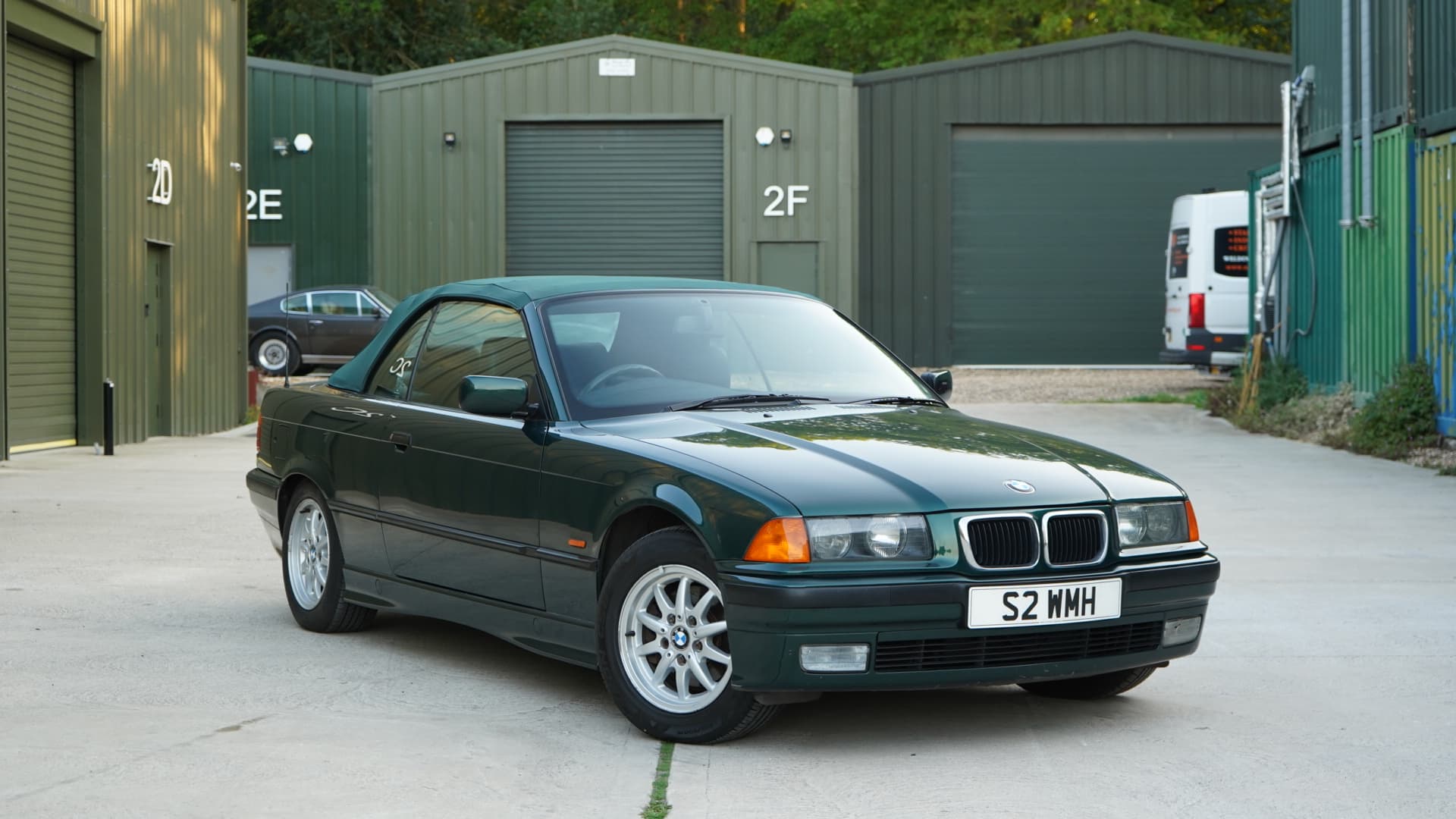
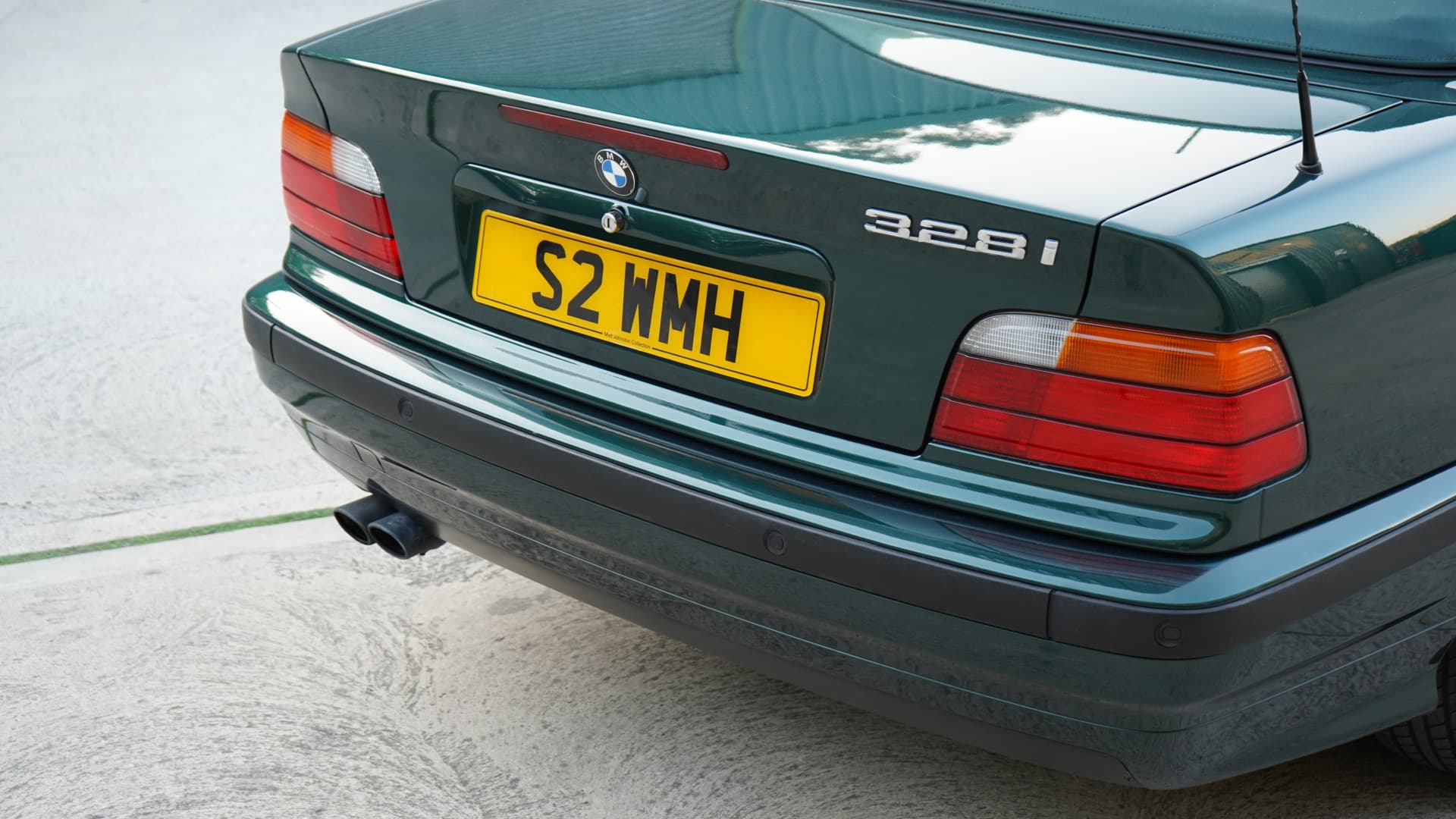
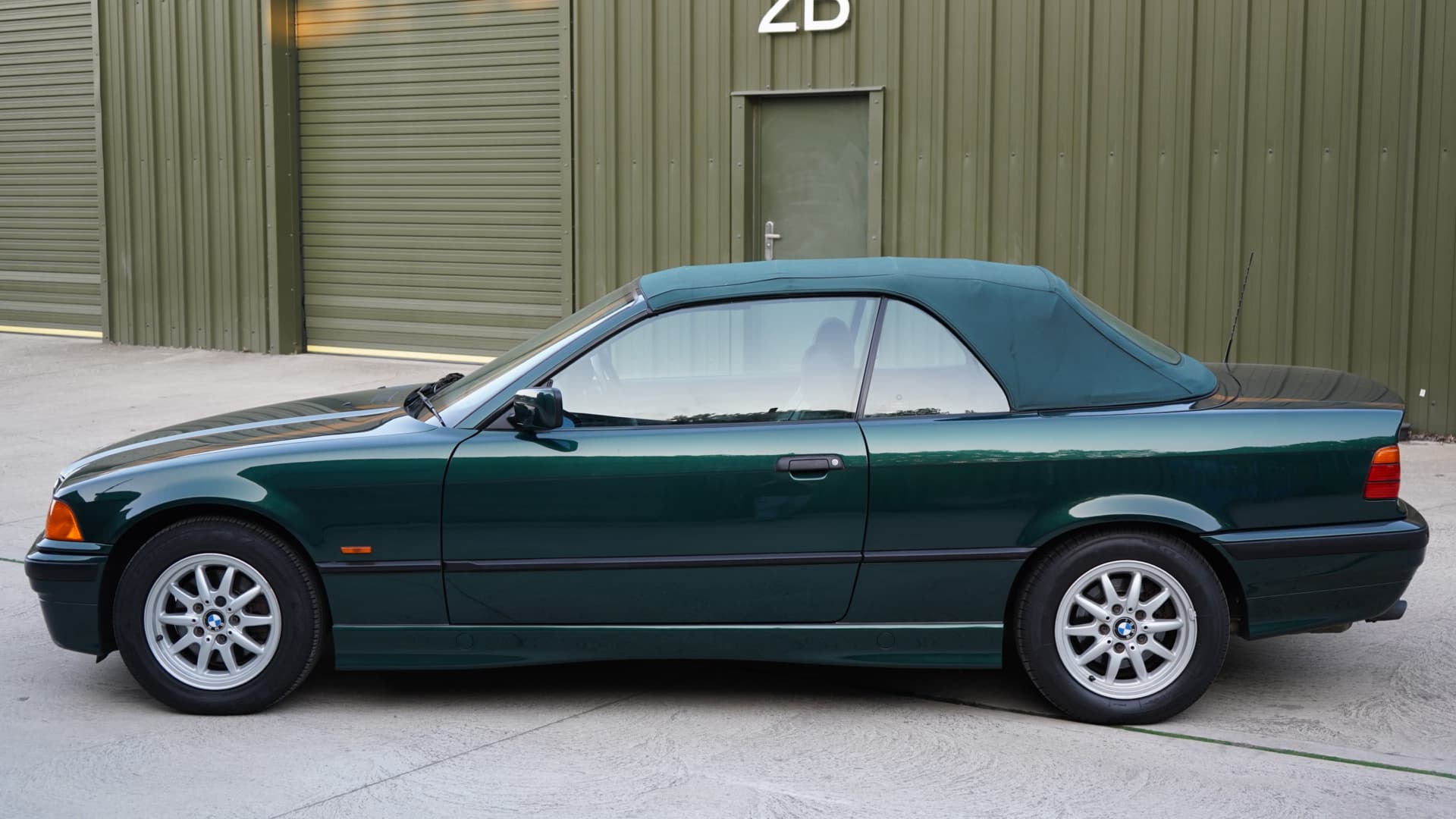
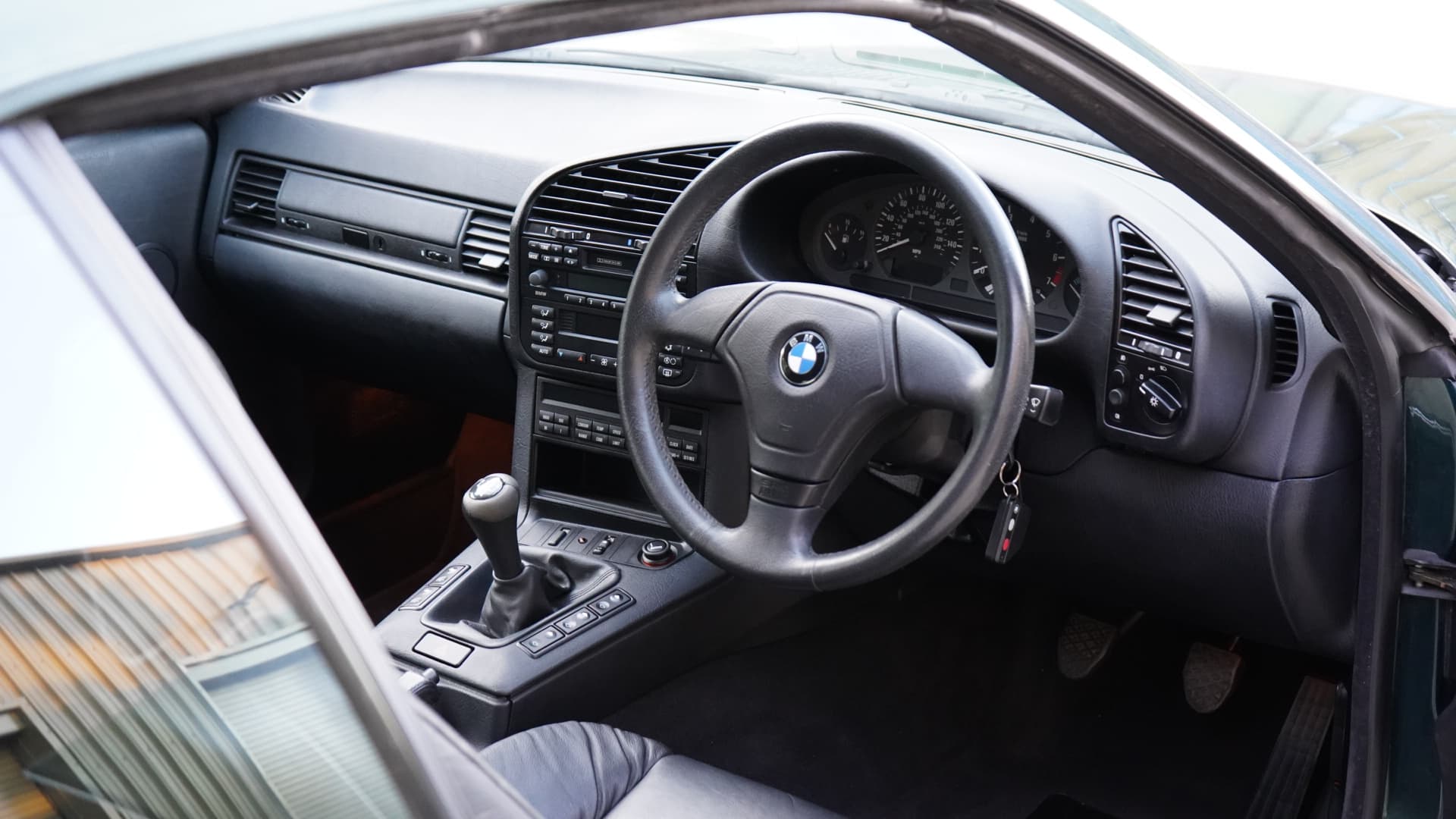
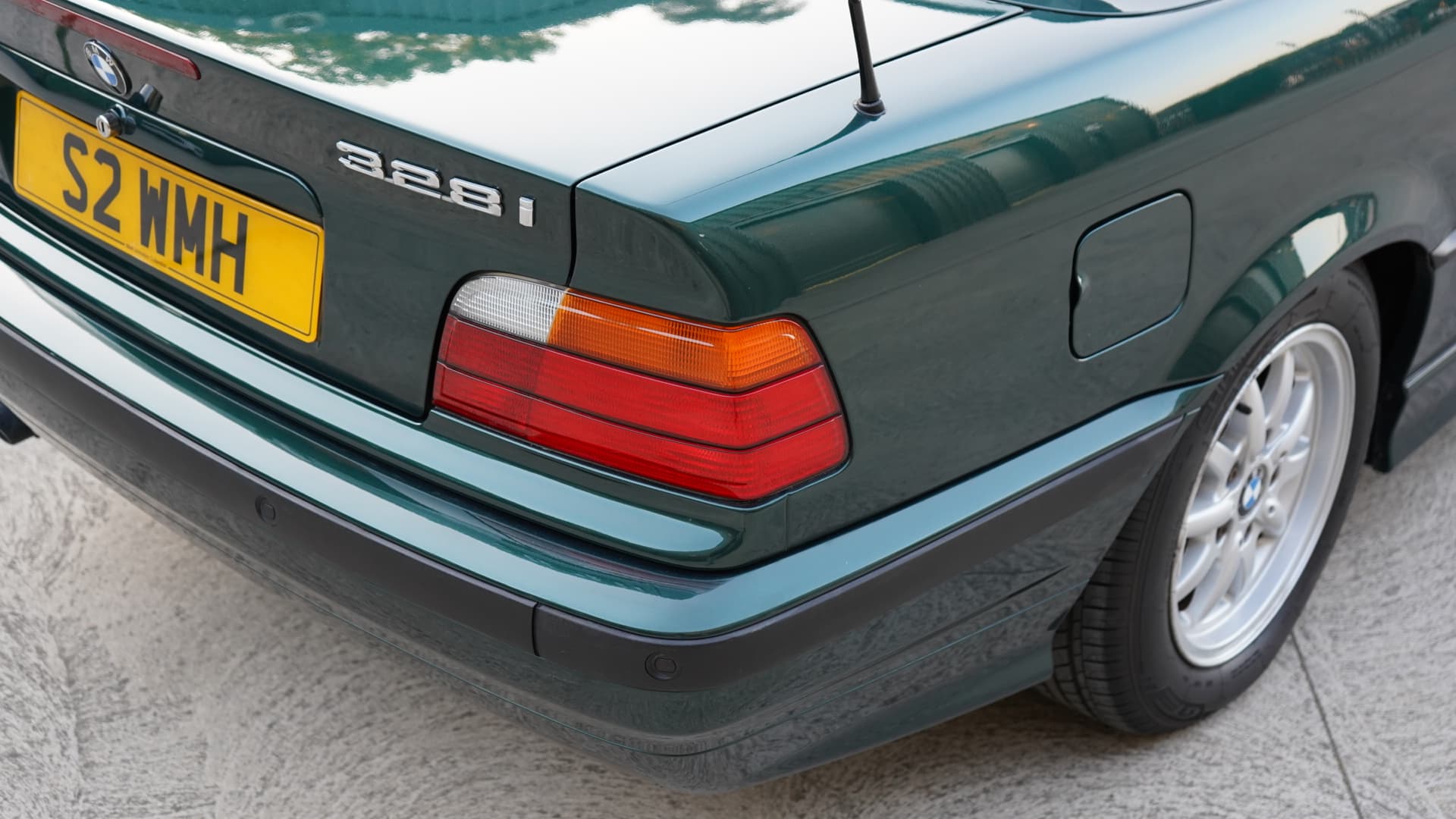
TMJC's 1998 BMW E36 328i Manual is a good example of why documentation can matter as much as a desirable badge. It was supplied new by BMW Park Lane on 10 September 1998 and retains unusually continuous ownership and service material, including its books and later specialist history.
Those are facts about that individual car. They do not prove that every late-registered 328i has the same engine construction, nor do they turn 10 September 1998 into the car's production date. They give a buyer a chronology against which identity, servicing and repairs can be checked.
The E36 is the generation in which the 3 Series became a much broader family without abandoning its rear-drive identity. It added distinct Coupé, Convertible, Compact and Touring bodies, introduced more sophisticated mainstream rear suspension, expanded diesel availability and moved into a later aluminium-six era before the E46 began replacing it.
BMW's approximate 2.75-million production figure also explains why the E36 was once so familiar. The collector question today is less about rarity across the whole generation and more about which body, engine and specification survived in good, correctly documented condition.
Editorial information
Research and editorial from TMJC Garage.
Research and editorialTMJC Garage
Reviewed byMatt Johnston
Last reviewed26 October 2026
Published byThe Matt Johnston Collection
Model lineage
TMJC photography
TMJC Guides
TMJC assistance
Continue to the main TMJC website and speak directly with the collection team.
Sell, consign or source
Continue with TMJC for a discreet conversation, professional presentation and collector-focused support.
Enquire now