Published guide
BMW E36 328i Nikasil: what buyers should check
BMW E36 328i Nikasil explained: why build date matters, which shortcuts mislead, and how to verify an M52 using history and cylinder-sealing evidence.
Overview
BMW E36 328i Nikasil explained: why build date matters, which shortcuts mislead, and how to verify an M52 using history and cylinder-sealing evidence.
This guide covers 328i and links directly to the relevant car record for further detail.
The BMW E36 328i’s Nikasil question is often reduced to a rule such as “avoid early cars” or “1998 cars are fine”. That is too crude to be useful.
For a UK-market 328i, the better approach is to establish the car’s production date and engine history, then judge the engine that is actually in front of you. A late registration date is useful context, but it is not the same thing as a build date. Nor does a seller describing a car as “Alusil” or quoting a particular engine code settle the question on its own.
BMW’s own archive describes the E36 328i as using a 2.8-litre lightweight-alloy six-cylinder, while BMW UK parts data identifies ECE 328i applications with the M52 engine. The complication is what happened at the cylinder bores during M52 production.
What was the BMW Nikasil issue?
Nikasil is a hard nickel-silicon-carbide coating applied to an aluminium cylinder bore. It is more accurate to think of an early M52 as having Nikasil-coated alloy bores than to imagine a conventional removable cylinder liner made from Nikasil.
The historical problem arose when some of these coatings were exposed to high-sulphur petrol. If the coating deteriorated, the piston rings could no longer seal effectively against the bore. That means the mechanically important symptom is loss of cylinder sealing/compression. A rough idle, poor cold starting, oil consumption or lack of performance can accompany that, but none of those symptoms is unique to Nikasil damage.
This distinction matters because a buyer can spend a lot of time diagnosing a 30-year-old BMW by reputation when the engine simply has an ignition, vacuum, sensor or other ordinary running fault.
The E36 328i really did use the M52
BMW Group Archive records the 328i Coupé as arriving in the mid-1990s with a 2,793 cc, 142 kW/193 bhp lightweight-alloy straight-six. BMW UK’s own parts catalogue identifies ECE-market E36 328i production codes with the M52 engine.
That is the solid factory-backed starting point. The more difficult question is whether a particular M52 block has the earlier coated bores, the later steel/iron cylinder liners, or a replacement engine fitted during the car’s life.
That is why generic advice imported from a different market can be misleading. The question has to be answered for the specific engine and production history, not simply for the badge on the boot.
For wider 3 Series context, see our BMW 3 Series generation guide.
When did the M52 change from Nikasil?
Simon Worby’s long-running BMW Nikasil technical article, now republished by ShiftBMW, states that steel liners entered M52 production at week 10 of 1998 — March 1998.
That cutoff should remain source-qualified: the date is supported here by a detailed specialist history rather than a BMW factory bulletin. It is useful evidence, but it should not be presented as a factory-confirmed production date.
The same source makes a point that is more useful than the date alone: build date is what matters, not the date the car was first registered or put into service. A finished car can sit before delivery. A “1998” registration therefore does not tell you which side of a March production change its engine came from.
That is the first misconception worth removing from any E36 328i advert.
| Shortcut | Why it is weak | Better evidence |
|---|---|---|
| “It is a 1998 car” | Registration year can differ from production date | VIN/build record and engine history |
| “It is an S6 4 engine” | The documented code change did not coincide exactly with the liner change | Build information plus block/engine evidence |
| “It has done 100,000 miles so it must be fine” | Mileage does not identify bore material or prove equal sealing on all cylinders | Current mechanical condition and, where justified, compression/leak-down results |
| “It has an Alusil block” | Seller shorthand often mixes the M52 story with BMW’s separate V8 material changes | Evidence for the actual M52 block or replacement engine |
| “It idles roughly, so the Nikasil is gone” | Rough running has many possible causes | Diagnose ordinary faults and cylinder sealing rather than guessing |
Why the S6 3 / S6 4 shortcut is not enough
One piece of internet advice that has survived remarkably well is to identify an engine by a code change from S6 3 to S6 4 and treat that as the Nikasil boundary.
The Worby reference specifically warns against doing this. It says the engine-code change did not coincide with the move to steel liners, so not every engine carrying the earlier-looking code can be classified safely from that code alone.
That does not make engine markings useless. It means they belong in an evidence chain rather than replacing the chain.
A careful buyer wants to know:
- when the car was built;
- whether the engine is original to the car;
- whether BMW or a specialist replaced the short engine/block during the period when these failures were being dealt with; and
- whether the engine now has healthy, consistent cylinder sealing.
Do not confuse the M52 fix with the V8 “Alusil” story
Used adverts often describe any later E36 328i as having the desirable “Alusil block”. That wording deserves caution.
The M52-specific historical material describes the six-cylinder remedy as steel/iron cylinder liners in the aluminium block. BMW’s use of Alusil on other engine families, particularly in discussions of the V8 Nikasil problem, is a separate technical story.
For an E36 328i, “non-Nikasil” is not a licence to substitute whatever material name sounds familiar. Ask what evidence supports the claim about that particular engine.
What does a bad Nikasil engine actually feel like?
Loss of bore sealing can show up as an uneven idle, weak compression, difficult cold starting, increased oil use or reduced performance. The trap is that all of those can have other causes on an E36.
A useful owner example appears in a long-running PistonHeads 328i thread. The buyer had purchased a 1995 Coupé showing only about 33,000 miles. A leak-down test then indicated early cylinder-sealing trouble attributed to Nikasil wear, and the engine was replaced.
That anecdote proves only what happened to one car, but it demonstrates an important buying principle: low mileage is not a substitute for diagnosis. It is entirely possible for a much higher-mileage engine to be healthy and for a low-mileage engine to have a problem that only becomes obvious when tested.
Conversely, there are surviving early M52s that continue to run well. The sensible conclusion is not that all early engines will fail, nor that any survivor is automatically safe. Condition is individual.
How to check an E36 328i before buying
1. Find the production date
Start with the VIN and the best available BMW/vehicle records. You are trying to establish when the car was built, not merely the year printed on the registration document.
If the car is around the reported March 1998 transition, precision matters more, not less.
2. Establish whether the engine has ever been replaced
An engine change is not automatically bad news. BMW replaced affected engines during the period, and a documented replacement can be valuable evidence.
Look through invoices, BMW/dealer history and specialist records for a short-engine, block or complete-engine replacement. Record dates and part/engine references rather than relying on somebody remembering that “BMW did them all”.
This is exactly the sort of claim where paperwork earns its keep. Our classic-car provenance guide explains how to separate a document that proves something from a pile of history that merely looks impressive.
3. Assess how the engine behaves from cold
Listen for an uneven idle and note starting behaviour, oil use and obvious performance issues, but do not diagnose Nikasil from one symptom. A vacuum leak or ageing sensor can make an M52 run badly without any cylinder-bore problem at all.
A good specialist should investigate the simple and likely causes rather than treating the engine’s reputation as a diagnostic tool.
4. Use compression or leak-down testing when the uncertainty justifies it
If an early/unknown engine materially affects the buying decision, a compression test and especially a properly conducted leak-down test can tell you far more about cylinder sealing than an advert description.
The result still needs interpretation: the aim is to compare cylinders and understand where leakage is occurring, not to chase a magic internet number without knowing test conditions.
5. Judge the whole car
Nikasil should not become so dominant that it hides everything else. An E36 can have an excellent engine and still need substantial rust, cooling-system, suspension or trim work. Equally, a well-documented car should not be rejected solely because an early engine still has its original coated bores if testing and long-term behaviour are good.
TMJC’s September 1998 E36 328i: what its history does and does not prove
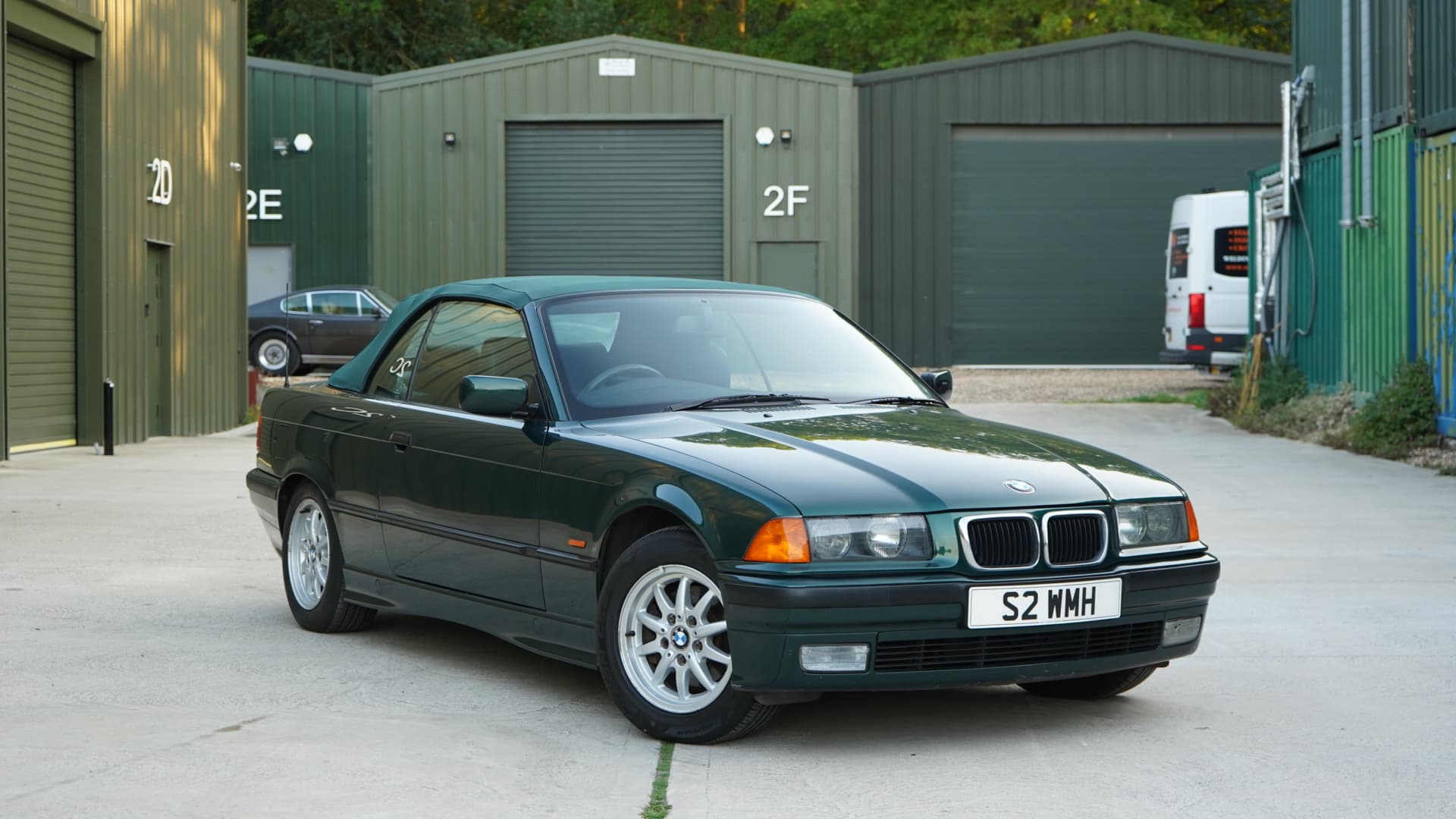
TMJC’s own BMW E36 328i Manual is a useful example because its provenance is unusually continuous.
It was supplied new by BMW Park Lane on 10 September 1998. The first owner kept it for around seven months, after which it spent roughly 26 years with the next keepers. Its history includes servicing by BMW Barrons of Farnborough and later BMW specialist Chris Plummer, together with the original handbooks, manuals and service booklet. The car has also continued to be driven and MOT-tested rather than simply sitting unused.
Those are meaningful confidence signals. They tell a buyer much more than a freshly written advert with no long-term paper trail.
What they do not tell us, by themselves, is the engine’s exact production week or cylinder-bore construction. The September registration comes well after the specialist-reported March 1998 liner change, which is reassuring context, but the responsible conclusion stops there unless VIN/build data or engine/block documentation confirms more.
That distinction is the point of this guide: evidence should narrow uncertainty, not be stretched until it says what we want it to say.
Is Nikasil still being damaged by UK petrol today?
The fuel environment that created the original problem has changed substantially. A UK Department for Transport technical review records that all UK petrol was below 50 ppm sulphur from 2001, and that from 1 January 2009 UK fuel contained less than 10 ppm sulphur.
So a buyer today is mostly asking whether an engine suffered damage historically and whether it remains mechanically healthy. Modern low-sulphur fuel does not reverse bore wear that has already occurred, but the high-sulphur exposure that made this such a notorious UK problem in the 1990s is no longer the normal road-fuel environment.
The short version
For a UK E36 328i, do not buy or reject the car on a registration-year rule.
- Confirm that you are dealing with the expected M52 and establish the production date.
- Treat the reported week-10-1998 steel-liner transition as strong specialist historical evidence, not a factory-confirmed BMW production date.
- Do not use
S6 3/S6 4, mileage or an “Alusil” advert description as standalone proof. - Search the history for engine/block replacement evidence.
- If the engine’s status materially affects the deal, test cylinder sealing rather than diagnosing by folklore.
The result is less dramatic than the usual Nikasil warning, but much more useful: identify the engine, establish its history, and test its condition when necessary.
Sources and further reading
- BMW Group Archive — BMW 328i Coupé (E36)
- BMW UK — E36 328i M52 parts/application data
- ShiftBMW / Simon Worby — The BMW Nikasil Issue
- PistonHeads — Yet another BMW E36 328i
- UK Department for Transport / TRL — review of fuel properties and sulphur levels
- The Matt Johnston Collection — 1998 BMW E36 328i Manual
For the broader marque story, see BMW history, Neue Klasse, M cars and classic model families.
Related car