Published guide
BMW E46 M3 subframe cracks: what actually fails?
BMW E46 M3 subframe/RACP guide: what cracks, how BMW inspected it, and what repair evidence buyers should check.
Overview
BMW E46 M3 subframe/RACP guide: what cracks, how BMW inspected it, and what repair evidence buyers should check.
The phrase "E46 M3 subframe cracks" is common shorthand, but it is not especially precise. BMW's own service information describes a fracture in the steel body structure around a rear axle carrier mounting point. In other words, the problem buyers usually mean is not simply a crack in the detachable rear axle carrier itself.
The distinction changes what a meaningful inspection looks like. A tidy carrier, fresh bushes or a quick look underneath the car do not by themselves prove that the surrounding body structure is sound. BMW's historical inspection procedure required access above a rear carrier bushing to look for small cracks that could otherwise be hidden.
For a used E46 M3, the question is not just "has the subframe been done?" It is: what was inspected, what damage was found, what work was carried out, and what evidence exists for it?
What does "subframe crack" actually mean on an E46 M3?
BMW's terminology helps separate three things that are often blended together in adverts and forum posts:
- the rear axle carrier, often called the rear subframe, is the detachable assembly that supports rear-axle components and bolts to the car;
- the rear axle carrier support is BMW's service wording for the body structure around those mounting points; and
- RACP, or Rear Axle Carrier Panel, is common specialist shorthand for the relevant body structure.
BMW Service Information bulletin SI B41 02 09 says that, under certain circumstances, a fracture could form in the steel body structure around one of the rear axle carrier mounting points. BMW also associated the condition with a distinct clicking noise during rear-axle load reversals, such as pulling away, selecting forward or reverse, or changing gear quickly.
That does not mean every click is an RACP crack, and it does not mean every E46 M3 has structural damage. It does mean that describing the issue simply as a cracked bolt-on subframe can send an inspection in the wrong direction.
What did BMW actually document?
BMW of North America developed an inspection and repair programme around the E46 rear axle carrier support as part of a US class-action settlement. BMW recognised the structural condition, but the programme itself was for US-specification E46 cars and US residents.
It should not be rewritten as a UK recall, a current warranty entitlement or proof that every E46 was affected.
BMW's October 2009 bulletin says qualifying cars found with damage could receive one of two approved repair routes under that historic programme: a structural-epoxy repair or replacement of the rear axle carrier support, depending on the evaluation of the damage. The linked inspection bulletin, SI B41 01 09, then sets out how BMW wanted the relevant area checked.
The value of those documents today is not that a buyer should copy a 2009 US warranty repair procedure. It is that they show BMW did not treat this as something that could always be judged from an ordinary glance under the car.
Why can a quick underside inspection miss damage?
BMW's 2009 inspection procedure required the two rear carrier mounting bolts to be removed and the rear of the carrier to be lowered. BMW explicitly says this step was required to inspect for small cracks located above the bushing and to measure any crack that was present.
The bulletin then directs the technician to inspect the body around the left-rear mounting point, noting that most fractures found in that specified area would start at a weld point and grow outward.
BMW's procedure gives classified-ad wording a clearer benchmark. Phrases such as:
- “subframe checked”;
- “no cracks visible”;
- “boot floor looks good”; or
- “no noises from the rear”
can all be true and still tell you very little about how deep the inspection went.
A UK BMW specialist such as Redish Motorsport takes the same general lesson further in its current RACP inspection work. Redish says it checks both the underside and internal sections of the RACP, including closed cavities hidden by rear-seat and boot-floor panels, and uses photographs and reports to document findings. That is specialist practice rather than a BMW factory requirement, but it illustrates why a documented inspection is stronger evidence than seller shorthand.
Does a later E46 M3 avoid the issue?
It is too strong to say that later cars were simply "fixed" and can be ignored.
BMW's US inspection bulletin applied to 1999-2006 E46 vehicles within that programme and differentiated repair treatment by production date and damage severity. It specifically provided a different repair route for cars produced from October 2004 if any crack was present.
That does not prove that every year has the same risk, nor does it establish a failure rate for UK M3s. It does show that BMW's own service programme did not define later E46s as automatically outside the structural issue.
Build year provides context. It is not a substitute for condition evidence.
Coupé and Convertible: should the body style change the question?
The buying question remains relevant to both body styles. BMW's inspection procedure even includes a Convertible-specific step to remove the V-strut before lowering the rear of the carrier.
That does not mean Coupé and Convertible body structures are identical in every respect, and it does not justify saying that one body style must crack. It simply means that a Convertible should not be waved through on the assumption that its extra body reinforcement makes RACP inspection unnecessary.
See the E46 M3 Coupé and E46 M3 Convertible references for exact-variant specification and buying context. This guide focuses on the narrower structural question that applies across both M3 body styles.
Inspection, repair and reinforcement are three different claims
One reason this subject becomes confusing is that the phrase "subframe done" can describe several completely different histories.
A car may have been:
- inspected, with no damage found;
- inspected and found to have cracks;
- repaired after existing damage was found;
- reinforced preventatively when no crack was recorded;
- repaired and reinforced during the same job; or
- given much more extensive structural work because the damage or corrosion was greater than expected.
Those histories are not interchangeable.
A car with a properly documented repair is not automatically less desirable than one advertised as "never cracked". Equally, the word “reinforced” is not a quality certificate. What matters is what was found before work began, what work was actually carried out, who did it, and how well the finished structure has been protected and documented.
What should a good RACP history file contain?
For a car described as inspected, repaired or reinforced, look for:
- a dated inspection report that states which areas were examined;
- clear before photographs, especially where damage was identified;
- the workshop's description of the damage and the repair or reinforcement scope;
- during-work photographs, not only pictures of a freshly coated underside;
- an invoice that identifies the structural work rather than using a vague “subframe work” line;
- evidence of corrosion treatment and protection after fabrication or repair where applicable; and
- a later inspection or condition report if substantial time and mileage have passed since the work.
The absence of one item does not condemn a car. The point is to understand exactly what claim the paperwork supports.
A substantial invoice total is also not enough on its own. RACP work can involve exhaust, suspension, driveline, brake, fuel-system and corroded-fastener work around the same area, so a large bill may include far more than the structural repair itself.
What does a "no cracks" inspection prove?
It proves only what was actually inspected at that time.
A specialist report that identifies the areas checked, documents them photographically and records no damage is meaningful evidence. A seller remembering that someone "looked at the subframe years ago" is much weaker.
The date matters as well. A clean report from a decade and tens of thousands of miles ago is still useful provenance, but it does not have the same evidential value as a recent documented inspection when you are deciding what the car is like today.
If the car has subsequently been used on track, fitted with significantly different suspension, suffered a collision or received structural work in the same area, those later events also belong in the history.
What about clicking from the rear?
BMW did mention a distinct clicking noise during load reversals as a possible symptom of the documented condition. That makes the symptom worth investigating, but it is not a diagnostic test.
An E46 rear axle contains many components that can create knocks, clicks or movement. Conversely, the absence of noise is not proof that the body structure is crack-free. Structural condition should be established by inspection, not by a test drive alone.
The same caution applies to handling. A car can feel tight and composed while still needing a closer structural look, just as a worn bush or mount can make a structurally sound car feel poor.
How should you judge a reinforced E46 M3?
Treat reinforcement as a piece of history to understand rather than a badge of superiority.
Ask:
- Was damage found before reinforcement?
- If so, where and how extensive was it?
- Was the work primarily repair, preventative reinforcement, or both?
- Which areas of the structure were accessed and documented?
- Who performed the work?
- Are there photographs before, during and after it?
- Was corrosion found or treated while the area was dismantled?
- Is there evidence of subsequent inspection?
Different specialists use different repair and reinforcement strategies. No single plate kit, brace or fabrication method is universally correct. Structural repair quality depends on the starting condition, diagnosis, workmanship and complete repair scope, not simply the brand name of the reinforcement parts.
TMJC-linked E46 M3 examples show why wording matters
The Matt Johnston Collection has handled both E46 M3 body styles represented in Garage.
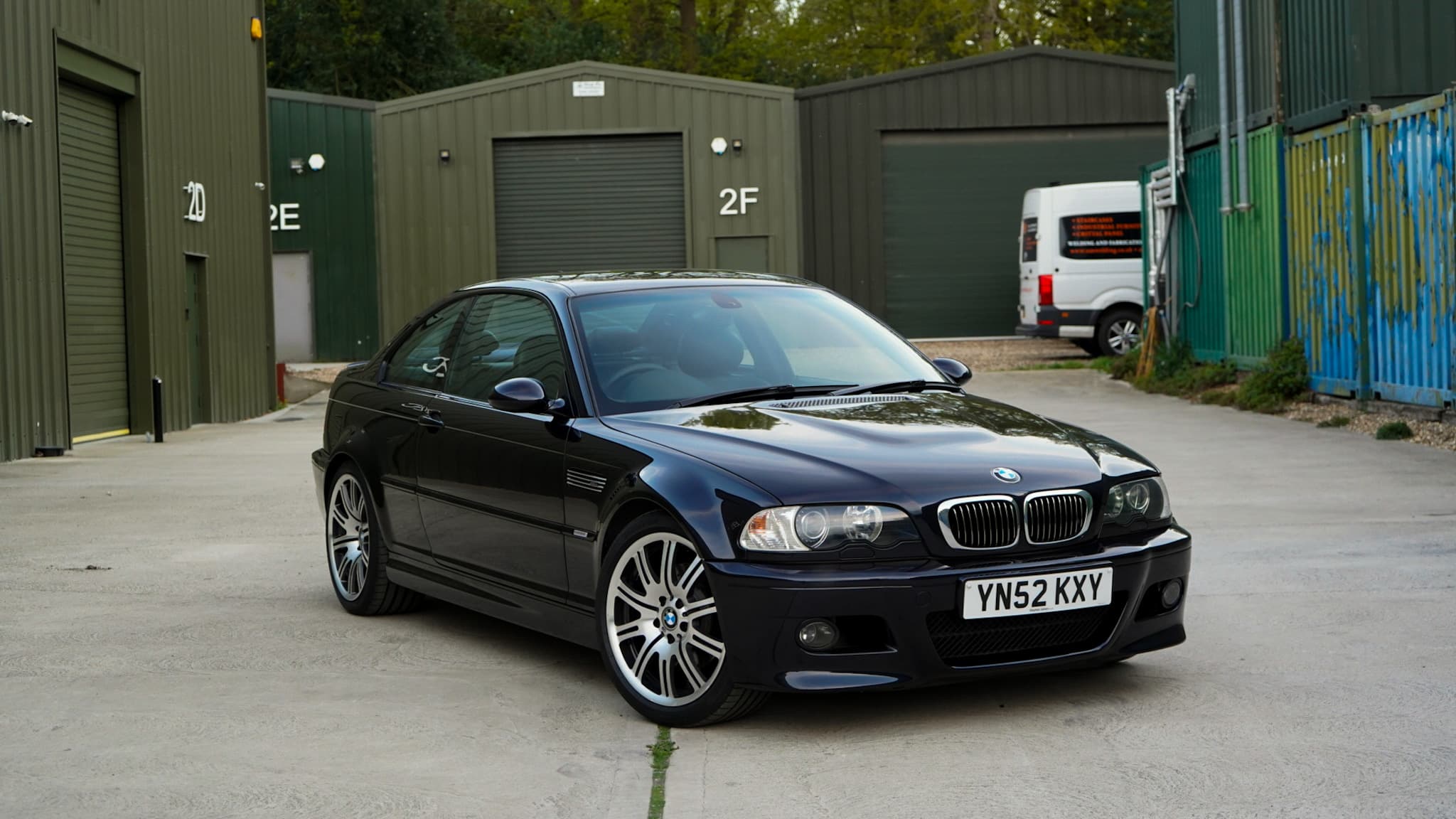
The surviving advert for YN52KXY, a 2002 right-hand-drive six-speed M3 Coupé with 78,049 miles, documents a detailed service history and specific BMW-performed work including seller-stated rod-bearing replacement under extended warranty and a later clutch replacement. The advert does not provide a separate RACP inspection or repair record in the surviving copy.
That is not evidence that the car had a structural problem. It is a good example of a broader rule: excellent evidence in one mechanical area should not be stretched into proof about another part of the car.
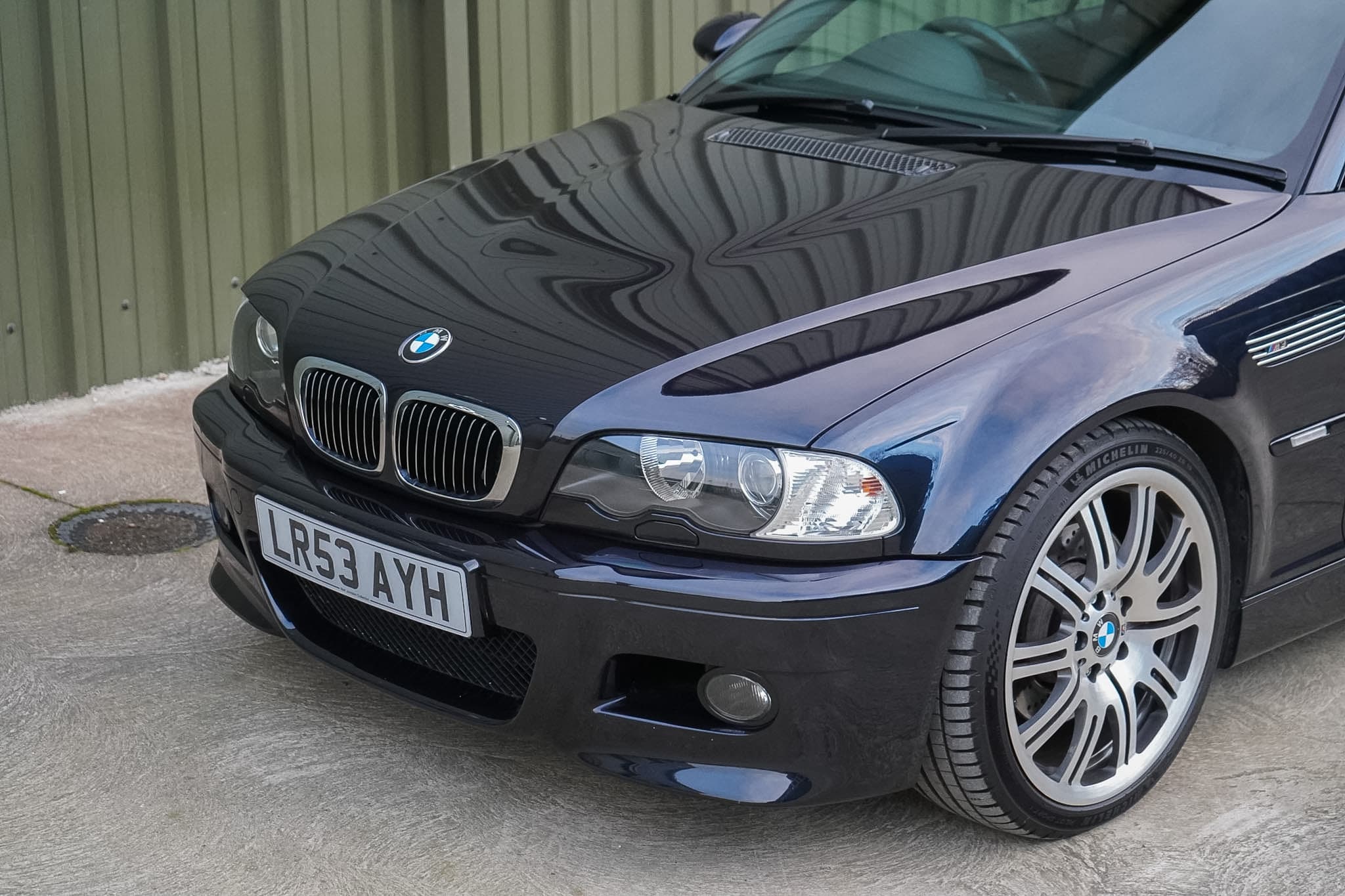
The surviving advert for LR53AYH, a 2003 M3 Convertible with 24,643 miles, says the familiar E46 M3 "big three" showed no signs of concern. It also offered an underside-photo pack on request. That is useful seller context, but the archived advert itself is not the same thing as a dated specialist RACP report showing what areas were inspected.
For either car, a proper structural conclusion would require the vehicle-specific evidence file rather than inference from mileage, presentation or general service history.
A sensible buyer checklist
When viewing an E46 M3, ask the structural-history questions early enough that the seller has time to produce the paperwork.
Useful questions are:
- Has the rear axle carrier support/RACP ever been formally inspected?
- Who carried out the inspection and when?
- Was the inspection underside-only, or were hidden/internal areas also assessed?
- Was any crack, failed weld or deformation recorded?
- Has the structure ever been repaired or reinforced?
- If so, what exact work was performed and why?
- Are before/during/after photographs available?
- Was corrosion found in or around the repair area?
- Has there been a later follow-up inspection?
- Is there accident history or previous structural work that changes how the area should be assessed?
If the answers are vague, a pre-purchase inspection by a workshop that knows the E46 structure is a more useful next step than arguing over whether the internet calls the part a subframe, boot floor or RACP.
What this means for an E46 M3 purchase
The E46 M3's rear-axle structural issue deserves attention because BMW itself documented fractures around the carrier mounting points. It does not deserve mythology.
Avoid the two extremes: "they all crack" and "later/low-mileage cars are immune". Neither is a substitute for evidence from the actual car.
A strong buying position is simple:
- understand that the commonly discussed crack is in the body/support structure, not merely the bolt-on carrier;
- recognise that small damage can be hidden from an ordinary underside glance;
- separate inspection, repair and reinforcement in the history;
- judge any structural work by documentation and workmanship rather than a one-line advert claim; and
- obtain a knowledgeable inspection when the available evidence is incomplete.
That approach is more useful than treating the issue as a reason to reject every E46 M3, and more defensible than assuming a clean-looking or low-mileage example needs no structural due diligence.
Sources and further reading
- BMW of North America — SI B41 02 09, Rear Axle Carrier (Sub-frame) Support Proposed Class Action Settlement (archived PDF)
- BMW of North America — SI B41 01 09, Rear Axle Support Inspection (archived PDF)
- Redish Motorsport — E46 M3 RACP Check & Report
- Redish Motorsport — E46 M3 RACP repair and reinforcement overview
- The Matt Johnston Collection via Car & Classic — 2002 BMW E46 M3 Coupé YN52KXY
- The Matt Johnston Collection via Car & Classic — 2003 BMW E46 M3 Convertible LR53AYH
Related car
Cars covered in this guide
Explore the cars this guide covers, with model information, history and related TMJC guidance.
M3 CoupéMaintenance
M3 Coupé
OwnershipExplore model details, specifications, history and related guidance for BMW 3 Series E46 M3 Coupé.
 M3 Convertible
Maintenance
M3 Convertible
OwnershipExplore model details, specifications, history and related guidance for BMW 3 Series E46 M3 Convertible.
Editorial information
The Matt Johnston Collection
Research and editorial from TMJC Garage.
Research and editorialTMJC Garage
Reviewed byMatt Johnston
Last reviewed26 October 2026
Published byThe Matt Johnston Collection