Published guide
Volkswagen Karmann Ghia restomod: what should you check?
How to assess a modified Karmann Ghia Type 14: prove the base car, inspect the body, then judge the roof chop, RHD conversion, engine and chassis work.
Overview
How to assess a modified Karmann Ghia Type 14: prove the base car, inspect the body, then judge the roof chop, RHD conversion, engine and chassis work.
A modified Volkswagen Karmann Ghia can be easier to use, faster, lower, more personal and much less original than the car that left Karmann's factory. None of those things tells you whether it is a good car.
The useful way to inspect a Karmann Ghia restomod is to split it into two questions:
- What is the underlying car, and is its structure sound?
- Do the later modifications form a coherent, well-documented package?
That distinction matters particularly on a Karmann Ghia. Volkswagen's own history describes the Type 14 as using Beetle-based engineering beneath Karmann/Ghia-developed coachwork. Mechanical familiarity is one of the model's attractions, but the body is not something to dismiss as a decorative Beetle shell.
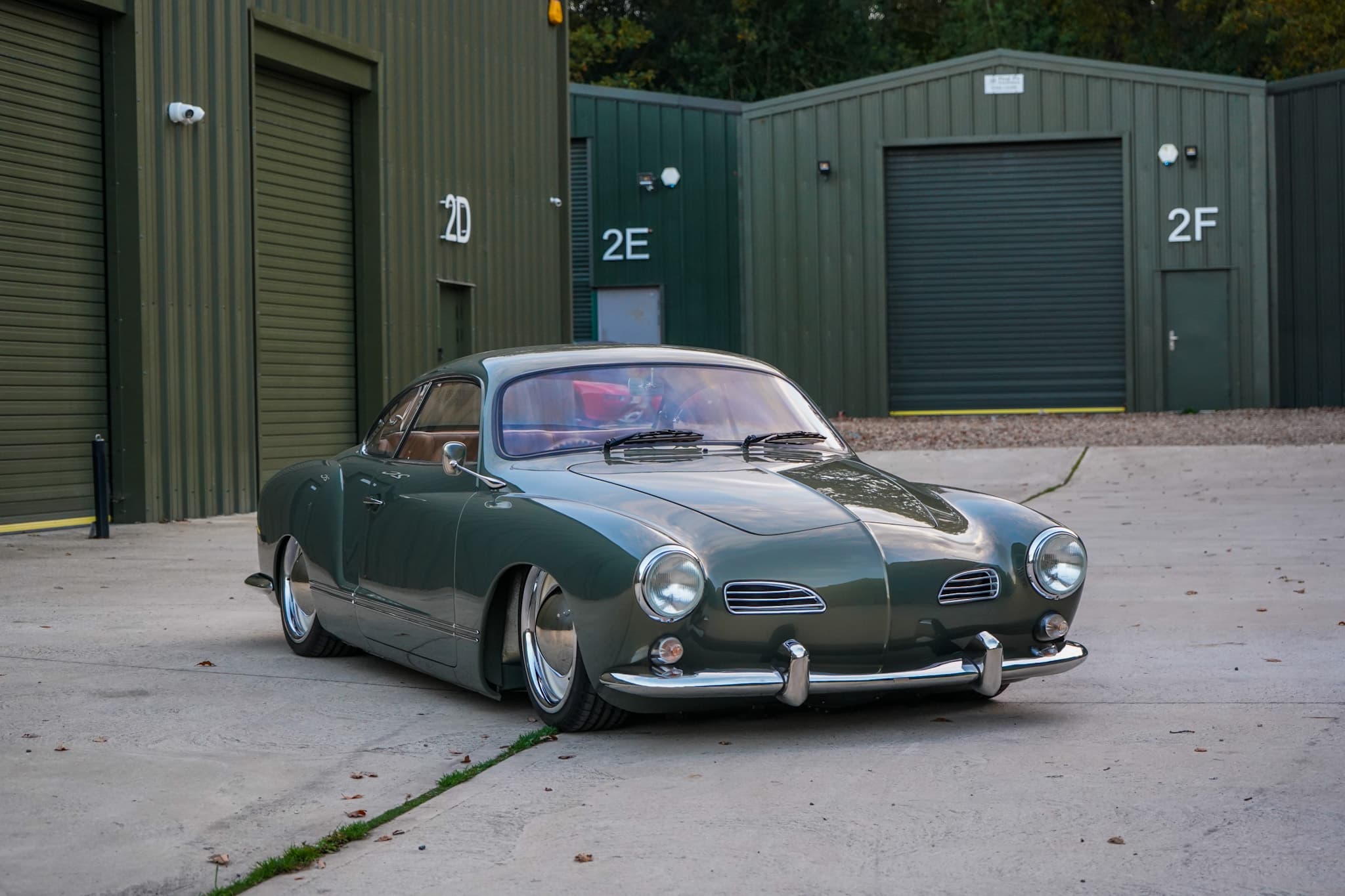
TMJC's 1970 Karmann Ghia Restomod makes the problem unusually clear. Its public description records a rebuilt 2.1-litre Type 1 flat-four, manual transmission, air suspension, a roof chop, Californian import history and a later right-hand-drive conversion. Those are details of that individual car, not factory 1970 specification. They also remove many of the shortcuts a buyer might otherwise use when deciding whether a Karmann Ghia "looks right".
The answer is not to give up on originality. It is to separate identity, structure and modification quality.
Start by proving the Type 14 underneath the restomod
Volkswagen introduced Type 14 Coupe production in August 1955 and ended Coupe production in 1974. Volkswagen's archives count Coupés separately from Cabriolets, so a Coupé production figure should not be treated as a total for all Type 14 Karmann Ghias.
For a standard car, year-correct trim, engine specification and body details can all help build a picture of what you are looking at. On a restomod, many of those cues may have been deliberately changed.
So begin with evidence that survives modification:
- chassis/body identity and registration documents;
- import records where the car came from another market;
- old photographs showing the car before restoration or modification;
- invoices that establish when major phases of work occurred;
- photographs of identity areas before and after metal repair;
- a clear timeline separating restoration from later custom work.
A right-hand-drive conversion does not erase a car's original market history. A larger engine does not tell you what engine the car originally carried. A roof chop does not make the shell's earlier identity irrelevant.
For the broader Volkswagen history behind the Type 14, see the Volkswagen reference. For document hierarchy and provenance evidence, the collector-car provenance checklist goes into more detail.
On a Karmann Ghia, the body can matter more than the parts list
The Beetle relationship is useful because it helps explain why many mechanical parts and skills are comparatively accessible. It can also create the wrong expectation that a Karmann Ghia is simply a Beetle with prettier outer panels.
Hagerty's Karmann Ghia buying guidance puts serious emphasis on corrosion in hidden heater-channel and sill areas, along with the front boot and battery area. It also warns that body and trim details change across the production run.
On a restomod, inspect those areas before getting distracted by the engine specification or the brand name on the suspension.
Ask for photographs from before paint. Look underneath the car. Inspect the sill/heater-channel areas, floor edges, inner body structure, front luggage compartment and battery-related corrosion points. Check whether previous repairs are visible and understandable rather than hidden under fresh underseal.
A costly engine build cannot compensate for a weak shell. Air suspension cannot make poor sill repairs stronger. A beautiful interior does not tell you how much original metal remains underneath it.
The more heavily a car has been modified, the more valuable a photographic record of the body becomes.
A roof chop should be inspected as fabrication, not styling
TMJC describes its example as roof-chopped. That immediately changes the inspection method.
The question is no longer whether the roof profile matches a factory drawing. The question is whether the altered roof was engineered and finished properly.
The public listing does not establish the exact fabrication method used on the TMJC car, so there is no responsible universal recipe to infer from it. Instead, inspect the result and ask for the build evidence.
Look at:
- left-to-right symmetry in the roof and pillars;
- door, quarter-window and windscreen aperture fit;
- how glass and seals have been made to work with the new geometry;
- drain paths and water sealing;
- weld finishing and corrosion protection where the body was cut;
- whether doors open and close cleanly without the body loaded awkwardly;
- paint cracking, filler movement or stress marks around altered joints;
- photographs showing how the shell was supported while the work was carried out.
A roof chop can be visually convincing from ten metres away and still be difficult to live with if glass, seals, apertures and structure were treated as afterthoughts.
This is one reason a modified Karmann Ghia needs a different standard from a standard-car concours inspection. Factory originality is no longer the test at the altered area, but quality of fabrication absolutely is.
UK paperwork: do not treat historic tax and MOT exemption as the same thing
TMJC's 1970 example was advertised as “MOT and Tax Exempt”, but current GOV.UK guidance separates those questions. A car built before 1 January 1986 can qualify for the historic vehicle tax class, while MOT exemption for a vehicle over 40 years old additionally depends on it not having been substantially changed in the previous 30 years.
That distinction matters on this car because TMJC dates its restoration/custom build to 2017 and lists a two-inch roof chop and air suspension. Current DVLA guidance expressly lists cutting, lengthening or shortening roof pillars as a structural modification. The current historic-MOT criteria also treat a change in the type or method of suspension or steering as a substantial change, subject to defined exceptions.
So do not use the age of a Karmann Ghia, or a zero-rate historic tax class, as proof that it should also be MOT-exempt. On a car whose major modifications fall inside the current 30-year window, check the actual registration and MOT record.
For a structural modification, GOV.UK says the keeper must notify DVLA using form V627/3, with the V5C and supporting photographs. For a vehicle over 40 years old, DVLA also requires evidence of an MOT after the structural change when the modification is notified. If identity remains satisfactory, the updated V5C records that the vehicle has been modified from the manufacturer's original specification.
The engine paperwork deserves a separate check. TMJC lists this example at 2,100 cc, while Volkswagen's Type 14 history records a 1.6-litre engine for the 1970 model update. Current V5C guidance requires evidence when the engine number or cylinder capacity changes. A buyer should therefore check that the cylinder capacity recorded on the V5C agrees with the engine/build documentation rather than treating the invoice file and registration record as unrelated paperwork.
None of this proves from the public advert alone that the individual TMJC car was registered incorrectly. It means the current V5C, modification evidence and MOT position are part of the due diligence on a heavily altered UK-registered classic.
Treat a right-hand-drive conversion as a complete control-system change
Moving the steering wheel is the visible part of an RHD conversion. The important work lives around it.
TMJC's car is represented as a Californian import later converted to right-hand drive. That means a buyer should understand both stories: what the car originally was and how the control systems were later rearranged.
Inspect:
- steering-column alignment, joints and mounting points;
- pedal position and pedal-box work;
- brake and clutch actuation and hydraulic routing;
- dashboard structure and switchgear changes;
- wiring altered to suit the new driving position;
- heater/ventilation packaging;
- wiper operation and visibility;
- full-lock clearance and any interference under the dash or front bodywork.
On the road, pay attention at parking speed as well as at normal speed. Does the steering self-centre? Is there play, binding or a change in effort through the range? Are the pedals naturally aligned? Does the brake pedal remain firm and repeatable?
A tidy dashboard is not proof that the hidden part of the conversion is equally tidy.
A bigger Type 1 engine is only as good as the installation
TMJC describes a rebuilt 2.1-litre Type 1 flat-four in its 1970 Restomod. That is exactly the kind of headline specification that can dominate a modified-car advert.
Do not stop at displacement.
Ask who built the engine, what the internal specification actually is and which invoices support it. Establish the carburetion or fuel system, ignition arrangement, cooling strategy, exhaust, clutch and gearbox relationship. Check cold start, hot restart, oil leaks, oil-pressure behaviour where instrumentation allows, and whether the car behaves cleanly at low speed rather than only sounding impressive at full throttle.
A restomod should come with enough information that the next workshop can service it without reverse-engineering the build.
Useful records include:
- engine-builder invoices and parts list;
- compression or leak-down results where appropriate;
- carburettor/management setup notes;
- ignition specification;
- clutch and flywheel details;
- gearbox code or specification;
- cooling and oil-system changes;
- service intervals chosen for the modified engine.
The point is not that a 2.1-litre engine is better or worse than a standard unit. The point is that a non-standard engine moves the buyer from factory specification evidence to builder and installation evidence.
Air suspension, brakes and wheels need to work as one chassis
Air suspension can transform stance and usability, but the photographs that show a Karmann Ghia sitting low do not tell you how it drives at its intended road height.
Inspect the system as both suspension and pneumatic installation:
- mounting points for bags, dampers and brackets;
- hose routing and protection from heat or abrasion;
- compressor and tank mounting;
- leak-down behaviour after the car is parked;
- wiring, relays and fusing;
- tyre and wheel clearance at full lock and through suspension travel;
- alignment at the normal driving height;
- brake-line clearance around moving suspension parts.
Then road-test the car at the height the owner actually uses.
Does it track cleanly? Does it self-centre? Does it bottom out over ordinary road surfaces? Do the tyres touch bodywork under steering or compression? Does changing ride height materially alter steering feel or alignment?
If brakes, wheels, tyres and suspension were all changed, treat them as one system rather than four expensive items on an invoice. Wheel offset changes suspension and steering behaviour. Ride-height changes can alter geometry. Brake upgrades need appropriate hydraulic balance and pedal feel.
A coherent chassis is worth more than a fashionable component list.
Decide which originality still matters
The word restomod can make originality sound irrelevant. It is not.
On a heavily modified car, originality changes meaning. You may no longer care whether the engine displacement or ride height matches a 1970 brochure, but you still have reasons to care about:
- whether the underlying shell is what the documents say it is;
- whether original identity areas survived restoration honestly;
- which panels and structural sections are original, repaired or replaced;
- whether rare trim was removed, modified or retained;
- whether the build file preserves photographs of the car before major changes;
- whether removed factory components accompany the car, where that matters to you.
Originality is not automatically a quality score. A badly repaired original panel can be worse than a properly fitted replacement. But traceability helps you understand what you are buying and prevents a restomod specification from erasing the history underneath it.
The opposite shortcut is equally weak: expensive aftermarket parts do not prove engineering quality.
A convincing restomod should make its decisions easier to understand the closer you look.
TMJC's 1970 car: what its specification should make you verify
TMJC's Karmann Ghia is useful because its public specification immediately generates good due-diligence questions.
| Listed feature | What a buyer should verify |
|---|---|
| Californian import | Original market/identity, import chronology and documentation |
| Right-hand-drive conversion | Steering, pedals, braking, wiring and who performed the conversion |
| Roof chop | Fabrication photographs, aperture/glass fit, sealing and corrosion protection |
| Rebuilt 2.1-litre Type 1 engine | Builder, internal specification, fuelling/ignition, clutch/gearbox compatibility and service records |
| Air suspension | Mounts, air lines, compressor/tank installation, leaks, road-height alignment and clearance |
| Extensive restoration/custom work | Before-paint photographs, invoices by phase and evidence that structural repairs preceded cosmetic finishing |
That table is not a criticism of the car. It is what a good specification should do: tell you where to look for evidence.
The strongest restomod adverts make those questions easier to answer because the build is documented. The weakest use the size of the parts list to distract from gaps in the story.
Read the paperwork by build phase
A pile of invoices is useful. A chronology is better.
Separate the file into phases:
- base-car acquisition/import;
- strip-down and body restoration;
- structural/custom body fabrication;
- steering conversion;
- engine and transmission work;
- suspension/brake/wheel installation;
- trim, wiring and finishing;
- shakedown, servicing and post-build corrections.
Then ask whether the photographs, invoices and mileage support that sequence.
This helps distinguish deliberate development from repeated attempts to fix the same problem. It also makes it easier to identify which workshop is responsible for each system if something needs attention later.
For a complex modified car, the paperwork is part of the serviceability.
Road-test the car for coherence, not spectacle
A Karmann Ghia restomod may be designed to look dramatic parked low. The road test should answer less glamorous questions.
Try it from cold. Drive it slowly. Use full steering lock. Brake progressively. Let it get properly warm. Park it, restart it and inspect underneath again.
Look for:
- steering that is predictable around centre and at full lock;
- a stable brake pedal and straight braking;
- no tyre/body contact;
- no driveline vibration under load or overrun;
- sensible engine temperature and hot-start behaviour;
- no new fuel, oil or air leaks after the drive;
- ride quality that is acceptable at the intended driving height;
- doors and windows that still operate normally after the body has been driven over uneven roads.
A modified classic does not need to feel like a modern production car. It should, however, feel like one person understood how its systems interact.
Warning signs on a modified Karmann Ghia
Be cautious when several of these appear together:
- no photographs of the shell before paint;
- hidden heater-channel or sill repairs covered by fresh underseal;
- a roof chop with cracking, poor aperture fit or unexplained filler work;
- RHD conversion with no record of the steering/brake/pedal work;
- an engine described mainly by displacement with no builder specification;
- air suspension with rubbing tyres, leaking lines or improvised wiring;
- expensive wheels or brakes but no alignment/setup evidence;
- body or trim details from several years combined without explanation;
- import/registration history that does not match the physical car;
- a large claimed build spend with little itemised evidence;
- very little post-build mileage and no record of shakedown faults being corrected.
None of those single points automatically condemns a car. A pattern of undocumented structural and control-system work should change how much confidence you place in the finish and the asking price.
The best Karmann Ghia restomods remain legible
A good restomod does not have to imitate a factory car. It does have to explain itself.
You should be able to establish the underlying Type 14, inspect the Karmann Ghia-specific body structure, understand who altered the roof and driving position, trace the engine and chassis work and see evidence that the finished car has actually been driven and sorted.
That is the useful standard for a modified Karmann Ghia: not how close it is to a stock specification sheet, and not how expensive the parts are, but whether its identity, structure and engineering remain understandable.
Sources and further reading
- The Matt Johnston Collection — Volkswagen Karmann Ghia Restomod
- Volkswagen Newsroom — Karmann Ghia Typ 14 Coupe (1955-1974)
- Hagerty UK — Buying Guide: Volkswagen Karmann Ghia
- GOV.UK — Structurally modified vehicles
- GOV.UK — Historic vehicle MOT exemption criteria
- GOV.UK — Historic vehicle MOT and tax eligibility
- GOV.UK — Evidence for V5C vehicle-detail changes