Published guide
ALPINA B10 3.3 vs BMW E39 540i manual
Compare the ALPINA B10 3.3 manual with BMW's E39 540i manual: engine, torque, gearbox, factory identity and what to verify before buying.
Overview
Compare the ALPINA B10 3.3 manual with BMW's E39 540i manual: engine, torque, gearbox, factory identity and what to verify before buying.
This guide covers 3.3 Saloon Manual and links directly to the relevant car record for further detail.
The ALPINA B10 3.3 manual and the BMW E39 540i manual make a much better comparison than their badges initially suggest. Both are rear-wheel-drive E39 saloons with naturally aspirated engines, manual gearboxes and headline outputs clustered around 280 PS. The resemblance mostly stops there.
Official Swiss type-approval records show the B10 3.3 manual using a 3.3-litre inline-six, 206 kW, 335 Nm and five forward gears. The early 540i manual uses a 4.4-litre V8, 210 kW, 420 Nm and six forward gears. The ALPINA makes its rated power and torque higher in the rev range; the BMW brings substantially more torque earlier.
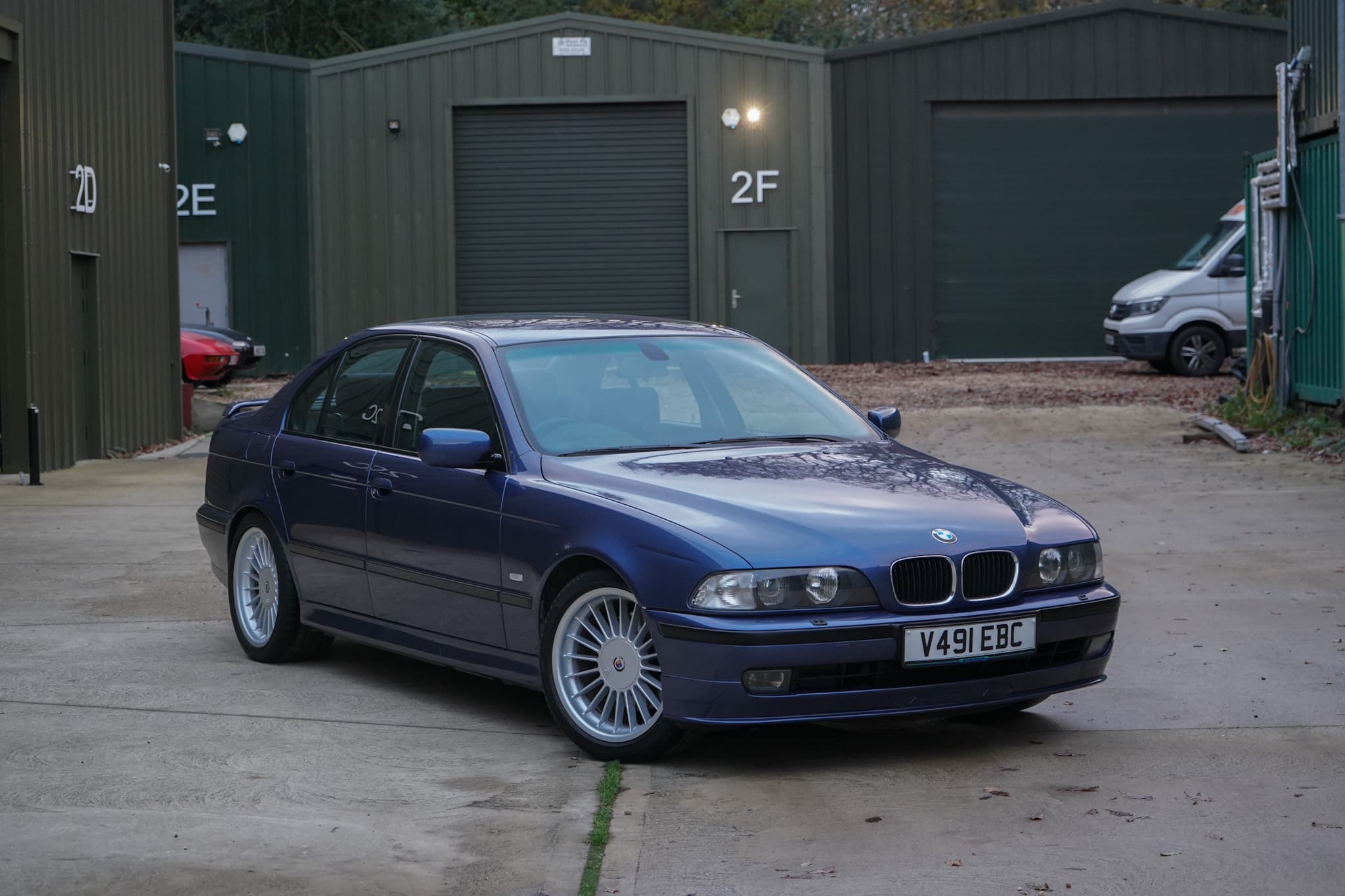
TMJC has handled examples of both: the 1999 B10 3.3 V491EBC and the 1996 factory-manual 540i M50CDG. They are two very different answers to much the same late-1990s fast-saloon question.
B10 3.3 vs 540i manual: the numbers that matter
| ALPINA B10 3.3 manual | BMW 540i manual, early M62 | |
|---|---|---|
| Manufacturer in homologation | ALPINA | BMW |
| Engine | 3.3-litre inline-six | 4.4-litre V8 |
| Displacement | 3,300 cc | 4,398 cc |
| Rated output | 206 kW / 280 PS | 210 kW / 286 PS |
| Rated-power speed | 6,200 rpm | 5,700 rpm |
| Maximum torque | 335 Nm | 420 Nm |
| Torque speed | 4,500 rpm | 3,900 rpm |
| Drive | Rear-wheel drive | Rear-wheel drive |
| Manual gearbox | 5-speed | 6-speed |
| Homologated maximum speed | 262 km/h | 250 km/h |
| Wheelbase | 2,830 mm | 2,830 mm |
The two Swiss records are unusually useful because they are the same kind of evidence. Type approval 1AF714 covers a B10 3.3 saloon manual configuration; 1BA823 covers the early E39 540i saloon including its six-speed manual configuration. They are homologation records rather than modern specification aggregators.
The 540i torque figure in this table is deliberately the early 420 Nm configuration, because that is the phase represented by TMJC's 1996 car. BMW revised the M62 later in the E39's life. A buyer comparing a later 540i should verify the exact engine phase rather than copy the 1996 figure across.
Nearly the same power does not mean the same engine character
A 6 PS gap looks trivial. The torque figures explain why that is a poor way to choose between the cars.
The B10 3.3's approval gives 335 Nm at 4,500 rpm and 206 kW at 6,200 rpm. The early 540i approval gives 420 Nm at 3,900 rpm and 210 kW at 5,700 rpm. The BMW therefore has 85 Nm more peak torque and reaches that peak 600 rpm earlier, while the ALPINA reaches its rated power 500 rpm higher.
That difference tells you more than the power figures alone. It shows two quite different engineering routes to a broadly similar headline output without needing to declare one objectively better.
A period Auto.cz report from May 2001 records the manual B10 3.3 at 0–100 km/h in 6.3 seconds and 262 km/h. For this comparison, the interesting point is not chasing tenths of a second but understanding the different engines, gearing and evidence behind the actual car being considered.
Five gears versus six
The gearbox difference is easy to miss because both cars are often described simply as manual.
Swiss type approval identifies the B10 configuration as m5, a five-speed manual. The early BMW 540i approval identifies m6, a six-speed manual. BMW Group Classic also specifically highlights the V8 and six-speed combination in its E39 540i history.
Neither gearbox count should be treated as a scorecard. The point is that the engines are paired with different transmission layouts. Verify the gearbox fitted to the individual car from its build or delivery documentation, then assess clutch, flywheel, shift quality and driveline condition mechanically.
That matters especially on a 540i because factory-manual identity is more meaningful than simply finding a manual gearbox in an old E39. On an ALPINA, the parallel documentary question is whether ALPINA's production and delivery record agrees with the transmission and engine in front of you.
The B10 is not just a BMW trim level
The comparison also contains a legal and documentary distinction that generic spec tables tend to erase.
BMW Group records ALPINA as an official automobile manufacturer in Germany from 1983. Its history of the partnership says BMW-based cars received extensive ALPINA work to the engine, transmission, chassis, aerodynamics and interior before completion.
The Swiss B10 3.3 approval therefore lists ALPINA B. Bovensiepen GmbH + Co. KG as manufacturer. The 540i approval lists BMW Bayerische Motoren Werke AG.
That changes how you authenticate the cars. A genuine B10 should be reconciled with ALPINA documentation: model designation, ALPINA chassis and production number, BMW chassis information, engine number and production data where available. ALPINA CLASSIC's Certificate of Delivery can document the original specification and those identifiers; ALPINA explicitly says it does not verify a surviving car's current originality, condition or value.
The 540i has a different question. A six-speed example should be verified as factory manual through BMW build information and coherent period paperwork rather than accepted from the gearbox alone.
Do not confuse the B10 3.3 with the B10 V8
The name B10 covers several different E39 ALPINAs. The 3.3 on this page is the naturally aspirated six-cylinder car. ALPINA also produced B10 V8 derivatives with different engines, torque outputs and transmissions.
That matters because current search results and classified descriptions often mix B10 E39 specifications together. A B10 3.3 should not inherit a B10 V8 figure merely because both carry the same model-family badge.
What the top-speed figures do — and do not — tell you
Type approval gives the B10 a mechanical maximum of 262 km/h and the BMW 540i 250 km/h. BMW Group Classic also lists 250 km/h for the 540i.
It is tempting to turn that into the ALPINA is faster. That is too simplistic. BMW Group Classic and the Swiss approval both give the 540i a 250 km/h maximum, while the B10 approval records 262 km/h. On a British collector car today, the useful point is that ALPINA engineered the six-cylinder B10 as a complete high-speed derivative, not that an owner should care about the last 12 km/h.
Tyres, suspension condition, geometry, brakes and the quality of previous repairs are much more relevant to buying either car now.
TMJC's two real examples
1999 ALPINA B10 3.3 — V491EBC
TMJC's historical advert records V491EBC as a right-hand-drive 1999 B10 3.3 with a five-speed manual, 119,206 miles, Alpina Blau II paint and ALPINA-pattern cloth. It also describes a substantial service-history file.
An earlier advert for the same registration records production plaque number 47. That is useful continuity evidence, but it is not the same thing as a factory certificate. The stronger next step for a buyer would be to reconcile the reported production number, chassis and engine details with an ALPINA delivery record.
TMJC's advert also says 112 B10 3.3 saloons reached the UK. Garage has not recovered the primary UK importer allocation document behind that figure, so it remains attributed seller information rather than a structured production fact.
1996 BMW 540i — M50CDG
TMJC's 540i advert records M50CDG as a 1996 right-hand-drive 4.4-litre V8 with a factory six-speed manual and 124,000 miles. It describes extensive BMW-main-dealer history and an invoiced replacement clutch and flywheel at 113,886 miles.
The advert is also a useful reminder not to adopt seller shorthand uncritically. It describes the early non-VANOS M62 as having no timing chain issues. Garage does not treat that as a safe model-wide conclusion. Age-related timing-chain and guide condition remains a separate inspection subject, covered in the dedicated E39 540i timing-chain guide.
The useful part of the listing is the individual car's documented configuration and maintenance history, not a blanket reliability slogan.
Which one should you buy?
There is no evidence-based universal winner. They reward different priorities.
Choose the B10 3.3 because you specifically want the ALPINA identity: its higher-revving six-cylinder, five-speed manual and manufacturer history. Then buy the car whose ALPINA documentation, production identity and maintenance file actually reconcile.
Choose the 540i manual because you specifically want BMW's 4.4-litre V8, much stronger peak torque and the six-speed manual. Then verify that it is genuinely factory manual, identify the exact M62 phase and buy on mechanical and body condition rather than assuming the simpler badge means simpler ownership.
For either car, the E39 shell underneath still matters. Corrosion, jacking points, suspension wear, cooling-system condition, steering, brakes and decades of previous work can overwhelm the differences in brochure specification. The right comparison is therefore not 280 PS or 286 PS?; it is which individual car has the identity, condition and records to justify buying it?
What to ask for before viewing
| B10 3.3 manual | 540i manual |
|---|---|
| ALPINA delivery/build documentation | BMW VIN/build specification |
| ALPINA production number and chassis reconciliation | Evidence it is a factory six-speed manual |
| Engine number and specification | Early M62 vs later M62TU identification |
| Complete service/invoice file | Complete service/invoice file |
| Correct ALPINA-specific equipment and trim | Correct original BMW specification |
| Evidence for any claimed UK allocation figure | Evidence for major engine/timing/cooling work |
Then inspect the same fundamentals on both: body structure, corrosion, tyres, suspension, brakes, cooling system, leaks, electrical equipment and the quality of previous repairs.
Read the exact car guides
Sources and further reading
- Swiss ASTRA type approval 1AF714 — ALPINA B10 3.3
- Swiss ASTRA type approval 1BA823 — BMW 540i
- BMW Group Classic — BMW 540i Sedan (E39)
- BMW Group — ALPINA company/manufacturer history
- ALPINA CLASSIC — Certificate of Delivery
- Classics World — BMW 5 Series E39 buyer guide
- Auto.cz, 28 May 2001 — BMW ALPINA B10 and D10 Biturbo
- The Matt Johnston Collection via Car & Classic — B10 3.3 V491EBC
- The Matt Johnston Collection via Car & Classic — 540i M50CDG
Related car
Cars covered in this guide
Explore the cars this guide covers, with model information, history and related TMJC guidance.
 3.3 Saloon Manual
Comparison
3.3 Saloon Manual
ComparisonExplore model details, specifications, history and related guidance for ALPINA B10 E39 3.3 Saloon Manual.
Comparison
540i Saloon Manual
ComparisonExplore model details, specifications, history and related guidance for BMW 5 Series E39 540i Saloon Manual.
Editorial information
The Matt Johnston Collection
Research and editorial from TMJC Garage.
Research and editorialTMJC Garage
Published byThe Matt Johnston Collection