Published guide
What is a TVR Tuscan Mk3? The “wavy dash” cars explained
“TVR Tuscan Mk3” is later shorthand rather than a clean factory generation. See what Mark 2 meant, why 16/23/35-car rarity claims use different scopes, and what a buyer should verify.
Overview
“TVR Tuscan Mk3” is later shorthand rather than a clean factory generation. See what Mark 2 meant, why 16/23/35-car rarity claims use different scopes, and what a buyer should verify.
The phrase TVR Tuscan Mk3 sounds as though it should identify a neat third factory generation. In practice, it does not work quite that cleanly.
Contemporary reporting in 2005 called TVR's substantially revised car the Tuscan 2. When the open version followed, Autocar called it the Tuscan 2 Convertible while reporting from the first official factory photographs. The label Mk3 or Tuscan 3 became useful shorthand for a small group of late cars associated with the redesigned, sculpted dashboard now usually called the wavy dash.
That distinction matters if you are trying to identify a car or judge a rarity claim. A dashboard style, a registration year and a seller's model label are three different pieces of evidence.
The short answer
| Term | Safest way to read it |
|---|---|
| Tuscan 2 | The major revised Tuscan introduced in 2005; contemporary road tests used this name. |
| Mk2 | Common shorthand for the Tuscan 2 facelift. |
| Wavy dash | The later sculpted dashboard design seen on late Tuscans and the Tuscan 2 Convertible. |
| Mk3 / Tuscan 3 | Later enthusiast and trade shorthand for certain late wavy-dash cars; useful, but not a sufficiently precise factory definition on its own. |
| Tuscan 2 Convertible | The name used in contemporary 2005 coverage of the new open derivative. |
So, if an advert says “Tuscan Mk3”, the useful next question is not simply “is that genuine?” It is: what exact late-car specification is the seller describing, and what evidence supports it?
The Tuscan 2 came first
The strongest period naming evidence is more specific than later advert shorthand. A TVR-branded price and specification sheet issued by authorised main dealer HL Gorner in March 2005 lists Tuscan Mark 2 and Tuscan S Mark 2. The TVR Car Club's Tuscan model reference likewise lists the production range as Speed Six 3.6, 4.0, Red Rose, Mk2 and Convertible; it does not establish a separate Mk3 model.
Contemporary road testing points the same way. In March 2005, evo described the revised car as the Tuscan 2 and as the second-generation Tuscan. More importantly, it was not merely a dashboard change. evo reported around 300 detail engineering revisions, ranging from ventilation to suspension geometry, steering assistance, springs and dampers.
That contemporary naming is useful because it gives us a fixed point. Tuscan 2 was already the recognised name for the substantially revised car before “Mk3” became the convenient label seen in later buyer guides and adverts.
This also explains why treating every late-car feature as evidence of a new model generation can become misleading. TVR continued developing the car inside the Tuscan 2 period.
Where the wavy dashboard enters the story
The clearest contemporary clue comes from June 2005. Reporting on the new open car, Autocar called it the TVR Tuscan 2 Convertible and said the photographs were the first official pictures released by the factory. Autocar singled out a new dashboard as the most noticeable change since the car's earlier motor-show appearance.
The Convertible also had a different roof arrangement from the familiar Tuscan Targa. Autocar described a removable central panel and a soft folding rear portion. Later enthusiast descriptions tend to pair that Convertible interior with the “wavy dash” name.
A useful modern cross-check comes from Hagerty's 2024 Tuscan feature. Henry Catchpole's late comparison car is described as a 2005 Tuscan 2 convertible with a wavy dash. That wording is revealing: Tuscan 2 and wavy dash are not mutually exclusive identities.
So why do people call them Mk3s?
Because it is a convenient way to distinguish the very late dashboard cars from earlier Tuscan 2s.
PistonHeads' Tuscan buying guide describes the 2005 facelift as the Mk2, then says that a handful of Tuscan 3 cars were made with the redesigned dashboard and were sometimes referred to as wavy-dash models. It separately notes that the same dashboard style appeared in the Convertible.
That is good evidence for how the terminology is used, but it is not the same thing as a factory model bulletin establishing a third formal generation with a fixed start chassis number.
The distinction can sound pedantic until you compare cars for sale. Mk3, wavy dash, Targa, Convertible, S and non-S can be mixed together in different combinations. A production figure for one subset then gets repeated as though it describes all of them.
How to identify what you are actually looking at
Start with observable configuration, then work backwards into documentation.
1. Establish that it is a Tuscan 2-era body
The 2005 revision is visibly different from the earlier Tuscan, most obviously at the front. This establishes the broad late-car family, but it does not by itself establish a wavy-dash specification.
2. Look at the dashboard
The later sculpted fascia is the feature behind the wavy dash nickname. It is a useful visual identifier. It is not, by itself, proof of an exact production total, build month or engine specification.
3. Distinguish Targa from Convertible
This is essential when comparing rarity claims. The Tuscan 2 Convertible used the removable central roof panel with a folding rear section described in period. The familiar Tuscan Targa arrangement is different. A statement about the number of wavy-dash Targas should not automatically be applied to Convertibles, or vice versa.
4. Verify S or non-S separately
Period sources distinguish Tuscan and Tuscan S versions. Do not infer an S specification from the dashboard, and do not assume one quoted power figure applies to every late wavy-dash car.
5. Separate build date from first registration
A V5C registration date tells you when the car was first registered, not necessarily when its chassis was completed. On a very late TVR this difference can be particularly important because unsold cars could remain with the dealer network after production activity in Blackpool had ended.
The best evidence is therefore cumulative: chassis identity, original order or factory paperwork where available, early invoices, dealer records, MOT chronology, service history and dated photographs.
How many wavy-dash Tuscans were made?
At present, no single number is secure enough to treat as settled fact.
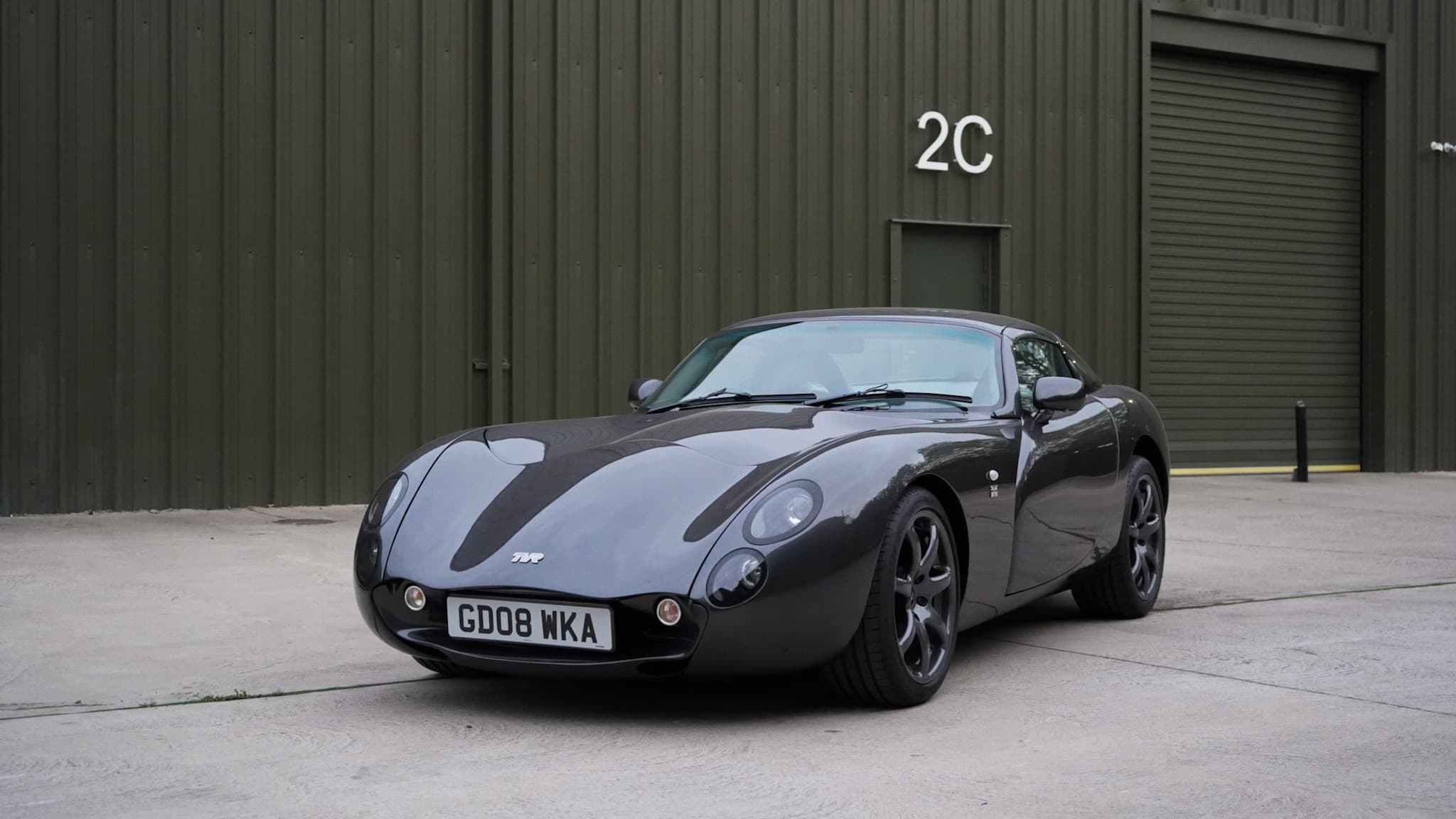
TMJC's own late Tuscan is described as one of 23 wavy-dash Mk3 cars. That is an important first-party claim about the car and it is one reason this question is worth investigating.
But the wider record is not consistent enough to promote 23 into a universal production figure. In a 2011 PistonHeads discussion specifically asking about wavy-dash Tuscan 2 S cars, one contributor remembered around 23 Mk2 wavy-dash cars, with nine or ten S models. Another remembered 26 wavy-dash Targas, ten of them S. The same discussion explicitly warns that no single set of figures was known to be completely accurate.
Later specialist coverage does not resolve the denominator. A 2024 PistonHeads feature explicitly calls Mk3 a colloquial name, says it is believed to have been Convertible-only and attributes a 16-car Tuscan S Convertible figure to that car's seller. HPC Classics says there was only a Mk2 officially, while separately stating that 35 cars left the factory in 2006. Those are not equivalent claims to TMJC's 23 wavy-dash-car statement: one is an S-Convertible subset and one is a calendar-year factory-output statement. They should not be averaged or treated as competing totals for one defined population.
Those figures may not actually contradict one another if they are counting different things.
| A quoted total might mean | Why it cannot automatically be compared with another total |
|---|---|
| All late wavy-dash Targas | May exclude Convertibles. |
| Wavy-dash S Targas | Excludes non-S cars and Convertibles. |
| Cars described by owners as “Mk3” | Depends on the owner's definition of Mk3. |
| Surviving cars on an enthusiast register | Not necessarily the number originally built. |
| UK-registered cars | May omit export/LHD examples. |
Until a documented factory ledger or a VIN-defined marque register is reconciled against those categories, the responsible wording is “claimed to be one of…”, with the scope of the claim stated.
That is more useful to a buyer than false precision.
TMJC's 8,204-mile car shows why dates need care
TMJC's example is especially instructive because it was registered in March 2008, well after the point at which normal Blackpool production was ending.
The listing says Henley Heritage TVR held the car at delivery mileage before its first private registration. It records 8,204 miles, one previous keeper, time-sensitive servicing despite very low annual mileage, later climate-controlled storage and a substantial history file.
None of that proves a 2008 build date. In fact, contemporary TVR Car Club reporting from 15 December 2006 records the company finalising plans to close the Blackpool factory after alternative proposals failed, with redundancy proceedings expected by the end of the year. The same report says TVR still hoped to pursue outsourced production.
For this reason it is better to describe the TMJC car as 2008-registered unless chassis-level build evidence establishes a more specific manufacturing date. “First registered”, “built”, “model year” and “sold by a dealer” should not be used as interchangeable dates.
That same approach applies well beyond TVR. Our classic-car provenance guide explains why different documents prove different parts of a car's story.
What should a buyer verify on a claimed Mk3?
If the car is being priced partly for its late specification or rarity, ask for evidence that matches the exact claim.
- Chassis identity. Check the VIN/chassis number against the documents and any credible marque register.
- Body style. Establish whether the rarity figure being quoted refers to a Targa, Convertible, S or another defined subset.
- Dashboard specification. Confirm the car has the actual late wavy-dash layout rather than relying on the advert title.
- Engine/version identity. Verify S/non-S and engine specification independently from the interior style.
- Build and registration chronology. Look for original invoices, factory/dealer documents and early history rather than treating the registration year as the manufacturing year.
- Modification history. A car can be a genuine late chassis while having later cosmetic, electronic or mechanical changes. Rarity and originality are separate questions.
- Specialist inspection. For mechanical condition, particularly on a low-mileage Speed Six car, use a recognised TVR specialist rather than assuming rarity compensates for deferred maintenance.
The point is not to distrust every seller. It is to make the description testable.
What would settle the production-number question?
A defensible answer needs more than several adverts repeating the same number.
The ideal evidence would be a factory build ledger or another contemporary production record identifying chassis numbers and specification. A strong marque register could also work if its methodology is transparent and it separates Targa from Convertible, S from non-S, RHD from LHD where relevant, and cars built from cars currently known to survive.
That would turn an interesting collector claim into reproducible research. Until then, the uncertainty is part of the story rather than something to hide.