Published guide
Classic Mini automatic gearbox: 3-speed vs 4-speed explained
Why classic Mini automatics are called both three-speed and four-speed, what Rover’s own ratios show, and how to verify a late automatic properly.
Overview
Why classic Mini automatics are called both three-speed and four-speed, what Rover’s own ratios show, and how to verify a late automatic properly.
This guide covers Mini and links directly to the relevant car record for further detail.
The short answer is that three-speed and four-speed both appear in credible material about the classic Mini automatic — and a classified advert’s gear-count field is not enough to identify the gearbox.
BMW Group’s official Mini history describes the automatic introduced in 1965 as having four forward gears. Rover’s own late Mini workshop manual uses a different shorthand: it calls the automatic a 3-speed torque-converter gearbox, then on the same page lists forward ratios for First, Second, Third and Drive.
That is more useful than choosing one label and calling the other wrong. It tells a buyer exactly why an automatic Mini can turn up in one database as a three-speed and another as a four-speed, and why the right way to authenticate an individual car is from its build, market and transmission evidence rather than a dropdown box.
The Mini automatic really did start as a four-forward-gear idea
Automatic transmission was not a late luxury added to the Mini in the 1990s. BMW Group’s heritage history dates the option to 1965, only six years after the original Mini appeared.
The engineering point BMW chooses to highlight is revealing. It says the automatic took up little more space than the manual transmission and had four forward gears, when many larger and more expensive cars still used only three.
So four forward gears is not merely modern classified-ad terminology. It is how BMW now describes the original classic-Mini automatic concept in its own historical material.
What that heritage summary does not do is define every automatic Mini built over the following 35 years. Ratios, engines, markets and service details changed. For a late Rover Mini, the workshop literature becomes more useful.
Why does a Rover workshop manual call it a three-speed?
Rover’s 5th Edition Mini Workshop Manual, publication RCL 0193ENG, gives the late automatic specification in unusually clear terms.
Its general-data table says:
| Rover workshop-manual item | Ratio / description |
|---|---|
| Gearbox type | 3-speed, torque converter |
| Drive | 1.000:1 |
| Third | 1.460:1 |
| Second | 1.845:1 |
| First | 2.690:1 |
| Reverse | 2.690:1 |
| Automatic final drive | 2.690:1 |
The important point is not to rewrite Rover’s heading. The manual really does use 3-speed as the type description. But its own ratio table then gives four forward ratio positions: First, Second, Third and Drive.
BMW’s heritage description and Rover’s service-data description therefore use different shorthand around the same long-running automatic Mini story.
It is tempting to invent a neat explanation for the naming — for example, to say that Rover counted three stepped gears and treated direct Drive separately. That may sound plausible from the ratio table, but the factory material reviewed here does not explicitly say that is why Rover chose the 3-speed label. It is better to preserve what the documents actually establish than turn an inference into engineering fact.
So is a classic Mini automatic three-speed or four-speed?
If the question is how many forward ratios are shown in Rover’s late service data, the answer is four: First, Second, Third and 1:1 Drive.
If the question is what type name Rover printed in that workshop manual, the answer is 3-speed, torque converter.
If the question is how BMW describes the automatic that joined the Mini range in 1965, BMW says it had four forward gears.
That is why a bare 3 speed or 4 speed field is a weak way to authenticate a car. The useful description should include the actual Mini derivative, period, market and supporting documents.
The workshop manual is late-car evidence, not a 1965-to-2000 universal spec sheet
The Rover manual itself gives an important applicability warning. RCL 0193ENG says it covers changes to Mini models from VIN SAXXNNAZEBD 134455 and should be used alongside earlier Mini repair material.
That means its exact ratios, engine-tuning pages and procedures should not simply be projected backwards onto every automatic Mini from 1965 onwards.
The reverse mistake is just as easy: BMW’s broad heritage statement about the original four-forward-gear automatic does not prove the exact specification of a 1990s Japanese-market Cooper.
For a real car, period and market matter.
TMJC’s 1993 automatic Cooper shows the metadata problem perfectly
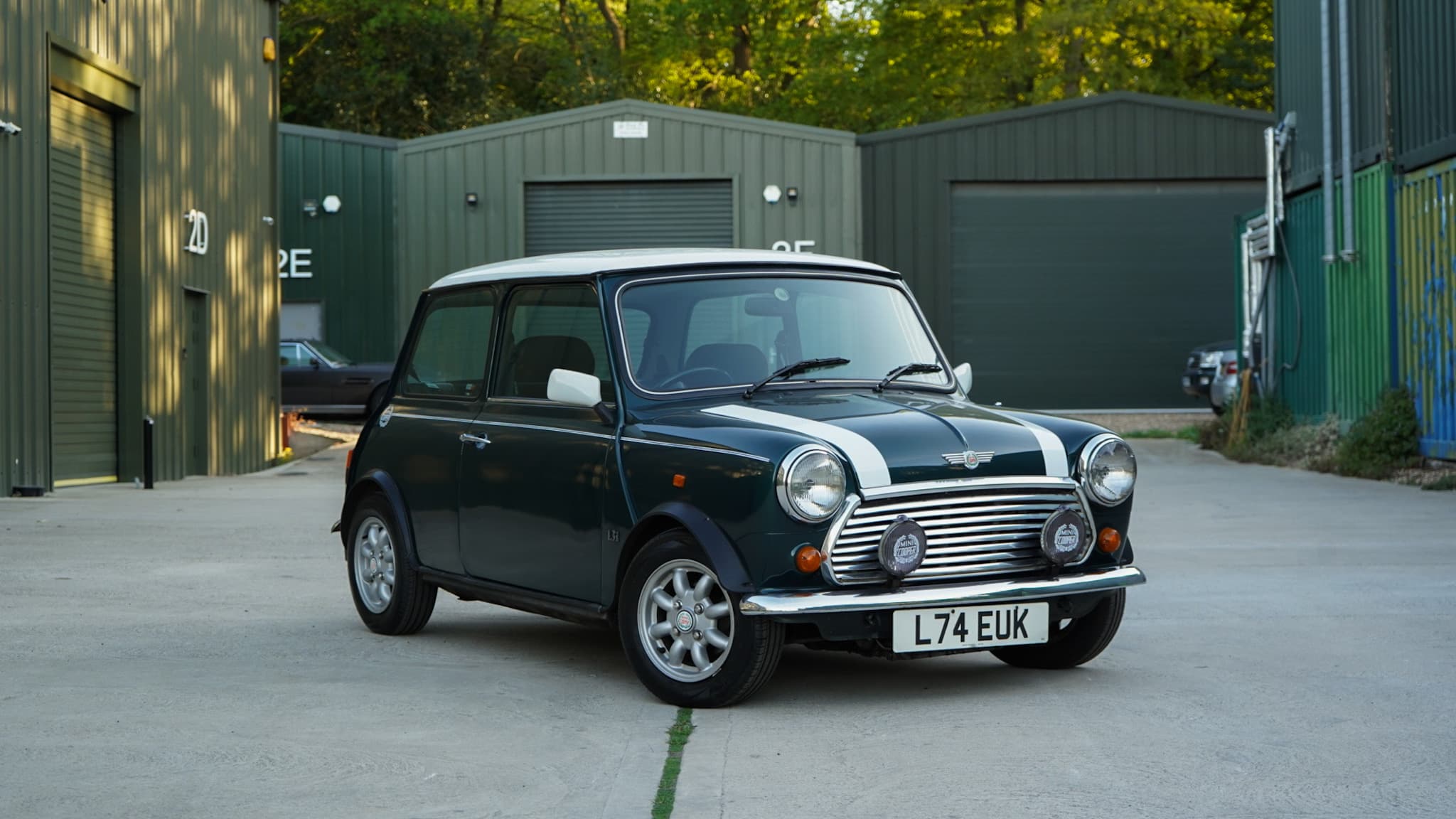
A surviving Car & Classic advert linked to The Matt Johnston Collection records L74EUK as a 1993 Rover Mini Cooper, right-hand drive, 1,300 cc and Automatic, 4 speed.
The seller describes the car as a factory automatic that was originally intended for the Japanese domestic market but was instead registered in Britain. It also records an unusual individual history, including early use as a Rover dealer demonstrator.
That is useful evidence about L74EUK, but it is not the same thing as a Rover build sheet. The advert’s 4 speed field should not be used on its own to prove the exact gearbox code or factory market specification.
The car is useful here for a different reason: it demonstrates why the terminology matters. A buyer can encounter a perfectly plausible four-speed description for a late automatic Mini while Rover service literature from the late period uses the three-speed type label.
How to verify an automatic Rover Mini properly
Start with the VIN and period paperwork
Record the VIN/chassis number and compare it with the V5C, original sales documents, service book and any surviving order or import paperwork. Registration year tells you when a car entered service; it does not settle every detail of its build.
For an unusual export-market car, original dealer paperwork can be especially valuable because a normal UK sales brochure may not describe the same trim or transmission application.
Identify the derivative and market before applying a specification
A 1993 Rover Mini is not one immutable specification. BMW Group Classic shows, for example, that the contemporary Cooper 1.3i and Mayfair did not even use the same fuelling system at that date.
The same discipline should be applied to the transmission. Establish whether the car is a Cooper, Mayfair or another derivative, whether it was built for Britain, Japan or another market, and whether the fitted transmission is consistent with that evidence.
Treat the listing’s gear count as metadata
A listing marked automatic, 3 speed or automatic, 4 speed can be useful search metadata. It is not a factory authentication document.
The fact that Rover’s own late manual uses 3-speed while showing four forward ratio positions is enough reason not to reject or authenticate a car from that one field.
Check the fitted car, not just its badges
Look for consistency between the paperwork, selector, gearbox installation, engine specification and the car’s history. If originality materially affects value, have a classic-Mini specialist familiar with the automatic system inspect it rather than relying on a badge, sales description or one parts-catalogue application.
One ownership detail Rover is very clear about: towing
The late Rover workshop manual gives a specific warning for automatic cars. It says the gearbox is not adequately lubricated without the engine running, so an automatic Mini that needs towing should use a suspended tow rather than simply being dragged on its driven wheels.
For the cars covered by that manual, Rover also says the selector should be at N, warns that a rear-suspended tow can seriously damage the automatic transmission, and says the car cannot be push- or tow-started.
That is exactly the sort of ownership information worth taking from factory literature. It is more defensible than broad internet claims that the automatic is simply “fragile” or “bulletproof”.
If you own an earlier automatic Mini, use the correct manual for that car rather than assuming a 1998 Rover procedure applies unchanged.
What about oil capacity?
Rover’s late manual lists 5.1 litres against the automatic gearbox in its capacities table.
That number needs context. It is service-data capacity, not an instruction to add 5.1 litres every time the oil level needs attention. The correct quantity depends on the operation being carried out and the applicable procedure, and the correct lubricant specification matters just as much as the headline capacity.
For maintenance, use the workshop or owner documentation appropriate to the exact gearbox and build period. A generic forum post or parts-store dropdown is a poor substitute here.
What should you check when driving a classic Mini automatic?
There is no useful universal mileage at which an automatic Mini suddenly becomes good or bad, and this research did not find a manufacturer failure-rate table. Condition and history matter more.
On a test drive, the useful observations are straightforward:
- check engagement into forward drive and reverse from cold and again when warm;
- make sure selection is repeatable rather than intermittently refusing to engage;
- feel whether changes through the forward ranges are consistent under gentle and moderate throttle;
- listen for abnormal mechanical noises rather than assuming every unfamiliar automatic sound is normal;
- inspect for leaks and evidence of careless previous work;
- read invoices closely enough to know what transmission work was actually done and what lubricant/service procedure was used.
Those observations are not diagnoses. If the car hesitates, slips, makes unusual noises or has a vague maintenance story, the sensible next step is a specialist inspection by someone who knows the classic Mini automatic.
Why factory automatic and four-speed are separate claims
A seller can be completely right that a car is a factory automatic and still use a simplified gear-count label. Those two claims answer different questions.
Factory automatic is about how the car was built. The strongest evidence is VIN-linked factory/order material, original documentation and a coherent surviving specification.
Three-speed or four-speed may simply describe how a database, service manual or seller has chosen to count/name the forward ranges.
For L74EUK, the surviving seller record strongly supports that an automatic configuration is central to the car’s history, but the best unresolved evidence upgrade remains its original Rover/Japan build or order documentation. That would tell us more than arguing over a classifieds dropdown.
What remains unresolved
The source conflict is clear, but it does not answer every automatic-Mini question.
We have not found a period factory document that explicitly explains why Rover’s late manual says 3-speed while listing First, Second, Third and Drive. Until one appears, a mechanical explanation for that nomenclature should be presented as inference, not fact.
A readable period Rover Japan order guide or VIN-linked factory record for L74EUK is also still missing. Those are the documents needed before stating its exact export-market automatic specification as factory-proven.
That uncertainty is useful. It tells a buyer which evidence is genuinely missing instead of replacing it with a confident-sounding guess.
Sources and further reading
Related car
Cars covered in this guide
Explore the cars this guide covers, with model information, history and related TMJC guidance.
MiniSpecification
Mini
ResearchExplore model details, specifications, history and related guidance for Rover Mini.
Editorial information
The Matt Johnston Collection
Research and editorial from TMJC Garage.
Research and editorialTMJC Garage
Published byThe Matt Johnston Collection