TMJC assistance
Want TMJC to help with this vehicle?
Sourcing, consignment and valuationContinue to the main TMJC website and speak directly with the collection team.
Manufacturer
Aston Martin began in London in 1913 and built its first prototype, Coal Scuttle, in 1914. Trace the DB, Newport Pagnell V8, Gaydon and St Athan eras.
Model directory
Choose a Aston Martin model family to compare its generations, engines, body styles and collector context.
TMJC guide
Aston Martin began in London in 1913 and built its first prototype, Coal Scuttle, in 1914. Trace the DB, Newport Pagnell V8, Gaydon and St Athan eras.
Aston Martin was founded in London in 1913 by Lionel Martin and Robert Bamford. More than a century later, the marque is based at Gaydon, England, but its identity still rests on a combination that was recognisable surprisingly early: fast touring cars, competition experience, distinctive British design and low-volume craftsmanship.
Four broad eras explain most of the Aston Martins collectors encounter today: the early Bamford & Martin years, David Brown and the DB bloodline, the hand-built Newport Pagnell V8 period, and the modern Gaydon generation.
The name joins Aston Hill with the surname of co-founder Lionel Martin. Aston Martin itself describes the Buckinghamshire hillclimb as the inspiration for the marque name and records Martin competing there first with home-tuned Singer specials and later with cars of his own design.
There is a more specific family story, but it deserves a little caution. The Aston Martin Heritage Trust says it is believed that Kate Martin encouraged her husband to put “Aston” at the front of the new marque name; the Trust also notes that this placed it high in alphabetical lists. That is an interesting piece of company folklore from the marque’s heritage custodian, rather than something to state as documented fact without the qualification.
The broad origin is solid: Aston Hill supplied “Aston”, Lionel Martin supplied “Martin”. The exact conversation that settled the name is less certain.
Aston Martin identifies Coal Scuttle as its first car: a prototype built in 1914 around a redesigned Coventry Simplex engine and a chassis of Bamford and Martin's own design. The car was registered in 1915. That distinction reconciles sources that use either year: 1914 is the build milestone, while 1915 is the registration milestone.
World War One interrupted the young firm's plans, and Coal Scuttle did not represent the start of uninterrupted series production. The early post-war years were shaped as much by competition and record attempts as by customer cars. Aston Martin says Coal Scuttle made its competition debut in 1919, while the company remained tiny and its sports cars evolved around racing, hill climbs and fast road use.
The Aston Martin Heritage Trust identifies A3, built in 1921, as the third Aston Martin and the oldest known surviving example. It was one of five early prototype chassis. A3 is therefore the earliest surviving Aston Martin, not the first car built; Coal Scuttle's fate is unknown.
That competition link should not be over-read. A racing result can explain the culture of the company without making a road car mechanically identical to a works racer.
The decisive post-war change came in 1947. Industrialist David Brown bought Aston Martin in February and acquired Lagonda later that year.
Lagonda brought more than another badge. Aston Martin's own history records that the W.O. Bentley-designed twin-cam six-cylinder engine acquired with Lagonda became central to the post-war cars. The 1948 Two-Litre Sports was later known as the DB1, while the DB2 established the mix of performance, long-distance ability, luxury and restrained styling that defined the post-war marque.
The DB initials came from David Brown, but this era was a genuine engineering transformation rather than a naming exercise.
Aston Martin's competition programme reached one of its defining results in 1959, when the DBR1 finished first and second at the 24 Hours of Le Mans.
By then the company was also changing how its road cars were built. David Brown bought the Tickford coachbuilding works at Newport Pagnell in 1954, and Aston Martin moved road-car production there in 1955. Aston Martin's own timeline places the final DB2/4 and Mk III derivatives at the site as well as the new DB4, so the DB4 is better understood as the model that defined the new works era than as the literal first Aston Martin road car assembled there.
The DB4 developed into the DB5 in 1963. The DB5's role in _Goldfinger_ and later James Bond films turned one particular Aston Martin into a global cultural symbol, but the collector significance is broader: the DB4/DB5/DB6 period established the proportions, materials, six-cylinder performance and grand-touring character that many people still picture when they hear Aston Martin.
Bond made the DB5 famous. Newport Pagnell made an entire era of Aston Martins.
By the late 1960s Aston Martin was developing a different sort of flagship. The DBS brought a wider, more modern body. In 1969, the DBS V8 added the company's new 5.3-litre V8.
After David Brown left in 1972, the V8 line continued under new ownership. Aston Martin's own archive lists the AMV8 from 1972 to 1989 and the separate V8 Vantage from 1977 to 1990. A standard V8 saloon and a V8 Vantage are related, but they are not interchangeable descriptions.
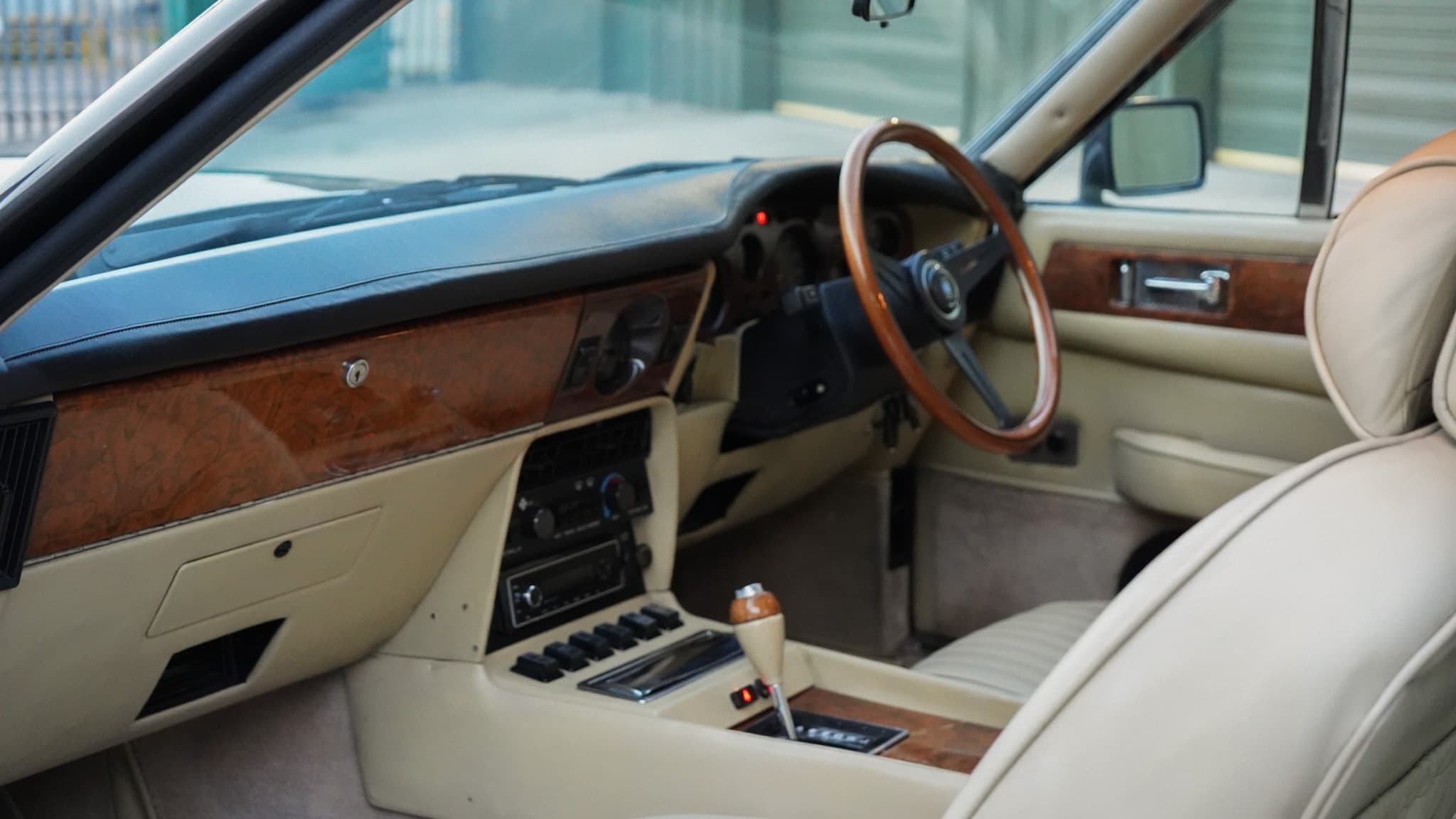
The long V8 period also evolved continuously. Carburettors, engine specifications, wheels, body details and later fuel injection changed through the run. In 1978 the standard V8 received the evolutionary specification widely known as Oscar India, including a smoother closed bonnet treatment, revised rear spoiler form and the return of burr walnut trim.
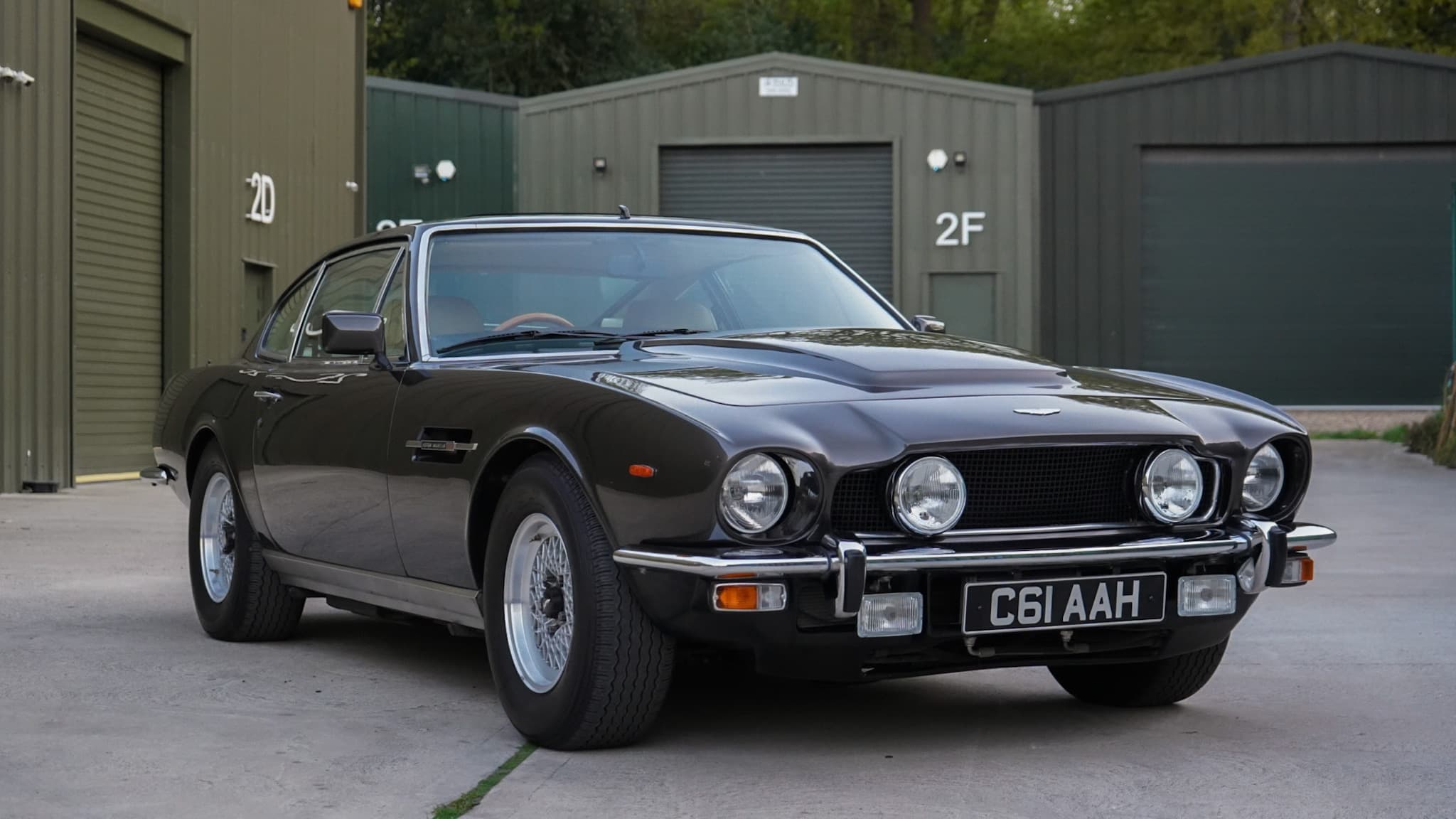
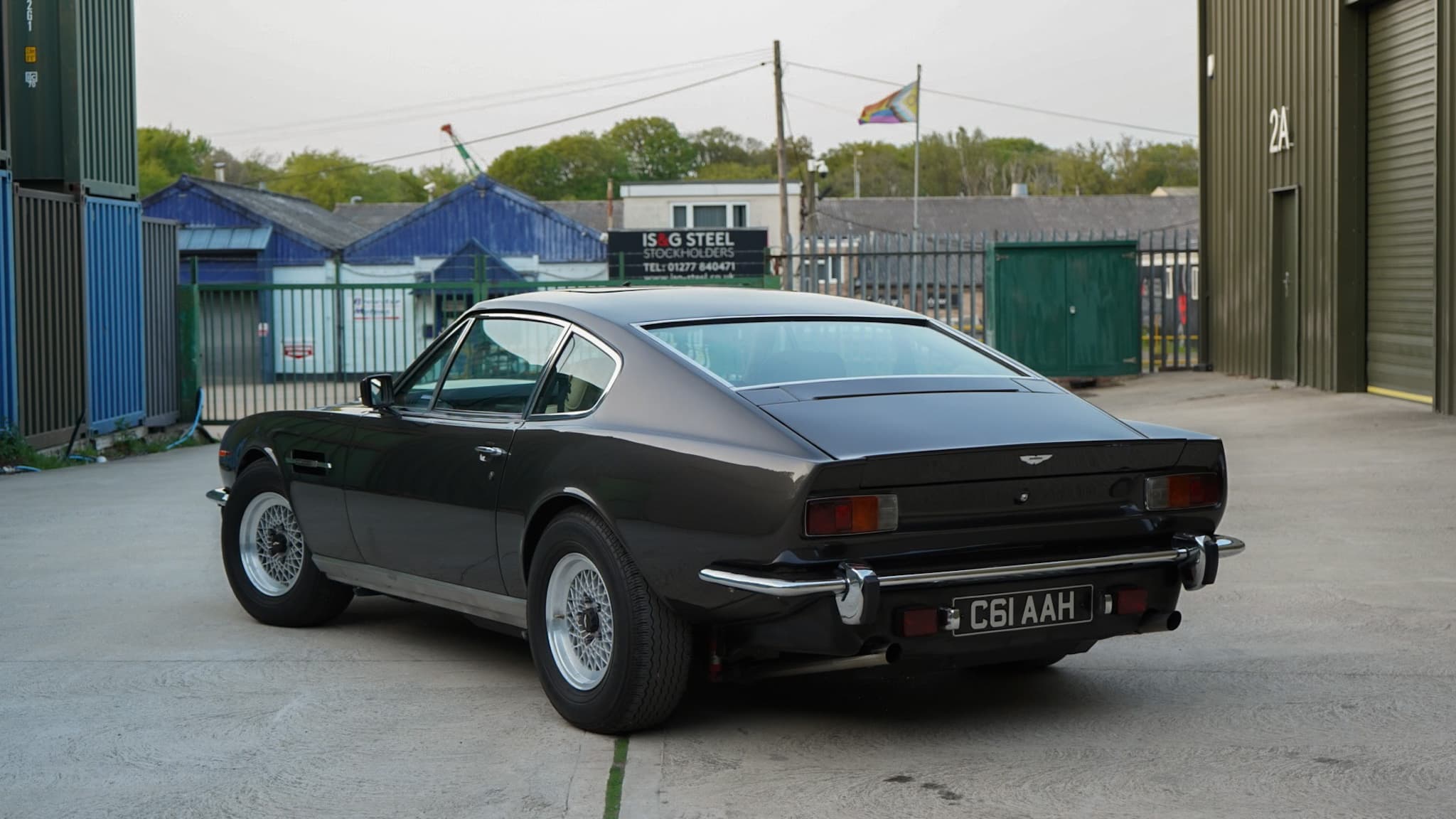
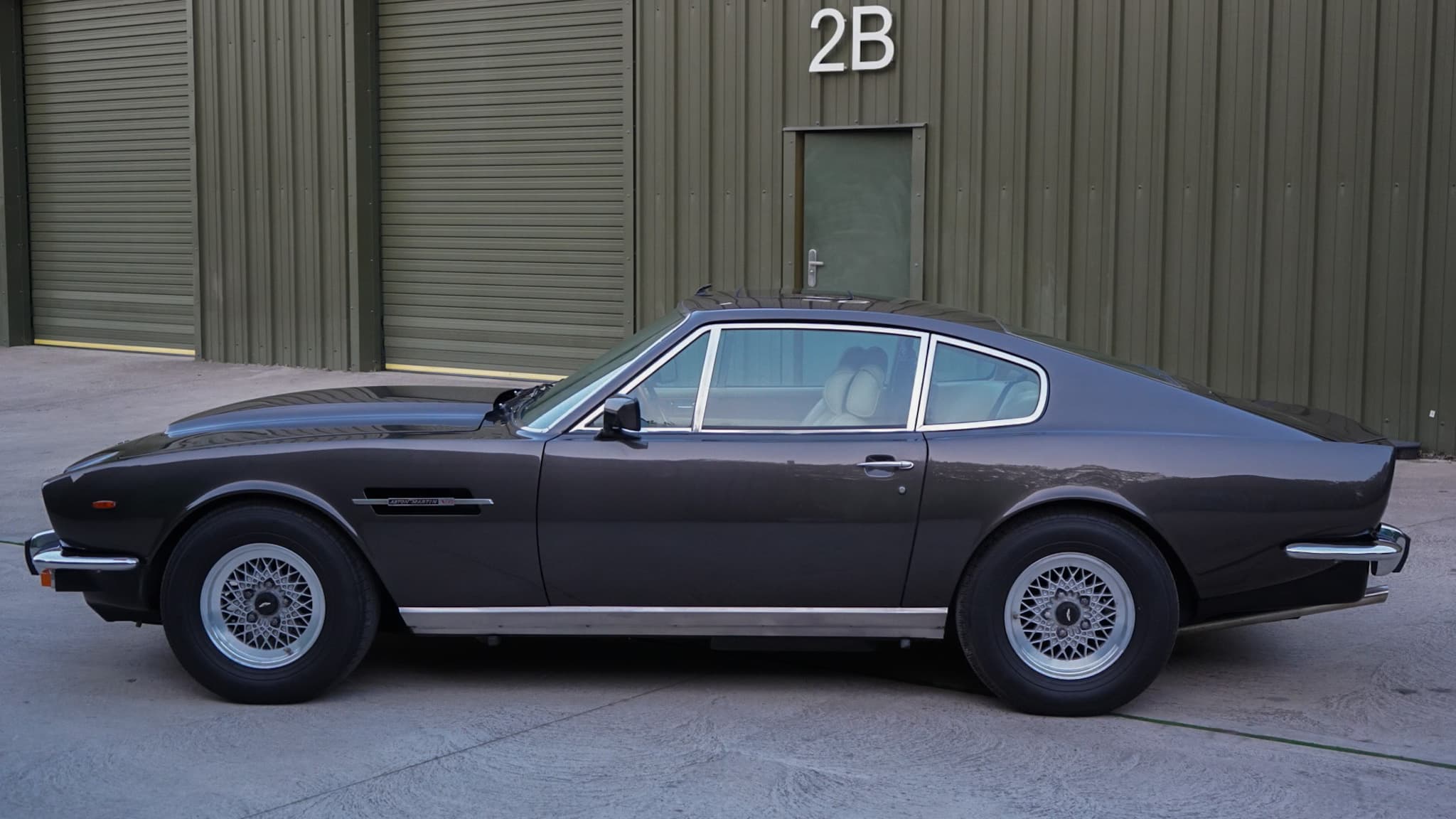
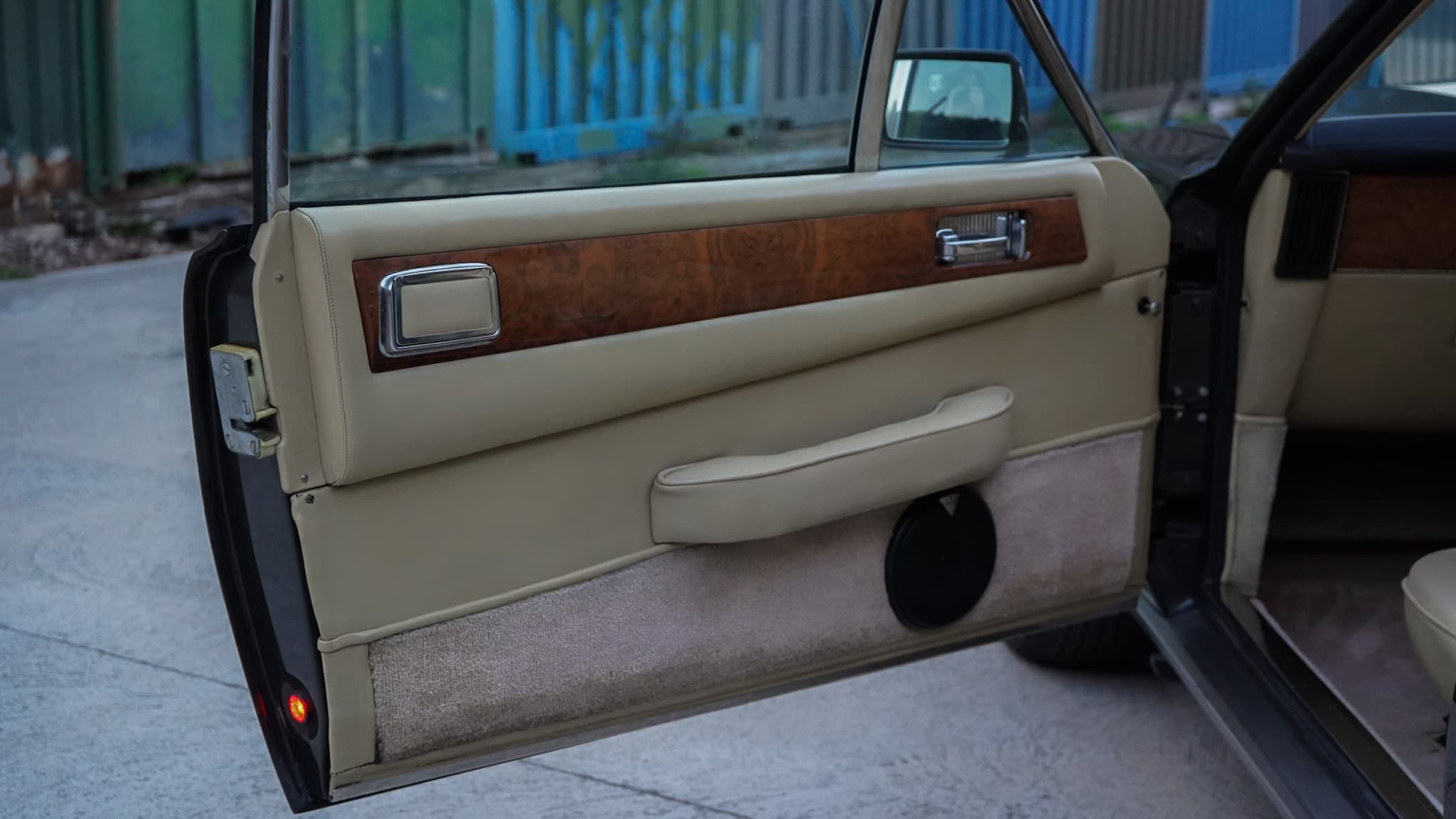
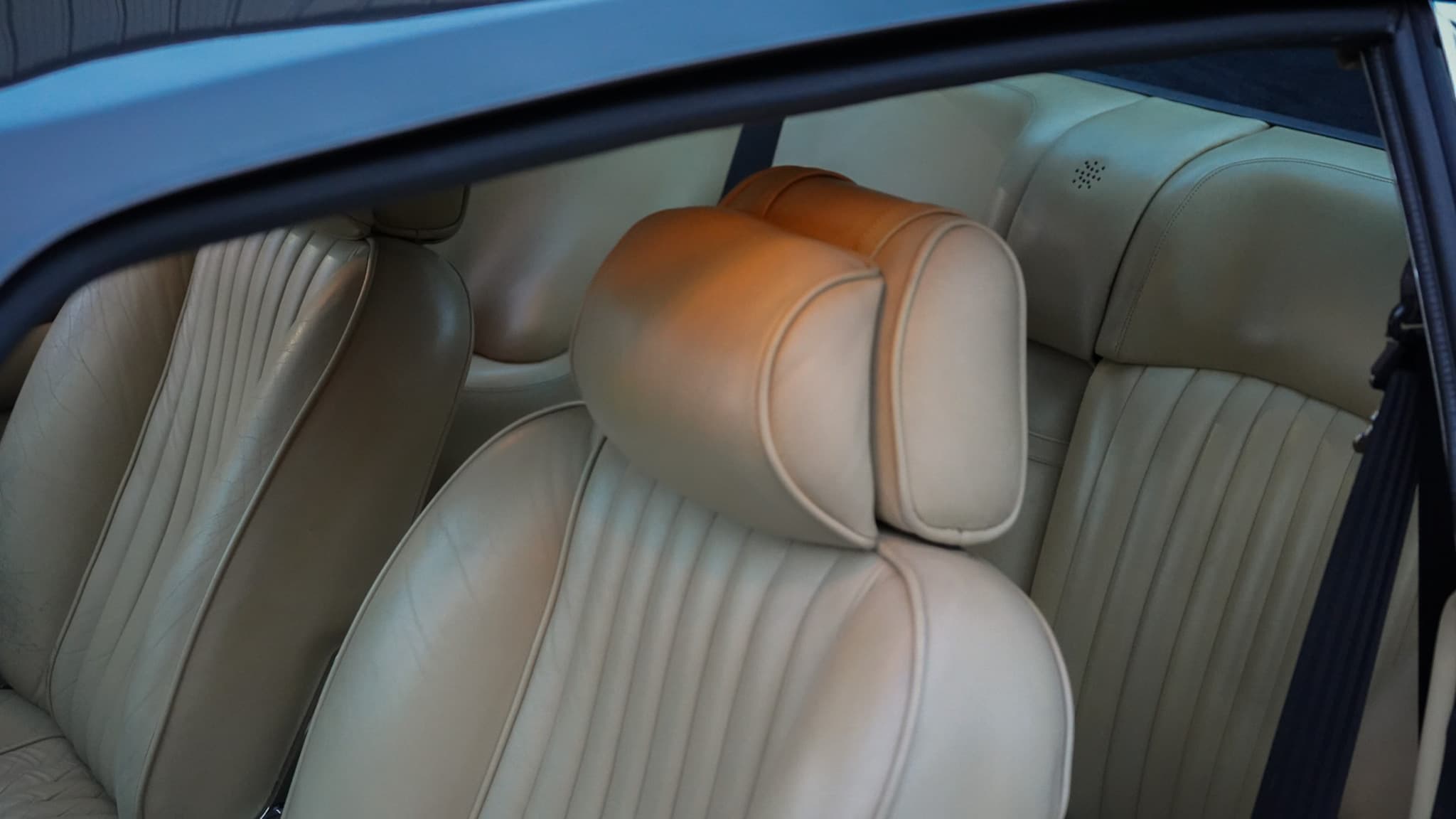
TMJC's 1985 V8 Saloon Series 4 Oscar India is a real example from this late period, and the Oscar India Guide explains that derivative in more detail. It is a right-hand-drive automatic with a 5.34-litre V8. Those details belong to that individual car, not every Aston Martin V8, but they connect the Collection directly to the hand-built Newport Pagnell era.
For classic Aston Martin buyers, Newport Pagnell is both a manufacturing place and a shorthand for a particular way of building cars. Those ideas overlap, but they are not identical.
David Brown bought the Tickford/Salmons coachbuilding works in 1954 and moved Aston Martin road-car production there in 1955. Aston Martin Works says the site was attractive not only because Feltham lacked space, but because Newport Pagnell already had an experienced coachbuilding workforce. The Aston Martin Heritage Trust describes a workshop in which aluminium panels were shaped and finished individually, with apprentices learning to make the hammers, dollies and formers needed for the work.
That craft extended beyond the body shop. The Heritage Trust says Aston Martin's V8 engine was built at Newport Pagnell for 30 years, with the final V8-engined Aston completed there in 2000. Aston Martin Works describes more than 13,300 cars as having been built at Newport Pagnell across the site's long production history.
TMJC's 1985 V8 Saloon Series 4 Oscar India belongs squarely to that period. Its individual specification still has to be proved from its own records, but its place in the model chronology connects it directly to the Newport Pagnell V8 and hand-built production story.
No. The DB7 went into production at Bloxham in 1994, at a separate facility near Banbury. But that does not mean Newport Pagnell had nothing to do with it. Aston Martin Works says Newport Pagnell continued building later Virage-family derivatives while also supplying interior trim and Volante roofs for the DB7.
For provenance, final assembly and component supply are different claims. A DB7 can contain work supplied from Newport Pagnell while still being a Bloxham-built car. Component or trim manufacture at one site should not be turned into a different final-assembly identity.
The same care applies at the other end of the chronology. Newport Pagnell's normal new-car production era ended with the Vanquish S in 2007, but the site remained Aston Martin Works and later returned to new-car manufacture for the DB4 G.T. Continuation programme in 2017. Saying simply that “Aston Martin stopped building cars at Newport Pagnell in 2007” therefore misses the continuation chapter.
For a collector, the question is precise: which model was this, when was it built, and what part of its manufacture actually happened at Newport Pagnell? A factory build record answers that better than applying the phrase “Newport Pagnell car” to an entire decade.
The Virage, introduced in 1988, replaced the long-running V8 shape with a new generation while retaining a front-engined V8 grand-touring layout. Later Vantage versions developed that platform much further.
The DB7, introduced in 1994 and built at Bloxham rather than Newport Pagnell, represented a larger industrial change. It allowed Aston Martin to build at higher volume than the old hand-built V8 line could realistically support, and the DB7 Vantage introduced V12 power to the DB range in 1999.
For collectors, these cars sit on different sides of an important transition. A Virage-family car still has a strong connection to Newport Pagnell's traditional methods; a DB7 belongs to a new production chapter. Neither should be judged by the same originality checklist as a 1970s AMV8 simply because all wear Aston Martin wings.
In 2003, Aston Martin moved its global headquarters to a purpose-built facility at Gaydon. The DB9 followed, using a new aluminium-intensive architecture that became the basis for a new generation of road cars.
The smaller V8 Vantage arrived in 2005 and became one of Aston Martin's major modern successes. Vanquish, DBS and later DB/Vantage models developed the front-engine grand-touring and sports-car families further, while One-77 and Valkyrie gave the company a separate route into low-volume hypercars.
The marque also expanded beyond two-door sports and GT cars. St Athan in Wales became the production home of the DBX SUV family, while Aston Martin returned to Formula 1 as a works team in 2021.
Modern Aston Martin no longer describes one engineering template. A Newport Pagnell carburetted V8, a Gaydon-era V12 DB9, a modern Vantage, a DBX and a Valkyrie share a marque identity rather than one mechanical formula.
Aston Martin Lagonda is the British company that designs and manufactures Aston Martin cars. It is based in Gaydon, Warwickshire, but not every modern Aston Martin is built there: the company currently describes two UK manufacturing sites, Gaydon and St Athan in South Wales.
Gaydon is Aston Martin's global headquarters as well as a production facility. The company describes design, engineering and production operating together there, and its 2024 manufacturing announcement says the Gaydon workforce supports production of its next generation of sports cars.
St Athan is a separate Production & Technology Centre created from three former RAF super-hangars. Aston Martin says SUV production started there in 2019; in its 2024 manufacturing update it identifies St Athan specifically as the DBX707 manufacturing facility.
So the shorthand “Aston Martins are built at Gaydon” is too broad. The modern distinction is Gaydon for the headquarters and sports-car production base, St Athan for the DBX/SUV production base. Low-volume specials and continuation programmes need their own build history rather than being forced into that shorthand — just as Newport Pagnell later returned to continuation-car manufacture after normal series production had ended.
For provenance, identify the model and build period first. The badge alone does not establish which Aston Martin facility assembled a particular car.
Aston Martin is not owned outright by Mercedes-Benz, Geely or Lawrence Stroll. Aston Martin Lagonda Global Holdings plc is a publicly listed company. The latest formal shareholder snapshot reviewed here is Aston Martin's 2026 AGM notice, which gives positions as at 10 March 2026. It records Lawrence Stroll's direct and indirect interest at 32.99% (including holdings also disclosed by Yew Tree Overseas and Ernesto Bertarelli), Li Shufu (Geely) at 14.08%, the Public Investment Fund at 13.88% and Mercedes-Benz AG at 7.54%. The 2025 Annual Report separately treats the Yew Tree Consortium as a controlling shareholder under the UK Listing Rules.
Those percentages are a dated snapshot, not permanent ownership figures. Aston Martin's current Board page lists shareholder representatives for Yew Tree, Mercedes-Benz, the Public Investment Fund, Geely and Ernesto Bertarelli. That makes the shorthand “Mercedes owns Aston Martin” misleading: Mercedes-Benz is a minority shareholder, not Aston Martin's parent company.
The relationship is important technically as well as financially. Aston Martin's 2025 Annual Report says its Strategic Cooperation Agreement with Mercedes-Benz AG gives the company access to technologies for its current generation of luxury vehicles and future derivatives. Mercedes-derived technology in an Aston Martin therefore does not make the marque a Mercedes subsidiary; ownership, technology supply and the build identity of an individual car are separate questions.
Aston Martin's model history is easier to read as overlapping eras than as one unbroken numbered sequence.
The pre-war names need their own row because they do not form an early DB sequence. International, Le Mans, Mark II and Ulster overlap as road, competition and derivative identities; the later Speed Model and 15/98 mark the move from the 1.5-litre Bertelli cars towards the two-litre range. Ulster is best treated as the sports/replica branch of the Mark II after the 1934 Tourist Trophy, not as another name for every Mark II.
| Broad era | Major road-car families | What changed |
|---|---|---|
| 1927-1940 | International, Le Mans, Mark II/Ulster, Speed Model and 15/98 | The Bertelli 1.5-litre sporting line evolved through overlapping road and competition branches before Aston Martin moved into its two-litre pre-war range |
| 1948-1958 | Two-Litre Sports (later called DB1), DB2, DB2/4 and DB Mk III | David Brown and Lagonda engineering established the post-war DB grand-tourer line |
| 1958-1972 | DB4, DB5, DB6, DBS and DBS V8 | Newport Pagnell, Touring's Superleggera method and then the move from six-cylinder DB cars towards V8 power |
| 1972-1989 | AMV8, Lagonda and V8 Vantage | The long hand-built V8 period developed through distinct saloon, Volante and performance branches |
| 1988-2000 | Virage, Virage-based Vantage, V8 Coupe and V8 Volante | A new Newport Pagnell generation overlapped both the outgoing AMV8 and the newer DB7 |
| 1994-2003 | DB7 and DB7 Vantage | Bloxham production revived the DB name; the family moved from a supercharged straight-six to V12 power |
| 2001-2018 | V12 Vanquish, DB9, modern V8/V12 Vantage, DBS and Rapide | Vanquish and Gaydon's bonded-aluminium architecture established a broader modern range |
| Current era | DB12, Vantage, Vanquish and DBX, with Valkyrie and Valhalla as specialist mid-engine programmes | The range now spans front-engine GTs and sports cars, an SUV family and low-volume high-technology cars |
This is a map of the main road-car families, not an exhaustive register of every Zagato, continuation, racing or special model. The labels are not perfectly consistent across more than a century. Vantage can be an uprated specification, a derivative or a standalone family; DBS, Virage and Vanquish have also appeared in more than one context. Exact year, parent model and body style always matter.
For the TMJC branch currently documented in depth, continue to the Aston Martin V8 model history or the Oscar India identification guide.
There is no universal answer because the marque spans pre-war sports cars, David Brown DBs, hand-built V8s, 1990s transition cars and modern production models.
On an older car, buyers often care heavily about identity and continuity: chassis and engine records, original build specification, matching major components, period-correct trim and credible restoration history. Hand-built production means small specification changes can matter more than a generic model-year table suggests.
On later cars, service history, electronic condition, expensive chassis and drivetrain systems and factory options can become more important. A well-documented replacement or restoration is often more useful than a vague claim that a car is all original.
Across every era, the same rule helps: establish exactly which Aston Martin you are looking at before valuing the badge. DB, Vantage, V8, Volante, Oscar India and other familiar names can describe very different technical packages depending on date and market.
| Date | Milestone | Why it matters |
|---|---|---|
| 15 January 1913 | Bamford and Martin establish the business | Start of the Aston Martin company story |
| 1914 | First prototype built | Beginning of Aston Martin vehicle development |
| 1947 | David Brown buys Aston Martin and Lagonda | Starts the DB-era ownership and engineering transformation |
| 1954 | David Brown acquires Tickford at Newport Pagnell | Establishes the site that becomes the classic production home |
| 1959 | DBR1 wins Le Mans overall | Defining motorsport result |
| 1963 | DB5 introduced | Iconic DB road-car era and Bond association |
| 1969 | DBS V8 introduced | Start of the long V8 road-car era |
| 1977 | V8 Vantage introduced | Establishes a distinct higher-performance V8 branch |
| 1978 | Oscar India evolution unveiled | Important visual/interior change to the V8 family |
| 1988 | Virage introduced | Successor generation to the long-running V8 shape |
| 1994 | DB7 enters production | Higher-volume bridge towards modern Aston Martin |
| 2003 | Headquarters moves to Gaydon | Start of the purpose-built modern manufacturing era |
| 2005 | Modern V8 Vantage arrives | Expands Aston Martin's sports-car range below the DB9 |
| 2019-20 | St Athan/DBX era begins | Aston Martin expands into SUVs |
| 2021 | Works Formula 1 return | Modern revival of top-level competition presence |
Aston Martin did not follow one uninterrupted technical formula. The marque survived by repeatedly changing its engineering, ownership and manufacturing model while preserving a recognisable idea of a fast, luxurious British performance car.
Editorial information
Research and editorial from TMJC Garage.
Research and editorialTMJC Garage
Published byThe Matt Johnston Collection
TMJC photography
TMJC Guides
TMJC assistance
Continue to the main TMJC website and speak directly with the collection team.
Sell, consign or source
Continue with TMJC for a discreet conversation, professional presentation and collector-focused support.
Enquire now